12 Best Performance Improvement Plans That Make a Difference

Just hearing the words Performance Improvement Plan (PIP) might make your stomach do a little flip. But a PIP isn't a punishment. It's a second chance. A structured, supportive way to help someone get back on track, not just professionally, but personally too.
PIP is a collaborative roadmap. In this blog, you'll find:
- 12 real-world PIP examples for common issues
- Key benefits of using PIPs effectively
- Practical tips to make them work
Let's jump in.
What is a Performance Improvement Plan?
A Performance Improvement Plan, or PIP, is simply a structured way to help someone get back on track at work. It lays out what's not working, what needs to improve, and how to get there... with clear goals, a realistic timeline (usually 30 to 90 days), and real support like training or mentorship.
Suppose a coach hands you a game plan... not to point out what's wrong, but to help you win. When used thoughtfully, PIPs build skills, boost confidence, and bring teams closer together.
Organizations that replace annual reviews with continuous feedback and structured Performance Improvement Plans outperform peers by 24%, attract 39% more talent, and retain 44% more employees.
1. Sales rep hits deadlines with better structure
The Problem
A high-potential sales rep keeps missing client report deadlines, holding up the team and frustrating clients.
The Performance Plan
- Submit all client reports by 5 PM every Friday for 8 weeks
- Complete a time management workshop within 2 weeks
- Use a task management tool like Trello to plan and prioritize daily tasks
Timeline
8 weeks
What Support Looks Like
- Weekly check-ins with their manager to stay on track
- Free enrollment in a time management course
- Paired with a teammate known for staying organized
Why This Works
Real change happens when there's structure and support. With both in place, the rep becomes more confident, consistent, and fully in control of their day-to-day.
2. Customer rep improves clarity and tone
A customer service rep's responses are often vague or too blunt, resulting in customer complaints.
- Maintain a 90% customer satisfaction score for 6 consecutive weeks
- Complete a communication skills course within 3 weeks
- Practice active listening techniques in every customer interaction
6 weeks
- Role-playing sessions with a supervisor
- Weekly reviews of recorded calls
- Access to customer communication training
It blends learning with real-world feedback, helping the rep become more thoughtful and engaging with every conversation.
3. Project manager rebuilds team trust
A project manager struggles to connect with their team, leading to unclear direction and missed expectations.
Share at least two ideas in every team meeting for 8 weeks
Complete a team-building workshop within 4 weeks
Host bi-weekly one-on-ones with each team member
Mentorship from a senior project manager
Access to collaboration tools like Slack or Asana
Monthly team feedback to gauge alignment
It fosters connection and leadership... two things that don't just fix misalignment but build long-term trust.
4. Developer delivers faster with fewer errors
A developer is consistently behind on sprint tasks, slowing down the team.
Hit 100% of sprint deadlines for the next 3 sprints
Cut code review revisions by 50% within 6 weeks
Complete an agile development course within 2 weeks
Pair programming with a senior developer
Weekly sprint planning with clear task breakdowns
Free access to coding tutorials
It targets both the speed and quality of work, while reinforcing collaboration through mentorship.
5. Admin assistant improves attendance and reliability
Frequent unexcused absences from an admin assistant are disrupting daily operations.
Maintain 100% attendance (except approved leave) for 8 weeks
Submit leave requests at least 48 hours in advance
Meet with HR to discuss any personal issues impacting attendance
Flexible scheduling where possible
Weekly check-ins for accountability
Access to employee assistance resources
It blends accountability with compassion... showing that the company cares, but also expects reliability.

6. Accountant boosts accuracy and consistency
An accountant's reports are riddled with errors, leading to rework and delays.
Submit 4 error-free reports in a row
Complete a financial accuracy training within 3 weeks
Use a quality checklist before submitting reports
Peer review of reports before submission
Bi-weekly feedback from the finance manager
Tutorials on using accounting tools more effectively
It builds a process that the accountant can repeat, reducing errors and restoring trust in their work.
Organizations with effective performance systems, like structured Performance Improvement Plans, are 42% more likely to outperform competitors, and 86% say performance management improves workforce efficiency.
7. Team lead grows confidence and influence
A team lead struggles to motivate the team, leading to low engagement and morale.
Host weekly motivation focused team meetings for 8 weeks
Improve engagement scores by 20% in the next survey
Complete leadership training within 4 weeks
One-on-one coaching with a senior leader
Access to leadership development resources
Regular team feedback to track morale
Improving performance is only part of the story. What shifts is the lead's presence... they step into real influence and earn their team's trust.
8. Retail associate meets sales targets with support
A retail associate keeps falling short of monthly sales targets.
Meet or exceed sales targets for 2 straight months
Attend a sales strategy workshop within 2 weeks
Create a personal sales plan with their manager
Weekly sales coaching sessions
Shadowing top-performing peers
CRM training to better track leads and customers
This isn't about hustle for hustle's sake. With a clear structure and smart strategy, the associate starts closing sales with confidence and intent.
9. HR specialist sharpens conflict resolution skills
An HR specialist struggles to resolve team conflicts, leading to unresolved tension.
Successfully mediate at least 3 conflicts with positive feedback
Complete a conflict resolution course within 3 weeks
Document all mediation outcomes clearly
Mentoring from a senior HR leader
Role-play mediation scenarios
Access to conflict resolution resources
With the right skills and structure, this HR specialist transforms into a go-to problem solver.
10. Marketing analyst upgrades reporting skills
A marketing analyst is behind on reports and struggles with data tools, delaying campaign decisions.
Complete a course on Excel or Google Analytics within 4 weeks
Deliver 100% of reports on time for 6 weeks
Cut report errors by 50% within 2 months
Weekly check-ins with the marketing manager
Access to training platforms for analytics tools
Peer mentoring for data related questions
Better tools, better timing, better output. This plan builds the technical confidence the analyst was missing.
11. Designer unlocks creativity and fresh ideas
A talented designer has strong execution skills but tends to play it safe... rarely offering new ideas or creative solutions.
Pitch at least 2 original concepts for every project over the next 6 weeks
Attend a creativity workshop within 3 weeks
Join and contribute to at least half of upcoming brainstorming sessions
Feedback sessions with the creative director
Access to design inspiration platforms like Behance
Collaboration with senior designers for idea generation
This wasn't just about upping productivity... it gave the designer the confidence to take risks and bring their unique perspective forward. The result? Work that stood out, and a designer who felt seen and supported.
12. Account manager improves client response and trust
An account manager was slow to respond to clients, and that silence was starting to cost business.
Reply to all client emails within 24 hours for the next 8 weeks
Hit a 90% client satisfaction score over 2 months
Complete CRM training within 3 weeks to stay organized and responsive
Weekly reviews with the sales director
CRM platform training
Shadowing a top-performing account manager
With structure, training, and accountability in place, the account manager rebuilt trust with clients... faster responses, clearer communication, and stronger relationships followed.
Transparency in performance criteria, often supported by a clear Performance Improvement Plan, can lead to a 56% increase in employee clarity, 46% higher engagement, and a 39% boost in productivity, while saving managers around 210 work hours each year.
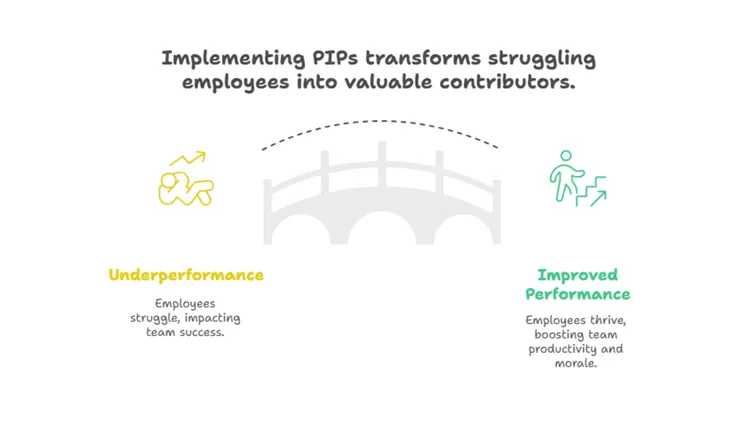
Benefits of a Performance Improvement Plan
Performance Improvement Plans often get a bad reputation, but when they're built with the right intent, they can do a lot more than just correct mistakes. Here's what they bring to the table:
- They clear the air. No vague feedback or confusing expectations. A good PIP spells things out... what's off, what needs to change, and how to get there.
- They turn setbacks into progress. With the right support, employees gain more than just a course correction... they build lasting skills.
- They rebuild belief. When someone turns things around, it reminds them (and their team) of what they're capable of.
- They lift the team too. One person's improvement can ease bottlenecks, smooth collaboration, and raise the bar for everyone.
- They send the right message. Instead of walking away, the company says: "We see your potential and we'll help you reach it."
- They create fairness. Everyone gets a real shot at improving, with transparency and consistency across the board.
- They stop small problems from becoming big ones. Addressing issues early means fewer surprises later and less stress for everyone involved.
Final Note
A Performance Improvement Plan is all about offering a path forward... it gives people the clarity, tools, and support they need to grow. As these examples show, real change starts with a little structure and a lot of trust. PIPs build confidence, strengthen teams, and create space for people to succeed. It is progress with a purpose...
FAQs
What is an example of a performance improvement plan?
Suppose a sales representative is having trouble meeting deadlines. A PIP could involve weekly check-ins with their manager, finishing a time management course, and turning in all reports by Friday every week. These activities would be monitored for eight weeks to ensure consistent progress.
How to write a 30 day performance improvement plan?
Be clear about what needs to change first. Next, establish two or three clear, quantifiable objectives with reasonable due dates. Incorporate coaching or training as support, and plan weekly check-ins to monitor progress and maintain alignment.
How do you write a PIP example?
Outline the problem, list specific improvement goals, define a timeline (e.g., 30-60 days), and mention the support or resources provided. Keep it realistic, measurable, and collaborative.
What is an example of a PIP for unprofessional behavior?
If an employee shows repeated rudeness, the PIP could include goals like attending a professional conduct workshop, receiving peer feedback weekly, and maintaining zero complaints for 30 days.