Anonymous vs. Confidential Surveys: Everything you need to know

You could craft the most thoughtful survey ever. Nail every question. Use all the right tools. But if people don't trust what happens to their answers? Doesn't matter. The data's already broken.
Research says, 70% of employees hold back on giving honest feedback when they aren't sure if it's truly anonymous. And what you're left with are half-truths and sugarcoated replies.
That one stat tells you everything — how you collect feedback shapes what you collect.
And that's why the terms anonymous and confidential become critical. They sound similar. A lot of people use them interchangeably. But they're not the same.
So in this blog, we will be clearing that up — what Anonymous and Confidential Surveys mean, when to use which, and how to earn people's trust without messing up your data.
What Are Anonymous Surveys?
It's simple. No names, emails, IPs, or anything traceable.
If a survey's truly anonymous, you can't link a response back to anyone — even if you tried.
Anonymous surveys work best when you want raw honesty. Think whistleblowing, employee pulse checks, or sensitive health questions — stuff people won't answer truthfully if they feel watched.
They can lead to 30% more honest answers on sensitive topics.
But yeah, there's a trade-off. You lose the chance to follow up or track patterns. So use them when your priority is trust over traceability.
What Are Confidential Surveys?
Confidential Surveys are not anonymous — but they're still private.
A confidential survey collects identifiable info like names or emails, but promises to keep it protected. Only a few authorized folks can access it, and only if there's a legit reason — like follow-up or deeper analysis.
You'll see these surveys used in HR investigations, research studies, healthcare settings — places where follow-up matters. Like if someone reports a serious issue at work, HR may need to check in — not to punish, but to support.
Thing is, people will only speak up if they believe the system's solid.
That means handling data right. Keeping access tight. And being super clear about what info is collected and what's not.
Confidential surveys hit the sweet spot — honest answers plus the power to act on them.
Differences Between Anonymous and Confidential Surveys
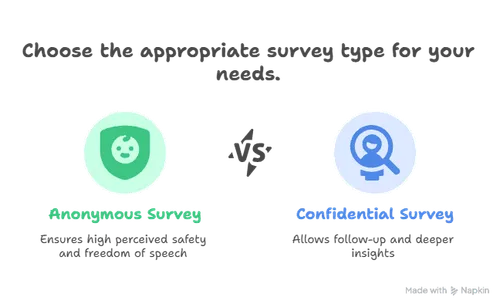
At a glance, they sound alike. But in surveys, that small difference changes everything — from ethics to data quality to how honest people are.
Let's break it down clean:
Identity Tracking: Anonymous surveys have no personal info and nothing traceable. Confidential surveys collect names, emails, etc. but keep them private.
Data Access: Anonymous surveys have no way to link answers to people. Confidential surveys allow only approved personnel to see who said what.
Perceived Safety: Anonymous surveys are high — people speak freely. Confidential surveys are medium — depends on how much they trust the system.
Follow-up: Anonymous surveys don't allow follow-up. Confidential surveys do — you can clarify, support, or dig deeper.
Use Cases: Anonymous surveys are best for whistleblowing, mental health, and exit feedback. Confidential surveys work for HR reviews, academic studies, and customer experience.
Misuse Risk: Anonymous surveys have low risk — nothing to misuse. Confidential surveys have higher risk — needs strong data handling or trust takes a hit.
Why It Matters
If you're asking sensitive questions, the wrong survey type can wreck your data or worse, your credibility.
Imagine someone thinks it's anonymous, then finds out their name's tied to their answers. That's a trust killer.
Before you hit "send," ask yourself:
- Do I need to follow up later?
- Will people hesitate to be honest?
- Am I really ready to protect personal data?
When you match the survey type to your goal and you're transparent about how responses are handled, people open up. And then the feedback is way more useful.
Pros and Cons of Each Type
There's no universal "better" here — it's about which fits your objective, audience, and risk tolerance. Here's how both stack up:
Anonymous Surveys
Pros:
- People open up. No names = less fear. Especially when it's about tricky or sensitive stuff.
- No backlash risk. Works well in workplace settings where folks worry about consequences.
- Feels safer. Sometimes leads to higher response rates because anonymity lowers the stress.
Cons:
- No follow-up. Can't go back and ask, "Wait, what did you mean by this?"
- No group breakdowns. You won't know what teams or roles are feeling unless you guess.
- Can get messy. Anonymity = no filter. Sometimes people vent, overshare, or misuse the space.
Confidential Surveys
Pros:
- You can follow up. Useful when feedback needs more context or action.
- Better insights. You can slice the data by team, location, tenure — without naming names.
- Perfect for formal stuff. Research studies, investigations, official HR feedback — this is where you need traceability.
Cons:
- Data protection's a must. If you're collecting personal info, you have to keep it safe.
- Slight trust issues. Some people will still hold back if they're unsure how "confidential" it is.

When Should You Use Anonymous vs. Confidential?
It really comes down to this: What do you want to learn and do you need to follow up? Also, how sensitive is the topic? And how much trust do you already have?
Here's a quick way to think about it:
Use Anonymous Surveys When
- The topic's sensitive. Mental health, harassment, whistleblowing — people won't speak freely unless they feel totally safe.
- You don't need to follow up. If it's just a pulse check or trend spotting, anonymity works.
- Trust is low. Maybe leadership's new. Maybe people are skeptical. Anonymity makes it easier for them to open up.
Use Confidential Surveys When
- You need to take action. Follow-up, support, even formal investigations — confidentiality lets you reach out when needed.
- You want deeper analysis. Slice the data by department, experience level, seniority — without exposing identities.
- It's formal or structured. 360-degree reviews, academic studies, compliance checks — anything that needs traceability.
Tips for Building Trust in Any Survey
Trust isn't automatic. You earn it. And the way your survey is designed — that's where it starts.
Let's talk about how to build it for real.
Be Transparent From the Start
Tell people exactly how the survey works. What's collected, what's not, who sees it, who doesn't. Vagueness freaks people out but clarity makes them chill.
Define "Anonymous" or "Confidential" Clearly
Spell it out, literally like this:
- "This survey is anonymous. We're not collecting your name, email, or IP."
- "This survey is confidential. Your responses are tied to your profile but seen only by [team/role]."
If they have to guess, they'll stop trusting.
Use a Trusted Survey Tool
Go with survey tools that support real anonymity or solid confidentiality settings.
And if you're promising anonymity, remove IPs, metadata, anything traceable. Otherwise, it's not really anonymous, is it?
Limit Who Can Access the Data
If the survey's confidential, limit access to a tight group. Say that upfront. "Only our People Ops lead will review individual responses." People want to know their data isn't floating through Slack channels.
Don't Ask for Unnecessary Personal Details
If you don't need names or emails, don't ask. If you do? Say why. And explain how it'll be stored and used.
Communicate the Purpose and Outcome
Tell them why you're asking. What you plan to do with their input.
And most importantly? Follow up. Even just a short summary like:
You spoke. We listened. Here's what's changing.
That one step builds more trust than a thousand survey questions.
Offer a Choice When Possible
Let them choose to stay anonymous or opt into follow-up. Not always possible, but when it is? It's a trust-builder. Feels respectful. Feels human.
Final Thoughts
Anonymous surveys or confidential surveys? It all comes down to trust. The way you collect feedback sends a strong message about how much you value your audience's voice and how safely you plan to handle it.
Anonymous surveys work best when honesty is your top priority, especially on sensitive issues where fear of backlash might silence people. They remove the risk, and in doing so, unlock raw, unfiltered truth.
Confidential surveys, on the other hand, give you context. You get richer data, the ability to follow up, and insights tailored by demographics or departments — crucial for driving real, actionable change.
Bottom line is one isn't "better" than the other. It's about choosing what aligns with your goals and earning trust every step of the way.
FAQs
What is the difference between confidential and anonymous surveys?
Anonymous surveys collect no personal information — responses can't be traced. Confidential surveys collect identifying info but keep it secure and private.
What is the difference between anonymous and confidential?
Anonymous means no one, not even HR, knows who said what. Confidential means someone could know, but they've committed to keeping it private.
Are anonymous surveys better?
For sensitive topics or honest feedback, yes. But if you need to follow up or sort responses by team or role, confidential is more useful.
What are the disadvantages of anonymous surveys?
No way to follow up, no ability to group data, and a chance of unhelpful or misused responses.