How to Mitigate Bias in Performance Reviews: A Complete Guide

Performance reviews have always been a cornerstone of people management. Ideally, they offer employees clear, constructive feedback, recognize their contributions, and guide career development.
But there's the uncomfortable truth about it, that they're also riddled with bias.
Even well-meaning managers can let personal preferences, stereotypes, or unconscious attitudes creep into their evaluations. It ends up with unfair ratings, demotivated employees, lower retention, especially among underrepresented groups, and ultimately, a less effective, less inclusive workplace.
So how do you fix it?
This guide breaks down what performance review bias is, why it's so damaging, and, most importantly, how you can systematically reduce it.
What Is Bias in Performance Reviews?
Bias is any unfair distortion in judgment.
In performance reviews, bias leads to assessments that don't accurately reflect an employee's actual work.
Bias can be explicit (conscious) or implicit (unconscious). Even managers who pride themselves on being fair can harbor implicit biases, shaped by cultural stereotypes or personal experiences.
Common types of bias in performance reviews include:
- Halo effect: Letting one positive trait (e.g., "good communicator") overshadow shortcomings in other areas.
- Horns effect: Overemphasizing a single negative trait or mistake.
- Recency bias: Overweighting recent events, good or bad, and ignoring performance over the full period.
- Affinity bias: Favoring people who are like the reviewer in background, interests, personality, etc.
- Gender bias: Women often receive less actionable feedback and are judged more on personality than results.
- Racial/ethnic bias: Employees from marginalized groups may be stereotyped or held to higher scrutiny.
- Leniency or severity bias: Being too easy or too harsh on everyone.
- Central tendency bias: Rating everyone in the middle to avoid extremes.
- Confirmation bias: Interpreting evidence in a way that confirms existing beliefs about an employee.
Why Is It So Important to Reduce Bias?
Biased performance reviews damage the entire organization.
Here's how:
- Employee dissatisfaction and turnover. If reviews are unfair, top performers may feel unrecognized and leave. Employees who perceive reviews as unfair are 2.5 times more likely to be disengaged.
- Stifled diversity and inclusion. Marginalized groups face systemic barriers when reviews are biased, reducing representation at senior levels. Companies in the top quartile for ethnic and cultural diversity outperform those in the bottom quartile by 36% in profitability.
- Lower productivity. Employees who don't get accurate feedback can't improve effectively.
- Legal and reputational risk. Systemic bias can lead to discrimination claims.
- Wasted talent. You miss out on the full potential of your team.
How to Spot Bias in Your Reviews
You can't fix what you don't see.
Before changing your process, audit your current reviews for bias.
- Look at the ratings distribution. Are certain groups consistently rated lower?
- Analyze feedback quality. Are some employees getting vague or subjective feedback while others get actionable, detailed notes?
- Check calibration sessions. Are managers advocating equally for all team members?
- Conduct employee surveys, like asking employees if they feel reviews are fair and useful.
- Review past promotion decisions, such as whether certain groups are underrepresented.
These diagnostics will show you where your process is falling short.
Proven Strategies to Reduce Bias in Performance Reviews
Let's talk about the practical solutions.
These are evidence-based, widely recommended methods that organizations of all sizes can adopt.
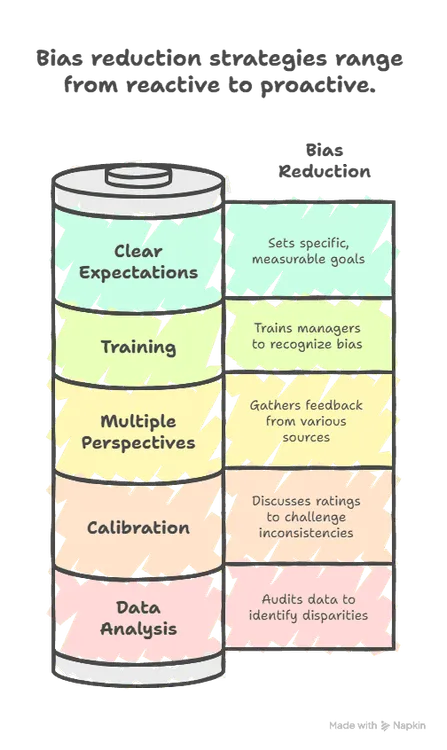
Structure is Fairness
Structure might seem rigid, but it protects employees from subjective whims.
When you use standardized forms and clear criteria, you force managers to think critically about what they're rating.
85% of Fortune 500 companies use 360-degree feedback to improve review quality.
Companies that invest in structured reviews often find managers grumble at first. Then they realize it's a safety net. It clarifies expectations and reduces the fear of being "unfair" unconsciously.
If you want equitable reviews, trade gut feel for clarity.
Training Managers to See Their Bias
Bias thrives in the shadows.
Many managers insist, "I don't see color or gender," but data shows disparities in their ratings.
Effective companies make bias awareness mandatory, not optional. They don't stop at slideshows about unconscious bias... they use real-life cases, and guided reflection.
Research in Harvard Business Review (2016) showed women are 1.4 times more likely to receive subjective critical feedback compared to men.
Evidence Over Adjectives
"Weak communicator." "Not strategic." These vague insults show up constantly in reviews, and they're poison.
Imagine getting this feedback with no examples. How would you improve?
Companies serious about fairness force reviewers to cite evidence. Instead of "weak communicator," the comment becomes:
In three Q3 meetings, Jane didn't clarify next steps, causing missed deadlines. Let's work on summarizing decisions clearly.
Not only is this fairer, it's useful. Employees can act on it. And reviewers must examine their own assumptions.
Getting Multiple Perspectives
Managers don't see everything.
That's why 360-degree feedback can be a powerful bias buster.
Peers, subordinates, and partners can highlight achievements that managers miss. Self-assessments let employees surface their contributions.
But there's a danger. Unstructured 360 feedback can turn into a popularity contest. Therefore, train everyone giving feedback to focus on observable behaviors, not personalities.
A marketing agency refined its 360 process by standardizing the questions: "Describe a time this person solved a problem collaboratively."
And, suddenly, feedback became specific, balanced, and fairer.
Calibration and Collective Accountability
Even with training, individual bias can slip through.
Calibration is the quality control step for reviews. Managers gather to discuss ratings, compare notes, and challenge inconsistencies.
It starts with asking tough questions: "Why is Sarah getting lower scores on leadership? Is that justified?"
For best results, keep calibration data anonymized to reduce internal politics.
Make Expectations Crystal Clear
Ambiguity is bias's best friend.
When goals are fuzzy, "Be more proactive," "Show leadership," managers lean on gut impressions shaped by their own biases.
Contrast that with setting specific, measurable goals at the start of the review cycle:
- "Reduce onboarding time by 15%."
- "Lead three cross-team workshops."
When goals are clear, the review becomes a simple question, Did they deliver?
Employees also feel safer.
They know what's expected and can push back if evaluations ignore the agreed targets.
Data Doesn't Lie (If You Look)
Many companies say they care about fairness but never check their data.
Bias often hides in the aggregate. Maybe women score consistently lower on "potential." Maybe underrepresented employees get less actionable feedback.
Organizations that are serious about equity regularly audit their review data. They look at patterns across gender, race, department, and tenure. And they ask the hard questions, Why?
Some even share summary stats internally to drive accountability.
Don't wait for complaints. Proactively analyze, discuss, and fix.
Make Feedback a Conversation, Not a Verdict
Annual reviews alone are a recipe for recency bias and surprises.
Modern companies are shifting to continuous feedback. Regular check-ins, project debriefs, and coaching moments create an ongoing dialogue.
When feedback is routine, it's less threatening. Managers document progress year-round, reducing memory bias. Employees get a chance to improve before formal reviews.
This is fairer and more effective.
Redefine What "Good" Looks Like
What does "leadership" mean in your company?
If your criteria are vague or culturally coded "executive presence," "polished" bias will flourish.
Inclusive organizations take time to define competencies with precision. Instead of "executive presence," they might use:
Clearly articulates goals, adapts message to audience, inspires action.
This approach honors diverse styles of communication and leadership.
It forces managers to rate behaviors, not vague impressions.
Technology is a Double-Edged Sword
HR tech can amplify fairness or bias.
Well-designed systems help by:
- Enforcing structured forms
- Flagging inconsistent ratings
- Providing dashboards to spot disparities
But be cautious... AI trained on biased historical data can replicate those patterns. Blindly trusting tech won't save you.
Successful companies vet their tools carefully and keep humans in the loop.
Technology is an aid... it's not an excuse to avoid hard work on culture and process.
A Practical Roadmap for Lasting Change
Bias reduction is an ongoing commitment.
Start small if needed. Pilot a structured form. Run one calibration session. Train one cohort of managers deeply.
Collect feedback, analyze outcomes, and iterate.
And keep the focus on why this matters.
To recognize real talent, to build trust, to make your workplace genuinely inclusive.
When employees see you doing the work to make reviews fairer, they'll repay you with loyalty, engagement, and their best work.
Be wary of AI systems trained on biased data... they can replicate and scale existing inequities.