Employee Appreciation: The Neuroscience Behind Why It Actually Drives Retention

TL;DR
- Employee appreciation triggers dopamine, oxytocin, and lowers cortisol, creating measurable changes in motivation, trust, and retention that go well beyond “feeling nice.”
- According to Gallup and Workhuman’s 2024 research, employees who receive quality recognition are 45% less likely to leave within two years, yet only 22% of employees say they get enough of it.
- Effective workplace appreciation must be specific, timely (within 48 hours), and personal. Generic “great job” messages barely register neurologically.
- Start this week: ask one direct report what kind of recognition actually means something to them. Their answer will reshape how you think about employee morale.
I lost my best engineer on a Tuesday. Her exit interview said “career growth,” which is the polite way of saying “I stopped feeling like my work mattered here.” Three weeks earlier, she’d shipped the feature that saved our Q3 revenue target. Nobody mentioned it in the all-hands. Nobody tagged her in Slack. Her manager forgot to bring it up in their 1:1 because he was prepping for a headcount review.
She told her husband about it at dinner. He was the only one who seemed to care.
I’ve seen this story repeat across a dozen organizations since then. And the strange part? Almost every leader I talk to knows employee recognition matters. They’ll nod along to the Gallup data. They’ll approve the budget for an annual awards dinner. But that daily, specific, human act of saying “I see what you did, and it mattered to this team” somehow gets buried under sprint planning, stakeholder meetings, and Jira backlogs.
This post covers what actually happens in your brain when someone appreciates your work, why most workplace recognition programs quietly fail, and what you can do in the next 48 hours to build an employee appreciation habit that sticks without feeling forced.
What Happens in Your Brain When You Feel Appreciated at Work
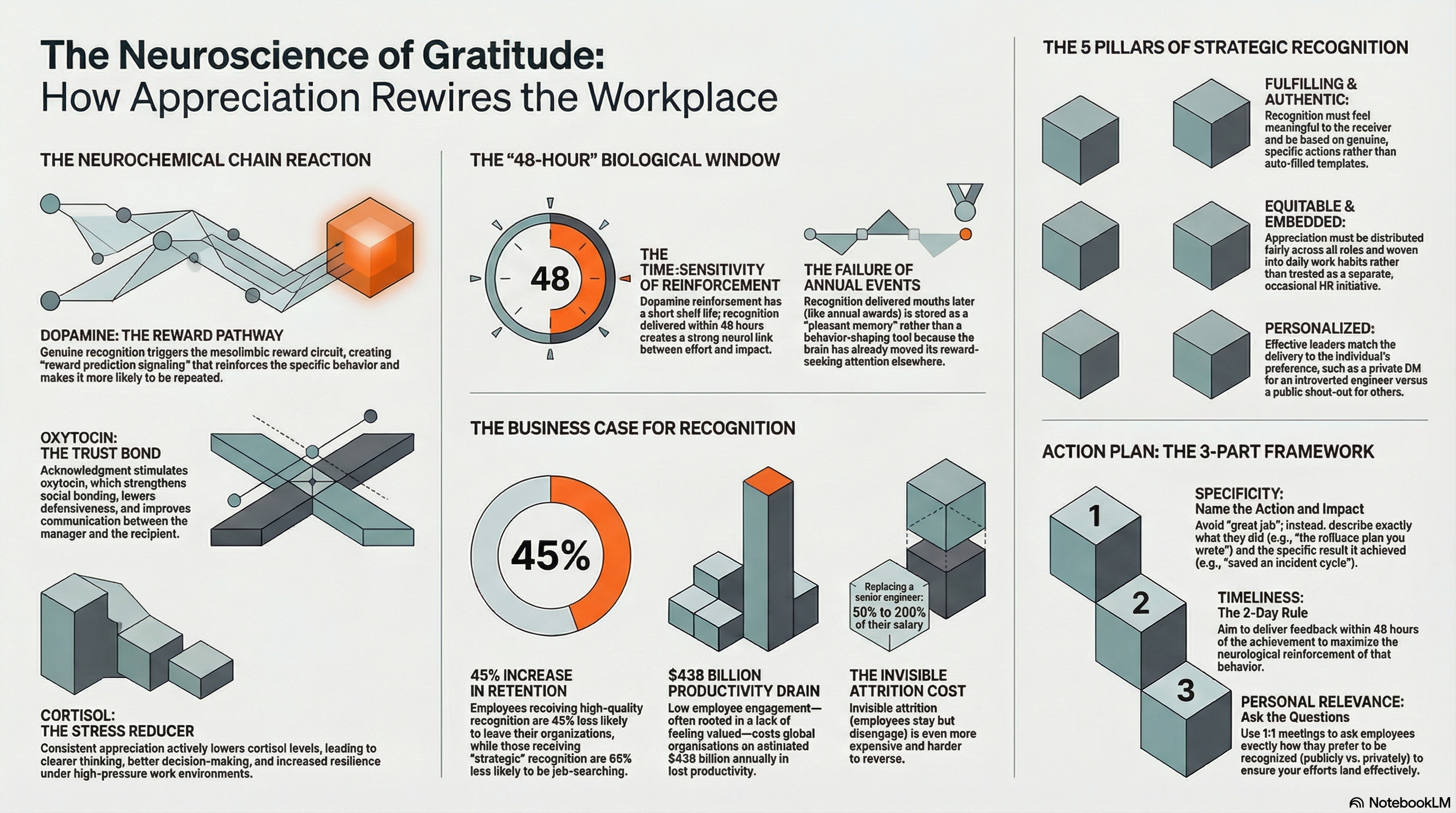
Employee appreciation is more than a feel-good initiative. It is applied neuroscience. When someone genuinely acknowledges a specific contribution you’ve made, three neurochemical systems activate simultaneously.
First, dopamine. Your brain releases it through the mesolimbic reward pathway, the same circuit that fires when you complete a hard workout or solve a problem you’ve been stuck on for days. That dopamine release doesn’t just feel pleasant. It reinforces the specific behavior that earned the recognition. Neuroscience researchers call this “reward prediction signaling,” and it’s why the person who gets recognized for a specific action is more likely to repeat it. Generic praise like “nice work” barely activates this system. But “the way you restructured the deployment pipeline cut our release time by half, and the on-call team noticed immediately” creates a clear neurological link between effort and impact.
Second, oxytocin. This neurochemical drives social bonding and trust. When a manager takes thirty seconds to acknowledge someone’s specific contribution, the recipient’s brain builds stronger neural pathways to that relationship. Trust increases. Defensiveness drops. Communication becomes easier in future interactions. According to research on workplace neurobiology published by Engage Employee, even witnessing an act of appreciation can stimulate oxytocin release in bystanders, which means public recognition has a team-wide neurological effect.
Third, cortisol drops. Consistent appreciation at work doesn’t just add a positive emotion. It actively lowers cortisol, your body’s primary stress hormone. Lower cortisol means clearer thinking, fewer reactive decisions, and more resilience under pressure, all things technical leaders and engineering managers care deeply about in their teams.
Why Timing Matters More Than Most Managers Realize
Here’s the part that kills most recognition efforts: dopamine reinforcement is time-sensitive. A recognition moment delivered three months after the work happened, say at an annual awards ceremony, doesn’t create the same neural pathway strengthening as one that lands within 48 hours. By then, your brain has already assigned that work to long-term memory and moved its reward-seeking attention elsewhere.
This is why annual employee appreciation events, while nice for team bonding, do almost nothing for day-to-day engagement or behavior reinforcement. The neuroscience is clear: if you want appreciation to change how someone works, it needs to arrive close to the moment it was earned.
The Employee Recognition Gap: What the Data Actually Shows
Despite strong evidence linking employee appreciation to retention and engagement, most organizations are failing at execution. The gap between knowing and doing is enormous.
The core finding from Gallup’s research with Workhuman: Only 22% of employees say they receive the right amount of recognition for the work they do. That number has barely moved since 2022.
Meanwhile, global employee engagement fell to 21% in 2024 according to Gallup’s State of the Global Workplace report, costing organizations an estimated $438 billion in lost productivity. That same year, 42% of senior leaders said their organizations value recognition, up from 28% in 2022. Awareness is rising. Impact is not.
Something is breaking down between the intent to appreciate employees and the employee’s actual experience of feeling valued. To understand why, you have to look at how most recognition programs are designed.
Why Most Employee Appreciation Programs Quietly Fail

Here’s a pattern I’ve watched unfold at least five times. An HR team rolls out a shiny recognition platform. There’s a launch email, maybe a lunch-and-learn. For the first month, usage spikes. People send each other digital high-fives and badge emojis. By month three, the same four enthusiastic people are the only ones using it. By month six, it’s basically abandoned, and someone in leadership says “recognition just isn’t part of our culture.”
The concept wasn’t the problem. The design was.
Gallup’s research has identified five pillars of strategic recognition that separate programs driving real business outcomes from ones that become another forgotten tool:
- Fulfilling - the recognition feels meaningful to the receiver, not just to the giver
- Authentic - it is specific and genuine, not a template auto-filled with a name
- Equitable - recognition is distributed fairly across teams, roles, levels, and demographics
- Embedded in culture - it is woven into how work happens daily, not a separate HR initiative people have to remember exists
- Personalized - it matches what the individual actually values (some people love public shout-outs; others find them deeply uncomfortable)
When recognition meets all five criteria, employees are up to four times more likely to be engaged. When even two or three pillars are missing, the effect drops dramatically.
This is where platforms like Pulsewise’s Kudos and Recognition system earn their place. Instead of a standalone recognition tool that lives in a tab nobody opens, Pulsewise integrates structured recognition directly into the daily flow of work. It includes AI-generated trait tagging and Slack integration, so when someone gives a kudos, it doesn’t sit in an isolated app. It connects to the person’s broader story: their recent wins, their growth patterns, their momentum. That’s the difference between a random compliment and what psychologists call structured reinforcement, and it’s why some recognition sticks and some evaporates by lunch.
How to Show Employee Appreciation That Actually Works: A 3-Part Framework
Let me be blunt. “Appreciate your people more” is advice on the same level as “be a better leader.” Technically true. Completely useless without specifics.
After watching recognition land and miss across engineering teams, people ops functions, and hybrid organizations for years, I’ve narrowed effective employee appreciation down to three non-negotiable ingredients.
1. Specificity: Name the Action, Name the Impact
“Great job on the project” triggers almost zero dopamine reinforcement. The brain needs detail.
Compare these two statements:
- Weak: “Thanks for your hard work on the migration.”
- Strong: “The way you wrote the rollback plan for the database migration meant we caught the schema conflict before it hit production. The SRE team said it saved them an entire incident cycle.”
The second version names the specific action, connects it to a measurable impact, and shows the employee that their work was visible to people beyond their direct manager. That level of specificity creates a neural reinforcement loop the vague version simply cannot.
2. Timeliness: The 48-Hour Window
Dopamine-based behavior reinforcement has a shelf life. Research on reward signaling consistently shows that recognition landing within 48 hours creates the strongest neurological association between effort and acknowledgment. Beyond a week, the reinforcement effect weakens significantly. Beyond a month, you’re creating a pleasant memory rather than changing future behavior.
Most companies batch their recognition into quarterly town halls or annual reviews, which is neurologically the equivalent of studying for an exam three months after you took it.
3. Personal Relevance: Know How Each Person Wants to Be Seen
Gallup’s work highlighted a finding that too many managers overlook: recognition needs to match what the individual values. Some engineers I’ve worked with would rather receive a quiet DM from their tech lead than a shout-out in the company all-hands. Others genuinely want the public stage. One of my reports once told me she hated being called out in meetings because it made her anxious for the rest of the day, and she’d never told anyone before I asked.
If you don’t know your people’s preference, you’re guessing. And guessing wrong doesn’t just waste the effort. It can make recognition feel performative or even stressful.
Try This in Your Next 1:1
Ask two questions in your next one-on-one meeting with each direct report:
- “When was the last time you felt genuinely recognized for your work here? What made it feel real?”
- “How do you prefer to be acknowledged: publicly or privately? Big milestones or small moments?”
Write the answers somewhere you’ll actually see them. I keep mine in a simple doc alongside my 1:1 prep notes. Most managers have never asked these questions, which means most employee recognition efforts are based on what the manager would want, not what the employee values. That gap is where appreciation quietly goes to die.
Employee Appreciation and Retention: The Business Case
Here’s where the conversation shifts from “nice to have” to “strategic priority.”
Gallup’s longitudinal research tracking employee outcomes from 2022 to 2024 found that employees who received high-quality recognition were 45% less likely to have left their organizations during that period. Those whose recognition met all five strategic pillars were 65% less likely to be actively job-searching.
Flip it: employees who don’t feel adequately recognized are twice as likely to say they plan to quit within the year.
Now layer in the cost. Replacing a senior engineer or high-performing people manager typically runs 50% to 200% of their annual salary once you account for recruiting, onboarding, ramp-up time, and the institutional knowledge that walks out the door. For a team of 15, losing even two people a year to preventable attrition can cost more than most managers’ entire annual budgets for recognition.
But the bigger cost is the one nobody budgets for: invisible attrition. The employees who stay but quietly disengage. They stop volunteering for stretch projects. They go from proactive to reactive. They still hit their metrics but stopped caring about the mission three months ago because nobody noticed when they went above and beyond. That erosion of discretionary effort is arguably more expensive than turnover itself because it’s harder to see and harder to reverse.
This is exactly the kind of slow drift that Pulsewise was built to surface. Their core belief is simple: people don’t experience work annually, they experience it daily. So measurement and support need to match that rhythm. When you combine daily mood signals, continuous feedback patterns, and recognition data in one system, you start seeing the early warnings, a drop in energy, a change in tone, a recognition gap, before someone mentally checks out. Not three months later when a survey tells you what you already suspected.
The Manager’s Role: Why Employee Appreciation Is a Leadership Skill
One of the most common mistakes I see in organizations is treating employee appreciation as an HR-owned program. It’s not. It’s a leadership behavior. And the most effective recognition comes from the person closest to the work: the direct manager.
Think about it from the employee’s perspective. A generic “kudos” from a CEO who barely knows your name feels categorically different from a two-sentence note from the manager who watched you debug a production issue at 9pm last Thursday. Both matter. But the second one lands deeper because it comes from someone who saw the effort firsthand.
For engineering managers and technical leaders specifically, this challenge has an extra layer. Technical work is often invisible by design. Nobody throws a party for clean architecture. A refactored module that prevents three future outages never trends in the incident channel. A well-documented API that saves the next hire two weeks of ramp time doesn’t announce itself.
If you manage engineers or technical teams, a huge part of building your appreciation muscle is learning to notice the work that doesn’t make noise.
What Manager-Led Appreciation Looks Like in Practice
- Catch contributions in real time. When you spot something noteworthy in a PR review, a design document, or a standup update, say something that same day. Don’t bank it for the next performance cycle.
- Make it visible to the team when appropriate. If the person is comfortable with public recognition, share it in a team channel with enough context that others understand why it mattered. “Shoutout to Maya” is empty. “Maya’s load testing caught a race condition that would have taken down checkout during peak hours” is memorable.
- Connect appreciation to business impact. “You did great” is nice. “Your documentation saved our newest engineer two full weeks of ramp time, and she mentioned it specifically in her 30-day check-in” is something that person will remember for years.
- Build recognition into your systems. Use your one-on-one meetings as a recognition touchpoint, not just a status update. Tools like Pulsewise’s One on One Board give managers AI-suggested next actions based on each employee’s recent wins, mood trends, and feedback patterns. So appreciation becomes part of your management workflow, not something you have to remember on top of everything else.
What Gets in the Way of Employee Appreciation (And How to Push Past It)
Let’s be honest about the real obstacles, because they’re predictable.
“I don’t have time for this.” This is the most common pushback, and the math doesn’t support it. A specific, two-sentence Slack message takes about 30 seconds. A mention in a standup takes 15 seconds. The time cost of genuine appreciation rounds to zero. The time cost of replacing a disengaged senior engineer who felt invisible? Six figures minimum, not counting the knowledge they take with them.
“It feels awkward and forced.” Completely fair if you’ve never worked in a culture of appreciation. The fix is embarrassingly simple: start small, start specific, start with one person. Don’t launch with a company-wide “recognition week” that nobody asked for. Just tell one person on your team, this week, exactly what they did that made your job or someone else’s job easier. That’s it. Do it again next week. The awkwardness fades faster than you’d expect.
“Good people should be motivated by the work itself.” This one sounds philosophically compelling but ignores basic neuroscience. Even deeply intrinsically motivated people benefit from external acknowledgment. Dopamine doesn’t check your management philosophy before deciding whether to reinforce a behavior. The brain needs signals that effort was noticed. Full stop. Denying your team recognition because you believe in pure intrinsic motivation is like refusing to water a plant because you believe in photosynthesis.
“Our recognition platform already handles this.” Does it, though? Pull up the usage data. If fewer than 40% of managers are actively using it each month, you don’t have a recognition program. You have a recognition suggestion that most people quietly ignore. The tool was never the problem. The habit is.
Your 48-Hour Employee Appreciation Action Plan
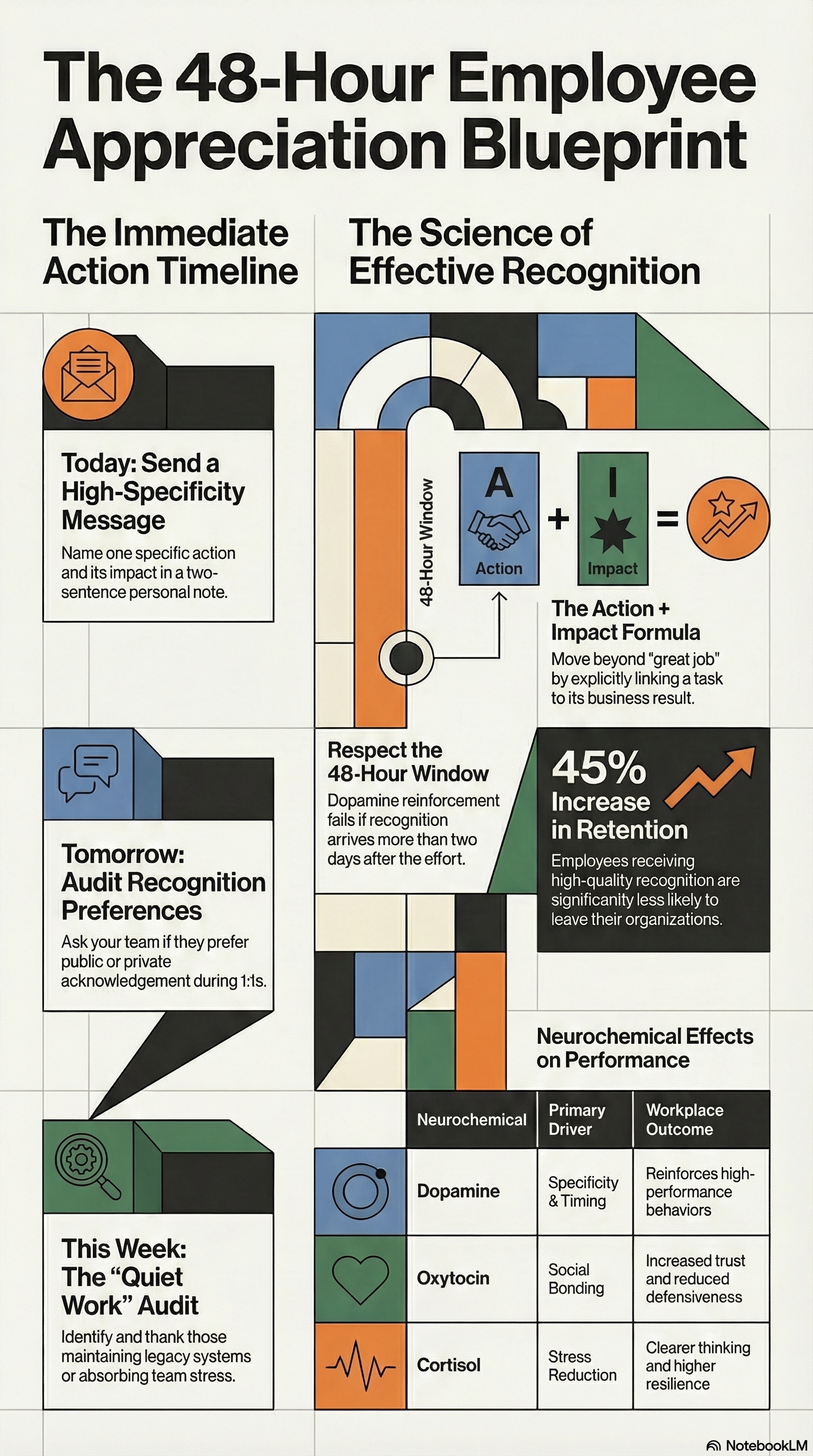
Stop overthinking this. Here’s what you can do before Friday:
Today: Send a specific, detailed message of appreciation to one person on your team. Not “great job.” Name the action, name the impact, and say why it mattered to you personally. Two sentences is enough.
Tomorrow: In your next 1:1, ask the two recognition preference questions from the framework above. Listen carefully. Write the answers down next to your other 1:1 prep notes.
This week: Run a quick mental audit. Who on your team hasn’t been recognized in the last 30 days? Is there someone doing quiet, essential work that nobody notices? An engineer maintaining a legacy system. A people manager absorbing team stress without complaint. A designer who keeps cross-functional reviews from going off the rails. Find them. Tell them you see what they’re doing.
This month: Have a conversation with your team about making appreciation a recurring practice. Not a program. Not a platform rollout. A practice. Something you do regularly because you’ve collectively decided it matters, not because HR sent an email about it.
Final Thoughts
Employee appreciation isn’t a soft skill bolted onto the edge of management. It’s applied neuroscience that directly shapes retention, engagement, and the quality of work your team produces. Every time you specifically acknowledge someone’s contribution close to when it happened, you are triggering a neurochemical response that strengthens their motivation, their trust in you, and their decision to stay. Every time you don’t, you’re quietly eroding all three.
The good news? This costs nothing. It doesn’t need executive approval or a new tool or a budget line. It just needs one person, you, deciding that the people around you deserve to hear when their work matters.
Start there. The science says everything else follows.
Frequently Asked Questions
What is employee appreciation and why does it matter?
Employee appreciation is the practice of recognizing and acknowledging someone’s specific contributions at work in a way that feels genuine and meaningful to them. It matters because it directly affects brain chemistry: genuine recognition triggers dopamine (which reinforces the behavior), oxytocin (which strengthens trust and bonding), and reduces cortisol (the body’s stress hormone). Organizations with strong recognition practices consistently see higher employee retention and engagement. According to Gallup’s research, employees who receive quality recognition are 45% less likely to leave.
How often should managers recognize employees?
Research suggests recognizing employees at least once a week delivers the most consistent impact on morale and engagement. However, frequency without quality backfires. A weekly generic “good job” is less effective than a bi-weekly acknowledgment that names the specific action, connects it to impact, and shows the employee their work was visible. The key is that recognition should be timely (within 48 hours of the contribution) and specific rather than just frequent.
What is the difference between employee appreciation and employee recognition?
While the terms are often used interchangeably, appreciation typically refers to valuing who someone is and their overall presence on the team, while recognition refers to acknowledging specific achievements or behaviors. Think of appreciation as “I’m glad you’re here” and recognition as “what you did on this project directly moved us forward.” The most effective approach combines both: regularly appreciating the person while recognizing specific contributions close to when they happen.
Does employee appreciation actually improve retention?
Yes, and the data is strong. Gallup’s multi-year tracking found that employees receiving high-quality recognition were 45% less likely to leave their organizations over a two-year period. When recognition met all five strategic pillars (fulfilling, authentic, equitable, embedded in culture, and personalized), employees were 65% less likely to be actively searching for other jobs. Conversely, employees who feel underappreciated are twice as likely to say they’ll quit within the year.
What are the best ways to show employee appreciation in remote or hybrid teams?
For distributed teams, digital recognition tools become essential because hallway conversations and casual in-person moments don’t happen naturally. Use async channels like Slack or Microsoft Teams for real-time, specific acknowledgment. Dedicate the opening minutes of virtual meetings to genuine callouts with context. Consider platforms that integrate recognition into daily workflows rather than requiring people to visit a separate tool. The most important principle for remote appreciation is making it documented and shareable, turning a private moment into a visible one that reinforces culture across time zones.
How does peer-to-peer recognition differ from manager-led appreciation?
Both forms of recognition activate the brain’s reward and bonding systems, but they serve different functions. Manager-led appreciation carries authority weight and signals that leadership is paying attention to individual contributions. Peer-to-peer recognition builds horizontal trust, strengthens team cohesion, and catches contributions that managers may not directly observe. The strongest recognition cultures combine both: managers model the behavior, and peers are empowered to reinforce it. Tools that support structured peer recognition, such as Slack-integrated kudos systems, help make this a natural part of daily work rather than a formal process.