Performance Review Phrases: 200+ Ready-to-Use Examples That Don't Sound Like Corporate Filler

TL;DR
- Generic phrases like “good team player” actively damage trust. Behavior-based, specific language is what makes reviews worth reading.
- Below you’ll find 200+ performance review phrases organized by skill and rating level (exceeds, meets, needs improvement) with real-world context for each.
- Dedicated sections cover engineering roles, remote/hybrid teams, and first-time managers.
- The single fastest upgrade to your next review cycle: pair every phrase with one concrete example from the past 90 days. That’s it. That one habit changes everything.
I’ve written somewhere around 400 performance reviews over the past eight years. The first dozen were awful. I remember spending 45 minutes on a single paragraph for a developer who’d had a phenomenal quarter, and the best I could come up with was “consistently demonstrates strong technical skills.” He read it, nodded politely, and I could tell it meant nothing to him.
That experience stuck with me. The problem wasn’t that I didn’t know his work. I’d watched him debug a production incident at 11pm on a Thursday, refactor a payment service nobody else wanted to touch, and patiently walk a new hire through our deployment pipeline three separate times. I just didn’t know how to translate what I’d seen into words that carried any weight on paper.
If you’re in that same spot right now, this post is going to save you a lot of time. I’ve pulled together over 200 performance review phrases organized by skill area, rating level, and role type. Not the hollow, corporate-approved sentences you’ll find in most HR templates. These are specific enough to drop straight into your review form, and flexible enough to customize for your team’s actual context. Whether you’re an HR leader building review templates, a tech lead writing your first round of reviews, or an engineering manager on your twentieth cycle who still dreads it, there’s something here for you.
Why Do Performance Review Phrases Matter So Much?
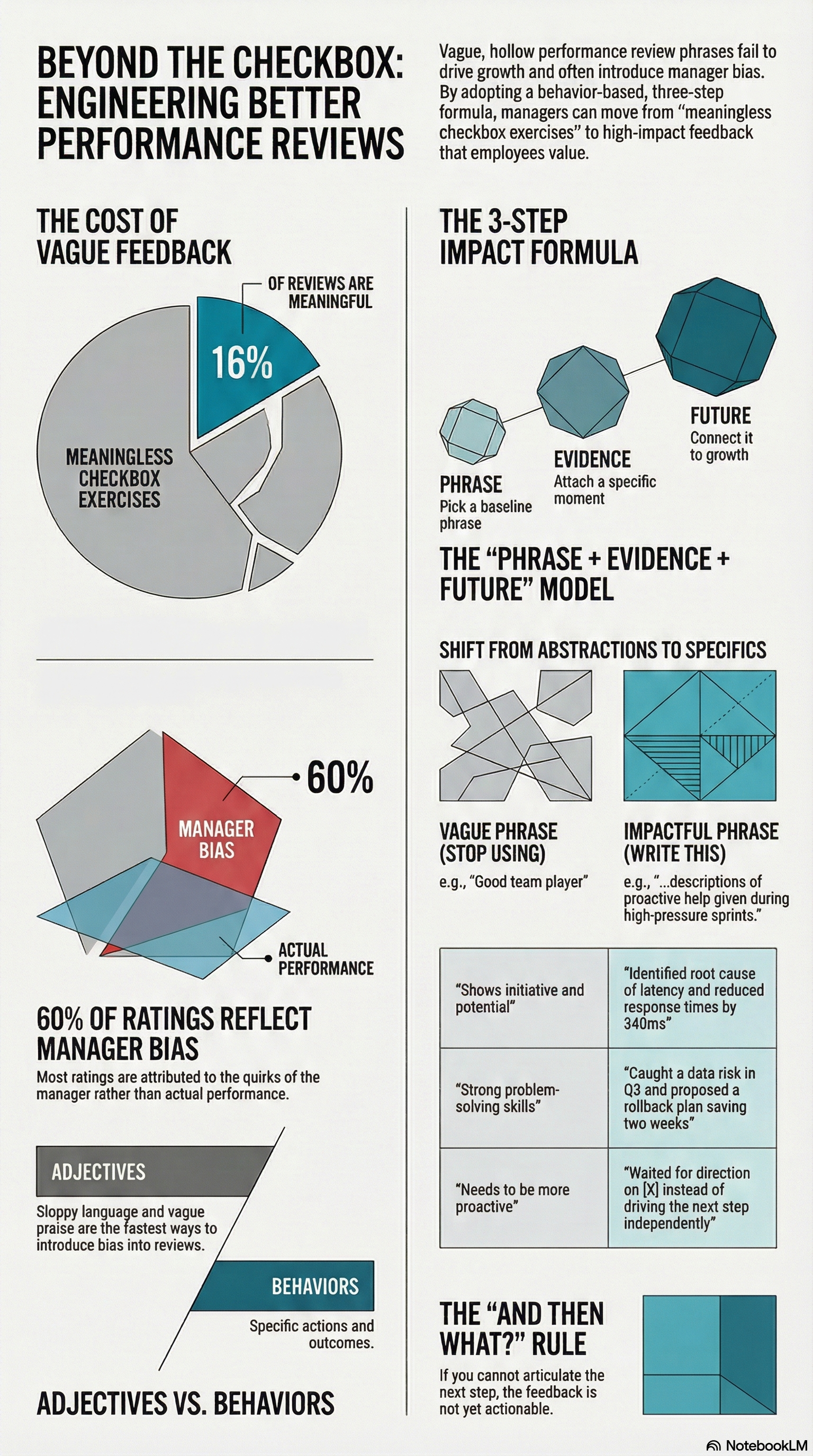
Let me put some numbers behind the frustration. Gallup’s workplace research found that only about 16% of employees feel their most recent conversation with a manager was deeply meaningful. Sixteen percent. That means roughly five out of six employees walk out of their review feeling like it was a checkbox exercise.
And here’s the part that should worry every HR leader: SHRM’s research shows more than 60% of a performance rating can be attributed to the quirks of the individual manager, not the employee’s actual work. So the words you pick aren’t just descriptions. They’re judgments that carry real weight, and sloppy language is one of the fastest ways to introduce bias into your review process.
I learned this the hard way at my second company. We had two engineering managers reviewing the same level of engineers. One manager wrote things like “shows initiative and leadership potential.” The other wrote “identified the root cause of our checkout latency issue within two hours and shipped a fix that reduced p99 response times by 340ms.” Guess which team’s engineers felt more valued? Guess which manager had lower attrition?
This is where tools like Pulsewise’s AI-assisted performance review workflow come in handy. Instead of staring at a blank text box trying to remember what happened in January, managers get structured prompts and suggested language built from actual feedback patterns, goal progress, and peer input collected throughout the cycle. It doesn’t write the review for you, but it gives you a starting point that’s grounded in real data rather than whatever you can recall from the last two weeks.
How Should You Use These Performance Review Phrases?
Before you start copying and pasting, ground rules. These phrases are starting points. The phrase itself is maybe 30% of the value. The other 70% comes from what you add to it.
Here’s the three-step formula I use every time:
- Pick a phrase from the matching skill area and rating level below.
- Attach a specific example from the review period. A project, a moment, a number. Something the employee would recognize.
- Point it forward by connecting the feedback to a growth area, a stretch assignment, or a continued expectation for next quarter.
Quick example of what this looks like in practice:
Weak version: “Demonstrates strong problem-solving skills.”
Stronger version: “Demonstrates strong problem-solving skills. During the Q3 data migration, she caught a data integrity risk the rest of us had missed and proposed a rollback plan that saved about two weeks of rework. I’d love to see her bring that same diagnostic instinct to our architecture planning sessions next quarter.”
The first version tells the employee nothing they can act on. The second one names the behavior, provides evidence, and gives direction. That’s a review comment worth reading.
One more thing about rating tiers. I’ve organized each category into three levels: Exceeds Expectations, Meets Expectations, and Needs Improvement. Be stingy with “Exceeds.” If everyone on your team exceeds expectations, the word has stopped meaning anything. Save it for the people who genuinely pushed beyond what was asked of them.
Performance Review Phrases by Skill Area
Communication and Collaboration
Exceeds Expectations
- Breaks down complex technical concepts into language that non-technical stakeholders can actually act on, which has noticeably reduced miscommunication on cross-functional projects.
- Proactively shares context and updates with the broader team without being asked. I’ve seen multiple instances where this prevented duplicate work or caught misaligned priorities early.
- Runs meetings where every participant walks out with clear action items and owners. This sounds basic but it’s rare, and the difference shows in how smoothly their projects ship.
- Adapts communication style depending on the audience. The way they present to executives versus how they pair-program with a junior dev are completely different modes, and both land well.
- Has created written documentation that other teams now reference regularly. That’s a force multiplier most people undervalue.
Meets Expectations
- Communicates status updates and blockers clearly in standups and async channels.
- Responds to messages and requests within a reasonable timeframe and follows up on open items.
- Participates in meetings and contributes relevant input without talking over others.
- Shares feedback with peers in a respectful way when the situation calls for it.
- Writes clear commit messages, PR descriptions, or project updates that teammates can parse without needing to ping for more context.
Needs Improvement
- Updates often lack enough detail for the team to take next steps, which creates confusion about where things actually stand.
- Tends to stay quiet in group settings even when their perspective would meaningfully shift the discussion. I’ve noticed this particularly in design reviews.
- Missed several chances to flag blockers early this quarter. In at least two cases, this led to avoidable delays for downstream teams.
- Written communication sometimes requires follow-up questions to understand the core point, which slows down the team.
- Technical explanations when working with non-engineering partners need more work. The audience doesn’t always share the same vocabulary.
Technical Skills and Problem Solving
Exceeds Expectations
- Consistently gets to root causes rather than surface symptoms. Their fixes tend to stick the first time, which saves the team significant rework.
- Has become the person everyone goes to for complex production issues. During the [incident name] outage, they diagnosed and resolved the problem in roughly half the time we budgeted.
- Proactively researches new tools and patterns, and three of their proposals this year have shipped and measurably improved team velocity.
- Writes code that other engineers genuinely enjoy reviewing. Clean, well-tested, well-named. This matters more than people realize because it directly reduces the technical debt backlog.
- Catches edge cases and failure modes during design discussions that would have been expensive to find later. On the [project name] effort, this probably saved us a full sprint of rework.
Meets Expectations
- Delivers technically sound work that meets the spec and follows team conventions.
- Debugs issues methodically and handles most problems without escalating.
- Stays current on relevant technical skills and applies them to everyday work.
- Writes tests for their code and follows the team’s quality bar consistently.
- Gives useful, specific feedback in code reviews rather than just approving or nitpicking.
Needs Improvement
- Struggles with debugging independently on issues that should be within reach at this level. Senior engineers are stepping in more often than expected.
- Code quality has been uneven. Recurring themes in review feedback include missing test coverage, unclear variable naming, and functions that try to do too much.
- Jumps to solutions before fully understanding the problem. On at least three recent tasks, this led to rework that could have been avoided with another 30 minutes of upfront investigation.
- The development goals we set in the last cycle around [specific skill] haven’t seen visible progress. Let’s revisit the plan.
- Needs to spend more time studying existing patterns in the codebase before proposing new approaches. A couple of recent PRs reinvented things we already had solutions for.
Leadership and Initiative
Exceeds Expectations
- Steps into ambiguous situations and creates structure where there was none. During [project], this directly unblocked two teams that had been waiting for someone to make a call.
- Mentors junior engineers in a way that clearly accelerates their growth. Three of their mentees took on stretch projects this quarter, and two delivered ahead of schedule.
- Doesn’t just raise problems, they bring solutions. Their proposal to restructure our sprint planning format saved roughly four hours per cycle and the team feedback has been positive.
- Handles cross-team coordination on complex projects so well that stakeholders now request them by name. That kind of trust takes years to build and they’ve done it in less than one.
- Keeps the team grounded during high-pressure moments. During the [incident] outage, their calm and clear communication in the war room made a noticeable difference.
Meets Expectations
- Takes ownership of assigned work and sees it through without needing close oversight.
- Volunteers when something needs an owner and follows through on what they commit to.
- Shares improvement ideas in retros and team discussions.
- Helps teammates during crunch periods by picking up adjacent tasks.
- Follows through on action items from 1:1s and team meetings.
Needs Improvement
- Waits for direction rather than identifying the next important thing, even in areas where they have clear ownership. At this level, I need to see more self-direction.
- Rarely volunteers for work outside their immediate lane, which limits growth and makes the team less flexible when priorities shift.
- Escalates routine decisions that should be within their authority. Building comfort with making calls and being wrong occasionally is part of growing at this level.
- Hasn’t yet shown the initiative expected at their current band to drive work forward without detailed instruction.
- Would benefit from seeking out mentoring or leadership development on their own. The team needs more people who can lead without a title.
Time Management and Reliability
Exceeds Expectations
- Delivers ahead of schedule regularly without cutting corners, and flags timeline risks before they become problems. During Q2, this early warning saved us from a client-facing miss.
- Juggles competing priorities across multiple projects with a level of organization that has genuinely impressed project managers and leadership.
- Uses their time efficiently enough to take on additional scope without overcommitting. Their sprint completion rate this half was the highest on the team.
- Creates estimates that consistently hold up, and communicates early when something might slip. That reliability has made planning easier for the whole team.
Meets Expectations
- Hits deadlines consistently and gives advance notice when timelines are at risk.
- Manages their workload independently and asks for help before things become overdue.
- Shows up to meetings on time and comes prepared.
- Balances daily work with longer-term project commitments effectively.
Needs Improvement
- Missed several deadlines this quarter without advance notice, which created cascading delays for dependent work.
- Tends to underestimate how long tasks will take. Investing time in estimation skills, maybe by tracking actual versus estimated hours for a few sprints, would help.
- Prioritization has been off. Some urgent items got deprioritized in favor of less time-sensitive work. Let’s set up a weekly check-in to work on this together.
- Often seems rushed or underprepared in meetings, which suggests workload management needs attention.
Innovation and Continuous Improvement
Exceeds Expectations
- Introduced [specific tool/process] that reduced [metric] by [percentage]. That’s the kind of impact that goes beyond “doing the job” into genuinely improving how the whole team works.
- Challenges the status quo with well-researched alternatives, not just gut feelings. Their proposal to refactor our CI pipeline cut build times by 40% and the ROI was obvious within two weeks.
- Brings ideas from outside our immediate space that get people thinking differently during planning. The [specific example] approach they suggested came from reading about how [company/industry] solved a similar problem.
- Creates room for experimentation by advocating for time to prototype. The team’s innovation output has gone up since they started pushing for dedicated exploration time.
Meets Expectations
- Open to new ideas and adapts when the team changes how things work.
- Suggests improvements in retros and is willing to try different approaches when the current ones aren’t delivering.
- Keeps up with relevant industry developments and shares useful findings with the team.
Needs Improvement
- Defaults to familiar approaches even after the team has decided to try something new. Change is hard, but at this level I need to see more willingness to experiment.
- Hasn’t contributed improvement ideas in recent retrospectives despite encouragement. Even small suggestions count.
- Pushes back on process changes without offering alternatives. Resistance without a counterproposal just slows the team down.
Accountability and Ownership
Exceeds Expectations
- Owns outcomes end to end, not just their slice of the work. When the onboarding project hit unexpected blockers, they reorganized the plan and communicated new timelines to stakeholders before anyone had to ask. That kind of proactive ownership stands out.
- Takes responsibility for mistakes openly and turns them into learning opportunities for the team. This has built a level of trust that’s hard to quantify but easy to feel.
- Follows up on their own work after delivery to check adoption, gather user feedback, and iterate. Most people ship and move on. They ship and make sure it actually worked.
Meets Expectations
- Takes responsibility for their deliverables and follows through.
- Acknowledges mistakes and works to fix them without delay.
- Keeps stakeholders informed about progress and any issues.
- Delivers work to the agreed standard without reminders.
Needs Improvement
- There’s a pattern of attributing missed deadlines to external factors without examining their own role. I’d like to see more honest self-assessment here.
- Several items from last cycle were left incomplete without explanation or handoff. Ownership means closing the loop even when things get messy.
- Tends to pass tricky issues to teammates rather than working through them. This creates extra load for others and limits their own skill development.
Teamwork and Cross-Functional Collaboration
Exceeds Expectations
- Acts as a genuine bridge between engineering and product. They translate requirements and constraints in both directions, and the result is noticeably less rework on projects they’re involved in.
- Actively seeks perspectives from people in other functions before proposing solutions. On the [project] initiative, this upfront investment in alignment saved us from at least one major scope change mid-sprint.
- Has built working relationships across departments that make the entire team more effective. When we needed design input on short notice last month, they had it sorted in under an hour because of the trust they’d already built.
- Volunteers for cross-team work and represents our team’s interests clearly without being territorial about it.
Meets Expectations
- Works well with people outside the immediate team and responds to cross-team requests promptly.
- Shares knowledge and context when teammates ask for help.
- Participates in cross-functional meetings and adds relevant perspective.
- Handles interpersonal friction professionally when it comes up.
Needs Improvement
- Works in isolation on tasks that would clearly benefit from input from others. This has led to duplicated effort more than once this quarter.
- Needs to better understand partner teams’ priorities before pushing back on their requests. Some recent friction could have been avoided with a five-minute conversation upfront.
- Has gotten feedback from cross-functional partners about slow response times. Worth prioritizing this next quarter.
Growth Mindset and Learning
Exceeds Expectations
- Actively asks for feedback from peers and managers, and you can see the changes show up in their work within weeks. There’s a clear improvement arc quarter over quarter.
- Completed [certification/course] on their own time and applied it directly to [specific project]. That kind of self-directed growth is exactly what we want to see.
- Takes on challenging assignments as learning opportunities instead of avoiding them. Volunteering for the [project] stretch role when they could have stayed in their comfort zone was a great move and it paid off.
Meets Expectations
- Receptive to feedback and makes genuine effort to apply it.
- Pursues learning opportunities when they arise and shows steady growth.
- Asks thoughtful questions that show they want to understand the why, not just the what.
Needs Improvement
- Gets defensive when receiving constructive feedback, which makes it hard for peers and managers to give the input they need to grow. Let’s talk about strategies for receiving feedback more openly.
- The development goals from last cycle around [skill area] haven’t seen meaningful progress. We need to figure out what’s blocking this and whether the goals need adjusting.
- Needs to take more initiative in finding learning opportunities rather than waiting for them to be handed over.
Performance Review Phrases for Specific Scenarios
How Do You Write a Performance Review for an Engineer?
Technical roles need technical specifics. Vague praise like “strong technical skills” tells a senior engineer nothing they can use. Here are phrases built for engineering and technical contexts:
- “Reduced deployment failure rate by [X%] through improved testing practices and pre-release checks. The on-call team has noticed.”
- “Took ownership of a legacy system nobody wanted to touch and incrementally improved its reliability until on-call incidents dropped by [X].”
- “Writes architecture decision records (ADRs) that the team actually references months later when revisiting technical choices. That documentation habit has compound value.”
- “PR review turnaround time is currently averaging [X days], which is creating bottlenecks for teammates. Let’s figure out a sustainable cadence.”
- “Their pair programming sessions have become one of the most effective onboarding tools we have. New hires consistently mention these as a highlight of their first month.”
- “Led the migration from [old tool] to [new tool], handling both the technical execution and the stakeholder communication with equal care.”
- “Struggles to break large tasks into smaller, shippable pieces. This makes it harder to track progress and increases the risk of late surprises.”
- “Showed strong incident response skills during the [incident]. Clear communication in the war room, good judgment under pressure, and a thorough postmortem write-up.”
What Performance Review Phrases Work for Remote and Hybrid Employees?
Remote work changes the signals managers rely on, but the fundamentals of good feedback don’t change. Focus on outcomes, communication habits, and collaboration patterns rather than visibility.
- “Maintains strong presence and communication despite being fully remote. Teammates across three time zones describe them as one of the most responsive people on the team.”
- “Proactively adjusts meeting schedules and communication patterns for the distributed team. Small accommodations like this make a real difference for people who’d otherwise always be in the 7am slot.”
- “Needs to improve participation in virtual meetings. Their input is valuable when they share it, but they’ve been quiet in several recent discussions where we could have used their perspective.”
- “Documents decisions and context in shared channels instead of keeping things in DMs. This is exactly the habit that makes async teams function well.”
- “Has struggled with async communication norms, sometimes expecting real-time responses from teammates in different time zones. Setting clearer expectations around response windows would help.”
How Do You Write a Performance Review for a New Manager?
The IC-to-manager transition is one of the hardest shifts in anyone’s career. Be specific about what’s working and where the gaps are.
- “Made the transition from individual contributor to team lead with less friction than most. Still shipping quality technical work while building strong 1:1 relationships with each direct report.”
- “Runs 1:1s that team members describe as supportive and action-oriented. That feedback came up in our skip-levels without prompting, which says a lot.”
- “Needs to get more comfortable delegating. The instinct to take everything on personally is understandable but it’s limiting the team’s development.”
- “Has shown real promise in giving constructive feedback, but there’s room to be more direct when performance issues need to be addressed quickly. Speed matters here.”
- “Created a team onboarding guide that cut ramp-up time for new hires from six weeks to four. That’s the kind of scalable impact that defines good management.”
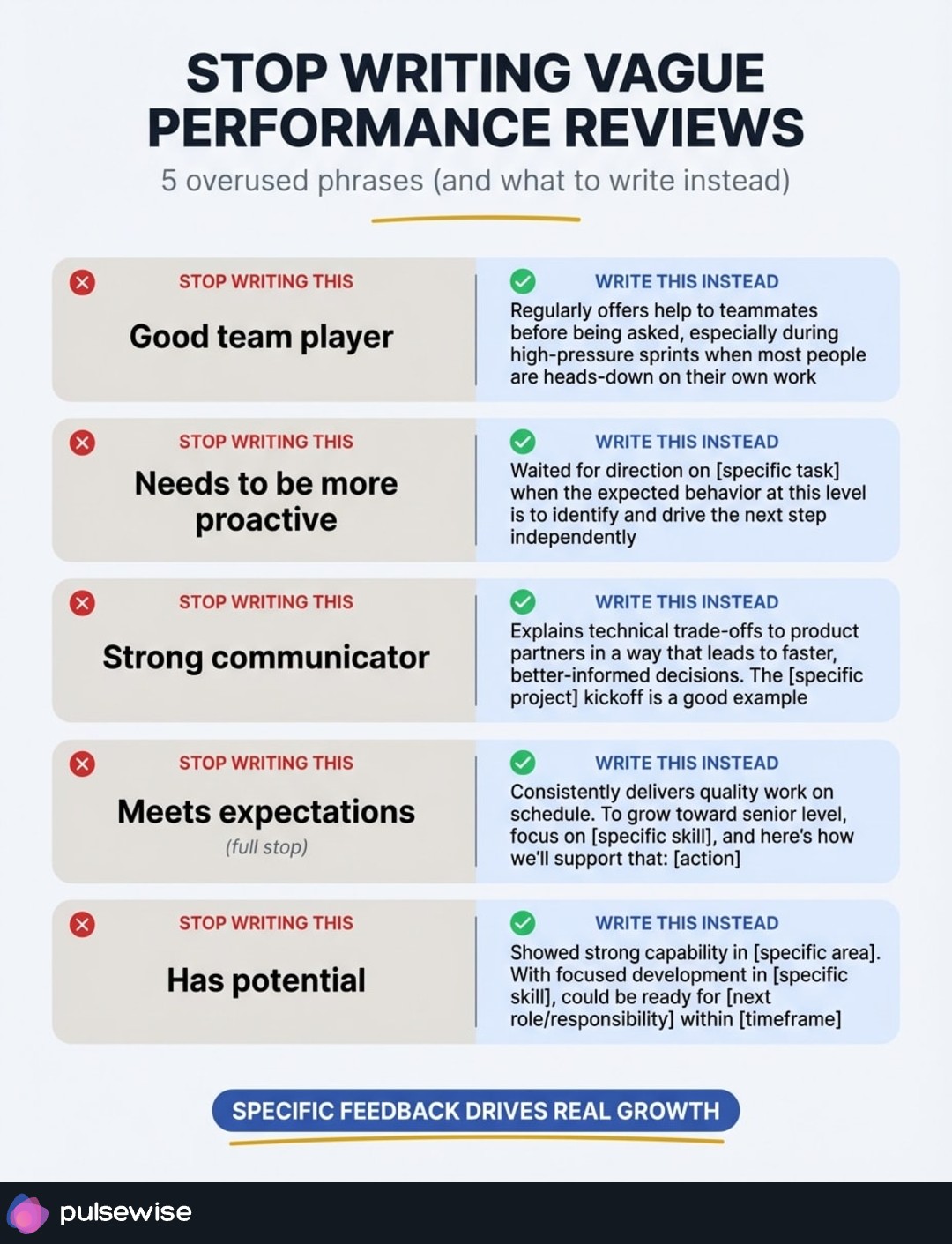
Phrases You Should Stop Using (and What to Say Instead)
Some review phrases are so overused they’ve become meaningless. If you recognize these in your own reviews, it’s time for an upgrade.
| Stop writing this | Write this instead |
|---|---|
| ”Good team player" | "Regularly offers help to teammates before being asked, especially during high-pressure sprints when most people are heads-down on their own work" |
| "Needs to be more proactive" | "Waited for direction on [specific task] when the expected behavior at this level is to identify and drive the next step independently" |
| "Strong communicator" | "Explains technical trade-offs to product partners in a way that leads to faster, better-informed decisions. The [specific project] kickoff is a good example" |
| "Meets expectations” (full stop) | “Consistently delivers quality work on schedule. To grow toward senior level, focus on [specific skill], and here’s how we’ll support that: [action]" |
| "Has potential" | "Showed strong capability in [specific area]. With focused development in [specific skill], could be ready for [next role/responsibility] within [timeframe]” |
The pattern is straightforward: swap adjectives for behaviors, and swap abstractions for specifics. Every time.
How to Make Review Phrases Actually Drive Growth (Not Just Fill a Form)
Writing a good phrase is only part of the job. The harder part is making sure it connects to something that happens after the review is submitted.
I’ve seen this cycle play out at three different companies: the review gets written, the employee reads it, maybe they have a quick conversation about it, and then it disappears into the HR system until the next cycle. Nothing changes. The phrases were fine. The follow-through was nonexistent.
Here’s what I’ve started doing differently, and it’s made a noticeable difference:
For every review comment, answer this question: “And then what?”
“Needs to improve estimation skills” is observation, not coaching. “Needs to improve estimation skills. For the next two sprints, we’ll review estimates together before they’re committed. We’ll track predicted versus actual hours and use the gap to calibrate” gives the person a path and gives you a coaching tool.
Build a 90-day follow-up habit. I set a calendar reminder 90 days after every review cycle to revisit the development points with each direct report. Most managers skip this. Don’t. It’s the single best way to show your team that the review wasn’t performative.
This is also where having good data throughout the review period changes the game. Pulsewise’s AI Employee Summary gives managers a consolidated view of each person’s wins, momentum shifts, risk signals, and feedback patterns before they even open the review form. So instead of reconstructing six months from memory (which is what most of us do), you’re writing from an actual record of what happened. That shift from memory-based to evidence-based reviews is what separates feedback that lands from feedback that gets forgotten.
If you’re an HR leader designing review templates, build the structure so that every rating requires a supporting example and a forward-looking development statement. It forces better writing and gives employees something real to work with.
Your Pre-Review Prep Checklist
Before you sit down to write, run through this. It takes about 10 minutes per person and will cut your actual writing time in half.
- Pull up their goals from the start of the cycle. What did they commit to? What actually shipped?
- Check your 1:1 notes for themes. What came up repeatedly? What progress did you observe?
- Scan peer feedback and any 360 input if your process includes it. Look for patterns, not outliers.
- Identify 2-3 specific moments that stand out, both strengths and growth areas. Name the project, the date if you can, the impact.
- Draft your “And then what?” for each development point. If you can’t articulate the next step, the feedback isn’t ready.
- Read it from their perspective. Would you find this useful if it were about you? Would you know exactly what to keep doing and what to change?
Reviews Work Best When They’re Not Surprises
The best performance review phrases in the world won’t salvage a review that’s the first time someone hears they need to improve. If the feedback in the written review is genuinely new information, something went wrong months ago.
The organizations that get the most out of their review processes treat the formal review as a summary of conversations that have already happened throughout the quarter. Gallup’s research backs this up: employees who receive meaningful feedback at least weekly are dramatically more engaged than those who only hear from their manager during formal cycles.
This is exactly the rhythm Pulsewise was built around. People experience work daily, not annually. So the feedback, recognition, and goal tracking that eventually inform a performance review should be continuous, not crammed into a panicked two-week window at the end of every quarter. When that daily signal exists, writing review phrases stops being painful because you’re documenting what you’ve both already discussed and agreed on.
Final Thoughts
A performance review is only as useful as the language in it. Vague phrases produce vague outcomes. Specific, behavior-based, forward-looking language builds trust, reduces bias, and gives people an actual map for growth.
Use the 200+ phrases above as your starting framework. Customize them with real examples from the review period. And if you want to stop dreading review season altogether, start building the habit of continuous, specific feedback now so the formal write-up is just a summary of what everyone already knows.
FAQs
What makes a good performance review phrase?
A good performance review phrase is specific, behavior-based, and attached to a real example. Instead of writing “great leadership skills,” describe the exact behavior you saw and the impact it had on the team or project outcome. The strongest phrases also include a forward-looking element that connects the feedback to a concrete next step or development focus.
How many performance review phrases should I include per employee?
Three to five well-written comments per review is the sweet spot. Each one should reference a specific example and include a development direction. Five strong, specific phrases will have far more impact than fifteen vague ones. If you’re writing more than five, check whether some of them are saying the same thing in different words.
How do you write performance review phrases for underperforming employees without being harsh?
Stick to observable behaviors and measurable outcomes. Never describe personality traits. Instead of “has a bad attitude,” write “declined to participate in the last three team retrospectives, which limited the team’s ability to surface and address process issues.” Name the gap clearly, pair it with a concrete suggestion for improvement, and include a timeline for when you’ll reassess. Being direct is not the same as being harsh. People generally respect clarity more than softened language that leaves them guessing.
Should performance review phrases differ for remote employees?
The fundamentals are the same: be specific, cite examples, focus on outcomes. But for remote employees, it’s worth specifically calling out communication habits, async collaboration skills, and documentation practices. These behaviors matter more in distributed teams. One thing to watch for: don’t penalize remote team members for lower hallway visibility if their output and collaboration are strong. SHRM’s research on proximity bias found that 67% of managers feel remote employees are more replaceable, which is a bias worth actively checking.
How often should I update the phrases I use in reviews?
At least once a year. As your team’s work evolves, the skills and behaviors that matter will shift. If your team adopted a new tech stack, changed methodology, or restructured, your review language should reflect that. Stale phrases lead to feedback that feels disconnected from what people are actually doing. I keep a running doc of new phrases that come to mind throughout the year, which makes the annual refresh much faster.