Employee Motivation: A Complete Guide for People Leaders

Employee Motivation: The Complete Guide for People Leaders
TL;DR
- Employee motivation is the internal and external set of forces that decides whether someone gives their job 60 percent or 100 percent on any given day.
- Only about 21 percent of employees worldwide are engaged at work, and managers explain roughly 70 percent of the difference between teams that thrive and teams that drift.
- Pay matters as a baseline, but recognition, autonomy, and meaningful goals consistently out-motivate financial incentives in the long run.
- The fastest motivation reset a manager can run this week: one specific kudos, one clarified goal, and one honest 1:1 question.
- Motivation is not a personality trait of the employee. It is a system the manager and the organization design.
When a strong performer suddenly goes quiet in meetings, finishes work on time but never goes beyond it, and then resigns three months later with the line “I just need a change,” the most common story leaders tell themselves is that the person lost interest. They didn’t. The system around them stopped earning their effort.
This guide is for HR leaders, technical leaders, and people managers who want a clear, modern view of what employee motivation is, why it has gotten harder to sustain, and what to do about it on a Monday morning. We will walk through the research that holds up, the frameworks that work in practice, and the small habits that move the needle faster than any annual program.
What is employee motivation?
Employee motivation is the combination of internal drive and external conditions that determines how much energy, focus, and care a person brings to their work. It has two parts: intrinsic motivation, which comes from inside the person (curiosity, mastery, purpose, pride in the craft), and extrinsic motivation, which comes from outside (pay, recognition, promotions, deadlines, fear of consequences). Both matter, and neither is enough on its own.
In simpler terms, motivation is the answer to a quiet question your employees ask themselves every morning: “Is it worth giving this my best today?” Your job as a leader is to make the honest answer “yes,” repeatedly, without manipulation.
Why is employee motivation harder to sustain in 2026?
The macro picture is not subtle. Gallup’s 2025 State of the Global Workplace report found that only 21 percent of employees worldwide are engaged at work. Sixty-four percent are not engaged. Sixteen percent are actively disengaged. The estimated cost of low engagement to the global economy is around $438 billion in lost productivity each year.
What makes the 2025 data different from previous years is who is dropping. Manager engagement fell from 30 percent to 27 percent globally, and engagement among female managers dropped seven points in a single year. Gallup also reports that managers account for roughly 70 percent of the variance in team engagement. The implication is uncomfortable: the people you rely on to motivate everyone else are the ones currently losing motivation fastest.
For HR and technical leaders, the takeaway is simple to state and harder to live by. You cannot push motivation out to your people through perks, posters, or quarterly all-hands. You have to rebuild it manager by manager, team by team, week by week. That is the work.
What is the difference between intrinsic and extrinsic motivation?
Most leaders intuitively know about pay, bonuses, and promotions. Fewer can clearly articulate why those things alone never seem to be enough. The reason is simple: extrinsic rewards move people in the short term but rarely build sustained energy.
Decades of research, summarized clearly in Deci and Ryan’s foundational work on Self-Determination Theory, shows that intrinsic motivation, the kind that comes from doing work that feels meaningful and within your control, is what drives sustained performance. McKinsey’s 2024 global research backs this up: intrinsically motivated employees show roughly 46 percent higher job satisfaction, 32 percent higher organizational commitment, and 16 percent better performance than those primarily motivated by external rewards (see McKinsey on motivating performance).
The catch most leaders miss is what happens at the intersection. Extrinsic rewards do not just fail to build intrinsic motivation. When used badly, they can quietly erode it. When you tie every interesting project to a bonus, the project starts to feel like a transaction instead of a craft. Use extrinsic rewards as a baseline of fairness (pay people well, recognize good work publicly), and design the day-to-day work to feed the intrinsic side.
Intrinsic vs extrinsic motivation at a glance
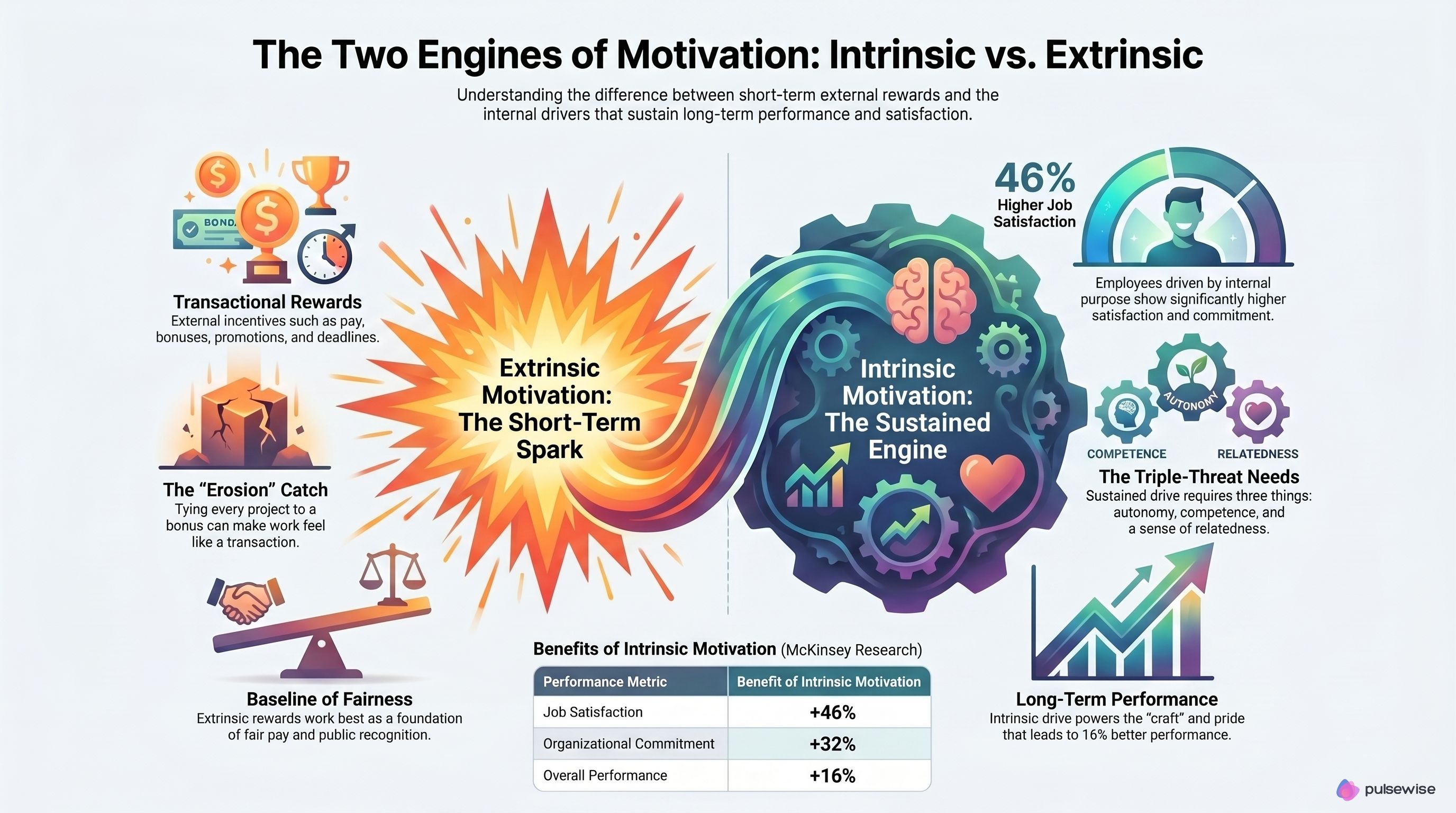
Extrinsic rewards spark short-term effort. Intrinsic drive is what sustains it, with measurable gains in satisfaction, commitment, and performance.
What are the three psychological needs that drive motivation?
If you only remember one framework from this guide, make it this one. It is the most useful, most evidence-backed model of human motivation we have, and it travels well across industries and cultures.
Self-Determination Theory says every working adult has three basic psychological needs that have to be met for motivation to take root.
1. Autonomy. The sense that you have meaningful choice in how you do your work. Not total freedom, but enough room to apply judgment.
2. Competence (or mastery). The sense that you are good at what you do, and getting better. Progress is visible. Skill is being built.
3. Relatedness. The sense that you matter to the people you work with, and they matter to you. You feel seen.
When all three are present, intrinsic motivation grows almost on its own. When even one is missing for too long, motivation collapses, no matter how good the comp plan is.
A useful test for any new initiative, policy, or process you are about to roll out: does it increase or decrease autonomy, competence, and relatedness for the people on the receiving end? If it shrinks any of the three, expect motivation to take a hit.
What actually motivates employees at work? (7 things that matter)
This is the operational core of the guide. Each of the seven connects to one or more of the three psychological needs above.
- Clear, meaningful goals. People need to know what good looks like and why it matters.
- Honest, frequent recognition. Not generic, not annual. Specific praise tied to specific behavior.
- A manager who listens. Most disengagement starts with a manager who stopped paying attention.
- Autonomy in how the work gets done. Tell people the outcome, not every step.
- Visible progress. The brain rewards momentum. People need to see that effort is moving something.
- Growth and learning opportunities. Even small ones. Feeling stuck is one of the fastest motivation killers.
- Fair, transparent compensation. Pay does not motivate by itself, but unfair pay actively demotivates.
What is missing from the list is just as informative. Ping pong tables, swag, free lunch, and off-sites are pleasant. They do not move motivation. The seven above do.
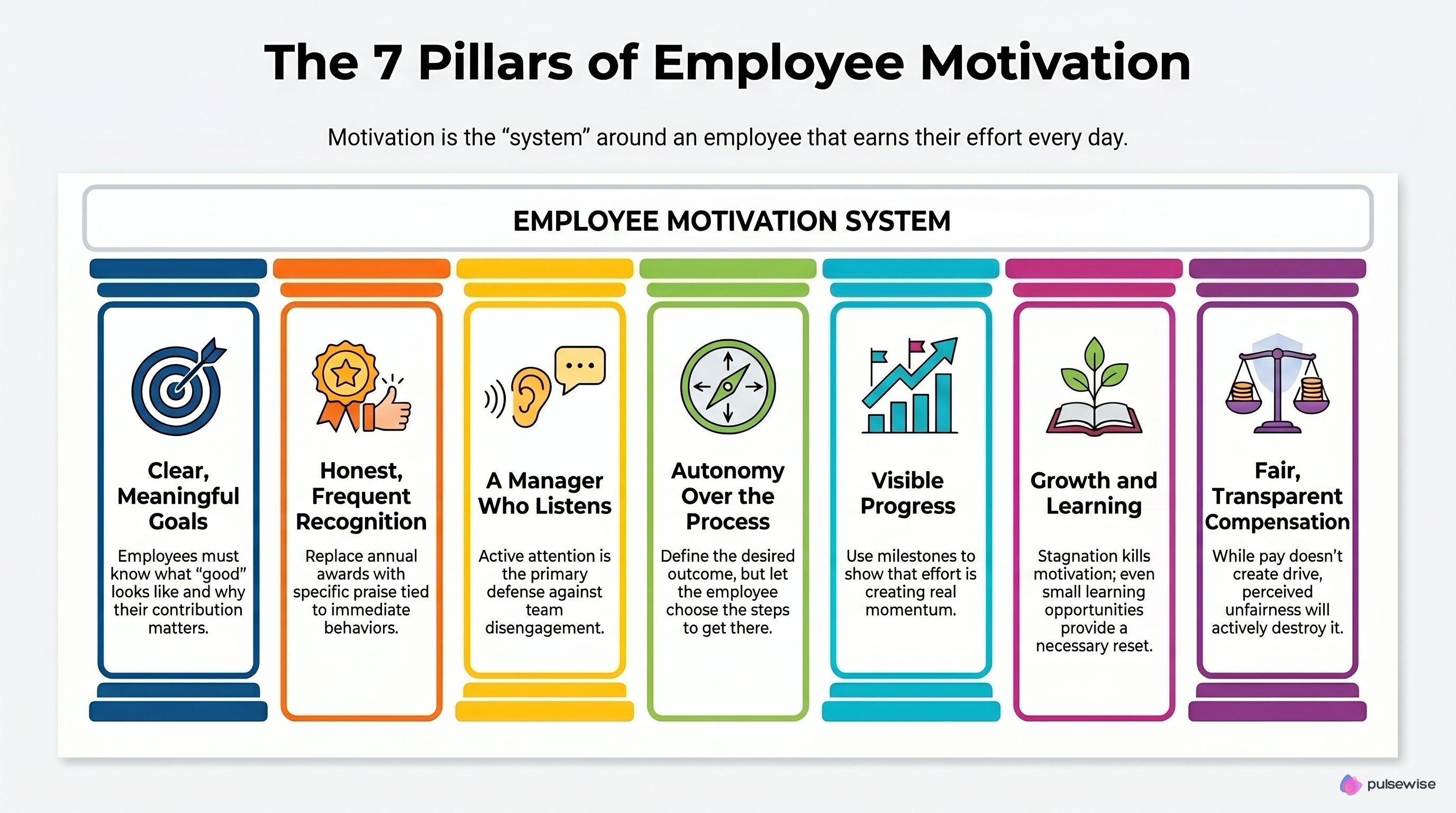
The seven pillars that consistently move employee motivation. Notice what is not on the list: perks, swag, and off-sites.
How do managers shape employee motivation?
If managers explain 70 percent of the variance in team engagement, then most of an organization’s motivation strategy is really a manager-effectiveness strategy in disguise. The good news is that the highest-leverage manager habits are not exotic. They are old-fashioned and small.
Hold a real 1:1 every week or two. Thirty minutes. Phone away. The agenda is set by the employee, not the manager.
Open with a question that signals you care. A favorite of ours: “What is one thing getting in your way this week that I could help remove?” Most managers never ask. The answers, when you do, are usually surprising and easy to act on.
End with one specific commitment from each side. Vague check-ins drift. Specific commitments build trust.
The reason this matters for motivation is that 1:1s are where the three psychological needs get reinforced or eroded. Autonomy is signaled when a manager respects employee judgment. Competence is signaled when a manager notices and names good work. Relatedness is signaled by the simple fact that someone in power is paying attention.
Tools like Pulsewise’s AI-powered manager feedback surface AI-suggested next actions for each report, based on recent mood signals, feedback patterns, and goal progress. Instead of going into a 1:1 cold, a manager gets a small nudge: “Mood trend has dropped this week, consider opening with a wellbeing check.” The prompt costs nothing to act on, but it changes the tone of the conversation.
Why does most workplace recognition fall flat?
Recognition is the most underused, highest-ROI motivation lever in most organizations. The data on this is striking. McKinsey’s research found that 67 percent of employees rated praise and commendation as a top performance motivator, scoring it above performance bonuses and other financial incentives.
The 2025 O.C. Tanner Global Culture Report, based on responses from over 38,000 employees across 24 countries, found that employees who gave recognition to others in the past 30 days reported a 57 percent decrease in the odds of burnout, a 24 percent drop in anxiety, and a 28 percent drop in depression. Recognition is not just nice. It is protective.
So why does most workplace recognition feel hollow? Three reasons.
First, it is too generic. “Great job this quarter, team!” lands as noise. It does not name the specific behavior that mattered, so it cannot reinforce it.
Second, it is too rare. Annual awards do almost nothing for daily motivation. The brain calibrates to the rhythm of feedback, and an annual rhythm is too slow.
Third, it is too top-down. When recognition only flows from manager to report, peer-to-peer trust never builds. Healthy cultures have recognition flowing in every direction, including upward.
Structured tooling changes the picture here. Pulsewise’s Kudos and Recognition system lets anyone in the organization send a structured kudos that is tied to a trait or value, with AI-suggested phrasing and a Slack post that the team sees. The product is the means, not the point. The real shift is that recognition becomes a habit instead of a heroic act, and the data later shows you who is being noticed and who has gone quietly invisible. That second insight is often more useful than the first.
A simple rule of thumb: if you cannot name the specific thing the person did when you praise them, the recognition has not happened yet.
How do goals drive motivation without becoming pressure?
Goals are one of the most misused motivation tools in the modern workplace. Done well, they create momentum. Done badly, they feel like surveillance.
The difference comes down to three things.
1. Are the goals connected to something the employee actually cares about? A goal that exists only because leadership cascaded it down rarely motivates anyone. The most motivating goals link the work to a clear team outcome and, ideally, a personal one too (skill growth, visibility, ownership of a problem the person finds interesting).
2. Is progress visible? Humans are momentum machines. We are wired to keep going when we can see the line moving. We slow down when progress is invisible, even if the work is going well. This is why milestone-level goals beat year-end goals every time.
3. Are goals revisited often enough to stay relevant? A goal set in January and ignored until December is not really a goal, it is a wish. Quarterly check-ins are the bare minimum. Monthly is better.
Systems built around live goal momentum matter here. Pulsewise’s Goals and Nested Milestones let teams break larger goals into milestones that auto roll up, so a manager can see at a glance which goals are on track, behind, or at risk, without asking anyone to update a slide deck. The motivation gain isn’t from the dashboard itself. It comes from the simple fact that progress becomes visible to the person doing the work, every week, not every quarter.
If you change one thing about goals on your team this month, make it this: shorten the feedback loop. Move from quarterly to monthly check-ins, or from monthly to bi-weekly. Motivation will follow the rhythm.
What mistakes quietly kill employee motivation?
These are the patterns we see most often, listed from most common to least.
Confusing busyness with motivation. A team that is constantly stretched thin looks productive but is usually heading toward burnout. Sustained motivation needs slack in the system.
Treating motivation as a personality trait. When a manager says “she just isn’t motivated anymore,” what they usually mean is that the system around her stopped meeting her needs and no one noticed in time.
Over-relying on extrinsic rewards. The more you tie effort to bonuses, the more effort starts to feel like a transaction. Use comp to remove unfairness, not to manufacture motivation.
Skipping 1:1s when things get busy. This is the single fastest way to lose a high performer. The week you cancel three 1:1s in a row is usually the week motivation starts dropping.
Recognizing only the loud wins. Quiet, consistent excellence often goes unnoticed because it doesn’t trigger any alerts. These are the people who leave first when they finally get a recruiter’s email.
Setting goals once and forgetting them. A goal that no one revisits stops being a goal and starts being background noise.
Mistaking surveys for action. An engagement survey without a visible response is worse than no survey at all. It confirms to employees that nothing will change. Lightweight, frequent pulse surveys tied to a clear “what we heard, what we did” follow-up are what break this pattern.
How do you reset team motivation in 4 weeks?
If you want a concrete sequence, here is one that works on almost any team without needing budget or executive buy-in.
Week 1: Listen. In every 1:1, ask the same two questions. “What is one thing about your work right now that energizes you?” and “What is one thing that quietly drains you?” Take notes. Do not try to solve anything yet.
Week 2: Recognize, specifically. Send three pieces of recognition to three different people. Each one must name the specific behavior, why it mattered, and who it helped. No generic praise.
Week 3: Clarify goals. Pick the most important goal each person is working on. Ask: “Do you know what good looks like, and do you know how it connects to what the team is trying to do?” If either answer is unclear, fix it together.
Week 4: Remove one thing. Look back at your Week 1 notes. Pick one drainer that came up across multiple people, a recurring meeting, an outdated process, an unclear hand-off, and remove or fix it. Tell the team you did it because they told you about it.
That last step matters more than people think. It closes the loop between feedback and action, which is the single biggest predictor of whether employees will speak up the next time something needs fixing.
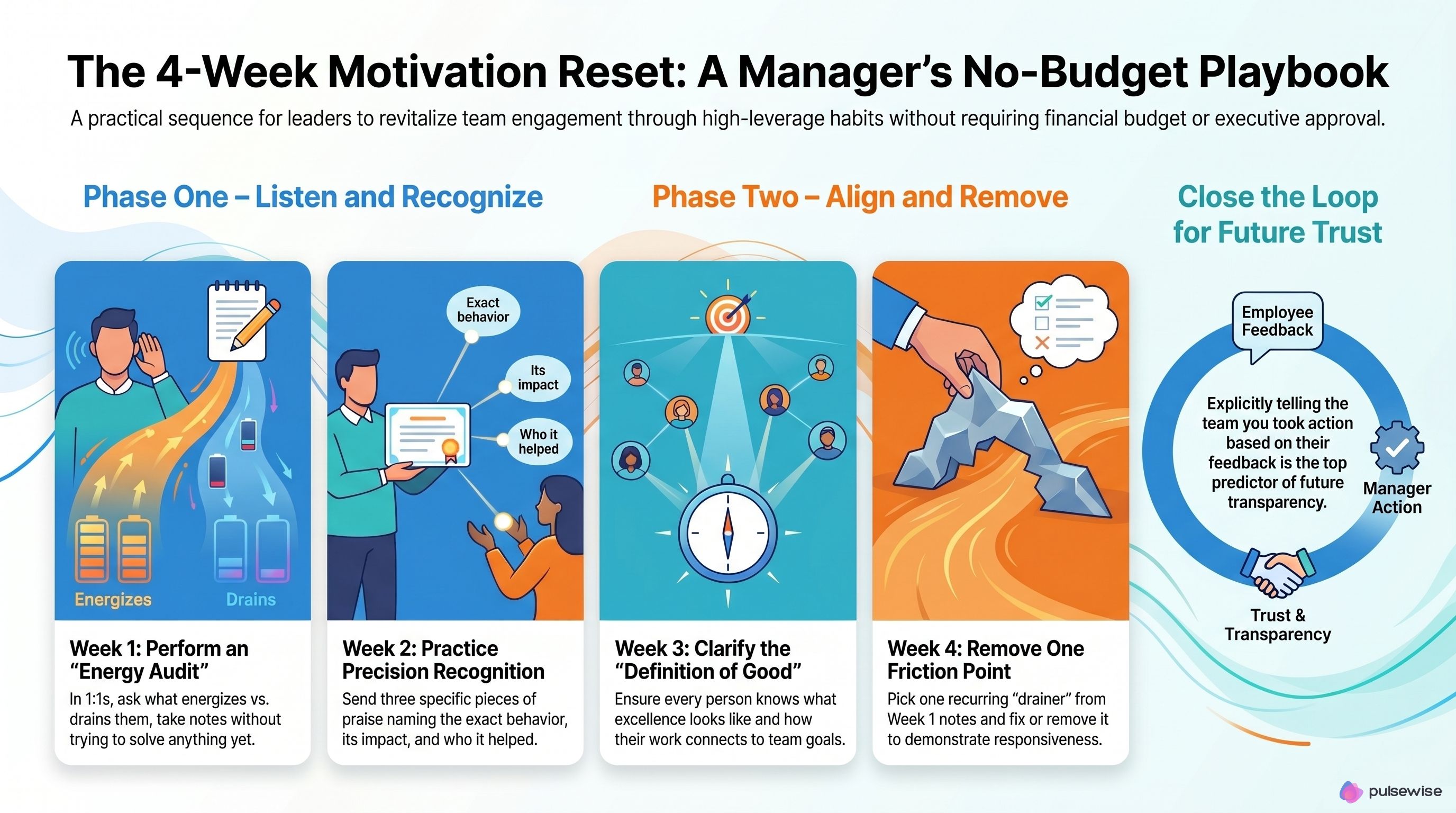
A no-budget playbook any manager can run. The closing loop, telling the team you acted on their feedback, is the part most leaders skip and the part that builds the most trust.
Final Thoughts
Employee motivation is not a soft topic. It is the operational layer that sits underneath every metric you care about: retention and productivity first, then quality, customer experience, and innovation downstream. When motivation drops, every other number eventually follows. When it rises, the same pattern holds in reverse.
The leaders who get this right do not run motivation programs. They build motivation habits, into 1:1s, into goal-setting, into recognition, into how they listen and respond. That work is unglamorous, but it compounds. And it starts with the next conversation you have today, not next quarter.
FAQs
What is the difference between employee motivation and employee engagement?
Motivation is the internal and external drive that determines how much effort someone is willing to put into their work. Engagement is the broader, longer-term emotional commitment to the organization and its mission. You can be motivated for a single project but disengaged from the company overall, or deeply engaged but temporarily unmotivated due to burnout or a bad manager. Both matter, and both need to be measured separately.
What are the most common signs an employee is losing motivation?
The earliest signs are subtle: shorter answers in 1:1s, less initiative on new ideas, finishing work on time but never beyond it, fewer questions asked in meetings, and a slow withdrawal from optional team interactions. The visible signs (missed deadlines, complaints, resignation) usually come months after the early signals. This is why continuous listening matters more than annual surveys.
How do you motivate employees without offering more money?
Pay needs to be fair, but beyond fairness, money is a weak long-term motivator. The strongest non-financial motivators are specific recognition, autonomy in how work gets done, visible progress on meaningful goals, growth opportunities, and a manager who listens. A weekly 1:1 done well costs nothing and consistently outperforms most perks programs.
How does recognition impact employee motivation?
Recognition reinforces the behaviors you want to see more of, validates effort that would otherwise feel invisible, and signals to the employee that they matter. Research from O.C. Tanner’s 2025 Global Culture Report shows that employees who give and receive recognition regularly report significantly lower rates of burnout, anxiety, and depression. The key is that recognition has to be specific, frequent, and tied to actual behavior, not generic praise.
Can goals demotivate employees?
Yes, easily. Goals demotivate when they are imposed without context, when progress is invisible, when they feel impossible to reach, or when they are set once and never revisited. Goals motivate when they are clear, connected to something the employee cares about, broken into visible milestones, and discussed often enough to stay relevant. The goal itself is rarely the problem. The system around the goal usually is.
How often should managers check in on employee motivation?
Continuously, in small ways, rather than annually in big surveys. A weekly or biweekly 1:1, a monthly pulse on how the work feels, and a quarterly conversation about goals and growth is a strong baseline rhythm. The exact cadence matters less than the consistency. People experience work daily, so listening that only happens once a year will always be too late to act on.