How to Build a Culture of Continuous Feedback (Without Creating More Noise)
TL;DR
- A continuous feedback culture is a team habit, not an HR policy. You build it weekly, in small moments, or you don’t build it at all.
- Four behaviors carry most of the weight: keeping feedback small and specific, writing it down the day it happens, making upward feedback safe, and closing the loop so people can see their input actually changed something.
- To start this week, all you really need is a protected 1:1 slot, one recurring question, and the discipline to jot notes the same afternoon.
- Regional context matters more than people admit. A team in Austin runs this differently from a team in Pune or Paris, and the French “right to disconnect” alone reshapes the cadence.
Think about the last performance review you attended where a manager raised an issue from six months ago. The person hearing it is doing the math in real time. This has been sitting in her head since October, nobody told me, and now it’s tied to my rating. The meeting is technically about improvement but feels a lot more like an ambush, which is how most people remember those conversations.
That moment, not an engagement report or a McKinsey chart, is usually what pushes a team toward continuous feedback. Someone walks out of a review gone sideways, and the whole leadership group decides they can’t keep running it this way.
So this piece is about what replaces that moment. Less theory, more practice: what continuous feedback looks like on an ordinary Wednesday, how different teams run it in different parts of the world, where the habit tends to break, and a playbook small enough that you can actually try it next week.
Why annual feedback stopped matching how teams actually work
Think about how work actually moves now. A designer ships three iterations in a week, an engineer opens four PRs, a CSM juggles seventeen customer conversations across two continents, and a marketer runs a campaign with a full life cycle inside nine days. Against that pace, a once-a-year feedback conversation is basically pretending to summarize a year of decisions it barely watched in the first place.
The continuous feedback argument isn’t really about philosophy. It’s operational. If the work is weekly, the feedback has to move at that speed too, or it stops telling the truth about what’s happening on the team. Long-running research from Josh Bersin, Gartner, and Deloitte has said the same thing for a decade, though most managers recognize it in their own calendar before they ever read the studies.
There’s a second shift, harder to measure but easy to feel. In teams where feedback happens rarely, the manager turns into a kind of sealed envelope. Nobody is quite sure what’s in there, which means every 1:1 carries a small dose of unspoken anxiety. In teams where feedback is weekly, the envelope stays open, there are no secrets building up for later, and hard conversations lose most of the heat they usually arrive with.

What continuous feedback actually is (in plain words)
Continuous feedback is the practice of giving and receiving small, specific, timely observations about work on an ongoing basis, rather than saving them for a formal review. It covers recognition, course correction, and upward feedback from report to manager. The point isn’t to produce more feedback overall, it’s to make the signal closer to real time so people can adjust while the work is still fresh in their hands.
A few misreadings are worth clearing up, because they trip almost every team.
The first is that continuous feedback is constant criticism. It isn’t. Teams that try to make every Monday a small reckoning burn out inside a quarter. What actually sustains the habit is that most of what gets said in the course of a week is small, specific, and fairly often positive.
The second is that it’s a software feature. You can buy tools to make the habit easier to run, but none of them will generate the habit for a manager who wasn’t going to practice it anyway.
The third is that it kills the performance review. It doesn’t. It changes what the review is for. Instead of being a high-stakes event where news gets delivered, the review becomes a calmer synthesis conversation where nothing in it comes as a surprise to anyone.
If you want one sentence to carry with you: continuous feedback is a rhythm a team learns, not a rollout HR runs.
The four things that hold a continuous feedback culture together
Across enough team rollouts, four behaviors show up in every culture that actually sustained the habit. If you drop any one of them, the whole thing tends to feel forced by the third month.

1. Keep feedback small, specific, and concrete
Vague feedback ends up worse than no feedback at all. “You’re doing great” and “you need to step up” both leave the person on the other end guessing about what you actually mean, and guessing tends to calcify into resentment faster than most managers realize. The move that works is tying every observation to a specific behavior and its specific effect.
Say the difference out loud and you’ll hear it. “Good job this week” barely registers. “In yesterday’s standup, you unblocked Priya in about thirty seconds by pulling up the shared doc, and the whole sprint moved faster because of it” is a completely different kind of sentence to receive.
Frequency is the other half. Once a week is the cadence most manager-report pairs can sustain without it feeling like theater. Daily feedback tends to come across as surveillance to the person on the receiving end, and quarterly isn’t really continuous feedback at all, it’s a mini-review in a different costume.
2. Write it down the same day
This is the ingredient most teams skip, and it ends up being the single thing that decides whether any of this compounds over a quarter or just fades away. Informal feedback culture sounds fine on paper, until a manager reaches the end of the week and realizes that half of what they meant to say lived in their head for twelve hours and then evaporated into Slack threads that no one will read again.
Your capture surface doesn’t need to be fancy. Plenty of good teams run on a shared 1:1 doc, and plenty of others use a notes app or a lightweight tool their team already opens. What matters is that observations get written down the day they happen, not reassembled from memory the week before a review cycle.
This is the point where a product like Pulsewise’s AI Daily Feedback earns its place in a manager’s workflow. A manager types a couple of scrappy lines about a tough meeting or a good handoff, and the system sorts what’s been written into dimensions like morale, teamwork, psychological safety, and L&D in the background. Ten weeks of that accumulation turns “I think things are mostly fine” into a trail of evidence you can actually point at when you need to.
3. Make it safe to push back upward
This is where most feedback cultures break, often without anyone naming it as the failure mode. Downward feedback is the easy direction because the power dynamic carries it. What actually distinguishes a real feedback culture from a performative one is how the upward direction feels, and most orgs avoid that measurement entirely.
The simplest manager habit that shifts this: in every 1:1, ask some version of “What’s one thing I could do differently that would make your week easier?” Then, and this is the part almost everyone skips, act on one of the things they mention. Once is enough. A single visible response does more for psychological safety than any training session.
Amy Edmondson’s 1999 study in Administrative Science Quarterly on team learning behavior made the point that still anchors the field: teams where people feel safe to speak up learn faster and outperform teams where they don’t, across almost every metric worth measuring. The leaders who generate that safety tend to be the ones who visibly invite criticism of themselves, and then let everyone see that it cost them nothing to hear it.
4. Close the loop, visibly
Feedback that disappears into a void teaches people not to offer it next time. What closes the loop is the receiver actually doing something with what they heard, or, if they decide not to act on it, explaining why. Either answer is acceptable. Silence is how feedback cultures die, usually without anybody realizing it’s happening.
The same principle applies a level up, to pulse surveys and engagement check-ins. When employees fill out a survey and nothing visible changes by the next quarter, response rates drop and the real feedback migrates to Glassdoor, LinkedIn comments, and the WhatsApp group chat nobody from HR is invited to. But when an HR team publishes a short note saying “here’s what we heard, here’s what we’re changing, here’s what we decided not to change and why,” the trust compounds over cycles in a way that’s hard to buy any other way.
How this actually runs in different regions
Continuous feedback tends to look a little different depending on where the team sits, even when the underlying rhythm stays the same. Here’s how it typically plays out across the three regions most of our readers operate in.
Inside a US team
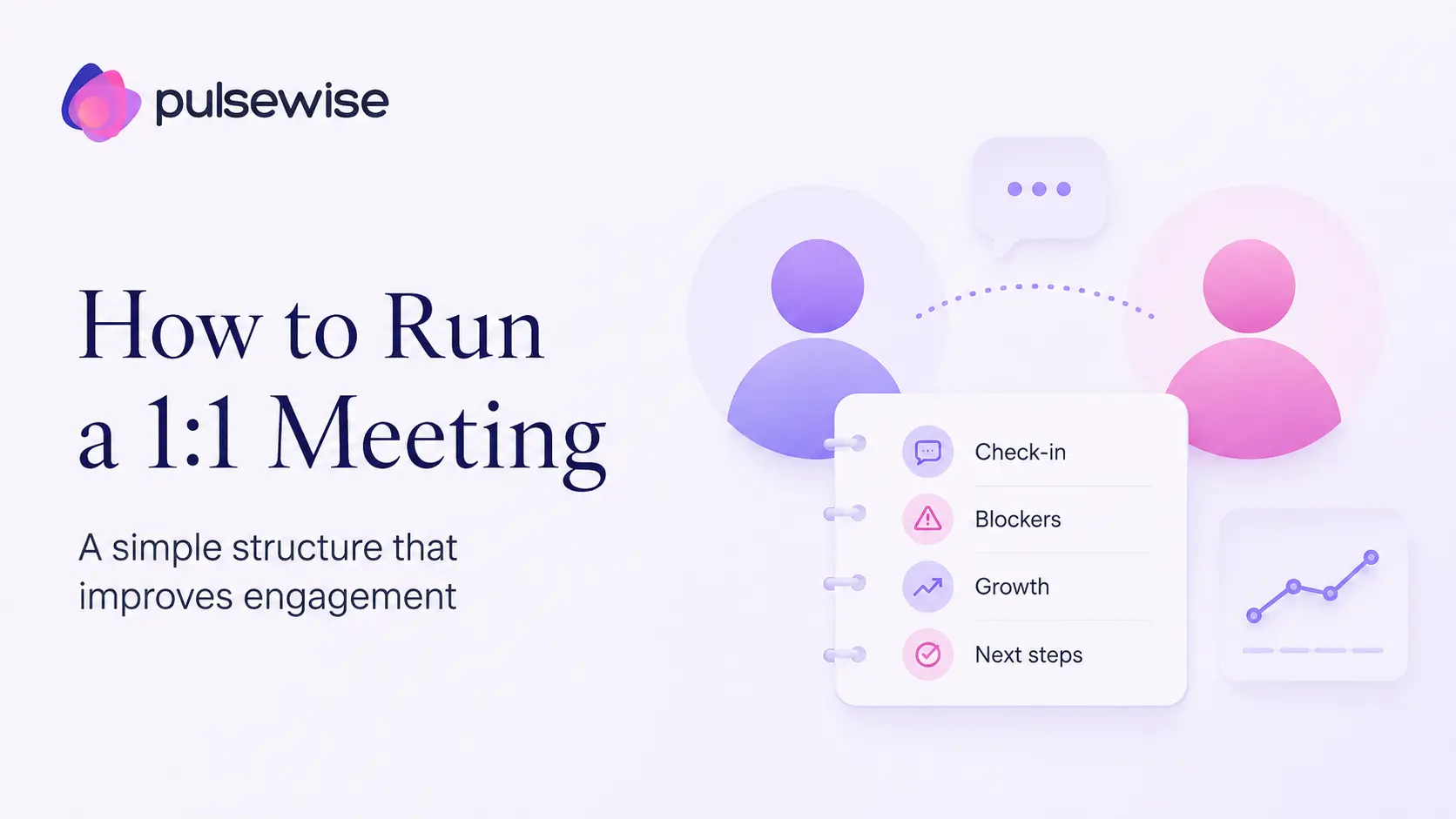
American workplaces lean toward direct, verbal feedback, and the weekly 1:1 usually reflects that. Thirty minutes, on the calendar, treated as a working conversation more than a formal check-in. The manager surfaces one thing going well and one thing worth refining, the report brings one blocker and one ask, and by the end of the meeting both sides walk away with a concrete update to the shared notes doc.
The consistent mistake US managers make is treating every piece of feedback as an evaluation. A weekly cadence can’t really sustain that emotional weight, because after six weeks the report stops hearing coaching and starts hearing ratings. “Here’s a behavior I noticed and its effect” lands very differently from “here’s my read on your performance.” Research out of SHRM and the quit-rate patterns tracked in BLS JOLTS data keep circling back to the same finding, which is that the manager relationship outweighs almost every other variable when it comes to retention. Feedback is the surface layer of that relationship.
Inside an Indian team
Indian knowledge work moves fast, often across wider spans of control than you’d see in the US or Europe, and it still carries a long shadow from the annual ratings culture that tied performance scores directly to compensation for most of the last two decades. Continuous feedback in an Indian context ends up doing two jobs at once. It has to lower the stakes of what used to be a once-a-year event, and it has to move development conversations earlier so that strong under-35 talent doesn’t drift into the interview market when nobody’s looking.
What works in practice is short, structured 1:1s with a written agenda. Long unstructured catch-ups lose definition in the middle of a busy week. A 25-minute meeting split into three fixed sections (this week’s wins, this week’s blockers, one upward note) reliably outperforms an open 60-minute slot.
The regional data points the same way. Great Place to Work India’s high-trust companies run weekly or biweekly feedback rituals as a near-universal trait, and NASSCOM’s workforce research keeps surfacing feedback frequency as one of the better predictors of retention in Indian IT and services. The Deloitte India Human Capital Trends edition has a particularly useful finding: Indian employees under 35 rate ongoing development feedback above compensation conversations when it comes to engagement. If you miss that signal, you end up paying more than you need to and still losing good people.
Inside a French team
France is the most interesting of the three cases, because the law itself shapes the feedback rhythm. The “droit à la déconnexion” (right to disconnect), enforceable since the 2017 El Khomri law, means continuous feedback has to live inside contracted hours. A manager who tries to run feedback through Slack pings at 9 pm is effectively building a culture French employees are legally entitled to ignore.
That constraint, somewhat counterintuitively, tends to make French feedback culture sharper rather than weaker. It forces the ritual into the workday, which forces structure onto it: a weekly 1:1, a short written note closed out by end of day, and a clean boundary at the end of the week. The channel is narrow on purpose, and the signal stays high because of it.
Published French research supports the direction. ANACT, the national agency for workplace conditions, has written extensively on how structured in-hours feedback rituals correlate with lower burnout and higher reported quality of work life. DARES, the research arm of the French Ministry of Labor, tracks working-conditions survey data pointing to the same conclusion: employees who report regular conversations with their manager about the work itself report better wellbeing outcomes overall.
The practical takeaway for French teams is simple enough: build the feedback habit inside the week, protect the boundary at the end of it, and the culture ends up working with the legal framework instead of fighting it.
A five-step playbook to run this week
If you’re a manager or HR lead reading all this and thinking “fine, but what do I do Monday morning?”, here’s the smallest version of the habit that actually produces something.
- Pick one cadence and defend it. A thirty-minute weekly 1:1 on the calendar, treated as non-negotiable. The most common failure mode isn’t bad feedback, it’s meetings getting moved so often that the rhythm never forms in the first place.
- Add one recurring question. Every 1:1, ask some version of “What’s one thing that got in your way this week I could help remove?” The exact wording doesn’t matter as much as the consistency. One question, every time, opens a reliable window for small feedback in both directions.
- Write it down the same day. Use whatever surface your team already opens, whether that’s a shared doc, a 1:1 board, or a dedicated platform. The important part is continuity of capture, not picking the perfect tool.
- Name one win and one opportunity per person, per week, out loud. This one forces you to actually observe your team’s work instead of just tracking deliverables, which is a much harder thing to do at most companies than people admit.
- Share a monthly team-level summary. A short note, maybe three sentences: what’s trending well, what pattern you’re keeping an eye on, and what you’re personally changing as a manager based on what you’ve heard. That small public loop does half the culture work for you by itself.
None of this will give you a world-class feedback culture in thirty days. A working one takes about ninety, which is roughly the amount of time new habits need to hold up under stress.
Annual review vs. continuous feedback, side by side
| Dimension | Annual Review | Continuous Feedback |
|---|---|---|
| Cadence | Once or twice a year | Weekly or biweekly |
| Primary purpose | Assess and rate | Adjust and coach |
| Emotional tone | High stakes, often anxious | Low stakes, habitual |
| Manager prep | Heavy, saved for the event | Light, distributed across weeks |
| Surprises | Common | Rare, by design |
| Upward feedback | Usually absent | Built into the rhythm |
| Decision-grade evidence | Memory-driven | Note-driven, accumulated |
| Connection to pay | Direct, in one conversation | Indirect, through cycles |
Where teams usually lose the thread
A handful of failure patterns come up in almost every rollout that eventually stalls.
The platform trap. A company buys a continuous feedback tool, sends a launch email, schedules one training session, and then waits for the culture to organically arrive. It almost never does. Tools amplify behavior that already exists, they don’t manufacture it from scratch, and if managers weren’t giving feedback in any consistent way before the platform showed up, the platform tends to sit mostly empty inside three weeks.
The too-much-too-fast trap. Leadership announces that starting next quarter, every employee will give and receive feedback weekly across seven dimensions, with 360s every quarter and a revised rating rubric, and the complexity kills the habit before it has a chance to form. It’s almost always smarter to pick one behavior, let that behavior stabilize for a quarter, and only then add a second one.
The one-way-street trap. Managers give feedback, employees receive it, and over a few months that hardens into something that starts to feel more like surveillance than coaching. Employees learn to perform around it, which is worse than having no system at all. The fix is making upward feedback equally normal, and the signal to the rest of the org comes from leaders who publicly accept criticism of their own work and then act on some of it.
The deeper version of all three failures is that feedback is less a process you implement and more a relationship output. If the relationship between a manager and a report is already weak, no process on earth is going to rescue it, and this is close to the core belief Pulsewise was built around: people experience work daily, not annually, which means the support around them has to operate at that cadence rather than trail behind it by six months.
One ordinary week inside a team that’s doing this well
Imagine a twelve-person product team split between Bengaluru and Austin, a setup that’s fairly common at scaling tech companies these days. Here’s what one unremarkable week looks like when the habit is working.
On Monday morning, the team lead drops a two-line Slack note to an engineer: “The way you rewrote that incident postmortem yesterday made the lessons actually usable, can you share the template with the rest of the team?” She also adds a one-line note in the shared 1:1 doc so it’ll still be there when review time comes around.
By Tuesday, a designer has told his skip-level in their regular 1:1 that the new feedback rhythm feels a bit performative to him, especially the weekly win-and-opportunity structure, which he doesn’t think maps cleanly onto design work. The skip-level doesn’t get defensive about the process she rolled out. She thanks him for naming it, says she’ll think about it, and asks what version would feel more useful.
On Wednesday, an engineer tells her manager that the rollout deadline set the previous week feels unrealistic, and walks through the reasons in some detail. The manager writes down the concern, thanks her for raising it early rather than at the last minute, and says she’ll come back Friday once she’s had a chance to think.
Friday brings two quiet wins. The manager comes back as promised, extends the deadline by four days, explains the tradeoff, and mentions what was raised in the team standup so the rest of the team sees that concerns get taken seriously around here. Meanwhile, the skip-level adjusts the design team’s 1:1 template to a simpler one-question version and names the designer in the team Slack channel when she announces the change.
By the end of the week, three small loops have closed visibly. Nothing about it is dramatic, there’s no new HR process in play, and nobody had to fill out a form anywhere. What it took was a manager with a simple structure, a small amount of courage, and the working assumption that feedback is a thing you do in the work itself, not a program you run alongside it.
Final Thoughts
A continuous feedback culture doesn’t really get built by announcement. It gets built one 1:1, one kudos, one uncomfortable upward comment at a time, usually over the course of several months, and usually before anybody notices a cultural shift has happened. The teams that end up with a real one tend to share a fairly quiet kind of discipline around it, which is that they treat feedback as part of weekly management rather than as an HR event that happens on a schedule.
If you want to walk away with one practical question, try this one the next time you sit down with someone on your team: what’s the single observation I could share right now that this person would most benefit from hearing while the context is still fresh? Start there, ask it consistently enough that it becomes a reflex, and most of the culture you’re aiming for will end up building itself around that habit.
Related Reading
- Employee Engagement: A Master Guide
- How to Mitigate Bias in Performance Reviews: A Complete Guide
- A Guide to the 360 Review Process in Your Organization
FAQs
What is continuous feedback in simple terms?
Continuous feedback is the practice of giving and receiving small, specific, and timely observations about work on a regular basis, usually weekly, rather than waiting for a formal review. It includes praise, course correction, and upward feedback from employees to their managers.
How is continuous feedback different from a performance review?
A performance review is a scheduled, formal assessment, usually once or twice a year, that summarizes performance and often ties to pay or promotion. Continuous feedback happens in between, in the flow of work. Done well, it makes the review feel almost boring because nothing in it is a surprise.
How often should managers give continuous feedback?
For most teams, once a week is the sweet spot. A weekly 1:1 plus a short recognition or course-correcting comment in between is enough to keep the loop tight without becoming performative. Daily tends to feel like micromanagement. Quarterly is too far apart to change behavior while the work is still fresh.
What are some examples of continuous feedback?
Examples include telling a teammate in the next standup that their walkthrough helped you unblock a bug, sending a kudos in Slack the same day someone helps a customer, flagging a missed commitment in a 1:1 while it’s still recent, and asking a report in every 1:1 what you could do differently as a manager to make their week easier.
Does continuous feedback replace performance reviews?
No. It changes what reviews are for. The review becomes a synthesis conversation. You look at patterns over six or twelve months, decide on development moves, and align on expectations for the next cycle. The raw material comes from the continuous feedback that happened week by week.
How do you make continuous feedback feel safe?
Two things matter most. First, keep feedback small and specific instead of sweeping and evaluative. Second, make upward feedback normal by inviting it every week and visibly acting on it sometimes. Safety is built by evidence, not by announcements.
Is continuous feedback legal to run in France with the right to disconnect?
Yes. Continuous feedback should stay inside contracted hours in France. Asynchronous pings outside work hours are discouraged by the droit à la déconnexion. Structured in-hours rituals align cleanly with French labor law.