How to Improve Employee Engagement: 15 Proven Strategies That Actually Work

TL;DR
- Global employee engagement dropped to 21% in 2024, costing the world economy $438 billion in lost productivity - and Europe sits at just 13%.
- The biggest engagement lever isn’t perks or pay raises. It’s the quality and frequency of manager-to-employee interaction.
- Recognition, continuous feedback, and visible goal progress are the three highest-impact areas most organisations still underinvest in.
- You don’t need a six-month transformation plan. Start with one weekly habit change per manager and build from there.
Employee engagement refers to the level of emotional commitment, motivation, and connection a person feels toward their work and organisation. When engagement is high, people bring discretionary effort. When it drops, productivity falls, turnover rises, and culture quietly erodes. Understanding how to improve employee engagement has become one of the most pressing challenges for HR leaders across Europe and the US.
You have probably seen the latest numbers. Gallup’s 2025 State of the Global Workplace report showed global engagement falling to 21%, down from 23% the year before. In Europe, the picture looks worse - just 13% of employees are engaged. In the UK specifically, that number sits around 10%, which puts it near the bottom of the continent.
Those numbers aren’t just survey results. They translate to real losses. The UK alone loses over £257 billion annually to disengagement. McKinsey estimates that for a median S&P 500 company, the combined cost of disengagement and attrition runs between $228 million and $355 million per year.
So if you are an HR leader reading this, the question isn’t whether workplace engagement matters. The real question is how to boost employee engagement in a way that produces real, measurable shifts - not just a temporary bump after an all-hands meeting. This guide walks you through 15 employee engagement strategies that have evidence behind them and can be put into practice without waiting for next year’s budget cycle.
Why Do Most Employee Engagement Efforts Fall Short?
Before jumping into the strategies, it helps to understand why so many engagement programmes fail. The pattern almost always looks the same. An annual survey goes out, results come back, a task force forms, initiatives launch, and six months later everything has quietly returned to the status quo.
The core problem is timing. Most organisations treat engagement like a yearly health check when it actually operates more like a daily vital sign. By the time you spot a problem in an annual survey, three good people have already left and two more are interviewing elsewhere. The data is real, but stale.
The second issue comes down to ownership. Engagement often gets treated as an HR project when it’s fundamentally about management behaviour. Gallup’s research consistently shows that 70% of the variance in team engagement comes down to the manager. Not the CEO’s vision statement. Not the office snack wall. The manager.
And that’s the gap Pulsewise was designed to close. The platform runs on a simple belief - people don’t experience work annually, they experience it daily. So measurement and support need to match that rhythm, not lag behind it by six months.
The 15 Strategies: How to Improve Employee Engagement Starting This Week
1. Replace your annual survey with continuous pulse checks
Annual surveys are better than nothing, but they give you a rearview mirror when you need a windscreen. Short, frequent pulse surveys - weekly or fortnightly - capture shifts in mood and satisfaction while there’s still time to act.
Keep them short. Three to five questions maximum. If a pulse survey takes more than 90 seconds, completion rates drop sharply. Focus each round on a specific dimension, rotating through psychological safety, workload, and team collaboration.
2. Reshape your one-on-ones from status updates to real conversations
Most managers either skip one-on-ones entirely or turn them into project check-ins. Neither approach moves the needle on engagement. The one-on-one is the single most important 30 minutes a manager has each week, and it should focus on three things - how the person is doing, what’s blocking them, and what support they need.
A simple reframe helps here. Instead of “What are you working on?” try “What’s one thing getting in your way this week that I could help remove?” Most managers never ask this. The answers will surprise you.
3. Make recognition frequent, specific, and visible
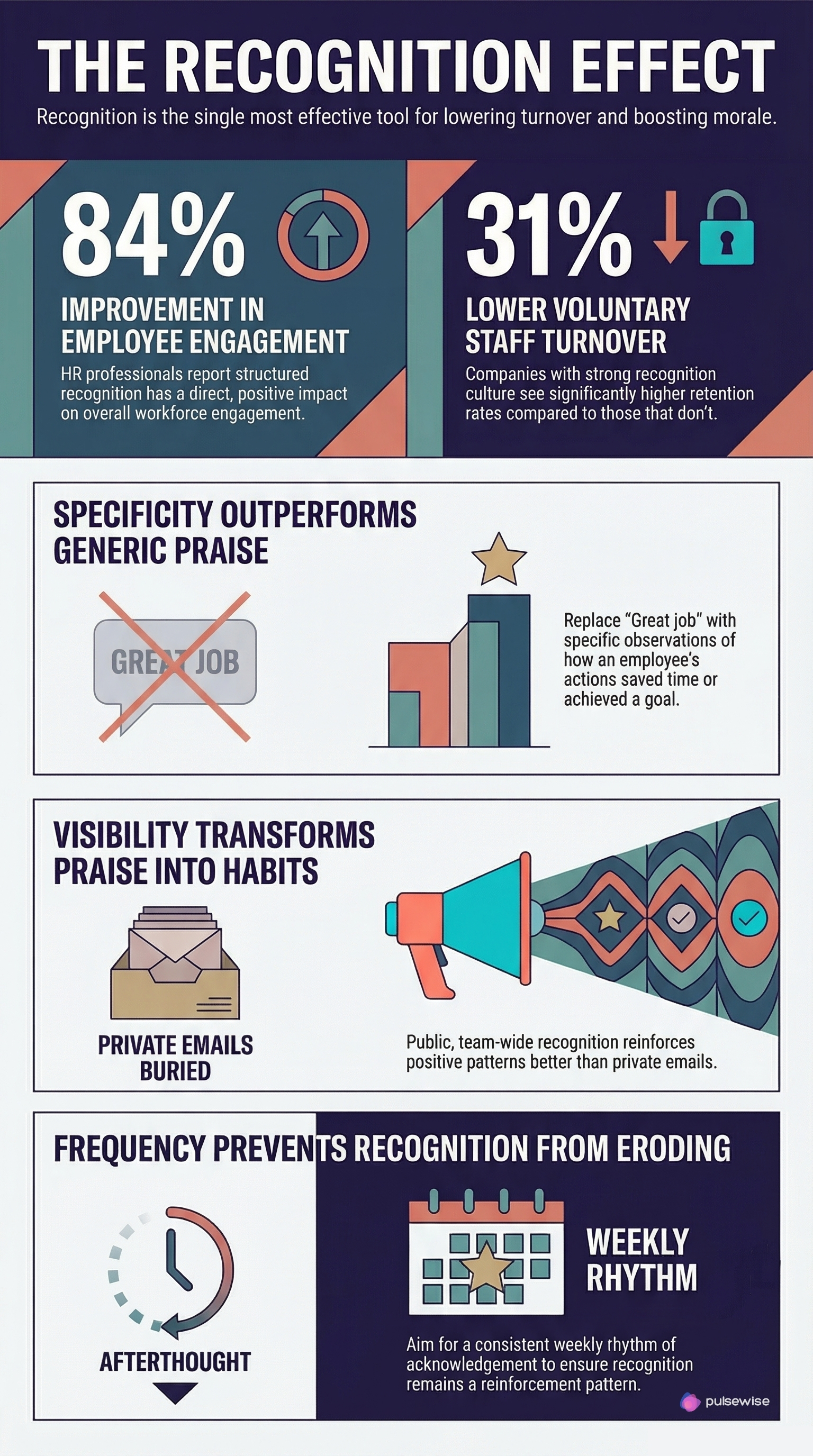
SHRM research shows that 84% of HR professionals report recognition programmes positively impact engagement, and companies with strong recognition cultures see 31% lower voluntary turnover. But most recognition still happens informally, inconsistently, and privately.
What works better is structured praise that doesn’t feel bureaucratic. Say something specific - “Your client proposal saved us two weeks of back-and-forth because you anticipated their objections” rather than “Great job”. Make it visible to the team rather than buried in a private email. And make it consistent enough to become a habit, not an afterthought.
Tools like Pulsewise’s Kudos and Recognition system support this by structuring recognition with AI-generated taglines and trait tagging, while integrating directly with Slack so that praise happens where work already happens. Recognition becomes a reinforcement pattern rather than a random event.
4. Connect every employee’s work to a visible outcome
When someone can’t see how their daily tasks contribute to anything larger, motivation erodes. I’m not talking about mission statements or corporate values posters here. I mean showing a direct line between what a person does each day and a result that matters.
The practical version of this comes down to goal transparency. When goals are nested - individual milestones rolling up into team objectives, team objectives rolling up into company priorities - people can see the connection. When progress gets updated regularly, momentum builds naturally.
5. Fix the feedback loop before it damages trust
The worst thing about annual reviews isn’t that they happen once a year. It’s that people receive corrective feedback months after the behaviour occurred, turning the conversation into an ambush rather than coaching.
Continuous feedback doesn’t mean constant criticism. It means short, timely observations shared close to the moment. “I noticed you handled that difficult client call really well today” hits differently on Tuesday afternoon than in a December review form. Similarly, “The report was missing the regional breakdown - can we add that before it goes out?” works as a five-minute redirect, not a performance issue.
6. Give managers real-time nudges, not just dashboards
Here’s the thing about data. Most managers don’t have time to sit with dashboards. They’re running meetings, putting out fires, and trying to hit their own targets. What they actually need is a well-timed nudge.
Pulsewise’s One-on-One Board with AI-suggested next actions does exactly this. It analyses each employee’s recent mood trends, feedback patterns, and goal progress, then surfaces a specific prompt before the manager’s next one-on-one. Something like “Mood trend has dropped over the past two weeks. Consider opening with a wellbeing check.” That kind of nudge costs nothing to act on, but it changes the entire tone of the conversation.
7. Treat psychological safety as a daily practice
Google’s Project Aristotle found that psychological safety was the single strongest predictor of team performance. When people feel safe to speak up, admit mistakes, and ask questions without fear, everything else improves - innovation, collaboration, problem-solving.
Building psychological safety isn’t a one-off workshop. It’s a set of daily behaviours. Admitting what you don’t know. Responding to bad news with curiosity instead of blame. Explicitly inviting dissenting opinions in meetings. As an HR leader, you build this by coaching managers to model these behaviours and by measuring whether people actually feel safe - not just assuming they do.
8. Fund manager capability, not just manager responsibility
Gallup’s 2025 data revealed a sharp drop in manager engagement - from 30% to 27% - with young managers and female managers hit hardest. When managers are burned out and unsupported, asking them to drive employee motivation is like asking someone who’s drowning to teach swimming.
Practical manager support looks like reducing meeting load so they have time to actually manage. It means providing structured coaching frameworks rather than vague advice to “be a better listener”. And it means giving them tools that reduce administrative burden. Every hour a manager spends compiling reports is an hour not spent with their people.
9. Design onboarding around belonging, not paperwork
Most onboarding programmes focus on compliance - paperwork, policies, system logins. By the end of week one, a new hire has signed twelve documents and met nobody who actually does the work they’ll be doing.
The engagement window in the first 90 days is enormous and most organisations waste it. Pair new hires with a peer buddy (not their manager), schedule informal coffee chats with team members in week one, and set a clear 30-60-90 day expectation framework. By day 30, every new employee should be able to answer two questions confidently - “I know what’s expected of me” and “I know who to ask when I’m stuck.”
10. Open up career visibility
Career conversations are one of the top drivers of engagement, and also one of the most neglected. In many organisations, the only career conversation happens during the annual review, and it often boils down to “Where do you see yourself in five years?” - a question most people honestly can’t answer.
A better approach is to help managers map skills to opportunities, hold quarterly conversations about growth interests, and be honest about what paths are realistic. Sometimes the most engaging thing you can say is “Here’s exactly what it would take to get to the next level, and here’s where you are today.”
11. Approach hybrid work as a design choice
McKinsey’s research shows that high performers are more likely to thrive in hybrid and remote environments, with 78% of employees reporting better mental health and higher engagement when given flexible work options. Yet many organisations still treat remote work as a concession rather than a strategy.
For European and US companies with distributed teams, the engagement risk isn’t remote work itself. It’s the lack of intentional connection. Structured virtual touchpoints, asynchronous feedback channels that work across time zones, and deliberate inclusion of remote employees in recognition moments all make a real difference. Without these, your distributed team members become invisible and eventually disengaged.
12. Run stay interviews before you need exit interviews
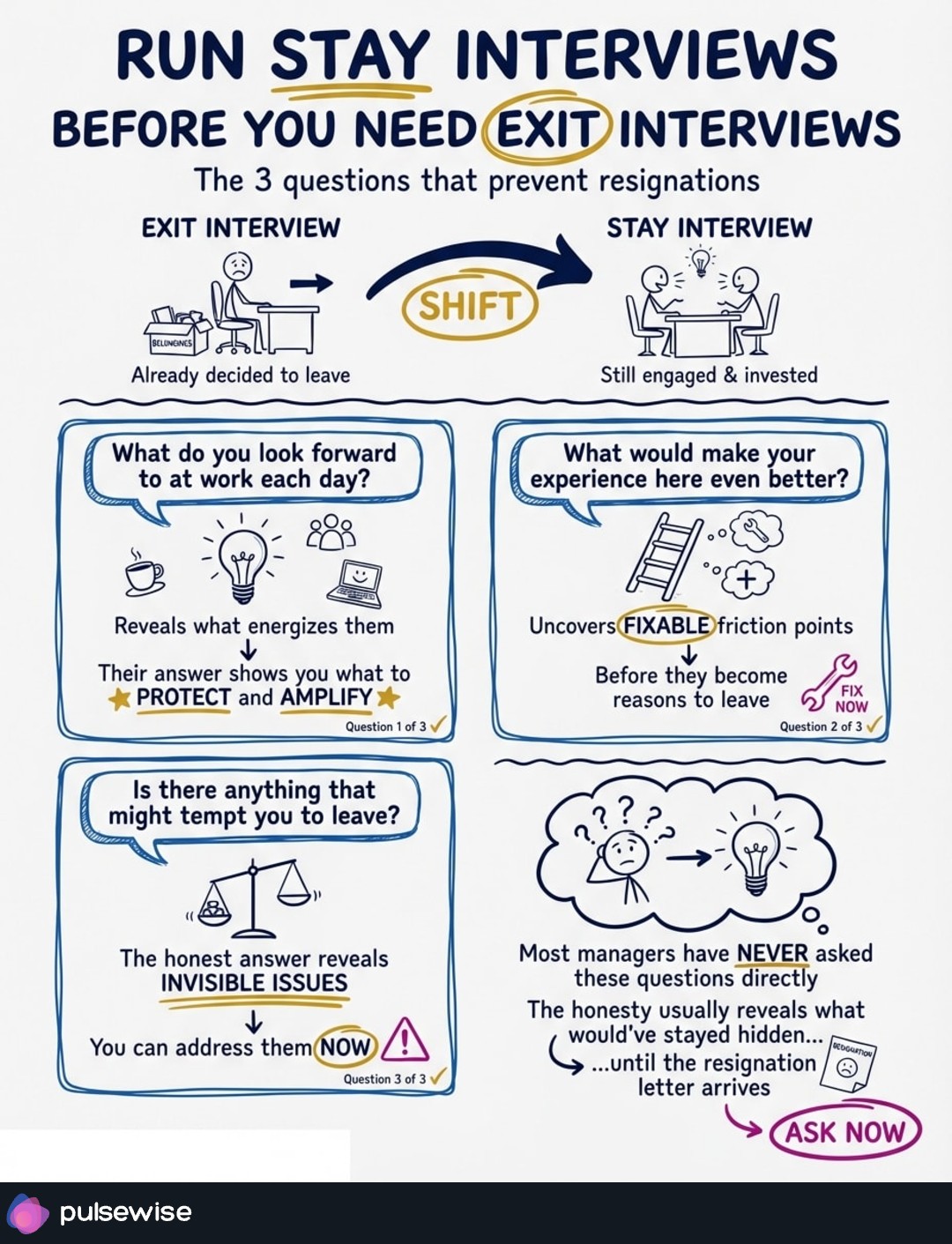
By the time someone sits in an exit interview, they’ve already decided to leave. Stay interviews flip the script by asking engaged, high-performing employees what keeps them and what might cause them to consider leaving.
Three questions usually cover it. “What do you look forward to at work each day?” Then, “What would make your experience here even better?” And finally, “Is there anything that might tempt you to leave?” Most managers have never asked these questions directly. The honesty of the answers often reveals fixable issues that would otherwise remain invisible until a resignation letter arrives.
13. Audit your meeting culture ruthlessly
Meeting overload is one of the most under-discussed engagement killers out there. When someone spends six hours a day in meetings, they aren’t doing their actual work, which means they’re doing it in the evenings and on weekends. That’s a direct path to burnout.
Run a simple audit. Ask every team to log their meetings for two weeks and answer three questions. Was this meeting necessary? Could it have been an email or a Slack message? Were the right people in the room? Most organisations find that 30-40% of meetings can be eliminated or shortened without any negative impact.
14. Close the action gap after every survey
Nothing kills engagement survey credibility faster than collecting feedback and doing nothing visible with it. If you run a pulse survey and the results show a concern, communicate what you heard and what you’re doing about it - even if the answer is “We heard this, we’re looking into it, and here’s the timeline.”
This close-the-loop discipline separates organisations that use surveys as a listening tool from those that treat them as a checkbox exercise. The act of responding to feedback is itself an engagement driver, and one that too many teams overlook.
15. Break engagement into the dimensions that actually matter
Engagement isn’t one number. It’s a composite of psychological safety, autonomy, recognition, growth, purpose, and workload sustainability. If you’re only tracking an overall “engagement score” you’re missing the signal in the noise.
Break your measurement into specific dimensions. Track them over time. Look for patterns by team, tenure cohort, and location. Your Berlin office and your Austin office may show completely different patterns because work culture, labour laws, and employee expectations vary significantly across regions. What drives engagement in Germany might be irrelevant in Texas, and vice versa.
What Are the Most Common Employee Engagement Blockers?
Blocker 1 - Leadership talks about engagement but doesn’t fund it. If engagement doesn’t have a line item, it doesn’t have priority. Gallup estimates that organisations matching best-practice engagement levels could add $9.6 trillion to the global economy. Build the business case with your own attrition costs and present it in financial terms, not HR terms.
Blocker 2 - Managers see engagement as extra work on top of their real job. This happens when engagement activities get layered on top of existing responsibilities instead of woven into them. Better one-on-ones, timely feedback, visible recognition - these aren’t additional tasks. They’re better versions of tasks that already exist.
Blocker 3 - Measurement happens but follow-through doesn’t. This failure mode hits organisations that have already invested in surveys. To solve this, assign owners to every insight, set follow-up timelines, and communicate progress back to employees. A survey without a response does more harm than no survey at all.
How Can You Start Improving Engagement This Week?
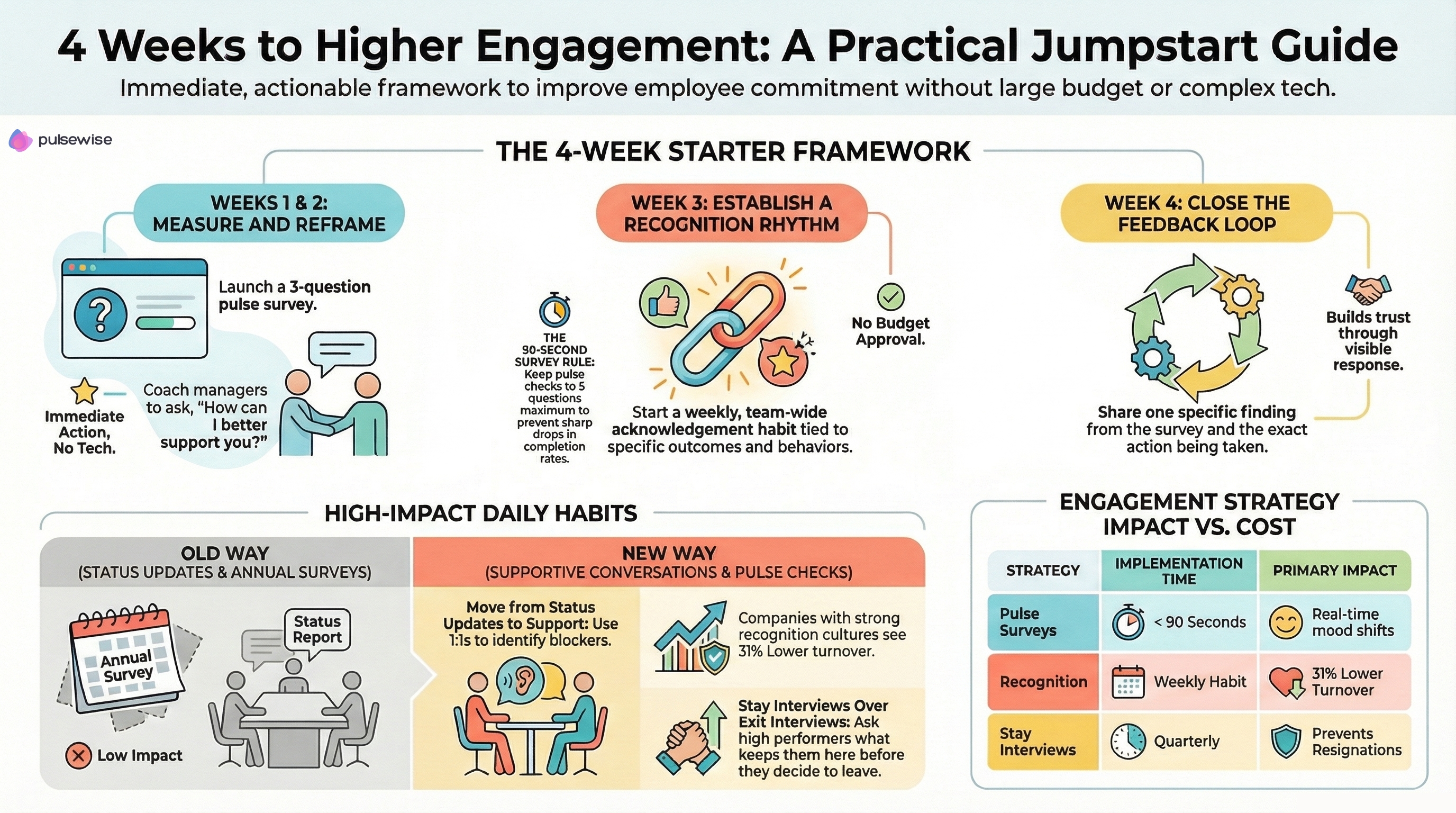
If you’re looking at this list and wondering where to begin, here’s a four-week starter framework.
Week 1 - Launch a three-question pulse survey to your most at-risk team (the one with the highest recent turnover or the lowest energy). Just measure. Don’t try to fix yet.
Week 2 - Coach five managers on a single one-on-one improvement. Give them one new question to ask their direct reports - “What’s one thing I could do differently to better support you?”
Week 3 - Start a visible recognition rhythm. One team-wide acknowledgement per week, tied to a specific behaviour or outcome. Keep it public.
Week 4 - Share what you heard from the pulse survey with the team. One finding, one action you’re taking. Close the loop.
That’s four weeks. No budget approval needed. No technology implementation required. Just better habits. And once those habits take root, a platform like Pulsewise can amplify them by connecting daily signals to real-time actions across your entire organisation.
Final Thoughts
How to increase employee engagement isn’t really a strategy question. It’s a behaviour question. The organisations that get this right aren’t the ones with the biggest budgets or the most sophisticated HR tech stacks. They’re the ones where managers have better conversations more often, where feedback flows in both directions, and where people feel seen in the small moments - not only during annual events.
Start small. Start this week. And measure what changes.
Frequently Asked Questions
What is employee engagement and why does it matter?
Employee engagement measures the emotional commitment, motivation, and connection a person feels toward their work and organisation. It matters because engaged employees are measurably more productive, stay longer, and contribute more to business outcomes. Gallup’s research links high engagement to significantly better profitability, lower absenteeism, and reduced turnover across industries.
How do you measure employee engagement effectively?
The most effective approach combines regular pulse surveys (weekly or fortnightly) with qualitative signals like one-on-one conversations and stay interviews. Measure across specific dimensions like psychological safety, recognition, growth, and workload rather than relying on a single engagement score. Break results down by team, location, and tenure to spot patterns that a company-wide average would hide.
What is the difference between employee engagement and employee satisfaction?
Satisfaction means someone is content with their conditions - pay, benefits, office environment. Engagement goes further and means someone is emotionally invested in their work and motivated to contribute beyond the minimum. A satisfied employee stays because it’s comfortable. An engaged employee stays because they care. You can have high satisfaction and low engagement at the same time which is why measuring both separately matters.
How long does it take to see improvement in employee engagement?
Behaviour-level changes like better one-on-ones and regular recognition can show measurable shifts in pulse survey scores within four to eight weeks. Structural changes like redesigning performance review cycles or building a feedback culture typically take three to six months to fully take root. Start with quick wins to build momentum and credibility before tackling larger systemic changes.
Why is employee engagement so low in Europe compared to the US?
Europe’s engagement figures (around 13% versus 31% in the US and Canada) reflect a combination of cultural, structural, and measurement factors. European work cultures often emphasise work-life boundaries more strongly, which can show as lower “emotional commitment” on surveys designed with US norms. Labour protections also mean dissatisfied employees may stay rather than leave, which inflates the disengaged population. That said, the gap represents a significant opportunity for European organisations willing to invest in daily feedback, recognition, and manager enablement.
What are the best employee engagement activities for remote teams?
Remote and hybrid teams benefit most from structured virtual one-on-ones, asynchronous recognition channels (Slack-based kudos, for example), regular pulse surveys that surface mood shifts early, and intentional social connection moments that don’t feel forced. The key for distributed teams is replacing the informal hallway interactions that office-based teams take for granted with deliberate, lightweight touchpoints that keep people visible and connected.
What causes low employee engagement in the workplace?
The most common root causes are poor manager relationships, lack of recognition, unclear expectations, limited growth opportunities, and feeling disconnected from the organisation’s purpose. Gallup’s research shows that 70% of the variance in team engagement traces back to the manager, making manager effectiveness the single most important factor to address.
How do you calculate the ROI of employee engagement programmes?
Start by quantifying your current cost of disengagement through three data points. Voluntary turnover cost (replacement typically runs 50-200% of annual salary), absenteeism rates (disengaged employees average significantly higher absence), and productivity differentials (Gallup’s meta-analysis links top-quartile engagement to 23% higher profitability). Compare these baseline costs against the investment in engagement initiatives to build a compelling business case.