Two vendors join the same discovery call and use employee experience and employee engagement interchangeably for approx forty minutes. Nobody stops to ask which one they mean. Six months later, you are holding a dashboard that went up and an attrition rate that did not move.
That is the practical cost of blurring these terms. Employee experience vs employee engagement is not a semantic debate for a glossary. It decides what you measure, what you buy, who owns the outcome, and what you can honestly promise your leadership team.
This guide from Pulsewise separates the two cleanly. You get a definition of each, a side-by-side comparison, an honest look at why Gallup and McKinsey appear to disagree about which one contains the other, and a practical way to run both without doubling your tooling.
TL;DR
- Employee experience is the sum of everything a person encounters at your organisation, from the first recruiter email to the exit interview and beyond.
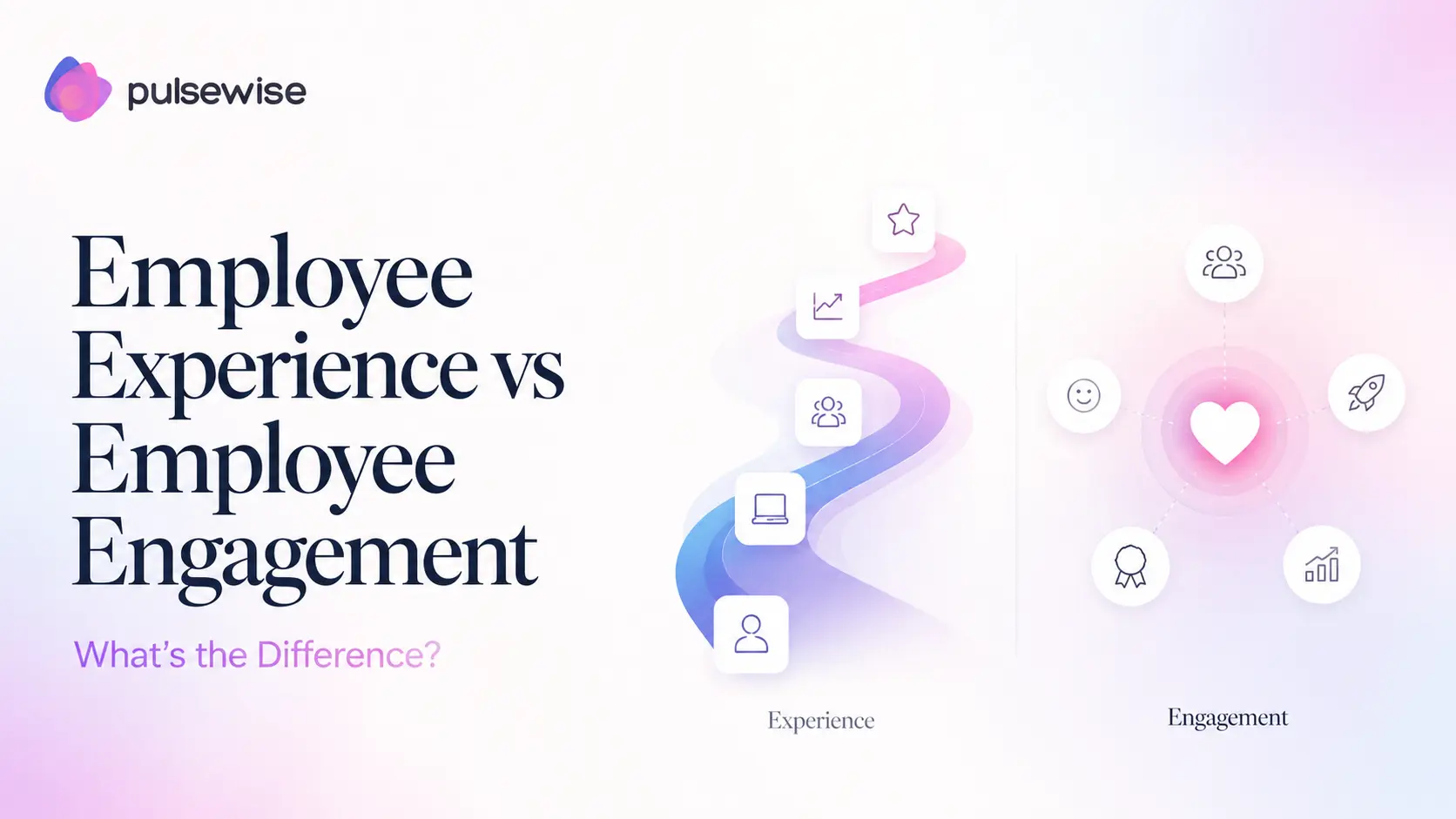
- Employee engagement is the emotional and psychological state that results from that experience, measured as involvement and enthusiasm in the work and the workplace.
- Experience is the input you design. Engagement is the output you measure. Treating the output as a lever is why so many engagement programmes stall.
- Gallup places engagement as a stage in the employee lifecycle. McKinsey treats engagement as an outcome of experience. Both are right at different altitudes, and this post shows how to reconcile them.
- Gallup’s 2025 data puts global engagement at 20% while best-practice organisations sit at 70%. The gap is an experience design gap, not a survey frequency gap.
What is employee experience?
Employee experience is the total of everything a person encounters, observes, and feels across their entire relationship with an organisation, from first contact as a candidate through to life after they leave.
It is broader than culture and broader than perks. It covers the recruiter’s response time, the quality of the onboarding buddy, the laptop that arrives on day one or does not, the manager’s weekly attention, the fairness of the promotion process, and the tone of the offboarding conversation.
Gallup groups these touchpoints into seven lifecycle stages: attract, hire, onboard, engage, perform, develop, and depart. Each stage shapes what a person believes about your organisation, and those beliefs compound.
The three environments that shape experience
Most credible EX frameworks split the experience into three overlapping environments. Naming them helps People teams assign ownership rather than treating EX as an abstract mood.
-
Physical and digital: workspace, tools, systems, and how much friction sits between a person and their work.
-
Social: relationships with managers and peers, psychological safety, belonging, and whether recognition reaches the people who earned it.
-
Growth and structural: clarity of expectations, access to development, fairness of pay and promotion, and whether progress is visible.
Employee experience is designed. Somebody chose the onboarding flow, the review cadence, and the recognition ritual. That is what makes EX actionable in a way engagement scores are not.
Most People teams can describe their experience design on a whiteboard, but cannot see it in data. Pulsewise maps 12 organisational dimensions daily, including morale, teamwork, psychological safety, and growth. See how Culture Analytics works.
What is employee engagement?
Employee engagement is the involvement and enthusiasm an employee brings to their work and their workplace. It describes a psychological state, not a set of activities.
Gallup measures it through the Q12, which tests whether basic psychological needs are met at work. Those needs include knowing what is expected of you, having the materials you need, having recent recognition, and doing work you are good at.
Engagement is not a perk, an event, or a happy hour. Gallup is blunt on this point: engagement forms daily through a person’s work environment and relationships, and roughly 70 percent of the variance in team engagement traces back to the manager.
What the current numbers look like
Gallup’s 2025 global figures give useful calibration. Global engagement sits at 20 percent, down one point from 2024. In the United States, it is 31 percent, while in Europe it drops to 12 percent.
The number worth staring at is 70 percent. That is the engagement rate inside Gallup’s best-practice organisations, and it has held steady for years.
The distance between 20 and 70 is not explained by survey frequency or software. It is explained by experience design that most organisations never get around to doing.
Source: Gallup Global Indicator, Employee Engagement, 2025 data. Engagement percentages are drawn from the Gallup World Poll and Q12 database.
Employee experience vs employee engagement: side-by-side comparison
If you need one table to settle the argument in your next planning session, this is it.
| Dimension | Employee experience (EX) | Employee engagement (EE) |
|---|---|---|
| What it is | The sum of every interaction, tool, relationship, and moment across the employment journey | The psychological state of involvement and enthusiasm that results from those interactions |
| Scope | Pre-hire through post-exit, including alumni and referral behaviour | The current employment period is usually measured per cycle or per quarter |
| Role | Input. It is designed, resourced, and owned | Output. It is measured, diagnosed, and reported |
| Who owns it | Distributed across People, IT, Facilities, Finance, and leadership | Concentrated in People teams and line managers |
| How you measure it | Journey mapping, lifecycle-stage surveys, onboarding and exit data, system telemetry, eNPS | Engagement index scores, Q12-style items, pulse surveys, participation and recognition rates |
| Time horizon | Multi-year, structural, slow to shift | Weeks to months, responsive, can move fast in either direction |
| Typical failure | Beautifully mapped journeys that nobody funds or staffs | A score that rises while attrition and productivity stay flat |
| Board question it answers | Are we a place where good people can do their best work? | Are our people actually doing it right now? |
How the two connect: input, output, and the lifecycle question
The cleanest way to hold both concepts is this: experience is what you give people, engagement is how they respond.
McKinsey’s research supports the causal direction. People reporting a positive employee experience showed 16 times the engagement level of people reporting a negative experience, and they were eight times more likely to want to stay at the company.
Those multiples are the reason experience deserves a budget. You cannot instruct someone into engagement, but you can redesign the onboarding, the manager cadence, and the recognition loop that produce it.
The relationship runs both ways
The causal arrow is not one-directional in practice. Engaged people improve the experience for everyone around them by giving better feedback, mentoring more willingly, and holding standards higher.
That reinforcing loop is useful. It means an early win in one team can compound, which is why targeted intervention often beats a company-wide initiative.
Why Gallup and McKinsey appear to disagree
Read enough on this topic, and you hit a genuine contradiction that almost no article addresses. It confuses People teams, so it is worth resolving directly.
Gallup’s lifecycle model lists seven stages: attract, hire, onboard, engage, perform, develop, and depart. In that model, engage is a stage sitting inside the employee experience.
McKinsey and most EX consultancies frame it differently. For them, engagement is the outcome that the whole experience produces, not one stage within it.
Both are correct at different altitudes
Gallup is describing where in the journey engagement is actively built and managed. Once someone is hired and onboarded, the daily work of meeting psychological needs begins, and that phase is what Gallup labels as engagement.
McKinsey is describing what engagement measures are. As a metric, engagement absorbs signal from every stage, including a bad hiring process; the person still remembers eighteen months later.
The practical resolution
Treat engagement as a stage when you are assigning ownership and building your operating rhythm, because that tells you where managers do the daily work. Treat engagement as an outcome when you are reading the score, because a dip may originate in any stage of the journey, not just the one where you noticed it.
This distinction saves real time. When your engagement score drops in one department, the fix is often upstream, in hiring, onboarding, or workload design, rather than in the engagement programme itself.
Why the distinction matters for your People strategy
Four concrete consequences follow from getting this right, and each one shows up in a budget conversation.
1. It changes what you measure
If you only track engagement, you are reading a thermometer. Adding lifecycle-stage measurement tells you which room is cold.
A useful test: Can you identify which stage of the journey led to your last engagement dip? If not, you are measuring output without measuring input.
2. It changes what you buy
Engagement tools measure and nudge. Experience platforms need to span the journey, connect signals, and route action to the right owner.
Buying a survey tool to solve an experience problem is the most common and most expensive mistake in this category. The survey will faithfully report the problem every quarter without touching it.
3. It changes who owns the outcome
Engagement can sit with People and managers. Experience cannot, because IT owns the tooling, Finance owns pay fairness, and leadership owns clarity of direction.
Naming EX as a distributed responsibility is often the single most useful thing a People Lead does in their first year.
4. It changes how you report to leadership
Executives are rightly sceptical of engagement scores that move without business results following. Framing engagement as an outcome of specific experience investments gives you a defensible narrative.
It also reframes retention conversations. Attrition is rarely an engagement failure alone, which is why predicting and preventing attrition works better when experience signals sit alongside engagement scores.
Put a number on it before your next budget conversation
Turnover, sick leave, and low engagement carry a measurable cost. The Pulsewise Wellbeing Calculator runs the numbers for your team size and salary band in about 60 seconds. No signup required.
How to measure employee experience and employee engagement
The two demand different instruments. Using an engagement survey to measure experience is the most common measurement error in People analytics.
Measuring employee engagement
-
Engagement index: a consistent set of items run at a consistent cadence so trend lines mean something.
-
Pulse surveys: short, frequent checks between formal cycles that catch drift before it becomes attrition.
-
Behavioural signals: recognition volume and spread, 1:1 completion rates, goal progress, and internal mobility applications.
-
Manager-level cuts: Given the manager effect on engagement variance, company averages hide almost everything useful.
If your current cadence is annual, the gap between measurement and reality is the problem. This is the case for continuous pulse surveys over point-in-time snapshots.
Measuring employee experience
-
Journey mapping: document each lifecycle stage and mark where friction and delight actually occur.
-
Moment-that-matters surveys: short checks at day 30, day 90, post-promotion, post-review, and at exit.
-
Operational data: time to productivity, IT ticket volume in week one, internal mobility rate, and regretted attrition by stage.
-
Qualitative depth: listening sessions and open-text analysis, because experience problems are usually specific and structural.
-
eNPS: useful as a directional experience signal, weak as a diagnostic on its own.
The connective tissue matters more than any single instrument. When survey scores, recognition data, goal progress, and feedback themes sit in separate tools, People teams spend their week stitching rather than acting.
Pulsewise was built for that gap. Signals from surveys, feedback, kudos, and goals flow into a single unified culture dashboard, with department comparisons and trend alerts that link straight to the underlying context.
Four mistakes People teams make with these two terms
1: Rebranding the engagement team as the experience team
Changing the name on the org chart without changing scope, budget, or cross-functional authority produces the same output with new stationery.
If the newly renamed EX team still cannot influence tooling, workload, or pay fairness, nothing has changed.
2: Chasing the engagement score instead of its drivers
Scores respond to attention, and a well-run communications push can lift a number without lifting anything real. The number then falls back and confidence in the measurement erodes.
Pick two or three drivers, invest in those, and let the score follow.
3: Treating experience as a design project with an end date
Journey maps are useful and frequently abandoned. An experience map with no owner, no cadence, and no budget attached becomes a slide deck.
4: Measuring both once a year
Annual measurement gives you a rear-view mirror when you need a windscreen. By the time results arrive, the manager who caused the dip has often already lost the person.
Manager cadence is where most of this gets fixed or lost. Structured, well-prepared conversations are the highest-leverage intervention available, which is why 1:1 intelligence and consistent recognition habits outperform most engagement programmes.
A practical operating rhythm for running both
You do not need two strategies, two teams, or two budgets. You need one rhythm that measures the output and manages the input.
| Cadence | What you do | What does it tell you |
|---|---|---|
| Weekly | Manager 1:1s and recognition activity | Whether the daily engagement work is actually happening at the team level |
| Monthly | Pulse check plus moments-that-matter surveys | Early drift, and which lifecycle stage is generating friction right now |
| Quarterly | Engagement index by department and manager | Where engagement stands and which teams need support |
| Half-yearly | Journey map review with IT, Finance, and leadership | Whether the experience design still matches how work actually happens |
| Annually | Full lifecycle audit, including exit and alumni data | Structural problems that short-cycle measurement cannot surface |
For leadership reporting, roll the whole picture into one view rather than presenting engagement in isolation. That is the purpose of board-ready org health reporting: one place where experience investment and engagement outcome sit side by side.
If you are still building the engagement side of this rhythm, our guide to 15 strategies to improve employee engagement covers the tactical layer, and the employee engagement master guide covers the fundamentals in depth.
The bottom line
The terms are not interchangeable, and the difference is not academic. Experience is what you build. Engagement is what you get back.
If your engagement score has plateaued despite genuine effort, the constraint is almost certainly upstream. Look at hiring, onboarding, workload design, and manager capacity before you redesign the survey.
The organisations sitting at 70% engagement did not find a better questionnaire. They designed a better experience and then measured what came back.
See both in one place
Pulsewise brings pulse surveys, feedback, recognition, goals, and performance into a single intelligence layer, so you can see experience investment and engagement outcome side by side instead of stitching four exports together. Pulsewise is free forever for the first 100 teams, with up to 100 users, no feature limits, and no credit card required. Claim your free spot | Schedule a demo
FAQs
What is the difference between employee experience and employee engagement?
Employee experience is everything a person encounters across their journey with an organisation, from recruitment through exit. Employee engagement is the involvement and enthusiasm that results from that experience. Experience is the input you design and fund. Engagement is the output you measure and report.
Is employee engagement part of employee experience?
Yes, in two senses. Gallup’s lifecycle model places engagement as one of seven stages within the employee experience. Most EX frameworks also treat engagement as an outcome that the full experience produces. Both readings are compatible: engagement is where daily work happens and what the journey ultimately produces.
Which comes first, employee experience or employee engagement?
Experience comes first causally. McKinsey found that people with a positive employee experience showed 16 times the engagement level of those with a negative experience. You design the experience, then engagement follows. The relationship then reinforces itself, since engaged people improve the experience for colleagues.
Is employee experience replacing employee engagement?
No. Experience is replacing engagement as the primary strategic frame, not as a measurement. You still need an engagement metric because it is the clearest signal that your experience investments are working. Dropping engagement measurement leaves you designing without feedback.
How do you measure employee experience?
Measure it by lifecycle stage rather than in aggregate. Combine journey mapping, moments-that-matter surveys at day 30, day 90, post-promotion and exit, operational data such as time to productivity and regretted attrition, and open-text listening. eNPS works as a directional signal but is weak as a standalone diagnostic.
What are the stages of the employee experience?
Gallup identifies seven: attract, hire, onboard, engage, perform, develop, and depart. Most organisations spend the bulk of their measurement effort on engage while under-investing in attract, onboard, and depart. Those under-measured stages often explain engagement scores that will not move.