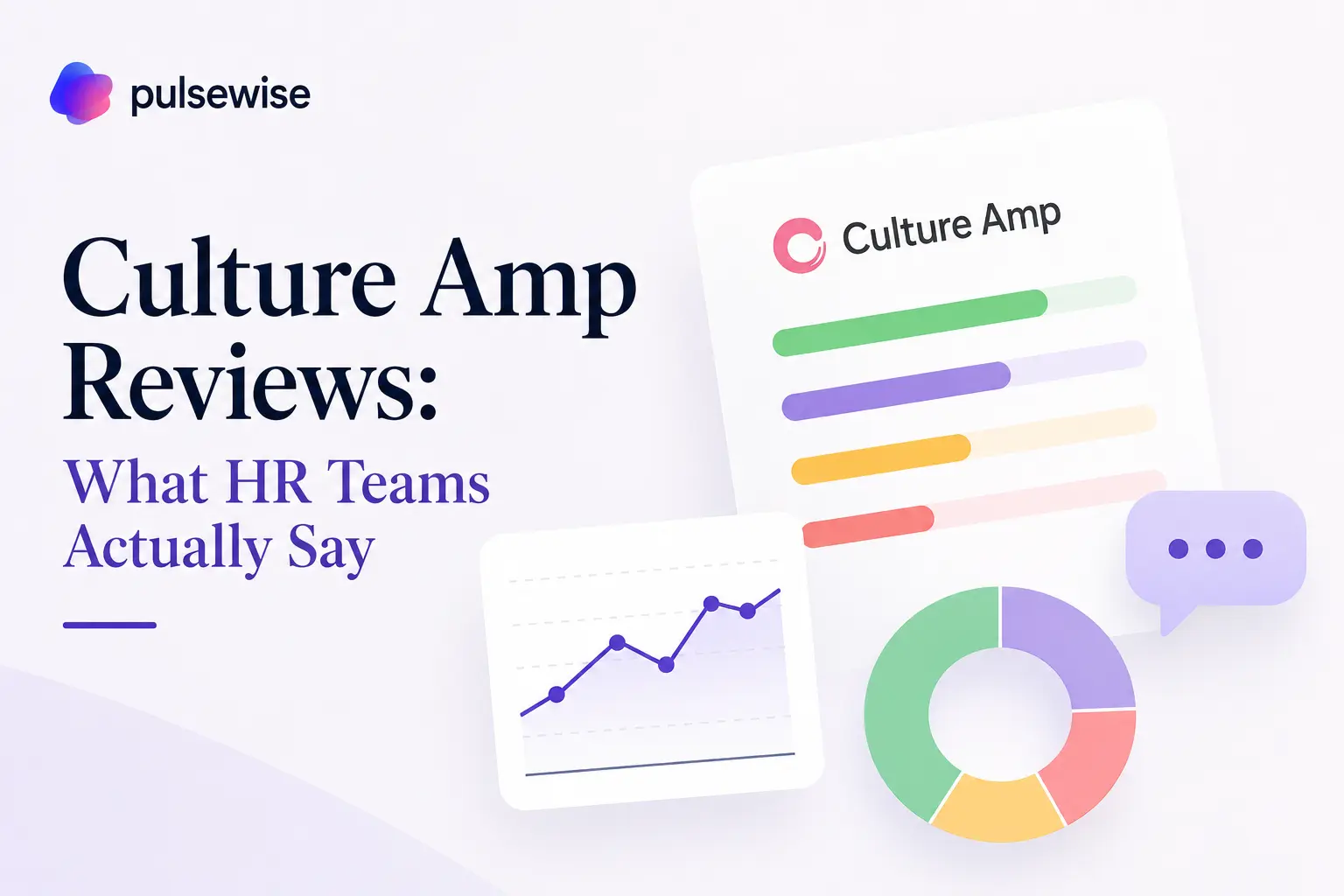
If Culture Amp is on your shortlist, you have probably already seen the star ratings. They are strong. The reviews underneath them tell a more useful story.
Most Culture Amp reviews split along a single line. Teams love the surveys and the people science behind them. They get frustrated with much of what they try to do after the survey closes.
This guide pulls together what HR and People Ops teams actually say about Culture Amp in 2026. It covers the aggregate ratings, the genuine praise, the recurring complaints by theme, and the pricing you only learn on a sales call. At the end, it shows where Pulsewise fits if those limits are the reason you started looking.
TL;DR
Culture Amp holds a 4.5 out of 5 on G2 across more than 1,600 reviews and 4.6 out of 5 on Capterra from 163 verified reviews. Reviewers rate the engagement surveys, benchmarking, and science-backed templates as best in class. The common complaints cluster around goals and OKRs, performance workflows, reporting depth, opaque pricing, and slow support on complex issues. The biggest single theme is an insight-to-action gap: Culture Amp shows you what is wrong but does less to help you fix it between survey cycles. Culture Amp fits research-heavy mid-market and enterprise People teams. Smaller teams and those wanting continuous feedback often shortlist an alternative.
Culture Amp ratings: what the numbers say
Culture Amp is one of the most reviewed platforms in the employee engagement category. Across the major software marketplaces, the scores land in a tight, positive band. That consistency is a real signal, so start there.
| Platform | Rating | Reviews | Source |
|---|---|---|---|
| G2 | 4.5 / 5 | 1,600+ | G2 Reviews |
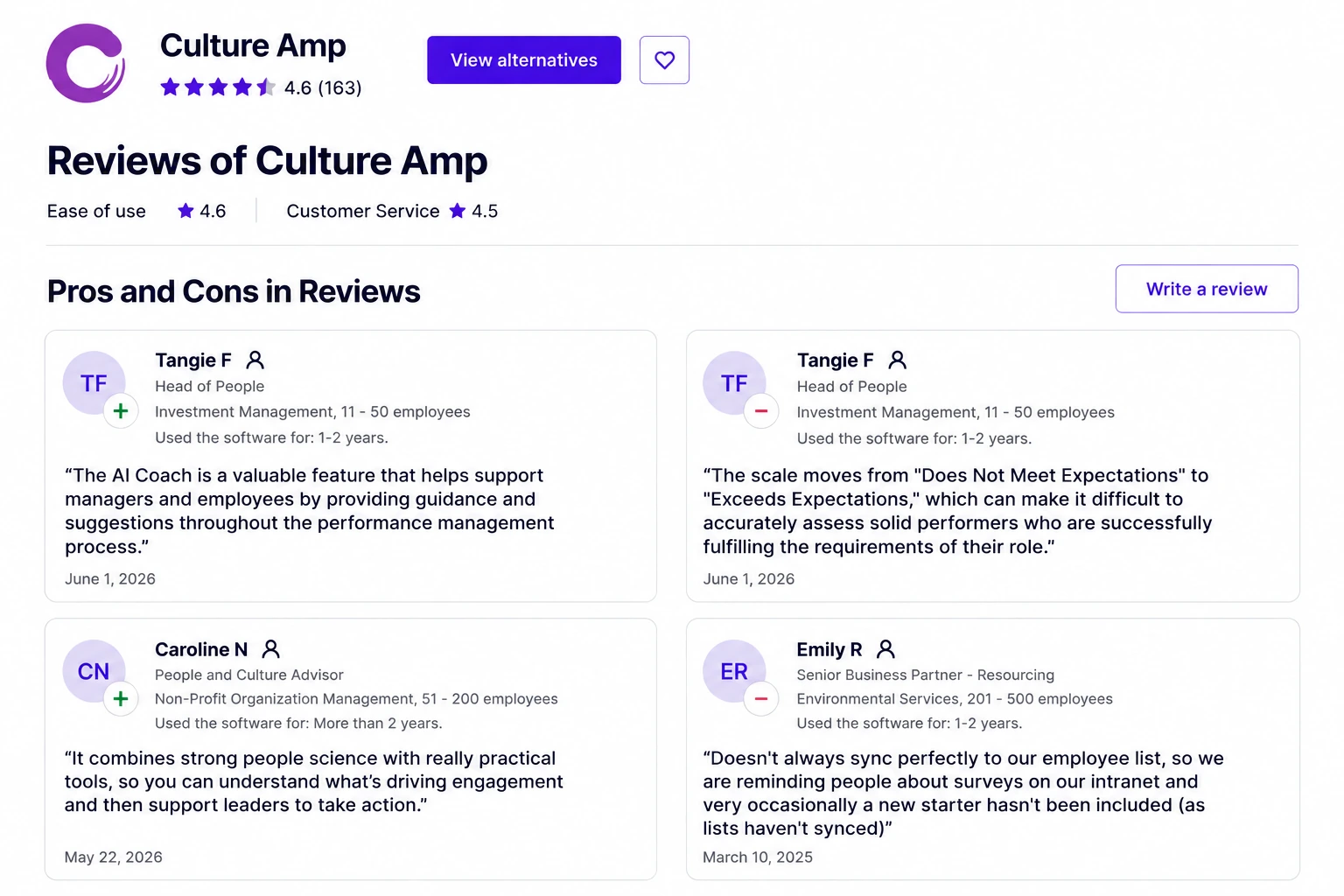
| Capterra | 4.6 / 5 | 163 verified | Culture Amp on Capterra |
| Research.com | 4.65 / 5 | editorial | research.com |
| HRStacks | 4.2 / 5 | editorial | hrstacks.com |
Note: ratings and review counts shift over time. Figures above were verified in August 2026 and should be refreshed before each republish.
The G2 breakdown is where it gets interesting. The most tagged strengths are ease of use, helpfulness, and support. The most tagged weaknesses are missing features, limited customization, and navigation difficulty. That split maps almost exactly onto what reviewers write in long form, and it frames the rest of this guide.
Curious what daily listening looks like instead of periodic surveys? See how real-time pulse surveys turn sentiment into a weekly signal, not an annual deck.
What HR teams love about Culture Amp
Culture Amp earns its ratings on a clear set of strengths. These show up again and again in verified reviews, so treat them as the reasons teams pick it and stay.
Best-in-class engagement surveys
The survey module is the heart of the product, and reviewers treat it as best in class. The templates are built on behavioral science and need little customization to deploy. Real-time participation tracking and built-in anonymity protection round it out.
One Capterra reviewer sums up the appeal: it combines strong people science with practical tools to understand engagement. That pairing of rigor and usability is the recurring reason teams choose it.
Benchmarking and sentiment analysis
Culture Amp lets you compare your scores against industry peers and companies of similar size. AI-driven sentiment analysis and comment summarization help People teams read thousands of open-text responses quickly. Multi-language support makes it workable for global teams.
Responsive support and learning resources
Support is a genuine strength when it works. On G2, more than 117 reviews specifically praise the customer support experience. Regular webinars and learning content help new admins get productive.
The AI Coach also draws praise. A Capterra reviewer notes that it helps managers turn feedback into clear next steps. For teams new to structured engagement work, that guidance lowers the learning curve.
Where Culture Amp falls short, by theme
No platform is all upside, and Culture Amp reviews are candid about the gaps. The complaints are remarkably consistent across G2 and Capterra, which makes them easy to plan around. Here they are grouped by theme.
Check-ins and 1:1s
The one-on-one tooling frustrates many managers. One Capterra reviewer puts it plainly: the 1:1 module is basic and cannot be customized. Others report unreliable email reminders that make a steady cadence hard to hold.
Google Calendar integration is a frequent request on G2 that has not landed. Note-saving states in 1:1s confuse users, and there is no way to send mass reminders for check-in completion. For teams that live in weekly 1:1s, these are daily annoyances.
Goals and OKRs
Goals are the weakest module by consensus. More than 65 G2 reviewers flag that the goals module lacks flexibility for robust OKR programs. On G2’s own dimension scores, OKR features sit around 8.0 while ease of use sits near 9.0, which captures the gap.
Progress tracking needs manual updates, with no automatic roll-up from sub-goals to parent goals. Oldest goals often appear first by default, which hurts adoption. If you are buying Culture Amp mainly for goal tracking, it helps to know what a solid performance and goals model should deliver before you commit.
Performance reviews and manager features
The 360-degree feedback and review workflows are flexible, and calibration sessions are supported. The friction is in setup and scale. Reviewers describe the performance module as clunky relative to the rest of the platform.
Staff selection during review setup confuses admins, and there is no probation-cycle support. Several reviewers say performance workflows get difficult to scale beyond 100 employees. Against dedicated performance tools, this module feels underdeveloped.
Analytics and reporting
The dashboards are powerful, and that is also the problem. More than 51 G2 reviewers flag navigation difficulty, and frontline managers describe the analytics as overwhelming. Slicing data beyond the standard filters is hard, and advanced analytics need real onboarding time.
Exports are a recurring pain, with calibration and talent-grid reporting often pushed out to manual CSVs. For a broader view of doing this well, see this guide to people analytics for leaders.
Pricing and value
Culture Amp keeps pricing behind a sales call, which frustrates smaller buyers. Reviewers describe it as expensive relative to the feature set, and note that module separation adds cost. Paying extra for performance on top of engagement is a common complaint.
Support and implementation at the edges
Support is praised when it works, but complex or technical issues can take a long time to resolve, with some reviewers citing months. First-line support leans on chatbots, and basic packages can lack live support access. Onboarding and data import are described as time-consuming.
The insight-to-action gap
The single most compelling criticism across every review platform is this: Culture Amp is world-class at identifying engagement problems and weaker at helping teams fix them.
HR leaders run a survey, see the issues clearly, and then watch the same scores show up six months later. The platform tells you what is wrong. It gives you limited tools to do something about it between survey cycles.
Three patterns feed that gap. A quarterly or annual cadence misses real-time shifts in how teams feel. Managers get data but lack a structured daily habit to act on it. And many teams end up running Culture Amp alongside separate 1:1, OKR, and recognition tools, which fragments the workflow. You can see the cost of that lag in the 2026 employee disengagement data.
Closing the gap is the whole point. See a side-by-side of how the two platforms handle the space between surveys in the Pulsewise vs Culture Amp comparison.
Is Culture Amp good, and who is it for?
Yes, Culture Amp is a good platform for the right buyer. The reviews make the fit unusually clear, so match it against your own situation rather than the star rating alone.
Best fit: mid-market to large organizations, roughly 100 to 5,000 employees, with a dedicated HR or People Ops team and budget for survey science.
Strong for: companies where engagement measurement and benchmarking are the primary need, and where someone owns acting on the results.
Weaker for: teams that need deep OKR management, heavily customized workflows, tight HRIS integration, or real-time continuous feedback instead of periodic surveys.
Not ideal for: smaller teams under 100 people, where the cost is hard to justify. If that is you, this roundup of employee engagement tools for 2026 is a good next stop.
Culture Amp pricing: what it actually costs
Culture Amp publishes no public pricing. Every plan is quote-only, and there is no free trial, so you learn the number on a sales call. The figures below come from procurement and third-party sources, so treat them as directional.
| What buyers report | Estimate |
|---|---|
| Per employee, per month | Roughly $5 to $9 (third-party estimate) |
| Annual minimum | Around $4,500 per year |
| Enterprise contracts | Reportedly $10,000 to $45,000+ per year |
| Pricing model | Module-based; adding performance or analytics adds cost |
| Free trial | Not available |
Because those numbers are unofficial, confirm any quote directly. For a like-for-like view across the category, see this employee engagement software pricing comparison. The takeaway most smaller teams reach: the survey science is excellent, but the total cost is hard to justify below a certain size.
Culture Amp vs competitors: where Pulsewise fits
If you are reading Culture Amp reviews because you are hitting one of its limits, it is worth seeing the contrast with a platform built around the opposite problem. Culture Amp is built to measure. Pulsewise is built to close the loop between measuring and acting.
Pulsewise is an AI-first employee experience platform that replaces five separate HR tools with one connected system. It covers pulse surveys, feedback, recognition, goals, and performance in a single intelligence layer. Here is how the two compare on the points reviewers care about most.
| Dimension | Culture Amp | Pulsewise |
|---|---|---|
| Pricing | Quote-only, ~$5 to $9 PEPM (est.), ~$4,500/yr min | Free forever for the first 100 teams, up to 100 users |
| Transparency | Sales call required | Public; paid per-seat plans on the roadmap |
| Free option | No free trial | Free forever, not a trial, no credit card |
| Feedback cadence | Periodic surveys, quarterly or annual | Daily pulse check-ins, seconds to complete |
| Goals and OKRs | Add-on module, limited OKR depth | Built-in nested goals with automatic roll-up |
| Insight to action | Strong measurement, weaker between cycles | AI action plans and alerts that flag issues early |
| Integrations | Vary by tier | Slack, Teams and more on all plans |
| Platform unity | Engagement core plus modules, some via acquisition | One connected platform, built together |
| Setup | Weeks of implementation | Minutes to start |
Why teams switch: lower and clearer cost, daily feedback that catches issues before they harden into survey scores, and a platform that nudges managers to act rather than only report. You also get goal tracking with automatic roll-up and contextual recognition in the same place, with no per-module bill.
Where Culture Amp still wins: if deep survey science, external benchmarking, and a large enterprise research program are your core need, its depth is hard to match. Be fair to the fit, and pick the tool that matches the job you are hiring it to do.
Try the action-first alternative Pulsewise is free forever for the first 100 teams, with every feature included and no credit card. Claim your free spot and start turning feedback into action this week!
The bottom line
Culture Amp deserves its ratings. The surveys are excellent, the science is real, and support wins genuine praise. If measurement is your core job, it is a safe choice.
The question worth sitting with is what happens after the survey closes. If your team keeps seeing the same scores six months later, the problem is not the measuring. It is the gap between insight and action.
That gap is exactly what Pulsewise is built to close, at a price that does not require a sales call. If the limits in these reviews are the reason you started looking, start free with Pulsewise and put daily listening and action planning in one place.
FAQs
Is Culture Amp a good tool?
Yes, for the right buyer. Culture Amp holds a 4.5 on G2 and 4.6 on Capterra, and reviewers rate its engagement surveys and people science as best in class. It fits mid-market and enterprise teams focused on measurement. Smaller teams and those needing continuous feedback often prefer a lighter alternative.
How much does Culture Amp cost?
Culture Amp uses quote-only pricing with no public rates and no free trial. Third-party estimates put it around $5 to $9 per employee per month, with a roughly $4,500 annual minimum and enterprise deals reportedly reaching $10,000 to $45,000 or more. Confirm any figure directly with sales.
What is Culture Amp’s rating on G2 and Capterra?
Culture Amp holds 4.5 out of 5 on G2 across more than 1,600 reviews and 4.6 out of 5 on Capterra from 163 verified reviews, as of August 2026. Ratings shift over time, so check the live pages for the current numbers before relying on them.
What are the most common complaints about Culture Amp?
The recurring complaints are a basic 1:1 module, a goals and OKR module that lacks flexibility, clunky performance workflows, overwhelming dashboards, opaque pricing, and slow support on complex issues. The overarching theme is an insight-to-action gap: it identifies problems clearly but offers limited help fixing them between cycles.
Who is Culture Amp best for?
Culture Amp fits mid-market to large organizations, roughly 100 to 5,000 employees, with a dedicated People Ops team and budget for survey science. It is strongest where engagement measurement and benchmarking are the priority. It is a weaker fit for small teams and for organizations needing deep OKRs or real-time feedback.
What are the best Culture Amp alternatives?
Common alternatives include Lattice, Leapsome, 15Five, Bonusly, and Pulsewise. Pulsewise stands out for buyers who want an all-in-one platform with transparent pricing, daily pulse check-ins, and built-in action planning. Compare them against your must-have jobs, from surveys to goals to recognition, rather than on star rating alone.