What Are Stay Interviews? How to Run One That Keeps Good People
A stay interview is a planned one-on-one conversation where a manager asks a current employee what keeps them at the company, what frustrates them, and what might make them leave. It happens while the person still works for you, and still cares enough to tell you the truth.
That’s the definition. Now, the part the definition leaves out.
Most companies find out why good people leave in the exit interview, which is an odd moment to ask, if you think about it. The offer is signed, the laptop return is booked, and the person across the table has very little reason to be completely honest with you.
A stay interview moves that same conversation six or twelve months earlier. Roughly the same questions. A completely different outcome, because now you can still do something with the answer.
This guide covers what stay interviews are, why they work, who should run them, how often, and a step-by-step process you can hand to a manager this week. It’s one piece of a wider employee engagement practice, and honestly one of the cheapest pieces to start.
TL;DR
- A stay interview is a structured one-on-one between a manager and a current employee about what keeps them, what frustrates them, and what could pull them away.
- People rarely warn you before they go. In Gallup’s study of voluntary leavers, 36% talked to no one before deciding to resign, and 45% said no manager or leader raised their satisfaction, performance, or future in their final three months.
- The direct manager should run the conversation, not HR, because the manager controls most of what comes up: workload, recognition, growth, and daily friction.
- Hold the first one within 90 days of someone starting, another around six months, then once or twice a year, kept well apart from performance reviews.
- The conversation is only half the job. End each one with a short stay plan, follow up within two weeks, and use pulse surveys to catch drift in the months between interviews.
What is a stay interview?
A stay interview is a scheduled, one-on-one conversation in which a manager asks an employee they want to keep what they value about their job, what frustrates them, and what might tempt them to leave. The goal is to act on those answers before a small frustration becomes a resignation.
The format is most closely associated with HR consultant Richard Finnegan, whose books on the method are published through SHRM. The idea itself is almost embarrassingly simple, though. Ask people why they stay, while they’re still staying.
In plain terms, the stay interview meaning comes down to three things:
- It’s proactive. You start it. You don’t wait for someone to hint that they’re unhappy.
- It’s about the future. Not “how did last quarter go,” but “what would make the next year here worth it for you?”
- It ends in action. A stay interview without a follow-up is just a nice chat, and people can tell the difference.
What a stay interview is not
This matters, because the fastest way to ruin one is to let it turn into something else.
- It’s not a performance review. Nobody is being rated, and nothing said should show up in a review form.
- It’s not a counter-offer. You’re not negotiating. You’re listening.
- It’s not your regular 1:1. A weekly 1:1 covers this week’s work. A stay interview steps back and asks about the job itself.
- It’s not an engagement survey read aloud. Surveys tell you what the team feels on average. A stay interview tells you what this one person needs.
Stay interview vs exit interview (and the rest of your listening tools)
The difference between a stay interview and an exit interview is timing. A stay interview happens while the employee still plans to stay, so you can act on what you hear. An exit interview happens after they’ve resigned, so you can only learn from it.
Here’s how stay interviews fit next to the other ways you already listen:
| Tool | When it happens | Who runs it | Anonymous? | What it tells you | Can you still act? |
|---|---|---|---|---|---|
| Stay interview | Once or twice a year, plus early tenure | Direct manager | No | Why this person stays, and what could pull them away | Yes, that’s the point |
| Exit interview | After resignation | Usually HR | No | Why this person left | Not for them. Only for patterns |
| Annual engagement survey | Once a year | HR | Yes | How the whole organization feels, on average | Slowly, often months later |
| Pulse survey | Weekly or fortnightly | HR or People Ops, results to managers | Yes, aggregated | Whether sentiment in a team is rising or falling right now | Yes, while the trend is forming |
| Regular 1:1 | Weekly or fortnightly | Direct manager | No | What’s happening with the work this week | Yes, but it rarely asks the bigger question |
Notice the gap in that table. Surveys are anonymous, so they can tell you a team is drifting but not who or why. Your 1:1s are personal, but they’re usually about the work, not about whether the person still wants to be here.
The stay interview is the only tool that is both personal and about the bigger question. That’s why it’s worth the 30 minutes.
If you’re rethinking the survey side too, we compared pulse surveys and annual surveys in detail.
Why do stay interviews matter?
Stay interviews matter because most people who quit never tell their manager they’re thinking about it. By the time a resignation lands, the decision was usually made weeks earlier, and a proactive conversation is often the only point where you could have changed it.
Gallup surveyed 717 people who had voluntarily left a job in the previous year, and the findings are hard to argue with. 42% said their manager or organization could have done something to prevent them from leaving. In other words, nearly half of turnover was fixable in the eyes of the people who walked out.
Now look at how quietly those decisions happen, from the same study:
| What Gallup found about voluntary leavers | Share |
|---|---|
| Left within three months of starting a job search, or never actively searched at all | 77% |
| Talked to no one before deciding to resign | 36% |
| Of those who did talk to someone, didn’t talk to their direct manager | 44% |
| Said no manager or leader proactively discussed their satisfaction, performance, or future in their final three months | 45% |
Source: Gallup, “42% of Employee Turnover Is Preventable but Often Ignored”
Sit with that for a second. Most people decide fast, and many decide alone.
And even among leavers who did get a proactive conversation from a manager, only 17% say they discussed what it would take for them to stay. So the conversation happened, sort of. It just skipped the one question that mattered.
That’s the whole case for a stay interview. It’s a deliberate, scheduled way of asking that question before someone has quietly answered it for themselves.
The benefits of stay interviews
Beyond the headline retention numbers, the benefits of stay interviews tend to show up in five places.
- You hear about problems while they’re still small. “My workload has been heavy since the reorg” is a fixable sentence in March. It’s a resignation reason in September.
- You learn what’s working, so you don’t break it. People often stay for reasons leadership never noticed: a flexible Friday, a great peer, a project they love. Stay interviews tell you what to protect.
- You build trust with the person. Being asked, genuinely, what would make the job better is rare enough that people remember it.
- You see patterns across a team. One person mentioning unclear priorities is a conversation. Six people mentioning it is a process problem.
- You avoid the replacement bill. Gallup estimates replacing someone costs around 40% of salary for frontline roles, 80% for technical professionals, and 200% for managers and leaders. One saved resignation pays for a lot of 30-minute conversations.
What does one regretted exit actually cost you? Our free Wellbeing Calculator turns your headcount, average salary, and last year’s exits into an annual cost figure in about 60 seconds. No sign-up, and it makes a useful slide when you ask leadership for time to run stay interviews.
Who should conduct a stay interview?
The employee’s direct manager should conduct the stay interview. The manager has the relationship, and the manager controls most of what people bring up: workload, recognition, growth, and the small daily frustrations that add up. HR’s job is to design the process, train managers, and track themes across teams.
This is where a lot of companies go wrong. They hand stay interviews to HR because it feels safer, or because managers say they’re too busy.
Finnegan’s guidance, as published by SHRM, is blunt about this. Leaders should run their own stay interviews, one person at a time, with HR stepping in only in exceptional cases. Being busy, he argues, isn’t one of those cases.
It makes sense when you think about Gallup’s numbers. More positive interactions with a manager was the second most common thing leavers said would have kept them, at 21%, behind only pay. You can’t outsource a relationship.
What HR should own
- The design. A short, consistent set of questions, a simple note template, and a schedule.
- The training. A 45-minute session on listening, probing, and not getting defensive does more than any script.
- The roll-up. Themes across all managers, reported back to leadership each quarter.
- The accountability. Tracking which managers have held their stay interviews, and which stay plans actually got done.
When someone else should run it
There’s one real exception. If the manager is the problem, the manager can’t run the stay interview.
Gallup found 8% of preventable exits came down to negative interactions with a manager, such as rudeness or micromanaging. If your pulse data or turnover by team points at a specific manager, have a skip-level leader or an HR business partner hold those conversations instead. Then deal with the manager separately.
It also helps to start at the top. SHRM’s guidance suggests the most senior leader runs stay interviews with their own direct reports first, and it cascades down from there. Every manager then experiences one as an employee before running one as an interviewer, which does wonders for how seriously they take it.
If your managers need more support than a single training session, our guide to manager enablement covers how to build that capability properly.
How often should you hold stay interviews?
Hold a first stay interview within an employee’s first 90 days, a second around the six-month mark, and then once or twice a year after that. Keep them at least a few months apart from performance reviews, and add an extra one after any big change, like a new manager or a missed promotion.
Here’s a cadence that works for most teams of 50 to 500 people.
| Moment | When | Why it matters |
|---|---|---|
| Early tenure | Around day 60 to 90 | New hires are the most likely to leave, and early doubts are easy to fix. BambooHR notes new employees are especially vulnerable to turnover. |
| Settling in | Around month 6 | The honeymoon is over, and people know what the job really is. |
| Ongoing | Once or twice a year | Catches slow drift: stalled growth, rising workload, a changing team. |
| Triggered | Within a few weeks of a big change | New manager, reorg, missed promotion, a major project ending, or a visible drop in team pulse. |
Keep them away from review season
This one is non-negotiable. If a stay interview happens the week before or after a performance review, people will treat it as part of the review, and they’ll edit what they say.
University of Michigan’s HR guidance suggests keeping stay interviews roughly six months apart from performance reviews. If your review cycle is annual, that means running stay interviews at the half-year point.
It’s a nice rhythm, actually. One conversation looks back, the other looks forward.
Who goes first?
You don’t need to interview everyone in the first month. Start with two groups.
First, the people you’d most regret losing: top performers, people with rare skills, people everyone else relies on. Second, anyone in their first six months.
Then widen it out over the following quarter, because the people you assume are fine are exactly the ones who resign and surprise you.
How to conduct a stay interview, step by step
To conduct a stay interview, prepare what you can and can’t change, tell the employee what the meeting is for, ask five open questions, listen far more than you talk, handle hard answers calmly, agree a short stay plan, and follow up within two weeks. Here’s each step in detail.
Step 1: Know what you can and can’t change before you walk in
This is the step almost everyone skips, and it’s the one that saves you later.
Before the conversation, get clear on the things people commonly raise. What’s the pay review process, and when is it? What’s the real promotion timeline for this role, and how flexible is the remote policy, honestly?
You don’t need answers to everything, but you need to know which topics you can move and which you can’t.
Why bother? Because the worst outcome of a stay interview isn’t hearing something hard. It’s making a promise in the moment that you can’t keep, and turning a mildly frustrated employee into a disappointed one.
Step 2: Tell them what it is, ahead of time
Nobody likes a surprise meeting called “quick chat.” Send a short note a few days before.
Something like this:
“I’d like to set up 30 minutes to talk about your job. Not your performance, just what’s working for you, what isn’t, and what would make this a better place to work. Nothing to prepare, and nobody’s in trouble. I just want to make sure I’m not missing anything.”
That last line matters more than you’d think. Plenty of people hear “can we talk about your role?” and assume the worst.
On timing, SHRM’s guidance has a neat trick. Tell the employee to expect about 20 minutes, but block 30 on your own calendar so you never have to cut someone off mid-thought.
Step 3: Pick the right setting
In person is best if you can manage it. For remote and hybrid teams, a video call with cameras on is the realistic floor.
Avoid squeezing it into the end of a regular 1:1. It deserves its own slot and its own name; otherwise it quietly becomes another status update. Pick a time that isn’t crunch week, and close Slack.
Step 4: Ask five questions, then mostly listen
Keep the question list short. Five open questions is plenty, and asking the same five to everyone makes it much easier to spot patterns later.
- What’s usually the best part of your week here?
- What part of the job would you happily hand to someone else?
- If a recruiter called you tomorrow, what would make you take the call?
- What are you learning here right now, and what do you want to learn next?
- What could I do differently that would make this a better place for you to work?
That’s it. If you want more options for different roles and tenures, we’ve put together a fuller set of 40 stay interview questions you can pick from.
The questions are the easy part. The skill is in what happens after each answer.
Aim to listen for about 80% of the conversation and talk for about 20%. It feels uncomfortable, honestly.
Let the silences sit. People often say the most useful thing right after a pause, when they realize you’re actually waiting.
Use simple follow-ups to go deeper:
- “Can you give me an example?”
- “How long has that been true?”
- “What would ‘better’ look like?”
- “Is there anything else?”
And take notes, by hand or in a doc. Capture the why behind each answer, not just the answer, because you’ll need it when you write the stay plan.
Step 5: Handle the hard answers without flinching
At some point, someone will tell you something you don’t want to hear. How you react in that moment decides whether anyone on your team is honest with you again.
If they say, “Honestly, I’ve been looking.” Don’t panic, and don’t pitch. Say thank you, genuinely, because they just gave you a chance most managers never get. Then ask what started it, and what would need to change for them to stop.
If it’s about pay. Don’t promise a number. Explain how pay decisions are actually made, when the next review is, and what you’ll do (for example, raise it with HR or check the band). Then do exactly that, and tell them when you did.
If it’s about you. This is the hardest one. Don’t explain, don’t defend, don’t correct their memory of events. SHRM’s guidance warns that if word gets around that a manager can’t take feedback, every stay interview after it becomes short and useless. “That’s really useful, thank you for telling me” is the whole answer.
Step 6: Close with a stay plan
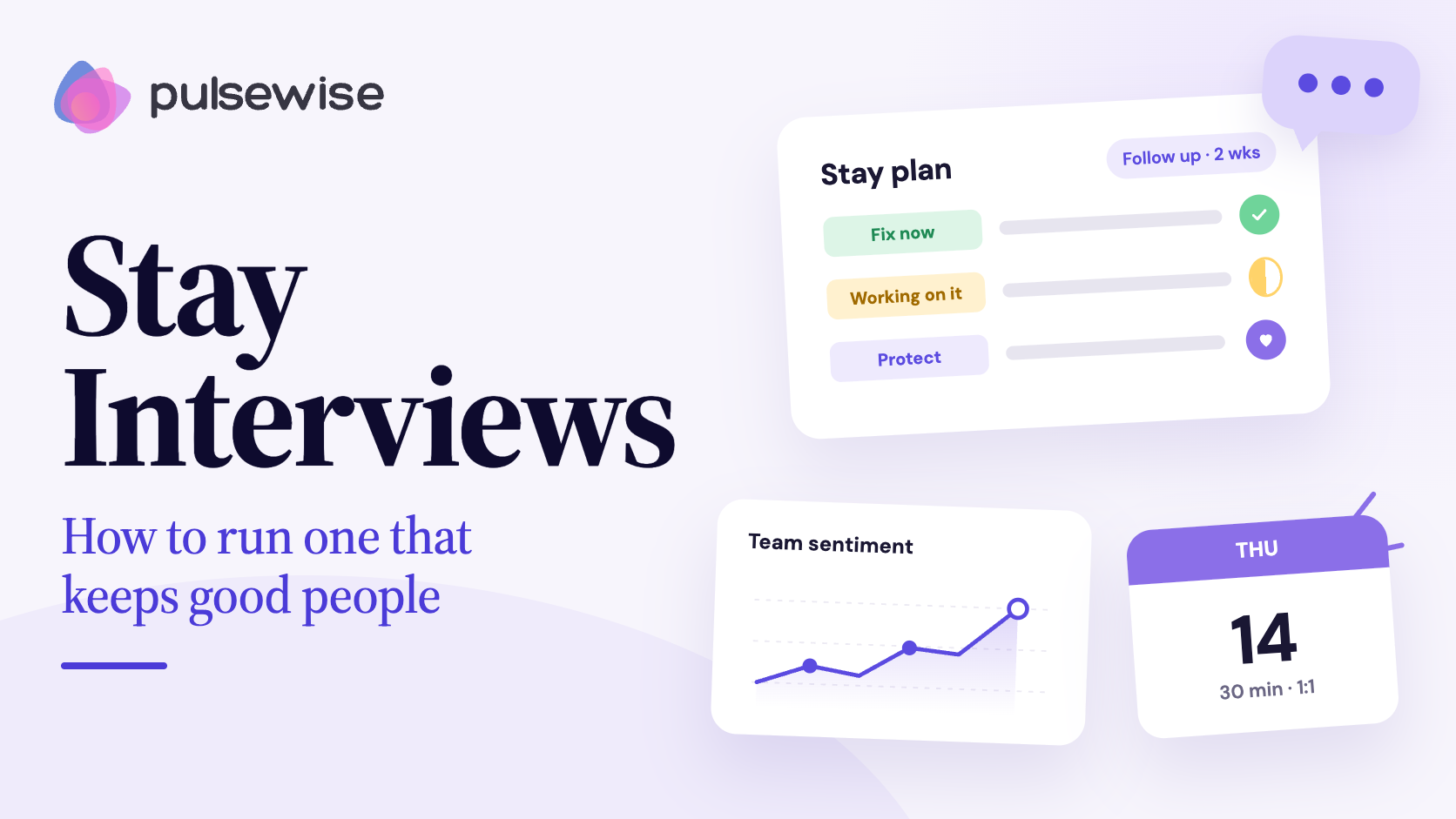
Before the conversation ends, agree on one to three concrete actions. Finnegan calls this a stay plan, and it’s the difference between an interview and a nice chat.
A good stay plan sorts what you heard into three buckets:
- Fix now. Things you control and can change within a month.
- Working on it. Things that need someone else, with a date for an update.
- Can’t change, and here’s why. Said out loud, kindly. People handle “no” far better than silence.
Write it down, share it with them the same day, and give each action a date.
Step 7: Follow up within two weeks, then roll up the themes
Book a short follow-up for no more than two weeks later, even if the only update is “I raised it, here’s what I heard back.”
This is where most stay interview programs quietly die. The conversation felt great, the notes went into a folder, and nothing visibly changed. Three months later the employee concludes, reasonably, that asking was just for show.
Then, every quarter, HR pulls the notes together and looks for themes. Which topics came up across multiple teams, and which managers have open stay plans past their dates?
That roll-up turns individual conversations into something leadership can actually act on, and it feeds straight into your engagement action plan.
What a stay plan actually looks like
Here’s an illustrative example. Say you manage a senior product designer, two and a half years in, at a 180-person hybrid company. She’s good, she’s quiet, and you’ve been assuming she’s fine.
In the stay interview, three things come up. She loves the design team, and she’s frustrated that research findings keep getting overruled in roadmap meetings she isn’t invited to. She also wants to move toward design leadership, but can’t see a path.
Her stay plan might look like this:
| What she said | Bucket | Action | Owner | By when |
|---|---|---|---|---|
| Research gets overruled in meetings she’s not in | Fix now | Add her to the monthly roadmap review for her product area | Manager | Next cycle, 3 weeks |
| Wants a path toward design leadership | Working on it | Draft what a lead designer role requires, and identify one mentoring responsibility she can take on this quarter | Manager with Head of Design | Update in 4 weeks |
| Wants a title change now | Can’t change yet | Explain that title changes follow the next review cycle, and what evidence would support it | Manager | Said in the meeting |
| Loves the design team | Protect | Don’t split the team in the upcoming reorg without asking her first | Manager | Ongoing |
Notice the last row. Some of the most important things you hear in a stay interview aren’t problems at all. They’re the reasons someone stays, and they’re easy to break by accident.
Common stay interview mistakes
Most failed stay interview programs fail in one of seven predictable ways.
- Running them during review season. People will filter everything they say through “will this affect my rating?”
- Handing them to HR. It feels efficient. It removes the one person who can act on most of the answers.
- Asking too many questions. Twenty questions turns a conversation into a questionnaire. Five good ones, followed by real listening, gets you further.
- Promising what you can’t deliver. One broken promise costs more trust than ten honest “not yet” answers.
- Getting defensive. The moment you explain why their frustration is wrong, the interview is over, even if it runs another 20 minutes.
- Only interviewing people you think are at risk. Your quiet, reliable people are often the ones who surprise you. Include them.
- No follow-up. This is the big one. A stay interview with no visible action afterwards is worse than no stay interview at all, because now you’ve shown people that asking doesn’t lead anywhere.
If you’re seeing early signs of withdrawal in someone before you’ve had the chance to talk, our guide to the signs of a disengaged employee is a useful companion to this one.
How to track retention signals between stay interviews
Stay interviews are a snapshot, and people change between snapshots. Gallup found 77% of voluntary leavers moved within three months of starting a search or never searched at all, which means a lot can shift in the gap between two interviews held six months apart.
That gap is where pulse surveys earn their place. A stay interview tells you, in depth, what one person needs. A pulse survey tells you, week to week, whether a team is drifting.
Between interviews, these are the retention signals worth watching:
- Team sentiment that keeps sliding. One bad week is noise. Four in a row is a trend.
- Participation dropping off. When people stop answering pulse questions, the silence is often the loudest signal you’ll get.
- Recurring themes in comments. Workload, fairness, and unclear priorities tend to show up in written comments before they show up in scores.
- Goals that go quiet. Work with no progress updates for a couple of weeks often tracks with someone checking out.
- Recognition drying up. A team where nobody has been thanked in a month is a team that’s starting to feel invisible.
How Pulsewise fits in
This is the exact gap Pulsewise pulse surveys are built for. You schedule short pulses daily, weekly, or on your own cadence, and responses roll up automatically by department into an Employee Satisfaction Score and a DailyMood trend.
Individual pulse responses stay aggregated rather than visible to managers, which keeps people honest. That’s also why pulses and stay interviews work so well together: the pulse tells you where to look, and the stay interview tells you why.
On top of that, Pulsewise’s engagement and retention view pulls mood trends, participation drop-offs, comment themes, stalled goals, and recognition gaps into one early warning signal. Managers see those signals on their 1:1 board, alongside AI-prepared talking points. So when a team’s sentiment dips for a few weeks, the practical move is simple: bring that team’s next stay interviews forward.
Want to know which team needs a stay interview first? Pulsewise runs lightweight pulse surveys in Slack and Teams and flags when a team’s sentiment starts to slide, so you can have the conversation early. See how pulse surveys work.
Do stay interviews actually work?
Stay interviews work when they lead to visible action, and they fail when they don’t. The strongest evidence behind them is the gap Gallup found: nearly half of leavers had no proactive conversation about their future in their final three months, and 42% believed their exit was preventable.
Being honest about it, most of the published evidence on stay interviews specifically is practitioner-driven rather than controlled research. What’s well established is the underlying mechanism. Regular, meaningful manager conversations are strongly linked to engagement, and Gallup has found that one meaningful conversation a week makes employees four times as likely to be highly engaged.
So don’t measure your program by whether people enjoyed the conversation. Measure it by whether anything changed afterwards. A few leading indicators help:
| Indicator | What good looks like |
|---|---|
| Stay interview coverage | Every regretted-loss risk has had one in the last six months |
| Stay plan completion | Most agreed actions closed or updated by their date |
| Follow-up rate | A follow-up held within two weeks of nearly every interview |
| Team pulse trend | Sentiment stabilizes or improves in teams where you acted |
| Regretted turnover | Falls over two to four quarters, cut by team and tenure |
Turnover is a lagging number and takes months to move. The indicators above move in weeks, which is what you need when someone asks, in month two, whether this is working. For the full measurement playbook, see how to reduce employee turnover.
Closing
Here’s the uncomfortable truth underneath all of this. Most of the people who leave your company this year have already started deciding, and most of them won’t tell you.
A stay interview isn’t a clever technique. It’s just the conversation that should have been happening anyway, put on the calendar so it actually does. Thirty minutes, five questions, a lot of listening, and a short plan you genuinely follow through on.
If you do one thing after reading this, pick the three people on your team you’d most hate to lose, and book their stay interviews before the end of the month. Then set up something that tells you, in between those conversations, when a team starts to drift.
That second part is what Pulsewise does. It brings pulse surveys, feedback, recognition, goals, and 1:1s into one platform, and it’s free forever for the first 100 teams, up to 100 users, with no credit card required.
Claim your free spot, or book a short demo and we’ll walk through it with your own team in mind.
FAQs
What is the purpose of a stay interview?
The purpose of a stay interview is to learn what keeps a valued employee at your company, and what might pull them away, while you can still act on it. It surfaces small frustrations before they turn into resignations, and it shows you which parts of the job are working so you can protect them.
What is the difference between a stay interview and an exit interview?
A stay interview happens while the employee still works for you and plans to stay. An exit interview happens after they have resigned. Both ask similar questions, but only a stay interview gives you time to act on the answers, while exit interviews help you spot patterns, not keep the person in front of you.
Who should conduct a stay interview?
The employee’s direct manager should conduct the stay interview, because the manager controls most of what people raise: workload, recognition, growth, and daily friction. HR should design the process, train managers, and track themes across teams. Bring in a skip-level leader or HR partner only when the manager is the problem.
How often should stay interviews be done?
Most teams run a first stay interview within an employee’s first 90 days, another around six months, then once or twice a year after that. Keep them a few months apart from performance reviews so the conversations do not blur. Add an extra one after a big change, like a new manager or a missed promotion.
What questions should you ask in a stay interview?
Keep it to about five open questions: what they enjoy most, what frustrates them, what would make them take a recruiter’s call, what they want to learn next, and what you could do differently as their manager. Then spend most of the time listening and asking for specific examples.
Is a stay interview a good sign?
Yes, a stay interview is a good sign. It means your manager wants to keep you and wants to know what would make the job better, not that you are under review or being warned. The most useful thing you can do is answer honestly, including about the things that frustrate you.