Ask a leadership team who is disengaged and the answers rarely change: Gen Z, remote workers, the frontline. The latest data points somewhere less comfortable, at the managers sitting in that same meeting.
Worldwide, the share of managers who are engaged at work fell from 31% to 22% in three years, the steepest drop of any group. Individual contributors barely moved over the same period.
That is the kind of finding that gets lost when statistics pages recycle the same decade-old numbers. So this page uses primary sources only, gives every data point a year and a link, and groups the numbers around the questions People leaders actually get asked.
TL;DR
five numbers to know 20% of employees worldwide were engaged at work in 2025, the lowest level since 2020. 22% of managers were engaged in 2025, down from 31% in 2022. $10 trillion in lost productivity, about 9% of global GDP, is Gallup’s estimate of what low engagement cost in 2025. 30% of exclusively remote workers are engaged, the highest of any work location, yet only 33% are thriving. 45% less likely to leave within two years: the retention gap for well-recognised employees.
HOW WE CHOSE THESE STATISTICS Every number comes from the original research publisher: Gallup, the U.S. Bureau of Labor Statistics, peer-reviewed journals or academic research outlets. We did not use statistics that only appear on vendor blogs or roundups. Each data point shows its source and year. Where the data year and the publication year differ, the text says which is which. We review this page every quarter. The next refresh is due in January 2027, after the BLS releases new turnover data.
Employee engagement levels in 2026
Gallup defines engaged employees as those who are involved in and enthusiastic about their work. The global figures below come from its 2026 report, which covers 2025 data from more than 141,000 employed respondents.
Global engagement
1. Only 20% of employees worldwide were engaged at work in 2025, down from 21% in 2024 and a peak of 23% in 2022. (Gallup, State of the Global Workplace 2026)
2. A further 64% of employees were not engaged and 16% were actively disengaged in 2025. (Gallup, State of the Global Workplace 2026, global data)
3. 2025 marked the second annual decline in a row and the lowest global engagement since 2020. (Gallup, State of the Global Workplace 2026)
4. Each percentage point of global engagement represents roughly 21 million employees. (Gallup, State of the Global Workplace 2026)
5. Over the long run, engagement has still risen, from 12% in 2009 to 20% in 2025. (Gallup, State of the Global Workplace 2026, global data)
6. No region increased employee engagement in 2025, and South Asia saw the largest drop at 5 points. (Gallup, State of the Global Workplace 2026)
7. The U.S. and Canada had the highest regional engagement at 31% in 2025, while Europe had the lowest at 12%. (Gallup, State of the Global Workplace 2026, global data)
8. Women were slightly more engaged than men worldwide in 2025, at 21% against 19%. (Gallup, State of the Global Workplace 2026, global data)
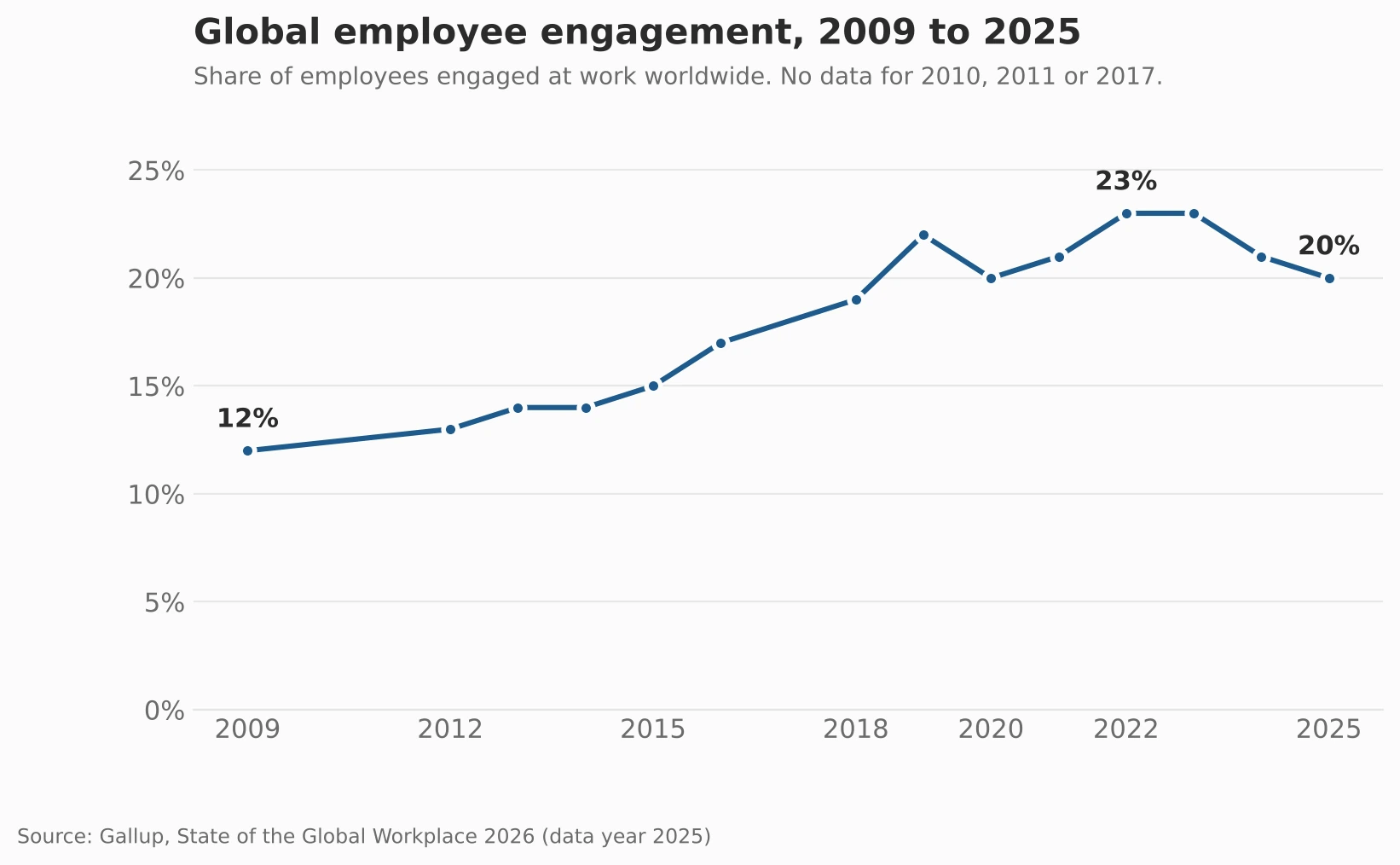
Global engagement rose for a decade, peaked in 2022 and has now fallen two years in a row.
U.S. engagement
9. 31% of U.S. employees were engaged in 2025, unchanged from 2024. (Gallup, January 2026)
10. U.S. engagement peaked at 36% in 2020, which means about 8 million fewer U.S. employees are engaged today. (Gallup, January 2026)
11. Since 2020, engagement has fallen 8 points among Gen Z and younger millennials, 9 points among older millennials and 6 points among Gen X, while baby boomers are unchanged. (Gallup, January 2026)
12. Clarity of expectations is the engagement element that fell most since 2020, down 9 points among all U.S. employees. (Gallup, January 2026)
13. Only 41% of Gen Z and younger millennials strongly agree someone at work cares about them as a person, down from 54% in 2020. (Gallup, January 2026)
14. 37% of Gen Z and younger millennials say they had opportunities to learn and grow in the past year, down from 48% in 2020. (Gallup, January 2026)
15. Only about one in five U.S. employees outside senior leadership strongly agree there is a clear definition of exceptional performance for their role. (Gallup, January 2026)
16. Managers and individual contributors with that clarity are nearly four times as likely to be engaged. (Gallup, January 2026)
WHAT THIS MEANS FOR PEOPLE LEADERS Engagement is not collapsing, but it has stopped improving, and the losses are concentrated among younger employees. The two biggest U.S. declines, clarity and feeling cared about, are both things a manager can change in a weekly conversation. For a structured response, see our employee engagement action plan.
What engagement is worth to the business
The strongest evidence on engagement and outcomes is Gallup’s Q12 meta-analysis. The 2024 edition covers 736 studies, 183,806 business units and more than 3.3 million employees in 90 countries, comparing top-quartile and bottom-quartile units on engagement.
17. Business units in the top quartile of engagement show 23% higher profitability than those in the bottom quartile. (Gallup Q12 Meta-Analysis, 2024)
18. Top-quartile units show 18% higher productivity measured by sales, and 14% higher productivity measured by production records. (Gallup Q12 Meta-Analysis, 2024)
19. Highly engaged units see 78% less absenteeism. (Gallup Q12 Meta-Analysis, 2024)
20. Turnover is 21% lower in high-turnover organisations and 51% lower in low-turnover organisations when engagement is high. (Gallup Q12 Meta-Analysis, 2024)
21. Top-quartile units record 63% fewer safety incidents and 32% fewer quality defects. (Gallup Q12 Meta-Analysis, 2024)
22. Highly engaged units have 28% less shrinkage, meaning theft and inventory loss. (Gallup Q12 Meta-Analysis, 2024)
23. Customer loyalty and engagement are 10% higher in top-quartile units. (Gallup Q12 Meta-Analysis, 2024)
24. Highly engaged units have 70% more thriving employees. (Gallup Q12 Meta-Analysis, 2024)
25. Gallup estimates that low engagement cost the global economy about $10 trillion in lost productivity in 2025, equal to 9% of global GDP. (Gallup, State of the Global Workplace 2026)
WHAT THIS MEANS FOR PEOPLE LEADERS These are associations across thousands of teams, not a promise for any one company. They are still the best evidence available that engagement shows up in absenteeism, safety and retention long before it shows up in revenue. Track the operational numbers first, using the measures in our guide to employee engagement metrics.
Managers and engagement
This is the section most statistics pages skip, and the one with the most important change. Managers are both the biggest driver of team engagement and the group losing engagement fastest.
26. Global manager engagement fell to 22% in 2025, down nine points from 31% in 2022. (Gallup, State of the Global Workplace 2026)
27. Manager engagement dropped five points in 2025 alone, from 27% to 22%, the largest annual decline Gallup reported. (Gallup, State of the Global Workplace 2026)
28. Individual contributors were 19% engaged in 2025, so the gap between managers and the people they lead is now just three points. (Gallup, State of the Global Workplace 2026, global data)
29. In Gallup’s best-practice client organisations, 79% of managers are engaged, nearly four times the global average. (Gallup, State of the Global Workplace 2026)
30. 36% of U.S. managers were engaged in 2025. (Gallup, State of the Global Workplace 2026)
31. 45% of managers experienced a lot of daily stress in 2025, compared with 39% of individual contributors. (Gallup, State of the Global Workplace 2026, global data)
32. Leaders report more daily stress, anger, sadness and loneliness than individual contributors, with 31% of leaders reporting daily loneliness. (Gallup, State of the Global Workplace 2026)
33. Managers account for at least 70% of the variance in employee engagement scores across business units. (Gallup, 2015)
34. Companies fail to choose the candidate with the right talent for a manager role 82% of the time. (Gallup, 2015)
35. Only 16% of employees say their last conversation with their manager was extremely meaningful. (Gallup, 2023)
36. 80% of employees who received meaningful feedback in the past week are fully engaged. (Gallup, 2023)
37. Meaningful weekly feedback gives four times the engagement lift of having the “right number” of days in the office. (Gallup, 2023)
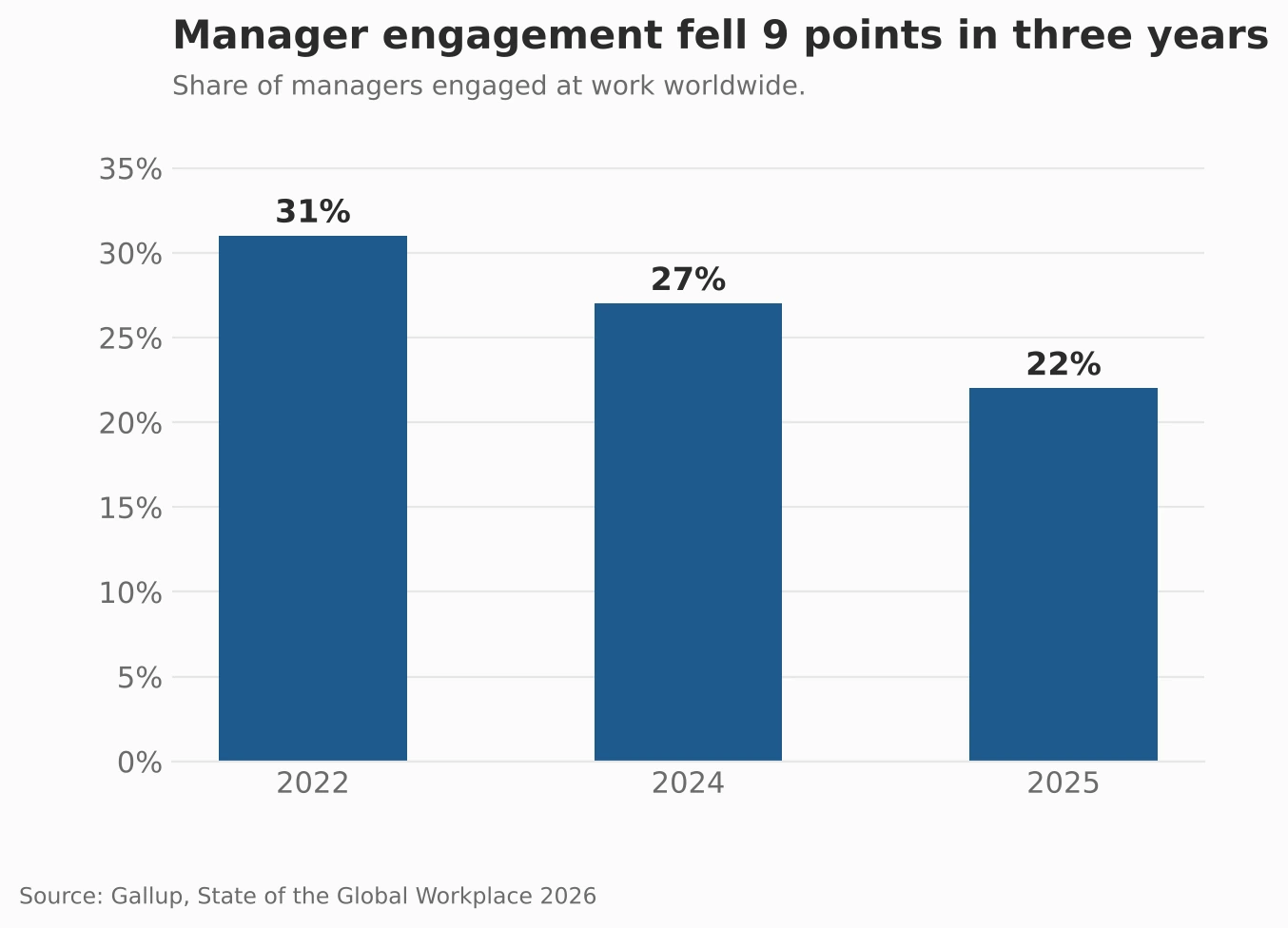
Manager engagement fell from 31% to 22% between 2022 and 2025.
WHAT THIS MEANS FOR PEOPLE LEADERS If managers carry most of the variance in team engagement and their own engagement is falling fastest, manager support is the highest-leverage engagement investment. Start with workload, training and a regular coaching rhythm, as covered in our guides to manager enablement and how to run a 1:1 meeting.
Remote and hybrid work engagement statistics
Remote work is the most argued-about engagement topic, and the data is more nuanced than either side admits. Remote workers are the most engaged, but they are not the most likely to be thriving.
38. 30% of exclusively remote employees worldwide were engaged in 2025, against 25% of hybrid, 24% of on-site remote-capable and 17% of on-site staff whose jobs cannot be done remotely. (Gallup, State of the Global Workplace 2026, global data)
39. Only 33% of exclusively remote employees were thriving in their overall lives in 2025, compared with 45% of hybrid employees. (Gallup, State of the Global Workplace 2026, global data)
40. 30% of exclusively remote employees reported daily sadness in 2025, compared with 20% of on-site remote-capable employees. (Gallup, State of the Global Workplace 2026, global data)
41. 24% of remote and hybrid employees reported daily loneliness in 2025, against 18% of on-site remote-capable employees. (Gallup, State of the Global Workplace 2026, global data)
42. 46% of hybrid employees reported a lot of daily stress in 2025, compared with 41% of fully remote employees. (Gallup, State of the Global Workplace 2026, global data)
43. Among U.S. remote-capable employees, 51% worked hybrid, 28% worked exclusively remotely and 21% worked fully on-site in Q2 2025. (Gallup, 2025)
44. U.S. hybrid workers spend about 46% of their week in the office, roughly 2.3 days. (Gallup, 2025)
45. 47% of remote-capable U.S. tech employees work fully remotely. (Gallup, 2025)
46. In a randomised trial of 1,612 employees, working from home two days a week cut quit rates by one-third, from 7.2% to 4.8%. (Bloom, Han and Liang, Nature, 2024)
47. The same trial found no effect on performance reviews or promotions over the following two years. (Bloom, Han and Liang, Nature, 2024)
48. Quit rates fell most for women (about 54%), non-managers (about 40%) and employees with long commutes (about 52%). (Bloom, Han and Liang, Nature, 2024)
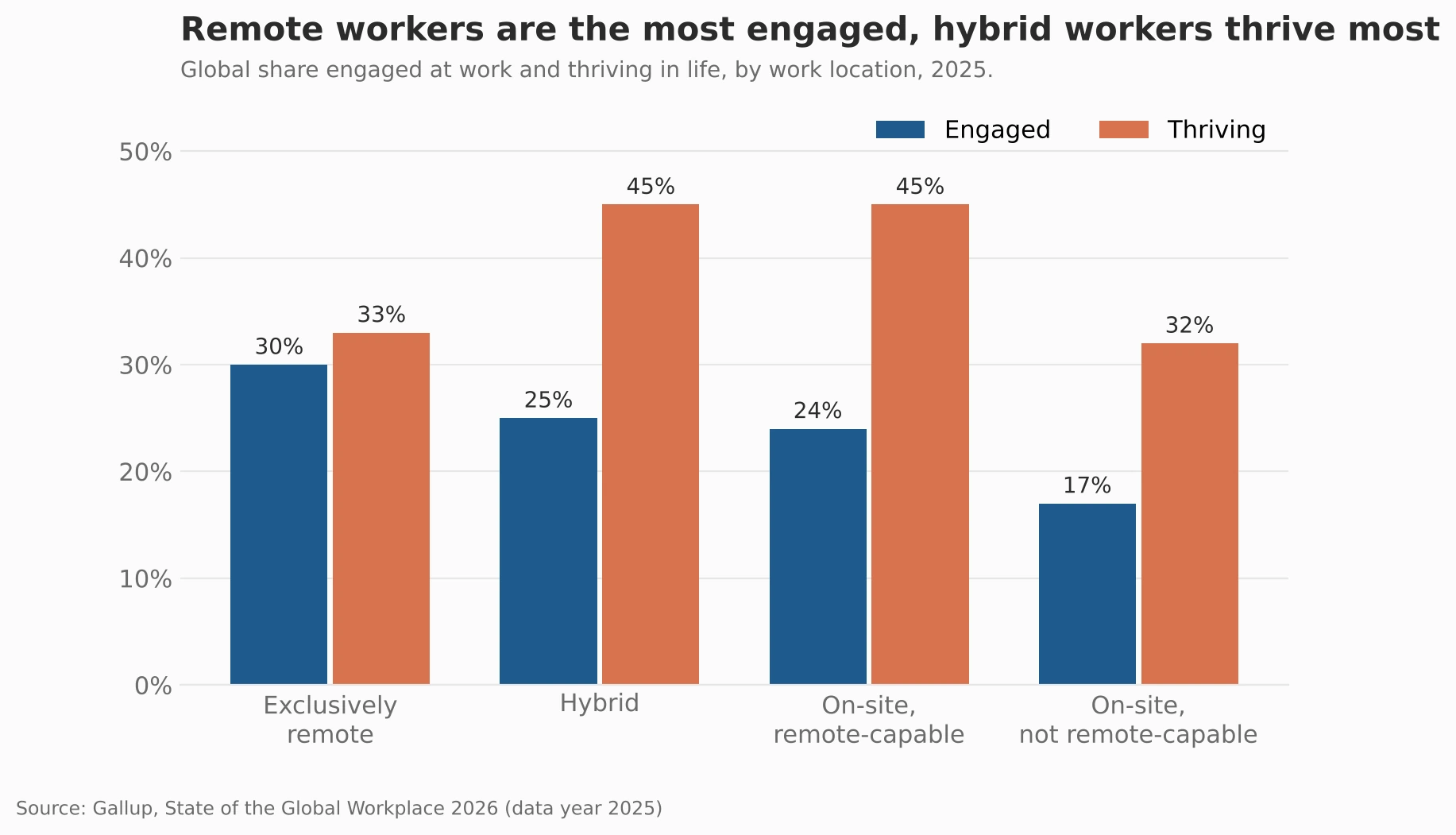
Remote workers lead on engagement, but hybrid workers are most likely to be thriving.
WHAT THIS MEANS FOR PEOPLE LEADERS Remote work is not an engagement problem on its own, but isolation is a real wellbeing risk for fully remote staff. Hybrid arrangements appear to balance both, and the strongest controlled evidence shows they improve retention without hurting performance. Our remote employee engagement guide covers the practical side.
Turnover and the cost of disengagement
Turnover is where engagement becomes a budget line. Quit rates have cooled since 2022, but a large share of employees are still watching the market.
49. U.S. employers recorded 3.1 million quits in August 2026, a quits rate of 1.9%. (U.S. Bureau of Labor Statistics, JOLTS, August 2026 data)
50. U.S. job openings stood at 7.1 million in August 2026, with 5.2 million hires, a hiring rate of 3.3%. (U.S. Bureau of Labor Statistics, JOLTS, August 2026 data)
51. 51% of U.S. employees were watching for or actively seeking a new job in May 2024. (Gallup and Workhuman, 2024)
52. Gallup estimates that replacing a leader or manager costs about 200% of their salary, a technical employee about 80% and a frontline employee about 40%. (Gallup and Workhuman, 2024)
53. 52% of employees worldwide said it was a good time to find a job in 2025, but in the U.S. and Canada that fell 10 points to 47%. (Gallup, State of the Global Workplace 2026)
54. A toxic corporate culture is 10.4 times more powerful than compensation in predicting a company’s attrition relative to its industry. (MIT Sloan Management Review, 2022)
55. Compensation ranked only 16th of 172 workplace topics in predicting attrition. (MIT Sloan Management Review, 2022)
56. Lateral career opportunities were 2.5 times more predictive of retention than compensation, and 12 times more predictive than promotions. (MIT Sloan Management Review, 2022)
Gallup’s replacement-cost figures exclude lost morale and knowledge, so treat them as a floor rather than a full cost.
WHAT THIS MEANS FOR PEOPLE LEADERS A cooler job market lowers quits, but it does not raise engagement, and people who stay disengaged still cost money. Culture and internal mobility beat pay as retention levers, which is good news for teams with tight budgets. See our guide on how to reduce employee turnover.
Recognition and feedback statistics
Recognition is one of the cheapest engagement levers, and the evidence now says quality matters more than volume. Gallup and Workhuman tracked nearly 3,500 employees from 2022 to 2024 to test it.
57. Employees who are well recognised are 45% less likely to have changed organisations two years later. (Gallup and Workhuman, 2024)
58. Only 22% of employees say they get the right amount of recognition, the same share as in 2022. (Gallup and Workhuman, 2024)
59. 55% of U.S. employees either receive no recognition or receive recognition that meets none of Gallup’s five pillars of quality. (Gallup and Workhuman, 2024)
60. Employees whose recognition meets at least four of the five pillars are 65% less likely to be looking for or watching for another job. (Gallup and Workhuman, 2024)
61. The same employees are nine times as likely to be engaged as those whose recognition meets none of the pillars. (Gallup and Workhuman, 2024)
62. Engagement rises from 10% for employees whose recognition meets no pillars to 90% for those whose recognition meets four or five. (Gallup and Workhuman, 2024)
63. In 2022, only 19% of senior leaders and managers called recognition a major strategic priority. (Gallup and Workhuman, 2024)
64. By 2024, 42% of senior leaders strongly agreed that recognition is valuable, up from 28% in 2022. (Gallup and Workhuman, 2024)
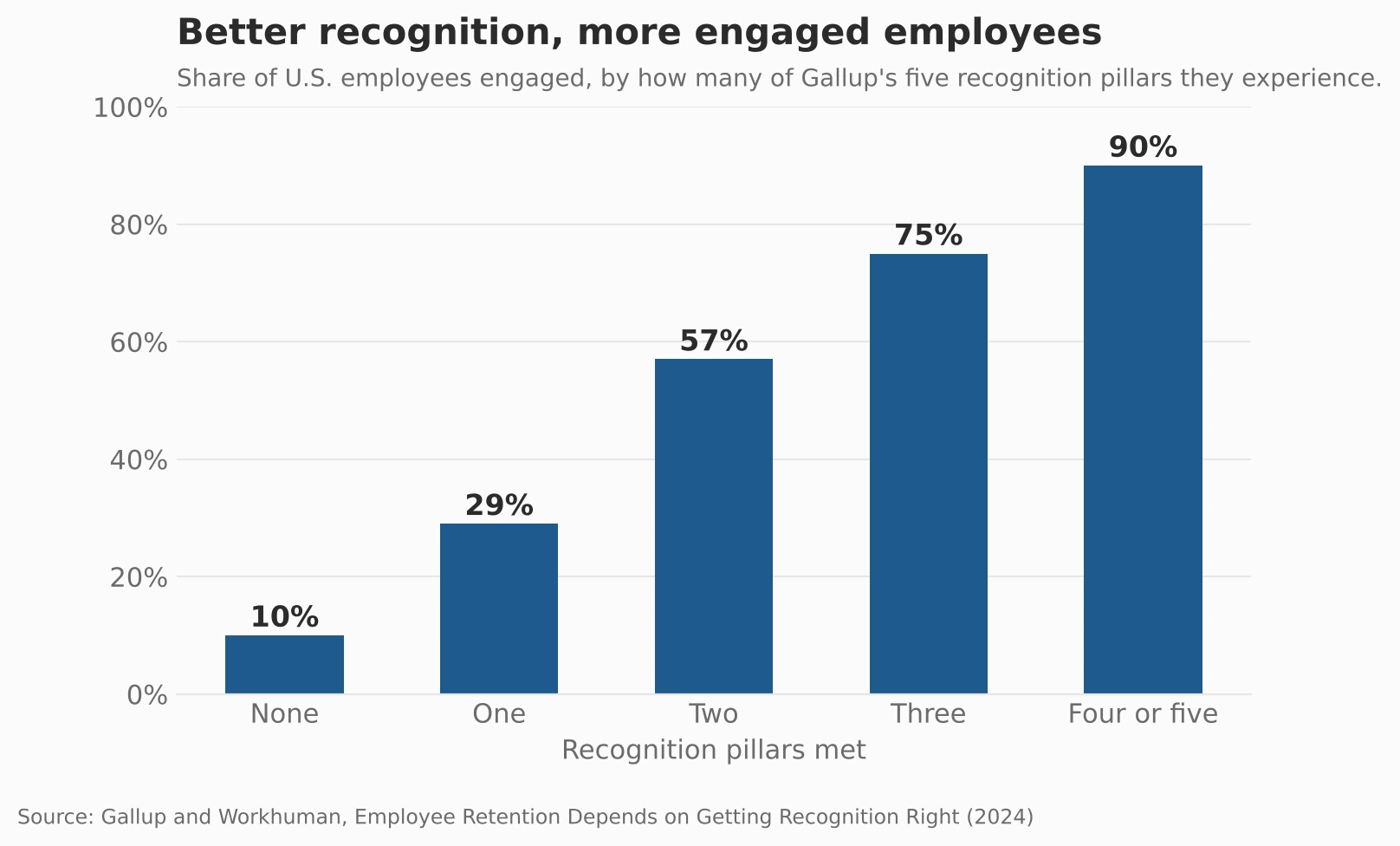
The better the recognition, the higher the engagement.
WHAT THIS MEANS FOR PEOPLE LEADERS Gallup’s five pillars are fulfilling, authentic, equitable, embedded in culture and personalised. A specific thank-you that names the work and its impact beats a points programme nobody notices.
Employee engagement trends to watch
Beyond engagement itself, Gallup tracks how employees feel in their daily lives. These numbers set the context for every engagement initiative in 2027.
65. 34% of employees worldwide were thriving in their overall lives in 2025, up one point from 2024. (Gallup, State of the Global Workplace 2026, global data)
66. 40% of employees worldwide experienced a lot of daily stress in 2025, unchanged from 2024. (Gallup, State of the Global Workplace 2026, global data)
67. The U.S. and Canada had the highest daily stress of any region in 2025, at 50%. (Gallup, State of the Global Workplace 2026, global data)
68. 22% of employees worldwide felt lonely a lot of the previous day in 2025. (Gallup, State of the Global Workplace 2026, global data)
69. 65% of U.S. workers in organisations using AI said it had a positive effect on their productivity. (Gallup, State of the Global Workplace 2026)
70. Less than one-third of U.S. employees strongly agree their manager actively supports their use of AI. (Gallup, State of the Global Workplace 2026)
71. Employees whose manager strongly supports AI use are 8.7 times as likely to say AI has transformed how their work gets done. (Gallup, State of the Global Workplace 2026)
Read together, the trends point the same way: managers are the hinge. They shape engagement, they carry rising stress, and they now decide whether new tools like AI help their teams or not.
How to use these statistics well
-
Compare like with like. Gallup’s global figure (20%) and U.S. figure (31%) come from different surveys, so do not mix them in one trend line.
-
Check the data year. The 2026 Gallup report describes 2025 data. Quote it as “in 2025” to stay accurate.
-
Treat outcome links as associations. Meta-analysis shows that engaged teams perform better, not that a single programme will lift profit by 23%.
-
Benchmark yourself, not the world. Your own trend over four quarters says more about your teams than any global average. Our guide to the pulse survey vs annual survey choice can help you decide how often to measure.
CTA Know your own engagement numbers, not just the global ones. Pulsewise pulse surveys and mood check-ins show how each team is doing, with anonymous responses and minimum group sizes built in. Explore pulse surveys
Final thoughts
The headline number for 2026 is not that engagement is low. It is that the people responsible for engagement, managers, are losing it fastest.
That makes the most useful response surprisingly practical: clearer expectations, more meaningful weekly conversations and recognition that is specific. For a fuller framework, start with our employee engagement master guide.
FAQs
What percentage of employees are engaged in 2026?
Globally, 20% of employees were engaged at work in 2025, according to Gallup’s State of the Global Workplace 2026 report. That is down from 21% in 2024 and a 23% peak in 2022. Another 64% were not engaged and 16% were actively disengaged, so most employees are neither thriving at work nor actively hostile.
What is the employee engagement rate in the US?
Gallup found that 31% of U.S. employees were engaged in 2025, unchanged from 2024. The U.S. peak was 36% in 2020, so roughly 8 million fewer employees are engaged than five years ago. The U.S. and Canada still have the highest engagement of any region Gallup measures.
How much does low employee engagement cost?
Gallup estimates that low engagement cost the global economy about $10 trillion in lost productivity in 2025, or 9% of global GDP. At company level, Gallup puts the cost of replacing an employee at about 40% of salary for frontline roles, 80% for technical roles and 200% for leaders and managers.
Are remote workers more engaged than office workers?
Yes, on engagement, but not on wellbeing. Gallup’s 2025 data shows 30% of exclusively remote workers are engaged, against 25% of hybrid and 17% of on-site staff who cannot work remotely. Yet only 33% of remote workers are thriving, compared with 45% of hybrid workers, and remote workers report more daily sadness and loneliness.
Why is employee engagement declining?
The clearest driver is managers. Global manager engagement fell from 31% in 2022 to 22% in 2025, and managers shape most of their team’s engagement. In the U.S., the largest drops since 2020 are in clarity of expectations and feeling cared about at work, both of which depend heavily on day-to-day management.
What are the biggest employee engagement trends for 2026?
Four trends stand out: manager engagement is falling fastest, younger employees have lost the most ground since 2020, remote work boosts engagement but not wellbeing, and recognition quality matters more than frequency. AI is an emerging fifth trend, since employees whose managers support AI use report far better outcomes from it.