Employee engagement action plan: a step-by-step toolkit for 2026
Most engagement action plans fail quietly. The survey goes out, the scores come back, someone builds a tidy deck, and six months later the team feels the same.
An employee engagement action plan only works when it changes what managers and employees actually do on a normal Tuesday. This guide hands you the full toolkit: a clear definition, the seven steps, a filled example, a driver-to-action map, and a copy-paste template.
You will also learn how to fix the real cause behind a low score, instead of chasing the number itself.
TL;DR
An employee engagement action plan is a documented set of priorities, owners, actions, metrics, and deadlines that turns survey feedback into real change. Most plans fail for three reasons: too many priorities, no single owner per action, and results that never leave a leadership deck. Strong plans focus on two or three drivers, assign one owner to each action, and re-measure on a 30-, 60-, and 90-day cadence. Managers own engagement at the team level. Gallup attributes about 70% of the variance in team engagement to the manager. Start from real pulse data, diagnose the driver behind the score, then match each priority to a specific, measurable action.
What is an employee engagement action plan?
An employee engagement action plan is a documented roadmap that turns engagement survey results into specific actions, each with an owner, a success metric, and a deadline. It moves a team from insight to change.
Think of it as the bridge between a survey score and a different daily experience at work. Without the bridge, the score is just a number on a dashboard.
A complete plan includes five parts:
-
Priorities: the two or three drivers you will fix first.
-
Actions: the concrete steps that address each priority.
-
Owners: one accountable person for every action.
-
Metrics: the signal that tells you the action is working.
-
Timeline: deadlines for each action and firm review points.
Pro Tip : This is different from a broad engagement strategy. If you want the wider playbook first, read our guide to fifteen practical strategies to improve employee engagement. An action plan is the narrower, accountable layer that sits underneath that strategy.
Start from real signals, & not just guesses
A plan is only as good as the data behind it. See how Pulsewise pulse surveys turn daily sentiment into the evidence your action plan needs.
Why most employee engagement action plans fail
Before the steps, it helps to know the traps. Most plans do not fail because HR picked the wrong template. They fail on execution, and almost always in the same three ways.
1. Too many priorities
A plan with ten focus areas is a wish list, not a plan. When everything is a priority, managers quietly default to none of them. Two or three drivers, done well, beat ten drivers done vaguely.
2. No named owner
“HR” is not an owner. “Leadership” is not an owner. Every action needs one person whose name sits next to it, or the action drifts until the next survey reminds everyone it existed.
3. Results stay in a deck
This is the big one. When survey results only reach a leadership slide, employees learn that feedback goes nowhere, and honesty drops in the next cycle.
The research backs this up. Gallup finds that teams whose managers openly share and discuss survey results see higher engagement in the following cycle than teams where results disappear into leadership-only reports.
The stakes, in Gallup’s numbers
Gallup’s Q12 meta-analysis (11th edition) compared business units in the top and bottom quartiles of engagement. The top quartile showed 23 percent higher profitability, 18 percent higher productivity in sales, and 78 percent lower absenteeism. Turnover fell 21 percent in high-turnover organizations and 51 percent in low-turnover organizations. Source: Gallup, State of the Global Workplace and the Q12 Meta-Analysis, 11th edition.
How to create an employee engagement action plan in 7 steps
Here is the full process, from raw survey data to a plan you can defend in a leadership meeting. Each step names the output it should produce.
Step 1: Start from real survey data, not assumptions
Begin with evidence. Pull your most recent engagement survey and pulse results, and look at both the scores and the free-text comments.
If your data is thin, run a short pulse first. A steady rhythm of three to five questions every one to two weeks catches dips faster than an annual survey alone.
Output: a ranked list of the lowest-scoring drivers, with supporting comments.
Step 2: Diagnose the driver behind the score
A low score is a symptom, not a cause. “Recognition” scoring low could mean managers never praise good work, or it could mean praise happens in private and no one sees it.
Read the comments for that driver and ask why twice before you decide on an action. Fixing the wrong cause is how plans waste a whole quarter.
Output: a short root-cause statement for each priority driver.
Step 3: Choose two or three priorities
Now cut the list. Pick the two or three drivers with the biggest gap between their importance and their score.
Resist the urge to fix everything. Focus is the single biggest predictor of whether a plan survives past week three.
Output: two or three named priorities, in rank order.
Step 4: Turn each priority into an action with an owner, metric, and deadline
This is where a plan becomes real. For each priority, write a specific action, assign one owner, define the metric that proves progress, and set a deadline.
Match the action to the cause. If recognition is the gap, launch a visible peer recognition and kudos habit rather than a vague “be more appreciative” note. If people cannot see momentum, make goals and progress visible on a shared board.
Output: an action row for every priority, fully staffed and dated.
Step 5: Cascade org goals into manager-level plans
Company-wide plans stall because engagement is felt at the team level, not the org level. Give each manager a small version of the plan for their own team.
Managers carry most of the weight here, so equip them. Weekly one-on-ones with real talking points are the highest-leverage habit, which is why one-on-one intelligence and resources built for managers matter more than another all-hands.
Output: a one-page team plan for each manager, aligned to the org priorities.
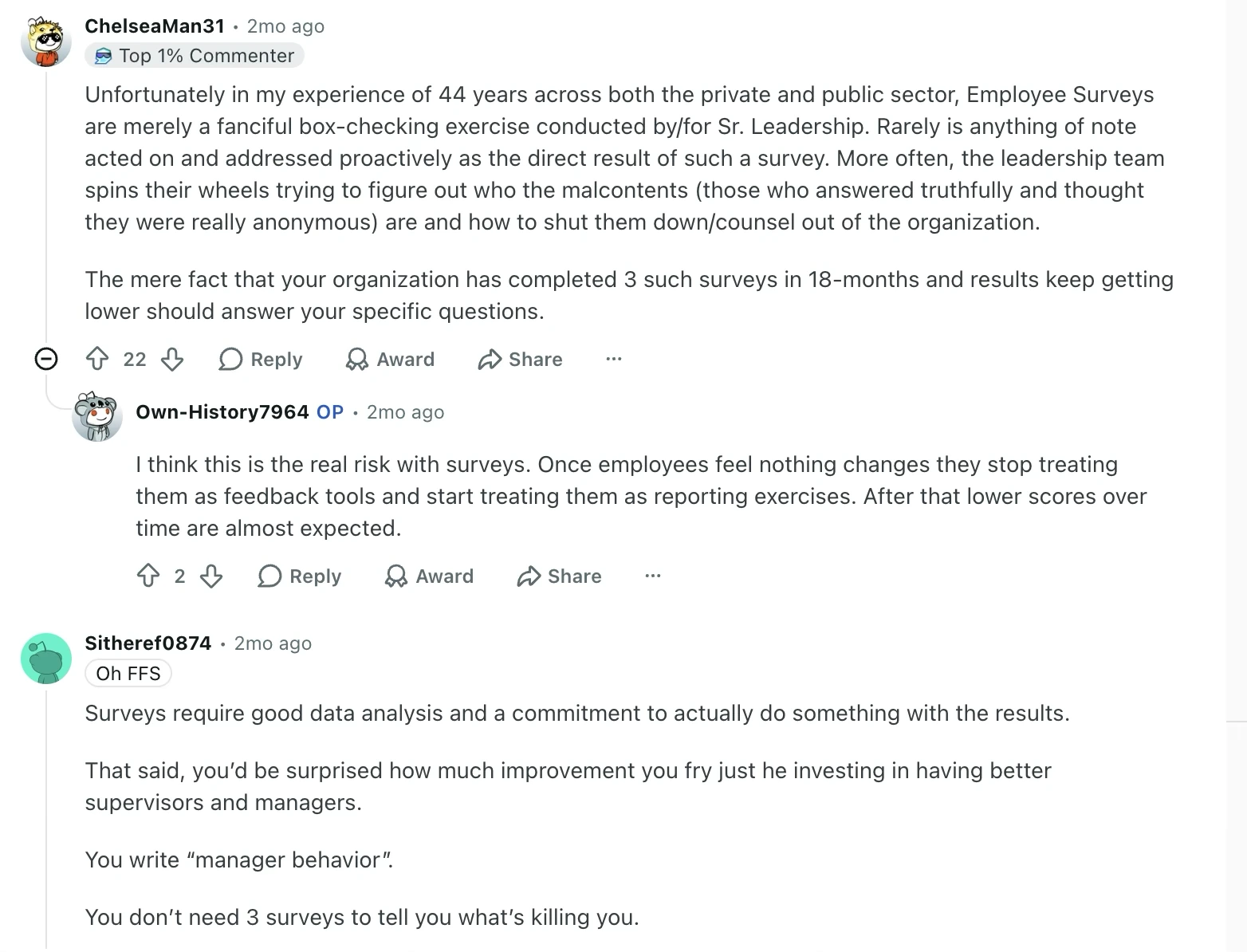
Practitioners describe this spiral in their own words all the time. Here is an example from Reddit which I have scrapped for your reference.
Source: Reddit
Step 6: Communicate the plan and close the loop
Tell people what you heard, what you will do, and what you will not do yet. A plain, honest summary beats a polished deck no one reads.
Closing the loop is what protects your next survey. When employees see one visible change, response quality rises the following cycle.
Output: a short, shared message to every team, in their own manager’s voice.
Step 7: Track on a 30-60-90-day cadence and re-measure
Set three checkpoints. At 30 days, confirm actions started. At 60 days, check early signals. At 90 days, re-measure the driver and decide what to keep, drop, or scale.
Re-measurement is the difference between a plan and a document. Watching engagement and retention signals between formal surveys tells you early whether an action is working.
Output: a dated review log and a decision for each priority.
See the whole loop on your own numbers
Diagnosing drivers, cascading to managers, and re-measuring is far easier when the data lives in one place. Book a short walkthrough and bring your latest survey.
Driver-to-action map: fix the cause, not the score
Use this map when you reach Step 2 and Step 4. It pairs a common weak driver with the signal to look for and the action that tends to fix the underlying cause.
| Weak driver | What the signal looks like | Action that fixes the cause | Owner | Metric |
|---|---|---|---|---|
| Recognition | Good work goes unseen; praise is rare or private | Launch a visible weekly peer-recognition habit in Slack or Teams | People Ops + managers | Recognitions sent per team, per week |
| Manager relationship | 1:1s are skipped, rushed, or status-only | Set a protected weekly 1:1 with prepared talking points | Each manager | 1:1 completion rate; 1:1 quality rating |
| Growth and development | ”No future here” comments; stalled promotions | Give every employee a simple growth plan and one skill goal | Manager + employee | Employees with an active growth goal |
| Clarity of expectations | People unsure what “good” looks like | Rewrite role expectations and review them in the next 1:1 | Manager | Clarity score in next pulse |
| Workload and wellbeing | Burnout language; late-night activity | Rebalance workloads; agree on focus time and off-hours norms | Manager + team lead | Workload pulse score; sick days |
Worked example: an action plan for a 180-person hybrid company
Generic templates leave you staring at empty cells. Here is a filled plan for a realistic case: a 180-person hybrid software company whose latest pulse flagged three weak drivers.
Notice that each row is specific, owned, measurable, and dated. That is the whole test of a good plan.
| Priority | Root cause | Action | Owner | Metric | Timeline |
|---|---|---|---|---|---|
| Recognition (score 5.8/10) | Praise happens in private DMs, so wins are invisible | Weekly team shout-outs in a shared channel; managers model it first | Head of People + team managers | At least 3 public recognitions per team each week | Live by day 14; review day 60 |
| Manager 1:1s (score 6.1/10) | 1:1s exist but slide when work is busy | Protected 30-minute weekly 1:1 with a prepared agenda | Each people manager | 1:1 completion rate above 90 percent | Day 30 checkpoint; re-measure day 90 |
| Growth (score 6.4/10) | No clear path; strong ICs feel stuck | Every employee sets one skill goal tied to a 6-month path | Manager + employee | 100 percent of team with an active growth goal | Goals set by day 45; review day 90 |
Read this plan out loud test
If you can read a row as “[Owner] will do [Action] by [Date], and we will know it worked because [Metric] moved,” the row is ready. If you cannot, the row is still a wish.
Copy-and-paste action plan template
Here is the blank version. Copy it into your own doc or tool, then fill one row per priority. Keep it to three rows so the plan stays focused.
| Priority (driver) | Root cause | Action | Owner | Success metric | Review date |
|---|---|---|---|---|---|
Fill it in this order: name the driver, write the root cause, then the action, then owner, metric, and date. Doing it in that order stops you from jumping to a solution before you understand the cause.
How Pulsewise helps you run the plan
You can run this whole process in a spreadsheet. Most teams do at first. The friction shows up in the loop: collecting honest signals, spotting the driver, giving managers the right nudge, and re-measuring without survey fatigue.
Pulsewise brings that loop into one platform so the plan does not stall between tools:
-
Pulse surveys and DailyMood surface the low drivers and catch dips between formal surveys.
-
Culture analytics connects sentiment to the driver behind a score, so Step 2 takes minutes.
-
The one-on-one board gives each manager AI-suggested talking points, which powers Step 5.
-
Kudos and goals make recognition and progress visible, the two most common actions in Step 4.
-
Engagement and retention views show whether the plan is working, which is Step 7.
Turn your next survey into action, for free
Pulsewise is free forever for the first 100 teams, with up to 100 users, no credit card, and no feature limits. Claim your spot and build the plan on live data.
The bottom line
A good employee engagement action plan is not a longer document. It is a shorter, sharper one that names a few drivers, gives each action a real owner, and gets re-measured on a schedule.
Start small. Pick your two weakest drivers this week, write one action each, and put a name and a date next to them. If you want the wider context first, the employee engagement master guide sets the foundation the plan builds on.
The teams that improve are rarely the ones with the biggest budget. They are the ones that actually close the loop.
FAQs
What is an employee engagement action plan?
An employee engagement action plan is a documented roadmap that turns survey feedback into specific actions. It names two or three priority drivers, assigns an owner to each action, sets a success metric, and adds deadlines. A good plan moves a team from a survey score to visible change on the ground.
What should an employee engagement action plan include?
A strong plan includes clear priorities based on survey data, targeted actions that address root causes, a single owner for each action, measurable success metrics, and firm timelines. It should also include a communication step, so employees hear what changed, plus review points to check progress along the way.
How long does an employee engagement action plan take?
There is no fixed length. Quick wins can land in weeks, while culture shifts run across one or two review cycles. Most teams work in 30, 60, and 90 day checkpoints, then re-measure. Set short deadlines for individual actions and a longer horizon for the drivers behind them.
Who is responsible for the employee engagement action plan?
Responsibility is shared. HR designs the plan, coordinates the survey, and tracks progress. Leadership sponsors it and provides resources. Managers own execution at the team level, since Gallup attributes about 70 percent of the variance in team engagement to the manager. Employees contribute feedback and ideas throughout.
How do you create an employee engagement survey plan?
An employee engagement survey plan sets what you will measure, how often, and how you will act on results. Start with a short pulse survey on a steady rhythm, pair it with a deeper annual survey, and define who reviews each result. The action plan then turns those findings into change.
Why do employee engagement action plans fail?
Most plans fail for three reasons. They chase too many priorities at once, so nothing gets real focus. They assign actions to a department rather than a named owner. And results stay inside a leadership deck, so employees never see change and stop trusting the survey.