Leapsome Alternatives: 7 Platforms Compared for People Teams (2026)
If you are checking Leapsome alternatives for 2026, you are in good company. Leapsome is a capable all-in-one people enablement platform. Its modular pricing, setup overhead, and review-first design still push plenty of People teams to look for something lighter, cheaper, or more listening-led.
This guide compares seven alternatives across pulse survey depth, pricing, G2 scores, and team fit. Every number here comes from a current vendor pricing page or verified 2026 review data, not a guess. One of the seven is free.
TL;DR
-
Leapsome is a strong all-in-one platform, but it runs expensive, needs weeks of setup, and treats pulse surveys as a feature inside a review-heavy product.
-
If continuous listening is your priority, Pulsewise leads on native pulse survey depth and is free for the first 100 teams.
-
For structured performance cycles, Lattice and 15Five are the most mature options, and 15Five has the most transparent pricing.
-
Culture Amp wins on benchmarkable engagement analytics, Workleap on low-admin simplicity, Bonusly on standalone recognition.
-
At a glance: pulse depth to Pulsewise, performance cycles to Lattice, manager check-ins to 15Five, engagement analytics to Culture Amp, simplicity to Workleap, enterprise OKRs to Betterworks, recognition to Bonusly.
What Leapsome Does Well (and Where It Falls Short)
Leapsome is a genuinely strong platform. It combines performance reviews, OKRs, engagement surveys, learning, and a lightweight HRIS in one place, and it earns a 4.8 out of 5 on G2 across more than 2,500 reviews. Users consistently praise its clean interface and responsive support.
The friction shows up in three places: cost, setup, and how it treats listening. Leapsome sells by module, so a stack covering surveys, OKRs, and reviews commonly lands between $8 and $15 per user per month, with no public pricing and a sales quote required. Implementation support only kicks in on annual contracts around $6,000 or more.
| Limitation | Impact on people teams |
|---|---|
| Opaque, modular pricing | No public numbers. A surveys, OKRs, and reviews stack commonly reaches $8 to $15+ per user per month once modules add up. |
| Setup overhead | Review cycles, competency frameworks, survey cadences, and workflows all need configuring before launch. |
| No native mobile app | Leapsome confirms it has no mobile app. You add a home-screen web shortcut instead, per Leapsome’s own help center. |
| Pulse surveys as a module feature | Survey design, cadence, and anonymity live inside the broader engagement module, not as a standalone listening product. |
| Notification load | Automated review-cycle reminders can create email fatigue, especially during active performance cycles. |
Why People Teams Look for Leapsome Alternatives
People teams leave Leapsome for four recurring reasons: price, setup time, listening depth, and scope fit.
Price is the loudest. Reviewers describe pricing that feels reasonable at 10 people and becomes a strain past 40, because every capability sits behind its own module. Budgets get hard to plan when the real total only appears after a sales call.
Setup time is the second. Getting review templates, competency frameworks, and survey cadences right takes real effort before anyone sees value. Iterating on questions later is clunky, a complaint that shows up often in reviews.
Listening depth is the third. Leapsome is review-led by design, so continuous pulse listening lives inside the engagement module rather than the core product. Teams that want daily signal, not quarterly campaigns, usually want a listening-first tool.
Scope is the fourth. Some teams find Leapsome does too much and want something simpler. Others outgrow it and want deeper analytics or enterprise OKR alignment. The right alternative depends on which of these four is your real pain.
If listening is your pain point Pulsewise treats pulse surveys as the core product, not a bolt-on, with daily signal and AI-driven dimension analysis. See how continuous pulse surveys work.
The 7 Best Leapsome Alternatives in 2026
1. Pulsewise: Best for Pulse Survey Depth and Continuous Listening
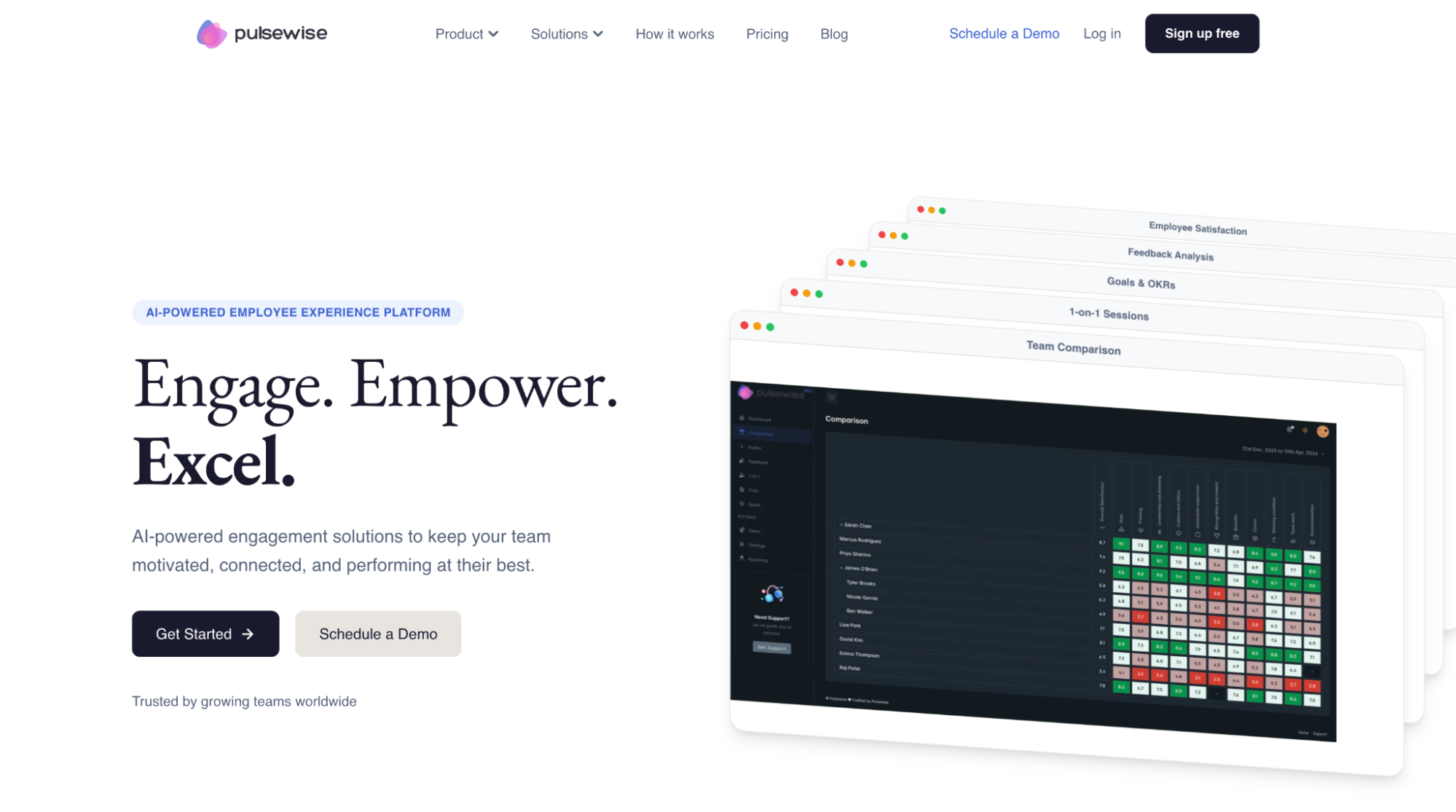
Pricing: Free forever for the first 100 teams, up to 100 users, with every current feature included and no credit card. This is a launch offer, not a trial. Once the 100 spots fill, new signups join a waitlist, and paid Growth plans with per-seat pricing arrive later. See the current offer.
G2 rating: Emerging platform, not yet rated on G2.
| What works well | Watch out for |
|---|---|
| Daily pulse surveys with AI dimension analysis (mood, engagement drivers) as the core product, not a module. Surveys, feedback, recognition and kudos, and goal tracking in one dashboard, all included on the free plan. Setup in under a minute, with no competency frameworks or templates to build first. Predictive attrition signals from combined survey, recognition, and goal data. Free forever for the first 100 teams, no credit card and no feature limits. | New platform, so there is no G2 track record or third-party review base yet. AI performance reviews and AI compensation planning are on the near-term roadmap, not fully shipped. Enterprise security items such as SSO and SAML are listed as coming, not live today. Best fit is 50 to 300 employees. Very large org complexity is still being tested. Paid pricing after the free window closes has not been published. |
Best for: hybrid or remote-first teams of 50 to 300 that want real-time engagement signal and a clean all-in-one setup, without an implementation project or a sales call. Pulsewise pairs the daily pulse with a live view of engagement and retention risk.
Not the best fit for: organisations that need a long G2 track record, shipped enterprise certifications, or a mature compensation module today.
2. Lattice: Best for Structured Performance Cycles at Mid-Market Scale
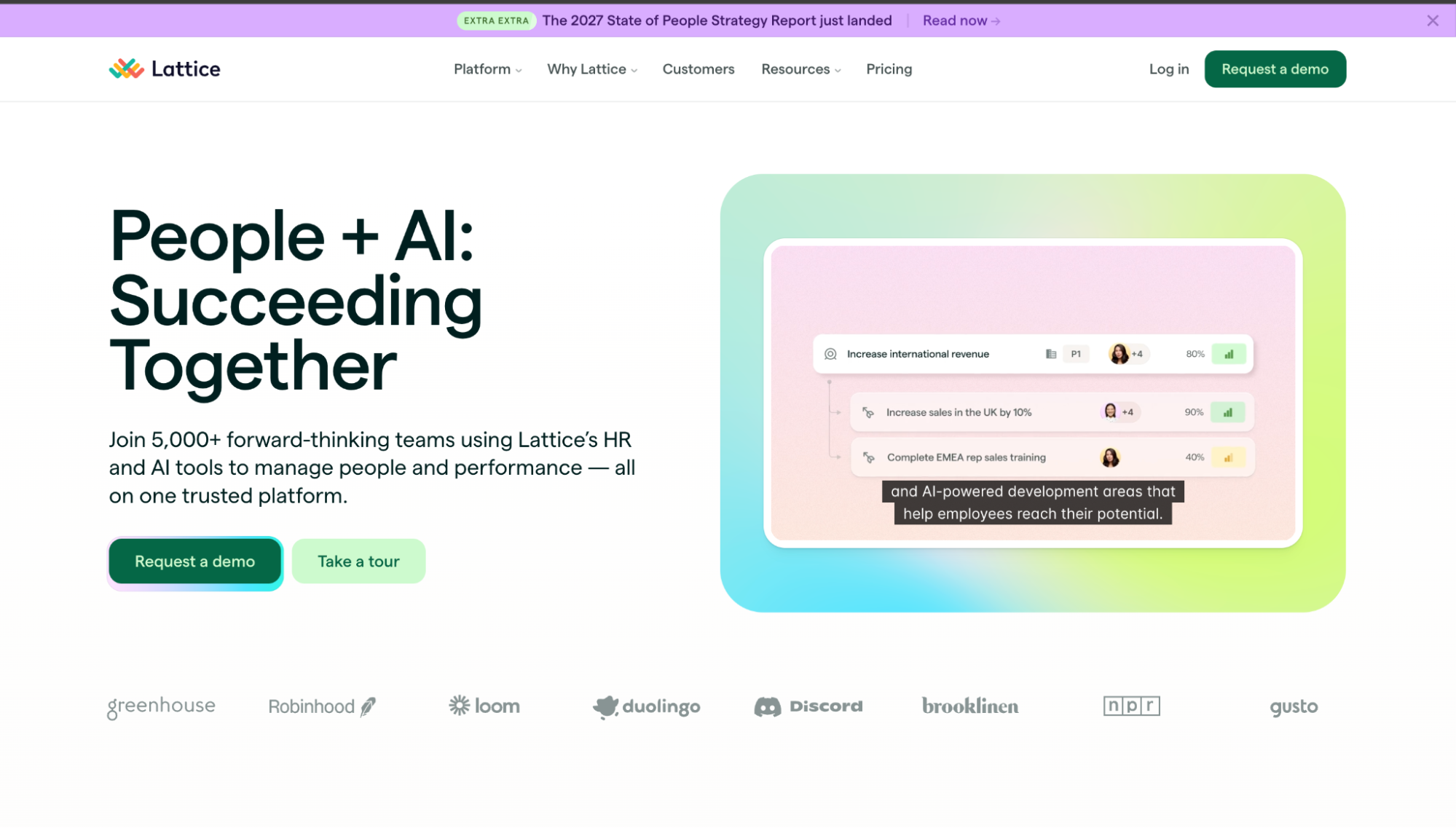
Pricing: Modular, billed annually in USD, with a $4,000 annual minimum. The Foundations bundle (performance, goals and OKRs, 1:1s, feedback, AI, analytics) is $13 per seat per month. Individual modules start lower, with engagement at $4 and performance around $8, and adding compensation and growth can push a full stack toward $23 per seat per month.
G2 rating: 4.7 out of 5 across more than 4,000 reviews. Lattice reports over 5,000 customer organizations.
| What works well | Watch out for |
|---|---|
| Coherent modular platform you can expand from performance into engagement, OKRs, and compensation as you grow. Strong compensation workflow tied directly to performance data. A deep review base and category recognition give procurement teams confidence. | Costs climb sharply once you add engagement, grow, and compensation modules. Survey customization and filtering are less flexible than dedicated engagement platforms. Lattice is sunsetting its standalone HRIS module in 2026, so confirm your HRIS plan before committing. |
Best for: mid-market teams of 200 to 1,000 already running structured review cycles that want room to expand into compensation and HRIS territory.
Not the best fit for: budget-tight teams, those who mainly want lightweight pulse surveys, or teams whose core Leapsome pain is complexity, since Lattice is comparably complex.
3. 15Five: Best for Manager-Led Continuous Feedback and Weekly Check-Ins
Pricing: Engage $4, Perform $11, and Total Platform $16 per user per month, all billed annually. This is the most transparent public pricing in the category. Compensation, AI coaching, and manager content are separate add-ons.
G2 rating: 4.6 out of 5 on G2 (around 1,850 reviews) and 4.7 out of 5 on Capterra.
| What works well | Watch out for |
|---|---|
| Published, predictable per-user pricing you can take to finance without a custom quote. A weekly check-in cadence that builds feedback habits and reduces review-time surprises. High Fives peer recognition is built in, adding a light social layer. | ROI depends heavily on manager adoption. Low participation hollows out the engagement data. Engagement questions need periodic refreshes, or survey fatigue sets in. Compensation is a paid add-on, not part of the core tiers. |
Best for: mid-market teams of 100 to 500 building a continuous feedback culture that want a transparent price they can take to finance without a quote.
Not the best fit for: organizations with low manager buy-in, or teams that need deep pulse analytics beyond weekly check-in data.
4. Culture Amp: Best for Data-Driven Engagement at Scale
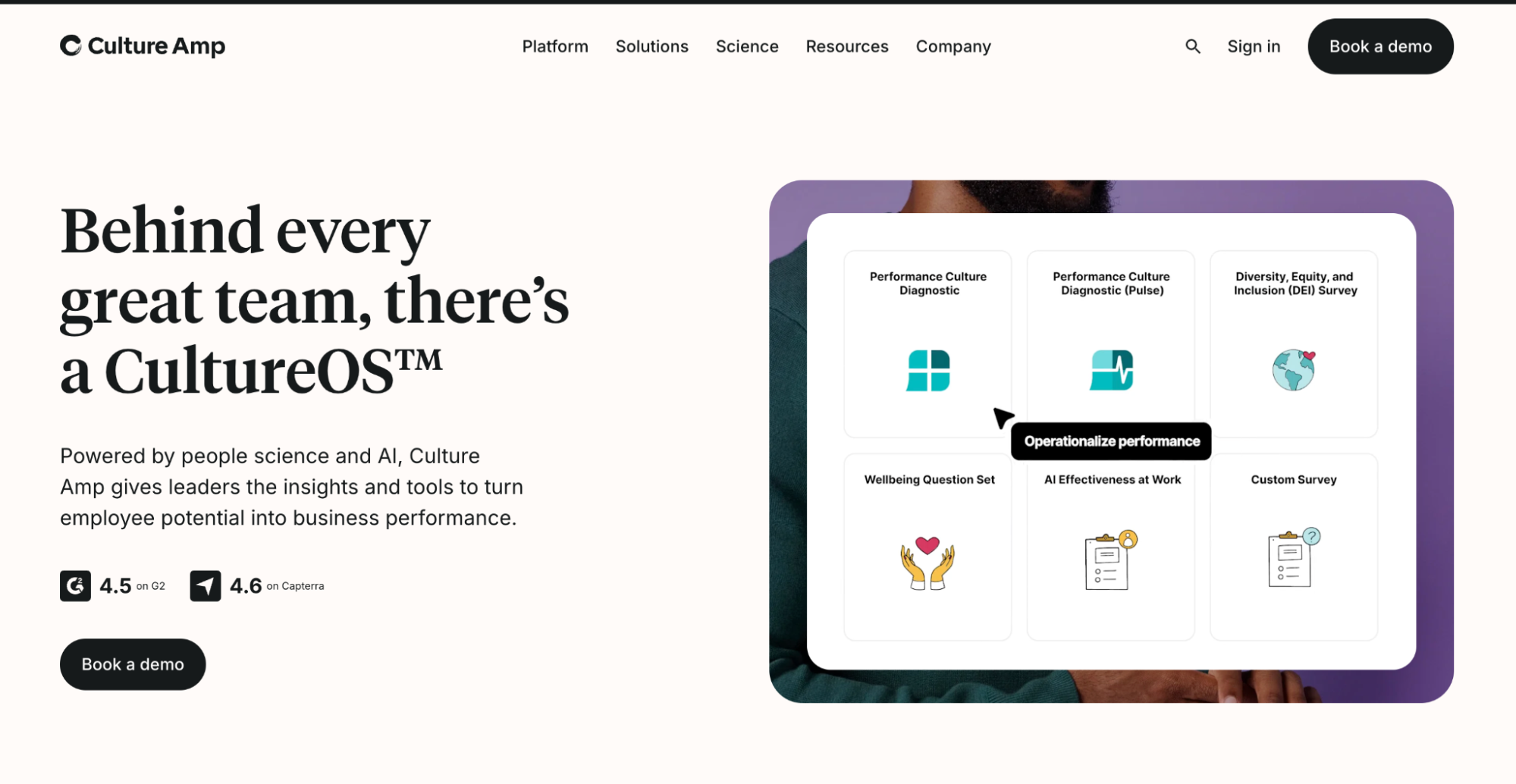
Pricing: Custom quote only, with no public rates. Third-party 2026 transaction data puts typical deployments at roughly $5 to $15 per employee per month, with a minimum spend near $4,500 per year. Enterprise contracts commonly run $10,000 to $45,000 or more annually.
G2 rating: 4.5 out of 5 on G2 across more than 1,500 reviews. Also rated on Capterra and Gartner Peer Insights.
| What works well | Watch out for |
|---|---|
| A science-backed survey library and benchmarks drawn from 6,000+ organizations. Turnover prediction and attrition modeling that give People leaders a board-ready business case. Cross-company benchmark data that gives engagement scores real external context. | Custom-only pricing means no budget estimate before a sales call, the same friction point as Leapsome. Dashboard depth can overwhelm new users, and reporting customization is narrower than the data suggests. Some configurations still require manual HRIS sync. |
Best for: companies of 150 to 5,000 that need externally benchmarkable engagement data, board-ready analytics, and a people-science team behind the product. If Culture Amp is on your shortlist, our Pulsewise vs Culture Amp comparison breaks down the trade-offs.
Not the best fit for: startups under 150, teams that want a self-serve evaluation, or teams that want daily listening rather than periodic deep surveys.
Not ready for another custom-quote process? Pulsewise is free for the first 100 teams, with pulse surveys, recognition, goals, and feedback included and no sales call required. See exactly what is included.
5. Workleap (Officevibe): Best for Low-Admin Pulse Surveys
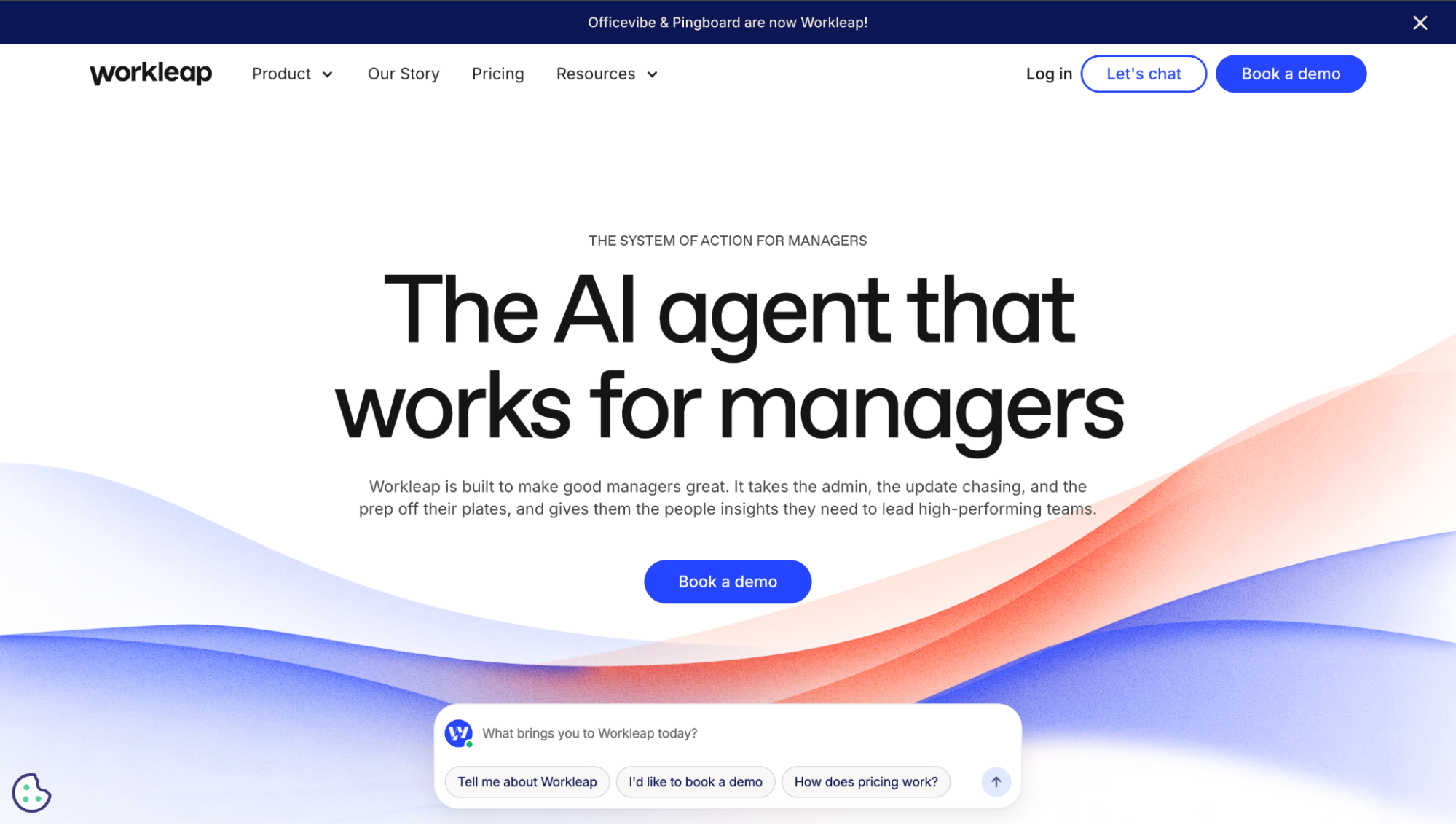
Pricing: Standalone Officevibe engagement runs about $5 per user per month billed annually, with a 10-user minimum. The Officevibe plus Performance bundle is around $9 per user per month, and the wider Workleap platform offers higher tiers. A free trial is available.
G2 rating: 4.3 out of 5 on G2 across more than 1,000 reviews, with a higher score on Capterra.
| What works well | Watch out for |
|---|---|
| Minimal admin. Automated pulse surveys run without HR intervention once configured. Anonymous feedback that actually gets used, thanks to native Slack and Teams delivery. Sentiment analysis on anonymous feedback out of the box. | Performance reviews, OKRs, and learning are separate Workleap modules, so the engagement layer alone does not replace Leapsome’s full suite. Reporting customization is limited. Analytics depth trails Culture Amp and Pulsewise. |
Best for: Slack-heavy teams of roughly 75 to 250 that want automated pulse surveys with minimal admin and are replacing the engagement layer, not the full performance stack.
Not the best fit for: teams that need reviews, OKRs, and goals in the same product, or very small teams once module minimums are counted.
6. Betterworks: Best for Enterprise OKR Alignment Across Matrixed Organizations
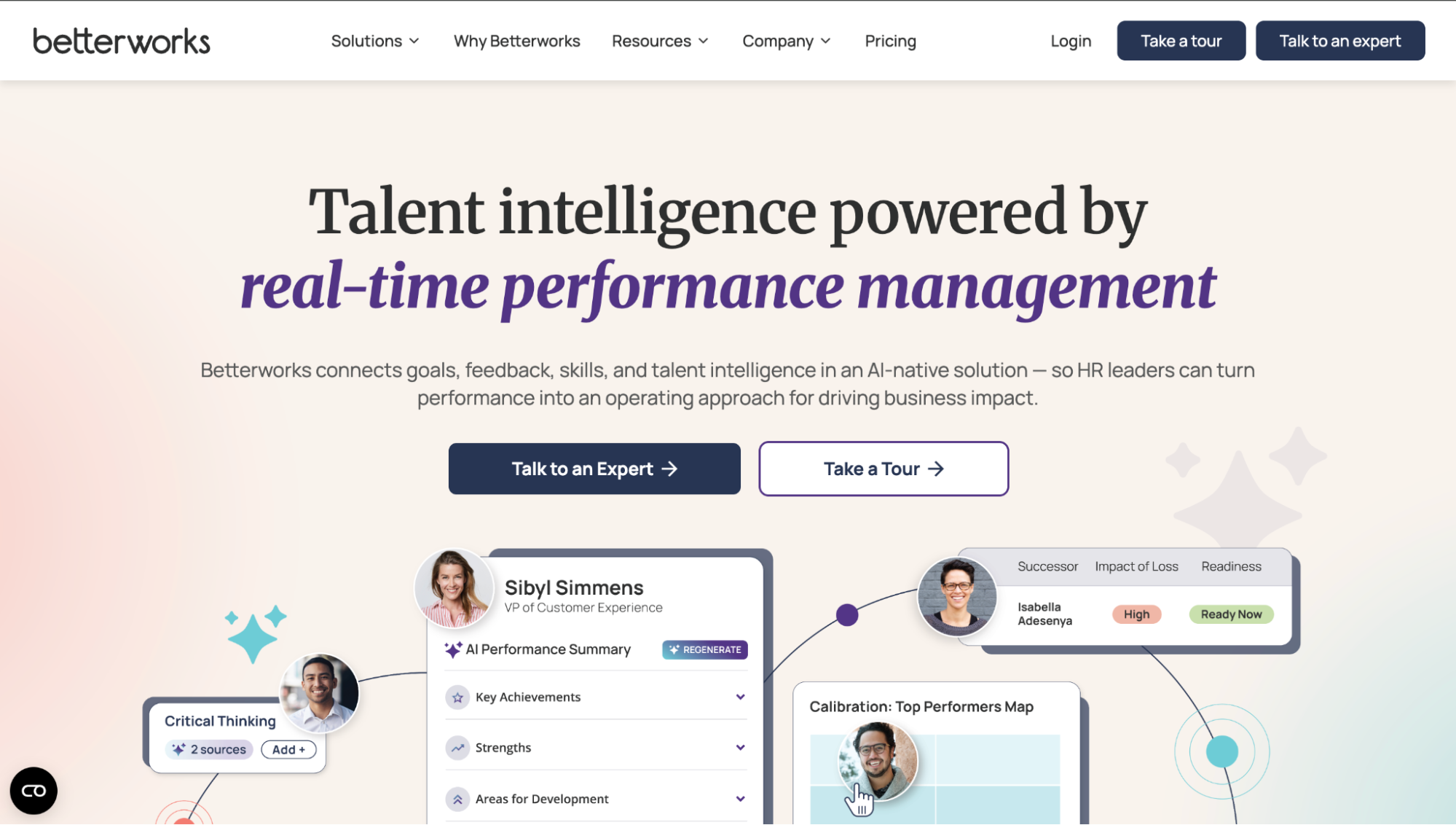
Pricing: Custom quotes only, with no public pricing and no free trial. Third-party 2026 estimates put enterprise deployments around $8 to $15 per user per month, with implementation fees on top. Betterworks is built for large organizations, typically 500 employees and up.
G2 rating: 4.3 out of 5 on G2 across roughly 220 reviews, and 4.2 out of 5 on Capterra.
| What works well | Watch out for |
|---|---|
| Enterprise OKR alignment across matrixed structures, stronger than Leapsome for complex goal cascades. AI-powered performance insights and calibration workflows built for large-scale reviews. Embeds into Slack and Teams so performance conversations happen in existing channels. | Ease of use ranks lower in the category. Initial setup needs meaningful HR-tech investment. The mobile experience trails desktop and is not practical for deskless populations. A smaller review base gives procurement less social proof than the larger platforms. |
Best for: enterprises of 500 and up in technology, financial services, or healthcare with a board-level OKR framework that need a performance layer to cascade it.
Not the best fit for: companies under 500, teams that want self-serve onboarding, or teams prioritizing pulse survey depth over goal alignment.
7. Bonusly: Best for Peer-to-Peer Recognition as a Standalone Practice
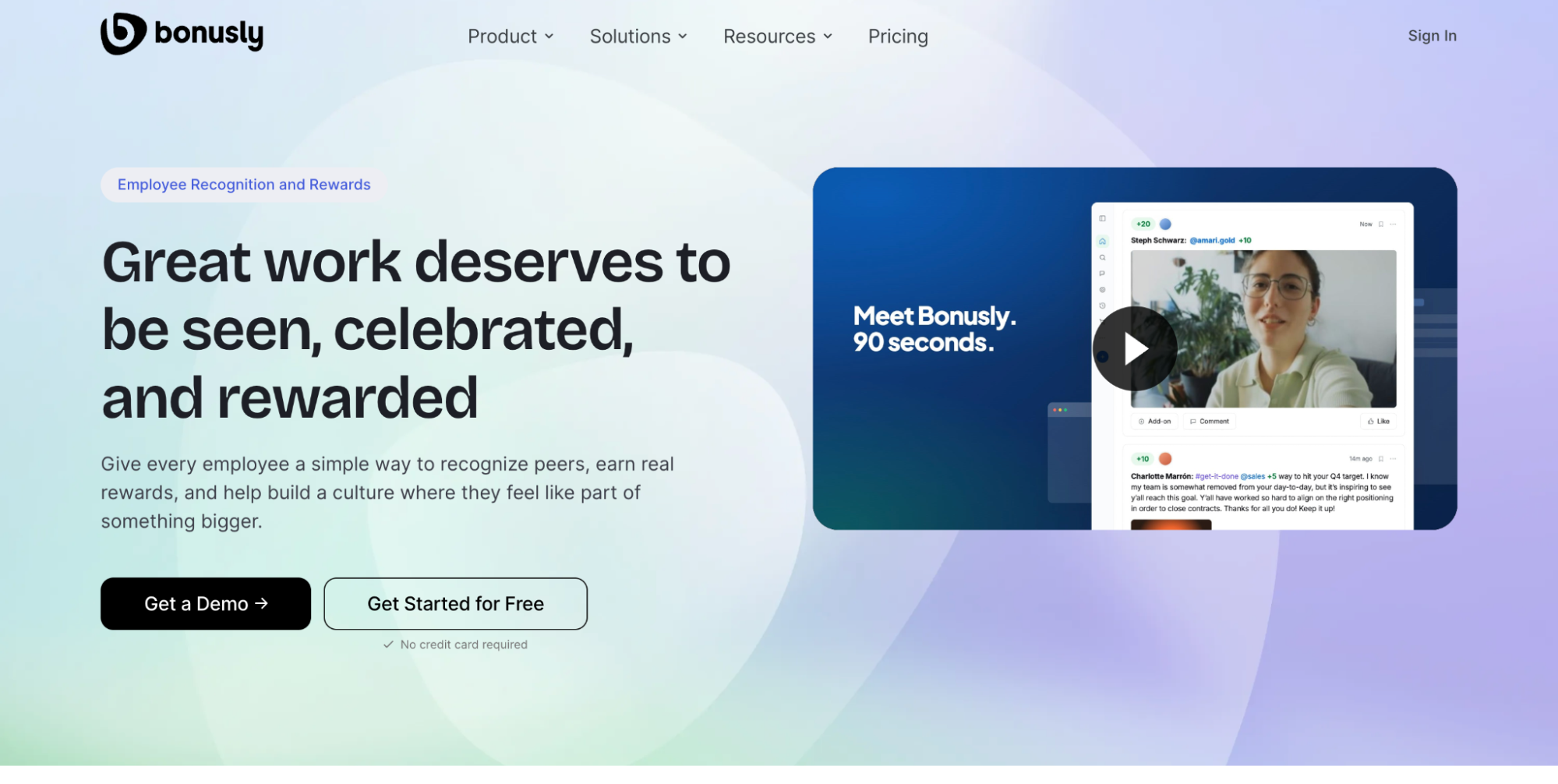
Pricing: A free plan for up to 8 users. The Team plan is $3 per user per month, or about $30 per user per year billed annually, which includes two months free. Organization pricing is custom. Reward points are funded separately on top of the subscription.
G2 rating: 4.7 out of 5 across roughly 6,900 reviews, one of the most-reviewed recognition platforms in the category.
| What works well | Watch out for |
|---|---|
| The deepest review base of any peer-recognition tool, at 4.7 out of 5. Real, redeemable rewards (gift cards, merchandise, donations) that make recognition tangible rather than performative. A free plan for up to 8 users lets small teams run a genuine pilot before committing. | Monthly point allocations can run out for managers who want to recognize frequently. Reward redemption options are thinner outside the US, and unused points can expire monthly. Recognition-first. Bonusly adds lightweight 1:1s and check-ins, but it is not a pulse-survey, performance-review, or OKR platform. |
Best for: teams adding a dedicated recognition layer alongside another platform, or organizations where points-based recognition is the primary cultural investment.
Not the best fit for: anyone trying to replace Leapsome’s full feature set. Bonusly is best-of-breed recognition, not an all-in-one people platform.
Side-by-Side Comparison: Leapsome vs 7 Alternatives
Leapsome sits at the top as the baseline. The seven alternatives follow in the order covered above.
| Platform | G2 rating | Pricing (from) | Best for | Pulse survey depth |
|---|---|---|---|---|
| Leapsome | 4.8/5 (2,500+) | ~$8 to $15/user/mo (quote) | All-in-one, review-led | Moderate (module) |
| Pulsewise | Emerging (unrated) | Free (first 100 teams) | Continuous listening | Native, AI, deep |
| Lattice | 4.7/5 (4,000+) | $13/seat/mo bundle | Structured performance | Moderate (add-on) |
| 15Five | 4.6/5 (1,850+) | $4 to $16/user/mo | Manager-led feedback | Good (check-ins) |
| Culture Amp | 4.5/5 (1,500+) | Custom quote | Data-driven engagement | Strong (benchmarked) |
| Workleap | 4.3/5 (1,000+) | ~$5/user/mo (10-user min) | Simple pulse surveys | Good (core focus) |
| Betterworks | 4.3/5 (220) | Custom (~$8 to $15/user/mo) | Enterprise OKRs | Limited |
| Bonusly | 4.7/5 (6,900) | Free up to 8, then $3/user/mo | Peer recognition only | None |
For a full cost breakdown across these platforms, see our 2026 employee engagement software pricing guide.
How to Choose the Right Leapsome Alternative
Match the tool to your single biggest Leapsome pain, not to the longest feature list. Three pains cover most switches.
If your main pain point is pulse survey depth
Choose a listening-first platform. Pulsewise and Culture Amp sit at opposite ends here. Pulsewise gives daily, AI-analyzed signal with a free entry point, while Culture Amp gives deep, benchmarked periodic surveys for larger, analytics-heavy teams.
Workleap is the low-admin middle option for Slack-first teams. Pick based on whether you want a daily rhythm or research-grade depth.
If your main pain point is pricing or complexity
Favor transparent, self-serve pricing and fast setup. 15Five publishes its per-user tiers, and Pulsewise is free for the first 100 teams with sub-minute setup.
Both spare you the quote wall and the multi-week implementation that push teams off Leapsome in the first place. If budget predictability is the goal, avoid custom-quote-only tools.
If your main pain point is scope (too much or too little)
Define what you are actually replacing before you shop. If you only need the engagement layer, Workleap or Bonusly cover it cheaply.
If you need the full all-in-one, Pulsewise, Lattice, or 15Five are closer fits, and Betterworks suits enterprises that live and die by OKR cascades. To sanity-check what each platform will really cost, our employee engagement software pricing breakdown lays out the totals. For the wider picture, start with our employee engagement master guide.
The Bottom Line
Leapsome is not a bad platform. It is a heavy one, and for a lot of People teams the weight, the quote wall, and the review-first design stop matching what they actually need day to day.
Start from your real pain. If it is listening, go listening-first. If it is price or setup, go transparent and self-serve. If it is scope, decide what you are replacing before you shop.
And if you want to feel the difference rather than read about it, the fastest way is to try one. Pulsewise is free for the first 100 teams, so you can have daily pulse signal running before your next 1:1.
Ready to test a Leapsome alternative that launches in under a minute? Pulsewise is free for the first 100 teams: pulse surveys, recognition, goals, and feedback, with no credit card and no setup call. Start for free,
FAQs
What is the main difference between Leapsome and its alternatives?
Leapsome is a review-led, all-in-one platform sold by module behind a sales quote. Its alternatives split into three camps: listening-first tools like Pulsewise and Workleap, performance-led suites like Lattice and 15Five, and recognition specialists like Bonusly. The right pick depends on whether you prioritize pulse depth, performance cycles, or recognition.
Is Leapsome too expensive for small companies?
Often, yes. Leapsome’s per-module pricing commonly totals $8 to $15 or more per user per month, and reviewers say costs that feel fine at 10 people strain budgets past 40. Implementation support requires annual contracts near $6,000. Smaller teams frequently move to transparent per-user tools, or a free option like Pulsewise.
What is the best Leapsome alternative for pulse surveys?
For continuous, listening-first pulse surveys, Pulsewise leads, since daily AI-analyzed surveys are its core product rather than a module. Culture Amp is stronger for deep, benchmarked periodic surveys at enterprise scale, and Workleap suits teams wanting simple automated pulses. Your choice comes down to daily signal versus research-grade depth.
Can I replace Leapsome entirely with one of these tools?
It depends on how much of Leapsome you use. All-in-one platforms like Pulsewise, Lattice, and 15Five can replace most of it: surveys, feedback, goals, and reviews. Point tools like Bonusly or Workleap replace only one layer. Map your active Leapsome modules first, then match a tool to that scope.
How long does it take to switch from Leapsome to an alternative?
It ranges from minutes to weeks. Self-serve tools like Pulsewise set up in under a minute with no templates required, while enterprise platforms like Lattice, Culture Amp, and Betterworks involve configuration and onboarding that can take one to four weeks. Data export and change management usually drive the timeline more than the software.
Does Leapsome have a free trial?
Leapsome does not offer a permanent free plan, but a free trial and guided demos are available, and pricing requires a sales quote. It also lets you use the platform free until an existing contract with another vendor ends. For a genuinely free option, Pulsewise is free forever for the first 100 teams.