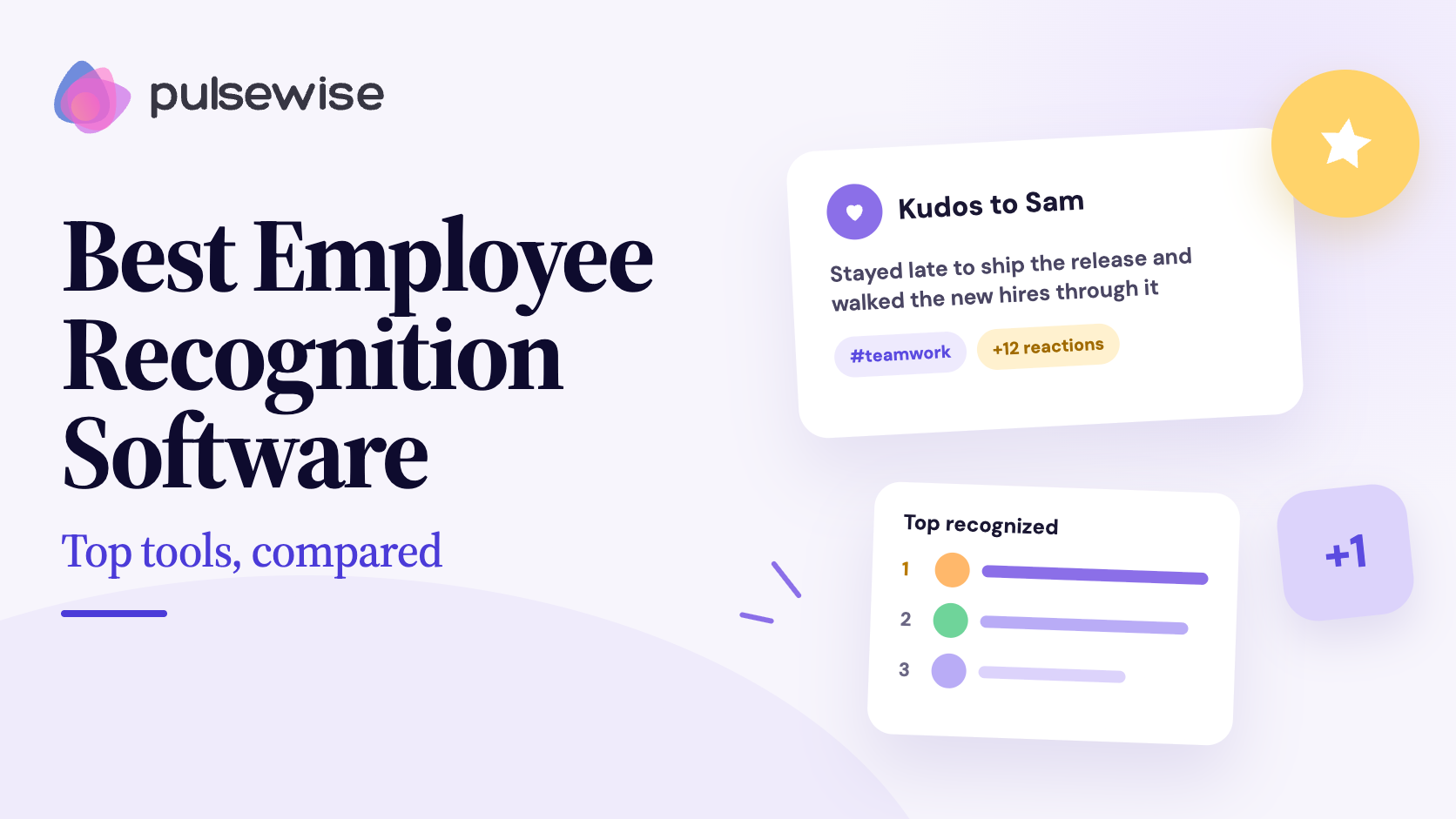
Most recognition programs look healthy in month one. The feed is busy, the leaderboard moves, and people redeem their first gift cards.
By month six, the same twelve people give most of the shoutouts, and managers still walk into reviews without remembering who carried the hard project in March. The recognition happened. It just never reached the conversations where it would have mattered.
That gap is the real test for employee recognition software. Some tools are built to run a rewards economy, others to make appreciation visible inside the work, and a few try to do both.
This guide compares nine tools for teams of roughly 50 to 500 people on four things buyers actually ask about: how recognition works, what rewards cost, whether it lives in Slack or Microsoft Teams, and the price you will pay.
TL;DR
- Best for recognition connected to goals, feedback, and 1:1s: Pulsewise Kudos, an emerging platform with a free-forever launch offer for eligible teams. It has no points or rewards catalog.
- Best-known points-and-rewards option: Bonusly, with a free plan for up to 8 users and paid plans from $3 per user per month.
- Best free option for Slack or Teams: Matter, free for unlimited users, with rewards from $3 per user per month.
- Best value points platform: Assembly at $3 per user per month, billed yearly, with Slack and Teams included.
- Best for global rewards at scale: Motivosity and Awardco, both quote-based with $3,000 starting spends for smaller teams.
- Best for manager-led recognition inside a performance suite: Workleap Good Vibes, priced as part of the Workleap platform.
Comparison table: 9 employee recognition tools
Seven of the nine tools run on points or currency that employees redeem for rewards. Pulsewise and Workleap take a different route, with recognition that stays attached to the person’s growth record rather than a rewards balance.
All prices come from each vendor’s own pricing page, in USD, as of October 2026.
| Tool | Recognition model | Rewards | Slack / Teams | Pricing |
|---|---|---|---|---|
| Pulsewise | Kudos with value tags, recognition feed, AI writing help; feeds individual Reputation alongside feedback, goals, and 1:1s | No points or catalog; shareable recognition cards and AI celebration artwork | Slack directory import; no in-chat kudos listed | Free forever for the first 100 eligible teams, up to 100 users (pricing) |
| Bonusly | Values-tagged peer recognition backed by redeemable points; Bizy AI assistant | Global catalog: gift cards, donations, cash, swag, billed at face value | Yes, both | Free up to 8 users; Team $3/user/mo, or $5 with Bizy AI; Org custom (pricing) |
| Matter | Kudos and Feedback Friday inside chat | eGift cards from 3,500+ brands in 200+ countries, face value (Pro) | Native in both | Free for unlimited users; Basic $1, Pro $3/user/mo billed annually (pricing) |
| Assembly | Peer recognition with points and budget controls; Dora Hub AI insights | Global reward catalog | Yes, plus 100+ integrations | Empower $3/user/mo billed yearly; Enterprise custom (pricing) |
| Nectar | Points-based peer shoutouts, milestones, nominations, challenges | 200+ gift cards, full Amazon catalog, swag store, custom perks | Yes, both | Bundles, quote only (pricing) |
| Motivosity | Funded or unfunded, dollar or points programs; spot bonuses | Reward marketplace in 140+ countries; swag store | Yes, both | Custom; Small Business bundle has a $3,000 minimum spend (pricing) |
| Awardco | Plans built on recognition types: automated, spot, nominations, earn, external | Amazon and other ecommerce, 163 countries | Yes, both | Quote; starter packages from $3,000 for 100 employees or fewer (plans) |
| Vantage Circle | Peer recognition, nomination awards, milestones; AI award recommendations | Amazon store, gift vouchers, experiences, merchandise | Add-ons | Custom (Grow, Transform, Scale) (pricing) |
| Workleap | Manager-led Good Vibes cards drafted from team activity, tied to values | None listed | Posts to both | Standard $4,999/year + $32/manager/month; custom above 250 employees (pricing) |
Points store or context: the two models of recognition software
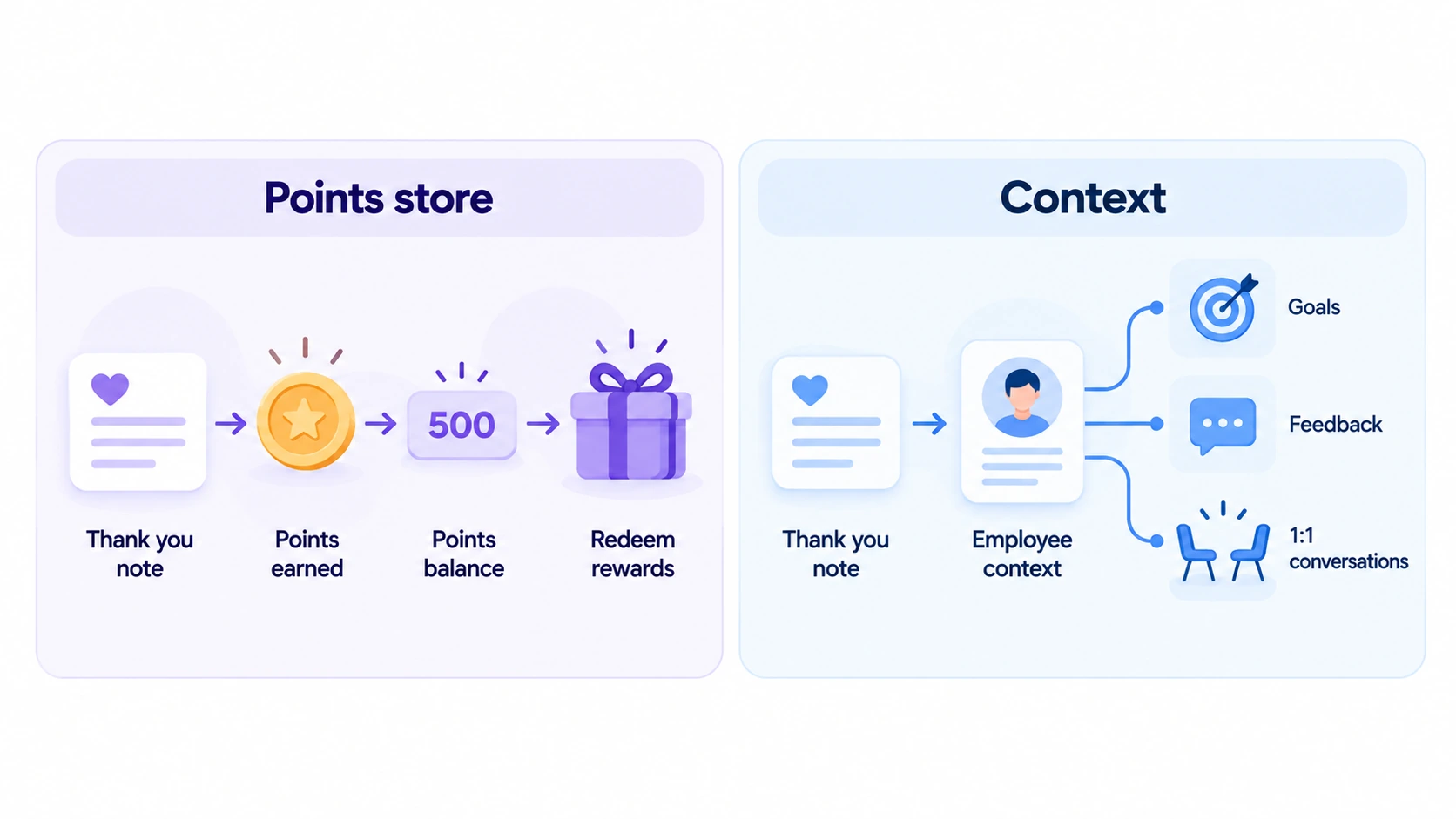
Every employee recognition platform answers one question differently: what happens to a thank-you after it is sent? The answer splits the market into two models.
The points store model
Points-based tools give employees an allowance or budget to send with each recognition. The recipient collects points and redeems them for gift cards, swag, or donations, so recognition has a cash value.
This model drives participation fast, and tools like Bonusly, Nectar, and Assembly have refined it for years. The trade-off is that rewards spending sits on top of the subscription, and the recognition itself rarely travels beyond the feed.
The context model
Context-first tools treat a recognition as evidence of contribution. The note, the value it reflects, and the people involved stay attached to that person’s record, where a manager can see it before a 1:1 or review.
Pulsewise and Workleap both lean this way. Neither runs a rewards catalog, so they suit teams that care more about recognition reaching growth conversations than about gift cards.
Why the quality of recognition matters more than volume
Recognition that people find meaningful changes whether they stay. In longitudinal research tracking nearly 3,500 employees from 2022 to 2024, Gallup and Workhuman found that well-recognized employees were 45% less likely to have changed organizations two years later.
The point is quality, not frequency. A specific, values-linked note that a manager later references does more than a stream of generic “great job” posts, which is why our employee turnover playbook treats recognition as a retention habit, not a perk.
What to look for in an employee recognition platform
Use these six criteria to test every tool on your shortlist. Each one ends with a question worth asking in the demo.
1. Where recognition happens
Hybrid and remote teams recognize each other where they already talk. If your company lives in Slack or Microsoft Teams, in-chat recognition will beat any web app on participation.
Ask the vendor: Can employees send and react to recognition without leaving Slack or Teams?
2. Values tagging
Linking recognition to company values shows which behaviours people actually notice. It also gives managers a shared language for feedback later.
Ask the vendor: Can we tag recognition with our own values and report on them by team?
3. Rewards and their real cost
Most points tools bill rewards at face value on top of the subscription. A $5 per user plan with a $10 monthly reward budget per person costs three times the list price.
Ask the vendor: What does a typical customer our size spend on rewards, beyond the license?
4. What happens to recognition after the feed
This is the criterion most roundups skip. Ask whether a recognition can surface in a 1:1, a performance review, or a person’s growth record, or whether it disappears as the feed scrolls.
Ask the vendor: Can a manager see a person’s recognition history when preparing for a review?
5. Manager visibility and participation gaps
Good analytics show who gives and receives recognition, and who never does. Recognition programs often miss quieter contributors and remote employees.
Ask the vendor: Can we see people who have received no recognition in the last 60 days?
6. Pricing at your headcount
Per-user prices look small, but minimum spends, AI add-ons, and HRIS fees add up. Price your real team at 100 and 300 people before comparing.
Ask the vendor: What is our annual total, including add-ons, minimums, and a realistic rewards budget?
The best employee recognition software in 2026
We selected tools that fit teams of 50 to 500 people, publish enough product detail to verify, and serve hybrid or remote work. Enterprise-first platforms built for thousands of employees are left out on purpose.
1. Pulsewise: best for recognition connected to goals, feedback, and 1:1s
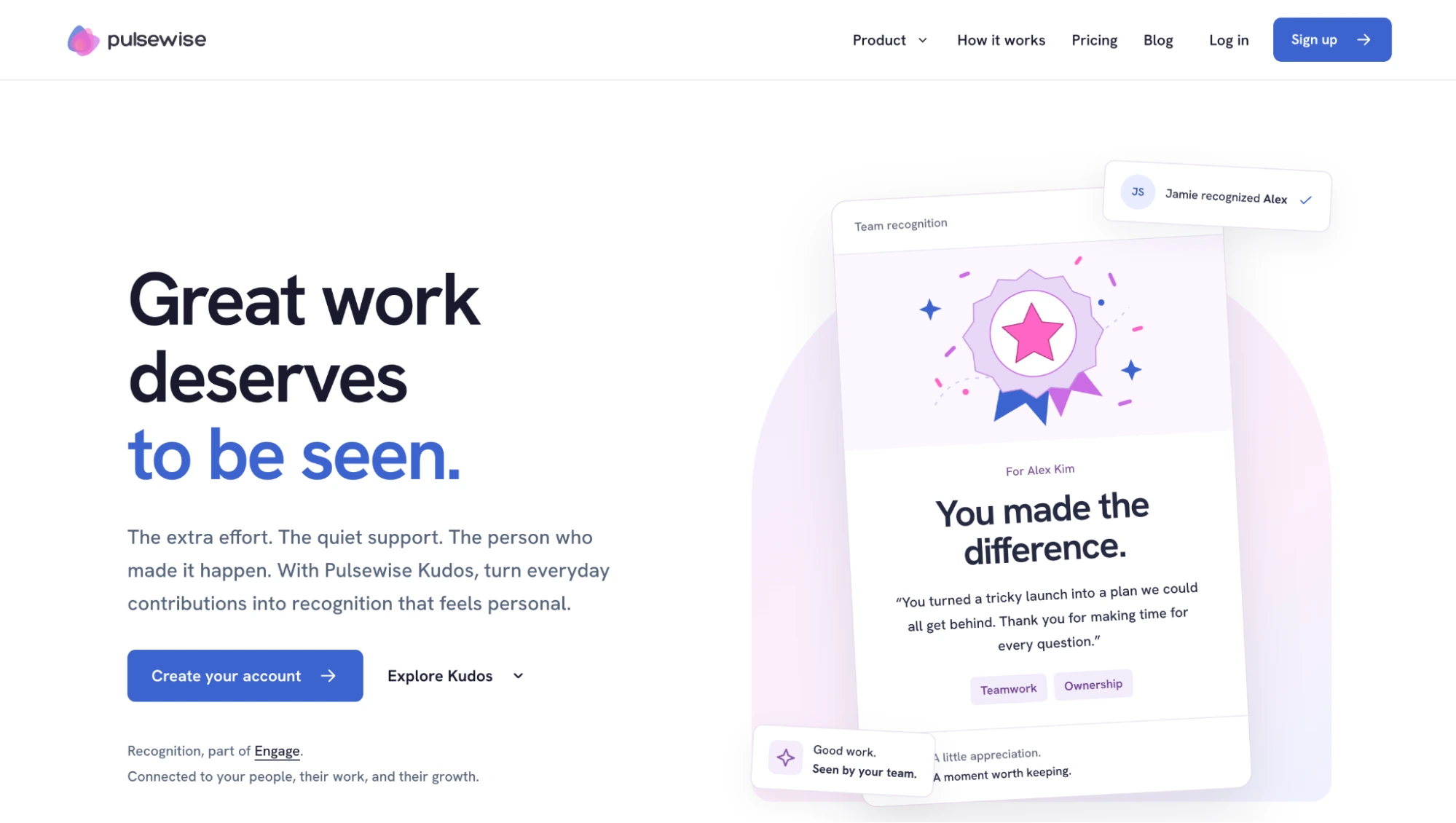
Pulsewise is an emerging people platform where Kudos sits inside the Engage area, next to pulse surveys and team insights. Employees recognize one or more teammates, describe what they did, and add value tags such as teamwork or ownership.
Writing assistance helps refine a message using the recipients and value tags as context, and the sender reviews every word before it goes out. Where enabled, AI-generated celebration artwork turns a note into a recognition card people can share or download.
The difference is what happens next. Kudos becomes one source of evidence behind a person’s Reputation, alongside feedback, goals, and completed 1:1 activity, so managers can bring that context into a growth conversation.
Pulse and mood responses stay separate and feed aggregated Workspace Health, protected by minimum group sizes. Anonymous survey answers never shape an individual’s Reputation, which keeps recognition personal and surveys honest.
- Pros: recognition, pulse surveys, goals, feedback, 1:1s, and reviews in one workspace; AI writing help with human review; recognition that reaches growth conversations
- Cons: no points, rewards catalog, or gift cards; no in-Slack or in-Teams kudos listed today (Slack is used for directory import); not yet rated on G2 or Capterra
- Pricing: free forever for the first 100 eligible teams, up to 100 users, subject to availability, as of October 2026. Paid plan prices are not published.
Want to try the idea before rolling out a platform? The free recognition postcards tool lets anyone make a personal thank-you card for a teammate in a minute.
See where a thank-you goes next. Explore Pulsewise Kudos and check whether your team qualifies for the launch offer.
2. Bonusly: best-known points and rewards platform
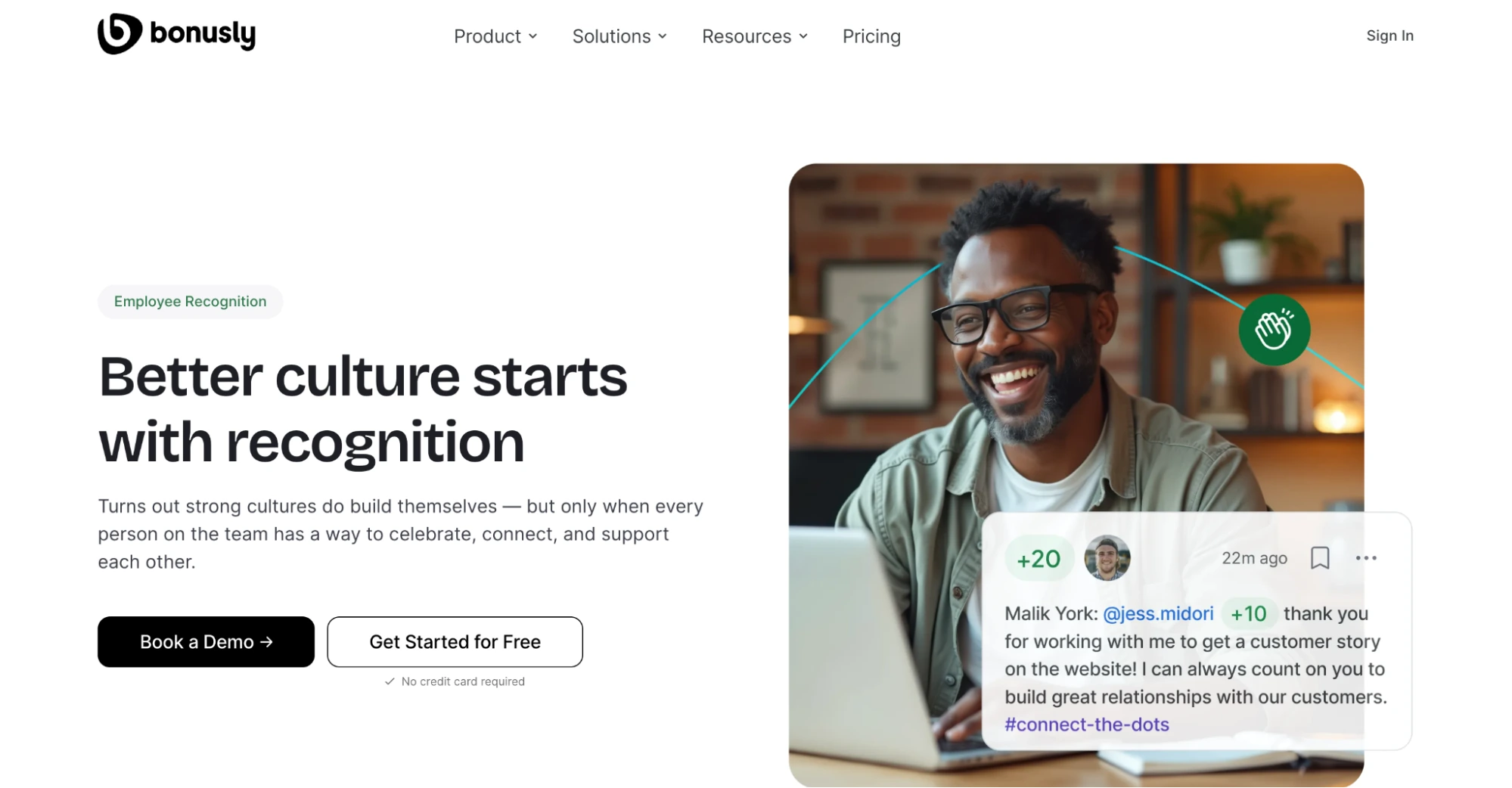
Bonusly made peer-to-peer points recognition mainstream. Employees send recognition tied to a core value with redeemable points attached, and recipients spend them in a global catalog of gift cards, charitable donations, cash, and company swag.
It has grown well beyond recognition. Team plans now add pulse check analytics, automated milestone celebrations, 1:1s with smart agendas, and performance recaps, plus Bizy, an AI assistant that nudges people to recognize each other.
- Pros: proven peer recognition, a wide global rewards catalog, Slack and Teams integrations, a free plan for small teams
- Cons: rewards are billed at face value on top of the subscription; the free plan stops at 8 users; Bizy raises the per-user price
- Pricing: Free up to 8 users; Team $3 per user per month without Bizy, $5 with Bizy ($50 per user per year); Organization custom, as of October 2026
3. Matter: best free recognition tool for Slack and Teams
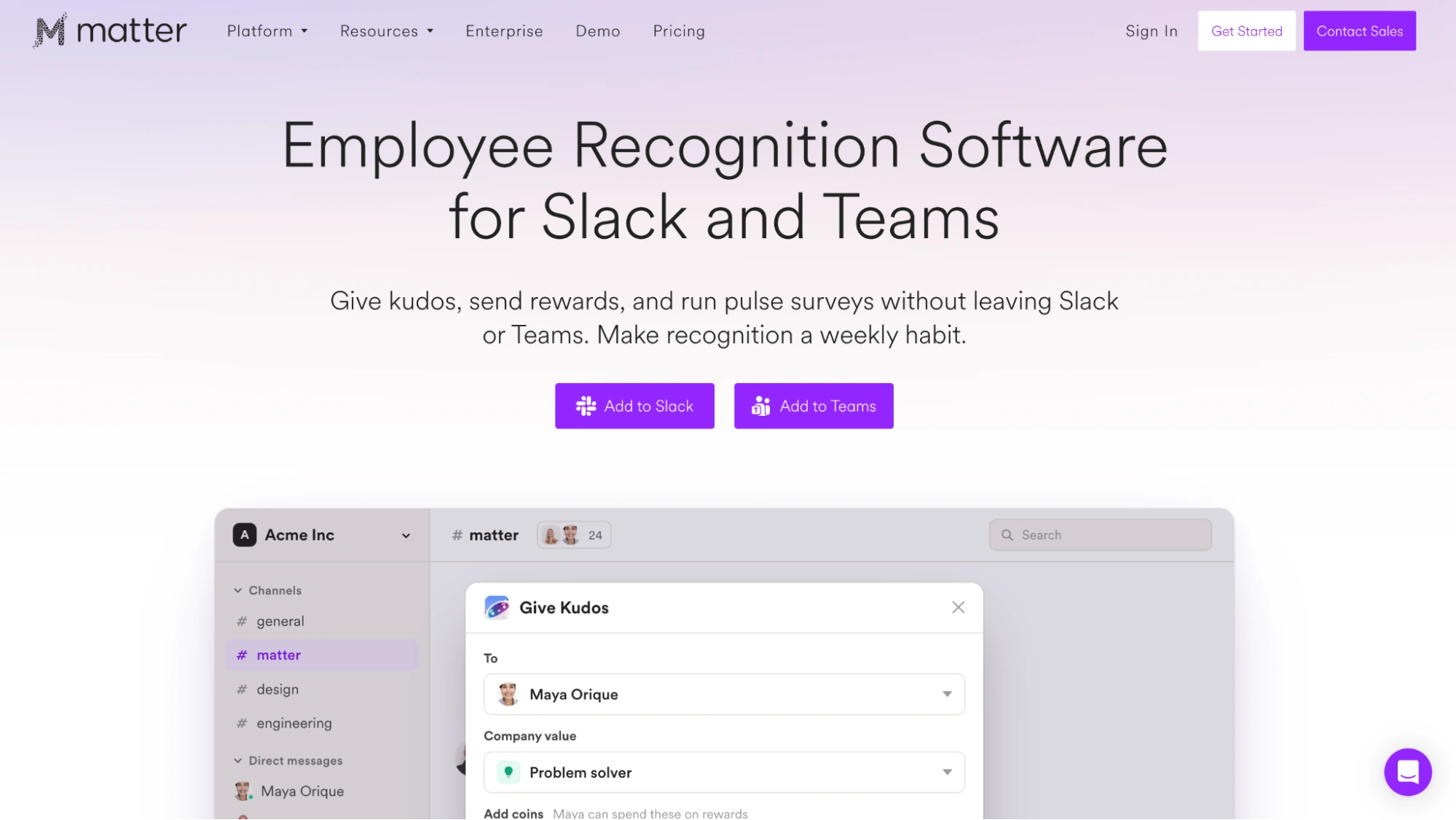
Matter runs entirely inside Slack and Microsoft Teams, so recognition happens in the channels where people already work. Its Feedback Friday ritual pairs kudos with a weekly feedback prompt.
The free plan covers unlimited users, which no other tool here matches. Rewards start on Pro, with eGift cards from more than 3,500 brands across 200+ countries, billed at face value with no markup.
- Pros: free for unlimited users, native in both chat tools, transparent pricing calculator
- Cons: no web-first experience for teams outside Slack or Teams; HRIS integration is a paid add-on; surveys cost extra
- Pricing: Free; Basic $1 and Pro $3 per user per month, billed annually; surveys add-on $2 per user per month, as of October 2026
4. Assembly: best value points platform
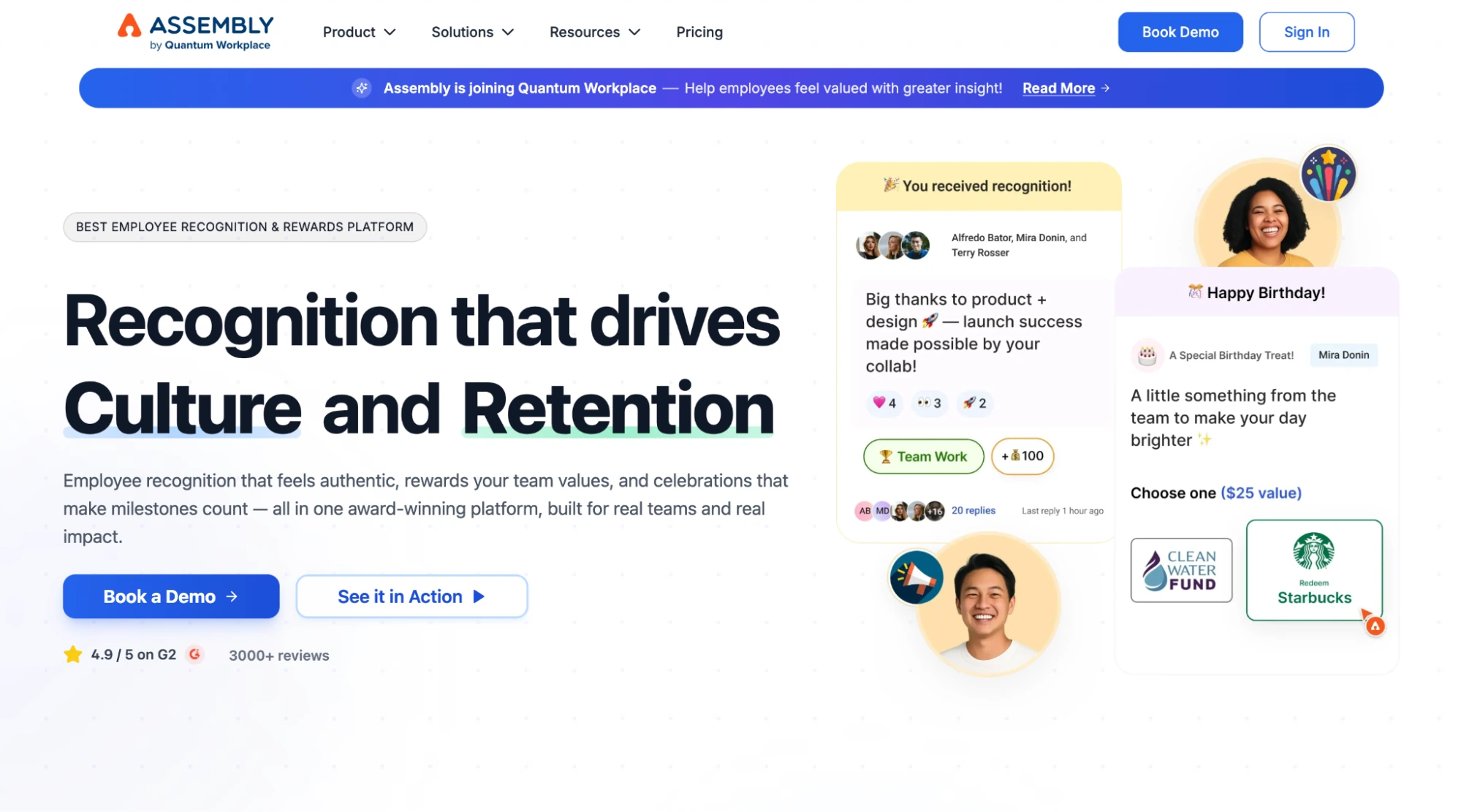
Assembly combines peer recognition, points with budget controls, and a global reward catalog in one plan. Milestone celebrations, announcements, awards, and challenges are included rather than sold separately.
Its Dora Hub adds AI insights, nudges, and recognition trends. Assembly lists more than 100 integrations, including Slack, Microsoft Teams, BambooHR, and Workday.
- Pros: low per-user price, broad feature set in one tier, strong integration list
- Cons: no free plan shown on the pricing page; rewards spend sits on top of the license
- Pricing: Empower $3 per user per month, billed yearly; Enterprise custom, as of October 2026
5. Nectar: best for gift card and Amazon rewards
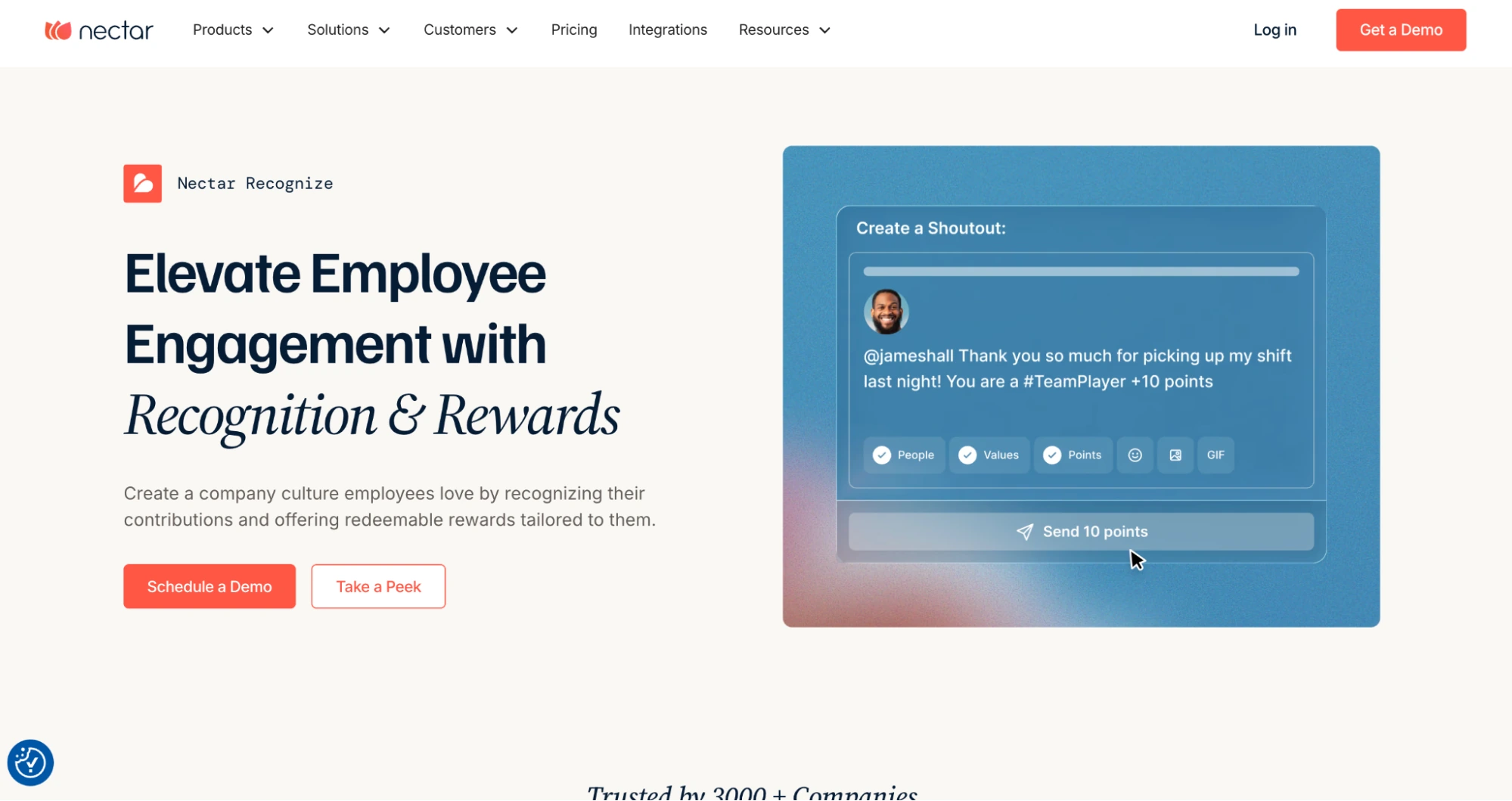
Nectar Recognize covers peer shoutouts, milestones, challenges, nominations, and a swag store. Points redeem for more than 200 gift cards, the full Amazon catalog, swag, or custom perks such as extra time off.
It sells in bundles, so you can add engagement surveys or internal comms to recognition. Its remote and hybrid bundle includes Slack and Microsoft Teams integrations.
- Pros: one of the widest reward choices on this list, flexible bundles, custom company perks
- Cons: pricing is quote only; surveys and comms cost more as separate bundles
- Pricing: quote-based bundles (Recognize, Engage, Comms, Nectar One), as of October 2026
6. Motivosity: best for global, multilingual teams
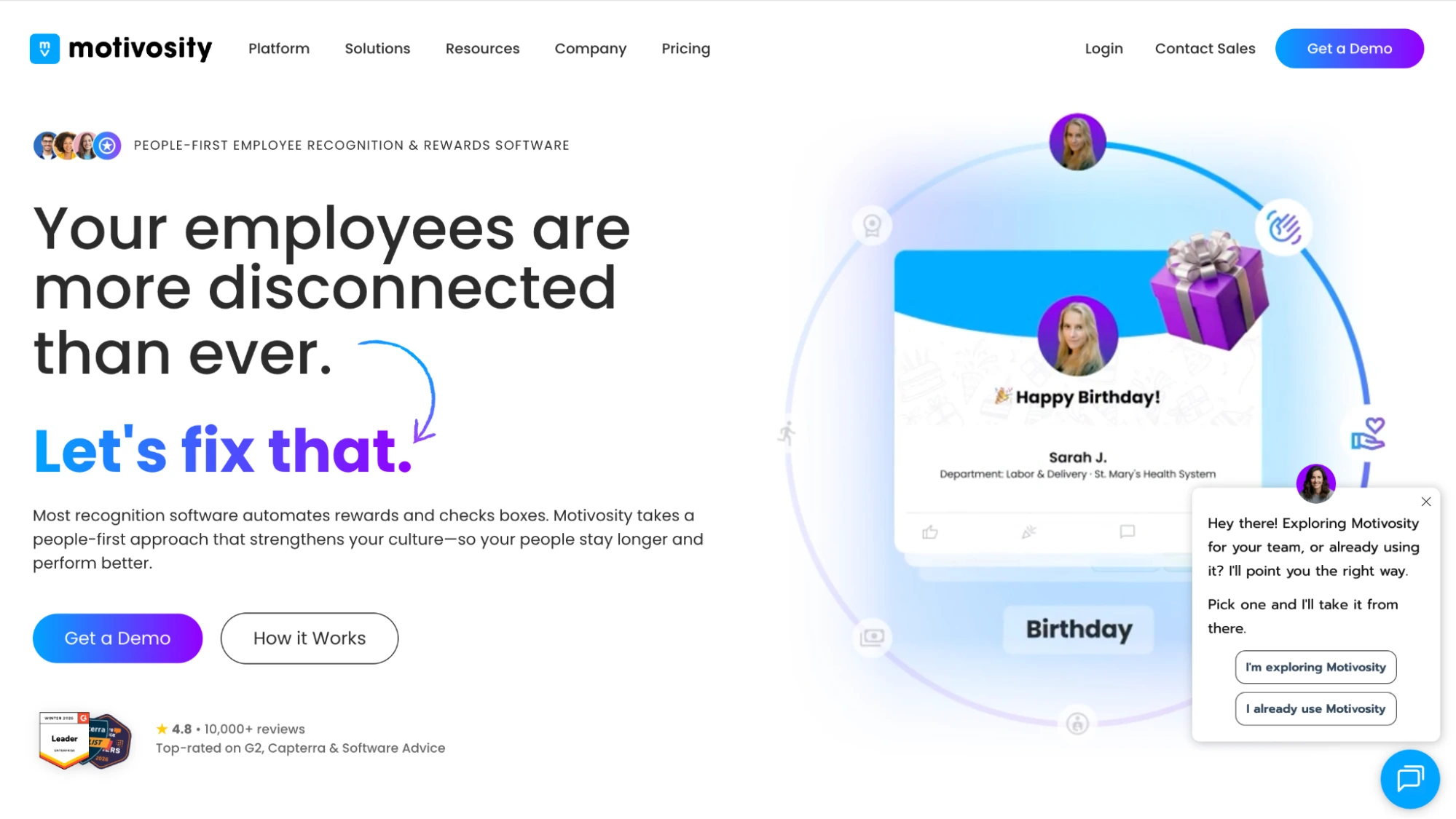
Motivosity supports funded or unfunded programs in dollars or points, along with spot bonuses, nominations, and service awards. Its reward marketplace reaches more than 140 countries, and its Native Thanks feature translates recognition across 70+ languages.
That global reach matters for EMEA teams spread across languages. Motivosity also includes MV6 pulse surveys and Slack and Teams integrations.
- Pros: strong multilingual and multi-country support, flexible program design, no markup on gifts
- Cons: fully custom pricing; a $3,000 minimum spend makes it costly for teams near 50 people
- Pricing: custom; the Small Business bundle for under 250 employees carries a $3,000 minimum spend, as of October 2026
7. Awardco: best for structured programs and service awards
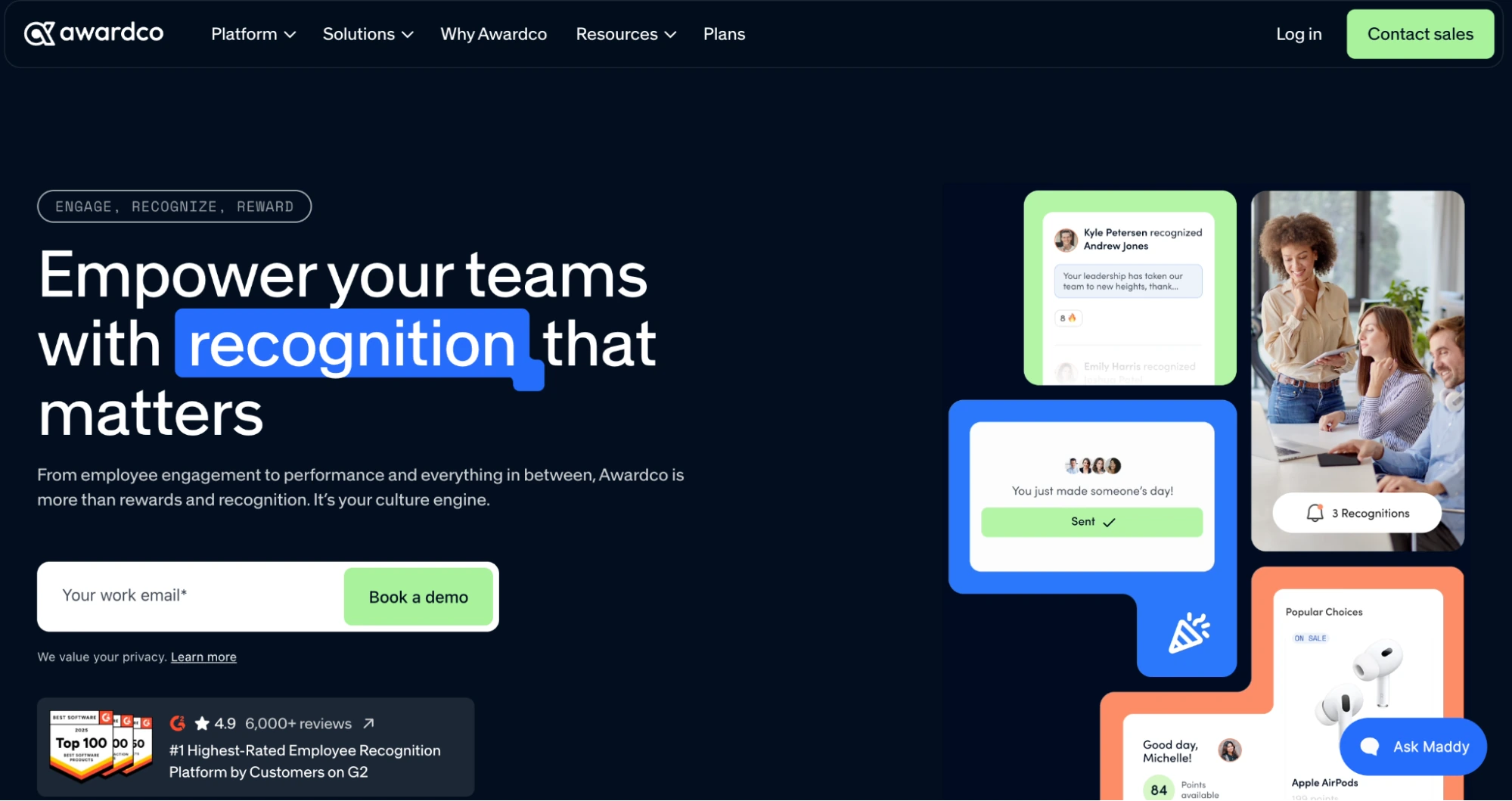
Awardco builds plans around recognition types: automated milestones, spot recognition, nominations, earn incentives, and external recognition. Higher plans unlock more types, and every plan includes Slack and Microsoft Teams integration.
Its reward network spans more than 163 countries, with Amazon and other ecommerce options. Tax buffers and purchase power parity help when you reward people in different currencies.
- Pros: deep program structure, large reward network, strong admin controls
- Cons: quote-based plans; more structure than a small team may need
- Pricing: quote-based; starter packages for 100 employees or fewer start at $3,000, as of October 2026
8. Vantage Circle: best for recognition bundled with perks and wellness
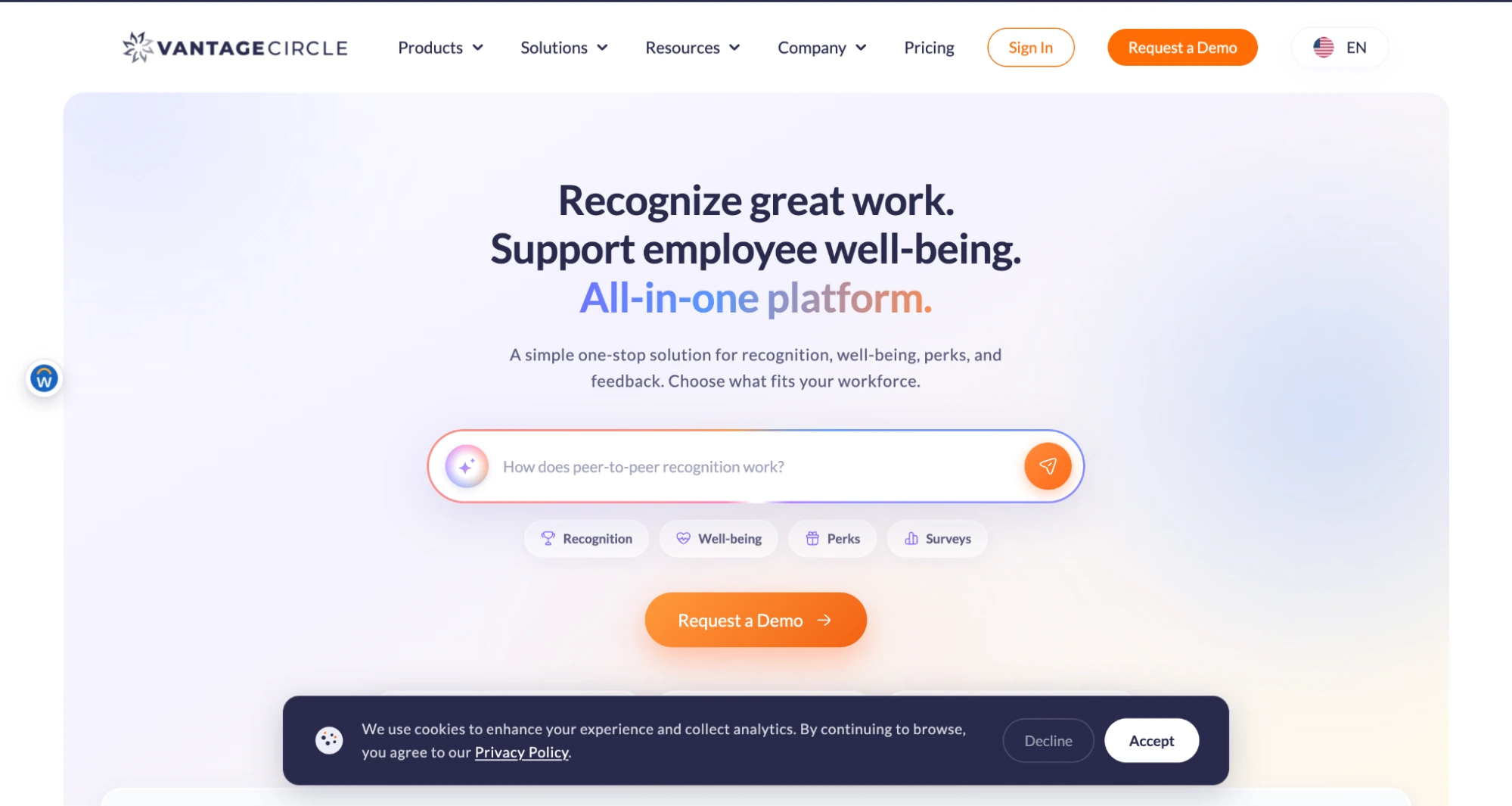
Vantage Circle pairs peer recognition, nomination awards, and milestones with employee perks, wellness challenges, and feedback. Rewards include an Amazon store, gift vouchers, experiences, and merchandise, with support in more than 70 countries.
AI award recommendations and smart compose help managers write recognition. Slack and Microsoft Teams connections are add-ons rather than included.
- Pros: recognition, perks, and wellness in one vendor; broad country coverage
- Cons: custom pricing on every plan; chat integrations cost extra; language support grows only on higher tiers
- Pricing: custom (Grow, Transform, Scale), as of October 2026
9. Workleap: best for manager-led recognition in a performance suite
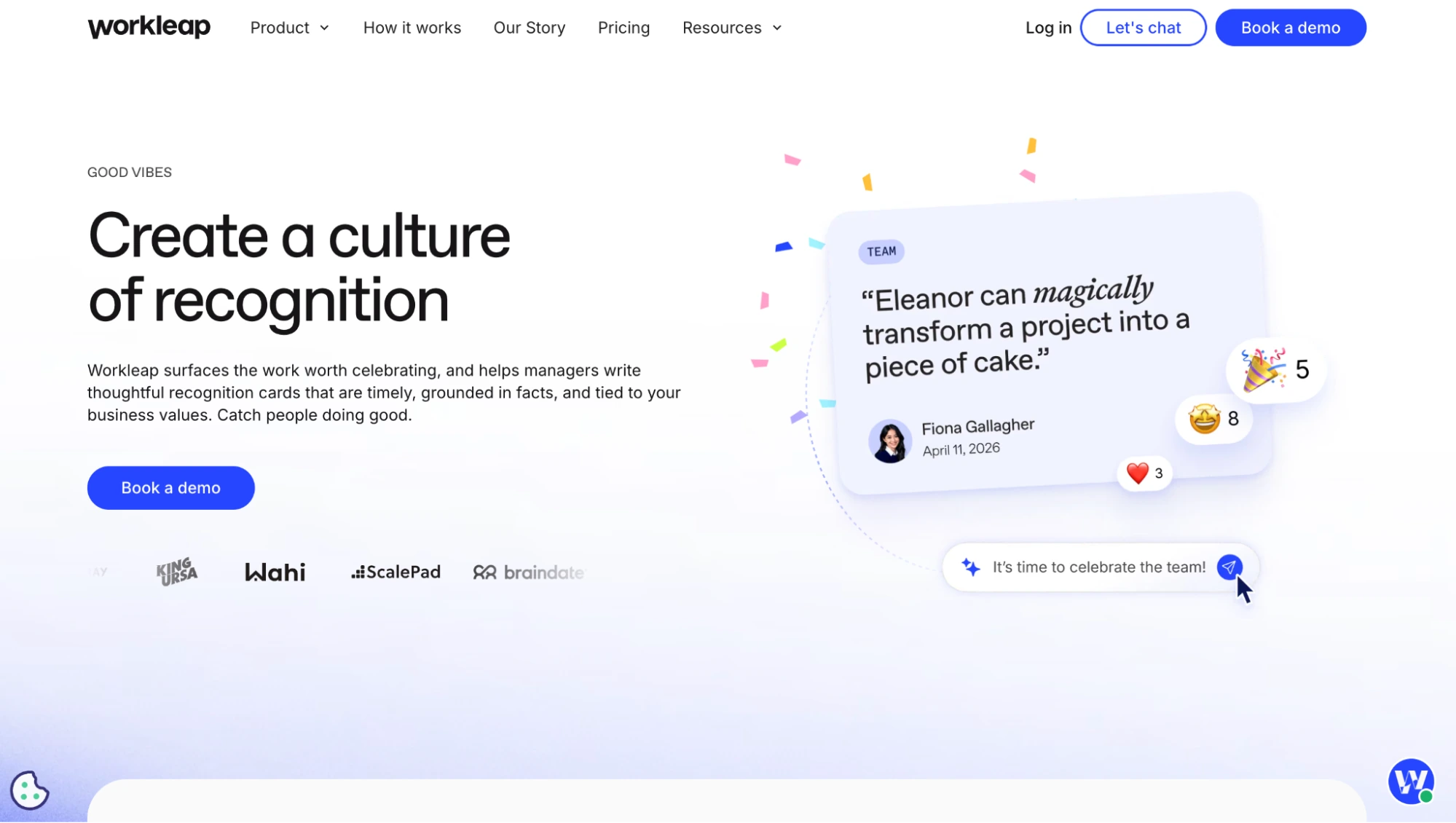
Workleap’s Good Vibes scans team activity for work worth recognizing and helps managers draft recognition cards tied to company values. Cards post to Slack, Microsoft Teams, or the Good Vibes wall, publicly or one to one.
Each Good Vibe stays in the person’s profile and resurfaces in 1:1s and reviews. It is part of the wider Workleap platform, so you buy it with performance management and team health tools. Our Officevibe alternatives guide covers that broader suite.
- Pros: surfaces quieter contributors; recognition reaches 1:1s and reviews; native in both chat tools
- Cons: no points or rewards; manager-led rather than peer-first; platform pricing is high for teams that only want recognition
- Pricing: Standard $4,999 per year plus $32 per manager per month; Pro $11,999; custom for 250+ employees, as of October 2026
Standalone recognition tool or recognition inside your people platform?
The ICP problem most People leaders describe is not a missing recognition tool. It is four tools that never talk: a review platform, a survey tool, a recognition app, and spreadsheets for goals.
A standalone tool like Bonusly or Matter makes sense when your performance and survey stack is settled and you mainly want participation and rewards. You get a polished recognition experience, but recognition data stays in its own app.
If you are already shopping for engagement or performance software, check what recognition the suite includes first. Lattice, 15Five, and Leapsome all offer praise features inside performance tools, and our comparisons of Pulsewise vs Lattice and Pulsewise vs 15Five show how they differ.
Running reviews, surveys, and recognition in separate tools? See how Pulsewise keeps kudos, goals, feedback, and 1:1s in one workspace! Book a short demo
How to choose, including Bonusly alternatives
Match your situation to one of these five. Each points to the tools that fit best, not the most features.
You want peer recognition with real rewards
Bonusly, Assembly, and Nectar are the strongest points platforms for 50 to 500 people. Assembly is the lowest-priced per user, Bonusly has the most familiar experience, and Nectar offers the widest reward choice.
Your company lives in Slack or Microsoft Teams
Matter is the simplest start, since it runs inside chat and is free for unlimited users. Bonusly and Assembly also work well in both tools.
You manage a multilingual or multi-country team
Motivosity and Awardco handle currencies, taxes, and reward fulfillment across many countries. Vantage Circle covers 70+ countries and suits teams that also want perks and wellness.
You want recognition to show up in reviews and 1:1s
Choose a context-first tool. Pulsewise connects kudos to feedback, goals, and 1:1 activity in one workspace, and our guide on how to run a 1-on-1 meeting shows how to use that context well.
You are looking for Bonusly alternatives
Most teams leave Bonusly for one of three reasons: price at scale, reward costs, or recognition that never reaches performance conversations. Pick the alternative that matches your reason.
- Lower price: Assembly at $3 per user, or Matter’s free and $1 tiers
- Wider rewards: Nectar or Motivosity
- Recognition tied to growth rather than points: Pulsewise or Workleap
Closing
Every tool on this list can post a thank-you to a feed. The real difference is what that thank-you becomes: a balance to spend, or context a manager uses in the next review.
If rewards drive your culture, start with Bonusly, Assembly, or Matter and budget for redemptions on top of the license. If you want recognition to sit beside pulse surveys, goals, and 1:1s, explore Pulsewise Kudos and check whether your team qualifies for the free launch offer.
FAQs
What is employee recognition software?
Employee recognition software helps peers and managers send visible appreciation for specific work, often tagged to company values. Many tools attach points that employees redeem for rewards, while others connect recognition to goals, feedback, and reviews. Most include a social feed, milestone celebrations, analytics, and integrations with Slack or Microsoft Teams.
How much does employee recognition software cost?
Published prices for tools in this guide run from free to about $5 per user per month, as of October 2026. Matter and Bonusly offer free plans, while Assembly and Matter Pro cost $3. Points-based tools bill rewards separately at face value, and quote-based vendors such as Motivosity and Awardco start around $3,000 a year.
Is there free employee recognition software?
Yes. Matter is free for unlimited users inside Slack or Teams, and Bonusly is free for up to 8 users. Pulsewise offers a free-forever workspace for up to 100 users to its first 100 eligible launch teams. Free plans usually exclude rewards, analytics, or HRIS integrations.
What is the difference between recognition and rewards?
Recognition is the specific acknowledgment of what someone did and why it mattered. Rewards add a tangible benefit, such as points, gift cards, or swag. Employee rewards software focuses on the second, while recognition-first platforms focus on making contributions visible and connecting them to growth conversations.
What is peer recognition software?
Peer recognition software lets any employee recognize a colleague, not only managers. It usually includes a public feed, value tags, and reactions so appreciation spreads across teams. Tools like Bonusly, Assembly, and Matter add points, while Pulsewise Kudos connects peer recognition to a person’s feedback, goals, and 1:1 history.
What are the best Bonusly alternatives?
The best Bonusly alternatives depend on why you are switching. Assembly and Matter cost less per user, Nectar and Motivosity offer wider rewards, and Pulsewise or Workleap suit teams that want recognition tied to performance conversations rather than points. Compare total cost, including rewards, before you decide.