Most 1-on-1s fail the same quiet way. The manager asks, “So, how is everything going?” The direct report says, “Yeah, fine, busy”, and thirty minutes later both people leave with nothing changed.
If that sounds familiar, the problem is not the meeting. It is the lack of a structure that turns thirty minutes into something people actually feel.
This guide covers how to run a 1-on-1 meeting that improves engagement, not just fills a calendar slot. You get a step-by-step structure, a ready-to-use agenda template, a bank of manager 1:1 questions, and the mistakes that quietly waste everyone’s time.
TL;DR
A 1-on-1 meeting is a recurring, private conversation between a manager and one direct report, focused on the employee’s growth, blockers, and wellbeing rather than status updates. Gallup found that employees whose managers hold regular meetings with them are almost three times as likely to be engaged, which makes the 1-on-1 the highest-leverage engagement habit a manager owns. A strong 1-on-1 follows a simple flow: connect, review commitments, surface blockers, talk growth, and agree next steps, with the employee driving most of the agenda. Weekly 30-minute 1-on-1s suit most teams. Bi-weekly works for senior or steady roles, and monthly is the floor before the benefits fade. The meeting only improves engagement if you close the loop, so capture action items and follow up before the next session.
What is a 1-on-1 meeting?
A 1-on-1 meeting is a recurring, private conversation between a manager and one of their direct reports. It centers on the employee: their growth, their blockers, their workload, and how they feel about the work.
It is not a status update, and it is not a performance review. A team meeting covers group priorities. A review looks backwards at ratings. A 1-on-1 sits between them and does the ongoing work of keeping one person supported and clear.
That distinction matters because the moment a 1-on-1 turns into project reporting, it stops doing the thing only a 1-on-1 can do.
Why 1-on-1s improve engagement (the part most guides skip)
Engagement is built between review cycles, not during them. The 1-on-1 is where that building either happens or quietly fails.
The manager is the lever. Gallup’s research shows managers account for roughly 70 percent of the variance in team engagement, more than any perk, policy, or mission statement.
Regular conversation is how that lever gets pulled. Gallup found that employees whose managers hold regular meetings with them are almost three times as likely to be engaged as those whose managers do not.
The absence shows up at the exit. Gallup reported that around half of employees who leave say that in the three months before they quit, no one talked with them about their job satisfaction or their future.
Organizations that get this right treat it as a habit, not an event. Quantum Workplace found 86 percent of highly engaged organizations hold regular 1-on-1s, compared with 50 percent of disengaged ones.
Want your managers walking into every 1-on-1 prepared, not scrambling? See how Pulsewise 1:1 meeting intelligence surfaces talking points, relationship context, and next actions before the meeting starts.
How to run a 1-on-1 meeting: a step-by-step structure
Here is a nine-step structure you can use for every 1-on-1, from a first check-in with a new hire to a weekly rhythm with a senior report.
1. Prepare before the meeting
Open a shared agenda at least 24 hours ahead so both of you can add topics. Review your notes and open action items from last time.
Two minutes of prep is the difference between a real conversation and “what did we talk about last week?“
2. Open with a genuine check-in
Start with the person, not the project. A simple “how are you doing this week, really?” signals that this time is about them.
Keep it human and brief. You are setting the tone, not running an interrogation.
3. Let the employee drive the agenda
The employee should own most of what gets discussed. Their topics come first, because those are the things actually on their mind.
When the manager owns the whole agenda, the meeting drifts back into status reporting. When the employee owns it, real concerns surface.
4. Review commitments and progress
Walk through the goals and action items you agreed on last time. Celebrate what moved and get honest about what stalled.
This is not surveillance. It is closing loops so nothing important quietly disappears.
5. Surface blockers and remove them
Ask what is slowing them down and what they need from you. Your job in the meeting is to clear the path, not just take notes on the potholes.
Where you can remove a blocker on the spot, do it before the meeting ends.
6. Talk growth, not just this week
Put development on the agenda regularly, not once a year at review time. Ask about skills they want to build and the direction they want to grow.
People stay where they can see a future. Growth conversations are one of the strongest engagement signals you can send.
7. Give and ask for feedback
Share timely, specific feedback while it still matters, both praise and course-correction. Then ask for feedback on how you are supporting them.
Asking “What is one thing I could do differently to support you better?” turns the meeting into a two-way street.
8. Agree on clear next steps and owners
Before you close, name the concrete actions, who owns each one, and by when. Vague good intentions do not survive a busy week.
9. Close the loop before the next session
Capture the notes and action items somewhere you will both see them. Check progress before the next 1-on-1 so momentum carries forward.
This final step is where most 1-on-1s leak value. The conversation only improves engagement if something actually changes afterwards.
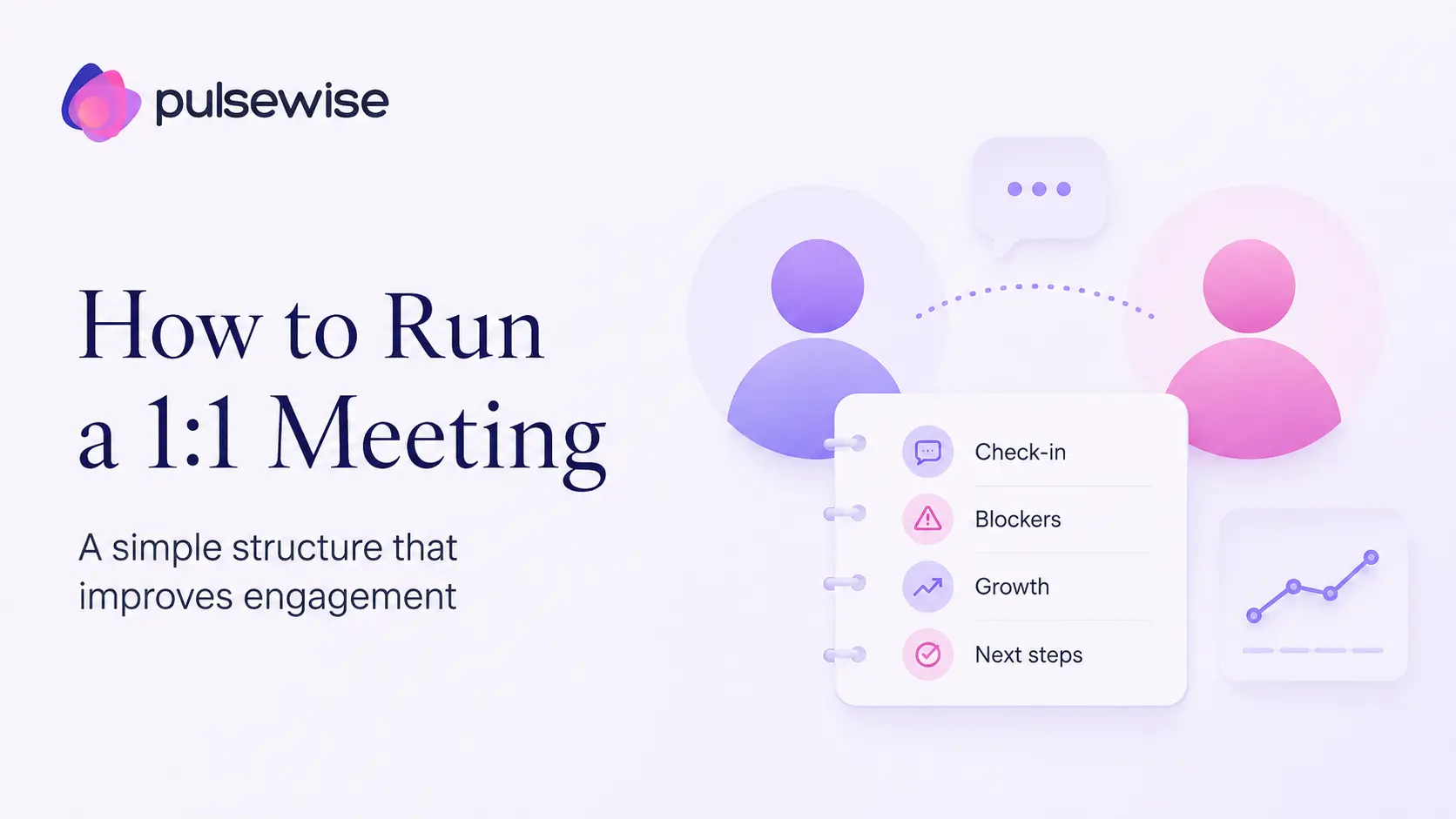
A 1-on-1 meeting agenda template you can steal
Copy this into your notes tool or calendar invite. Times are a starting point for a 30-minute weekly session, so adjust to the person and the week.
| Segment | Time | What happens |
|---|---|---|
| Check-in | 5 min | Reconnect as people. How is the week going, energy, workload. |
| Their agenda | 10 min | The employee’s topics first: questions, concerns, decisions they need. |
| Progress and blockers | 7 min | Review commitments, surface what is stuck, agree who removes it. |
| Growth and feedback | 5 min | One development thread plus two-way feedback. |
| Next steps | 3 min | Name actions, owners, and dates. Confirm the next session. |
Manager 1:1 questions that actually open people up
Good questions do more work than any template. Pull one or two from each group below rather than marching through all of them.
Connection and wellbeing
-
How are you doing this week, honestly, not just work-wise?
-
What has given you energy lately, and what has drained it?
-
Is your workload sustainable right now?
Blockers and support
-
What is slowing you down that I could help remove?
-
Where do you feel stuck or unclear on priorities?
-
What do you need from me before our next 1-on-1?
Growth and development
-
What skill do you want to build this quarter?
-
What part of your role would you like more or less of?
-
Where do you want to be in a year, and are we moving toward it?
Feedback and recognition
-
What is one thing I could do differently to support you better?
-
Is there any recognition or credit that has been missed?
-
What feedback do you have for me or the team?
Tired of 1-on-1 notes scattered across a dozen docs? Pulsewise 1:1 intelligence keeps agendas, action items, and past context in one place, so nothing rolls off the list between meetings.
How often should you hold 1-on-1s, and how long?
30 minutes weekly is the right default for most manager-direct-report relationships. It keeps feedback timely and problems small.
Adjust from there based on the person and the moment. Use the guide below as a starting point, then let the employee’s input fine-tune it.
| Situation | Suggested cadence | Length |
|---|---|---|
| New hire or onboarding | Weekly | 30–45 min |
| Most individual contributors | Weekly | 30 min |
| Senior or steady, low-change roles | Bi-weekly | 30–45 min |
| Someone who manages others | Weekly | 45–60 min |
| High-pressure or turnaround phase | Weekly or more | 30 min |
Whatever you choose, protect it. A cancelled 1-on-1 sends a louder message than the meeting itself ever could.
The mistakes that turn 1-on-1s into wasted time
Most bad 1-on-1s share the same handful of failure modes. Watch for these.
-
The status-update trap: the meeting becomes project reporting that belongs in a standup or a written update.
-
The manager monologue: aim for the employee talking most of the time, roughly 70 percent, with you listening and asking.
-
The cancel habit: rescheduling occasionally is fine; cancelling repeatedly tells the person they do not matter.
-
Only corrective feedback: 1-on-1s should build the relationship, not become a weekly list of what went wrong.
-
No follow-through: if action items never get revisited, people stop bringing anything real.
What this looks like in practice
Before: “How is the project going?” “Fine, on track.” “Great, anything else?” “Nope.” Both leave, nothing changed, and next week repeats.
After: “What is the hardest part of this project right now?” “Honestly, I keep waiting on design and losing days.” “Let me unblock that today. What else is on your mind?” Now the meeting earned its thirty minutes.
Running 1-on-1s with remote and hybrid teams
For distributed teams, the 1-on-1 is not a nice-to-have. It is often the only structured relationship time a manager and report get all week.
Keep cameras on so you can read tone and energy. Consider meeting slightly more often, since the hallway moments that used to catch small issues are gone.
Use a shared async agenda both people add to across the week. For more on distributed rhythms, see our guide to remote employee engagement.
Where a tool helps, and where it does not
No software runs a good 1-on-1 for you. The habit, the listening, and the follow-through are yours.
What a tool can do is remove the admin that makes managers skip prep. Pulsewise keeps a running agenda, carries forward unfinished action items, and provides AI-suggested talking points drawn from recent feedback and goal momentum, so managers walk in with context rather than a blank page.
It also connects the 1-on-1 to the wider picture. Because the same platform holds your pulse surveys, feedback, and recognition, a manager can see a dip in someone’s mood before the 1-on-1 and actually talk about it. That is the loop that ties individual conversations back to employee engagement across the team.
The bottom line
The best managers do not run 1-on-1s because a framework told them to. They run them because thirty focused minutes a week is where trust gets built, small problems surface early, and people feel genuinely seen.
Get that rhythm right and engagement follows, not as a program, but as a byproduct of paying attention. You do not need new software to start. You need the habit.
Try one change this week: send the agenda ahead, and ask one question you have never asked before. Then watch what a real 1-on-1 does.
Give every 1-on-1 the context to matter Pulsewise is free for the first 100 teams, up to 100 users, no credit card required. It hands managers talking points, running notes, and engagement signals in one place. Start for free
FAQs
What should you talk about in a 1-on-1 meeting?
Focus on the employee, not status updates. Cover how they are doing, progress on goals, blockers you can remove, growth and career development, and two-way feedback. Let them bring the first topics. Save project reporting for standups or written updates so the 1-on-1 stays about the person.
How long should a 1-on-1 meeting be?
Thirty minutes suits most weekly 1-on-1s. Extend to 45 or 60 minutes for development conversations, career planning, or when someone manages others. Shorter than 20 minutes rarely leaves room for real dialogue. Consistency matters more than length, so protect the time you schedule and avoid rushing the close.
How often should managers hold 1-on-1s?
Weekly is the default for most manager and direct-report relationships. Bi-weekly works for senior or steady roles, and monthly is the floor before the benefits fade. New hires and people in high-pressure phases benefit from weekly sessions. When unsure, start weekly and adjust with the employee’s input.
Who should lead a 1-on-1, the manager or the employee?
The employee should drive most of the agenda, while the manager owns the structure and follow-through. Share the agenda ahead of time so both can add topics. Employee-led 1-on-1s surface real concerns, whereas manager-led ones drift into status reporting. The manager’s job is to listen, coach, and remove blockers.
What is the difference between a 1-on-1 and a performance review?
A 1-on-1 is a frequent, informal conversation about ongoing work, growth, and well-being. A performance review is a periodic, formal assessment of results and ratings. Good 1-on-1s make reviews easier because nothing is a surprise. Keep feedback flowing weekly rather than saving it all for the annual cycle.
How do you structure a one-on-one meeting?
Use a simple flow: a brief personal check-in, the employee’s topics, progress and blockers, growth and feedback, then clear next steps. Give each section a rough time so none gets skipped. Capture action items and revisit them next session. A consistent structure builds trust and keeps the meeting from wandering.