How to boost remote employee engagement
You have run the virtual happy hours; I am sure. You added a Slack channel or a Basecamp campfire for pet photos. You even stood up a monthly culture committee that met twice and then quietly vanished from the calendar.
Alas… none of it moved the needle, and there is a reason. Remote employee engagement rarely breaks because people work from home. It breaks because the small signals that used to happen in a hallway never get designed back in.
This guide provides a practical, repeatable way to boost engagement among remote employees. You will get a seven-step method, the metrics that actually track progress, and the mistakes that waste budget. Everything here is built for distributed and hybrid teams, not retrofitted from office playbooks.
TL;DR
Remote employee engagement is the emotional commitment distributed workers feel toward their team and employer, tracked through continuous signals rather than one annual survey. The biggest lever is not office time. It is intentional connection: frequent recognition, prepared 1:1s, visible goals, and managers equipped to lead at a distance. Managers explain roughly 70 percent of the variance in team engagement, so enabling them is the highest-return move you can make (Gallup). Continuous pulse checks plus early warning signals catch disengagement weeks before a resignation letter, instead of at the exit interview. Start this week: replace one status-update meeting with a wins-and-blockers standup, and send one specific piece of recognition.
What is remote employee engagement?
Remote employee engagement is the emotional commitment and involvement that distributed employees feel toward their work, their team, and their organization. It measures whether people who work outside a shared office still feel connected, motivated, and invested in outcomes.
It is not the same as satisfaction. A satisfied employee likes their job. An engaged employee gives discretionary effort, shares ideas, and stays through a rough quarter.
Engagement also is not a once-a-year score. For distributed teams it is best read as a continuous signal, because morale can shift in a week and an annual survey will miss it. For the full foundation on the concept, see our employee engagement master guide.
Do remote employees actually have lower engagement?
Not automatically. Remote workers frequently report engagement at or above their in-office peers. What erodes engagement over time is isolation and the loss of informal connection, not the remote setup itself.
The macro backdrop is real. Gallup found global employee engagement fell to 20 percent in 2025, its lowest reading in over a decade, with low engagement costing the world economy around 10 trillion dollars a year. Source: Gallup, State of the Global Workplace 2026.
Distributed teams carry a specific risk on top of that: loneliness. Gallup reports that loneliness runs higher among fully remote workers than the workforce average. When people do not share a physical space, the quiet check-ins that catch a struggling teammate simply do not happen unless you design for them.
So the honest answer is that remote work does not doom engagement. Neglect does. The teams that thrive treat engagement as an engineered outcome, not a hoped-for byproduct of good vibes.
Want to see where your distributed team stands right now? Pulsewise turns daily mood and pulse signals into one live view, so you catch dips early. See how it works.
How to boost remote employee engagement: a 7-step method
Boosting remote engagement is less about events and more about rhythms. Work these seven steps into how your team already operates, and you build connection into the week rather than bolting it on.
Step 1: Measure continuously, not once a year
Annual surveys tell you how people felt months ago. That is too slow for a distributed team.
Run a short pulse survey of three to five questions every one to two weeks, and pair it with a lightweight daily mood signal. Together they show both where you stand and which way sentiment is moving. Set this up with continuous pulse surveys and real-time team pulse monitoring.
Step 2: Make recognition frequent, specific, and visible
Remote employees often feel invisible, so recognition has to be intentional and more frequent than it would be in an office. Gallup research suggests people need meaningful recognition at least once every seven days to stay connected.
Keep it specific and public. A named shout-out in a team channel beats a generic “great job” every time. Build the habit with recognition and kudos, and employee recognition ideas when you need fresh angles.
Step 3: Turn 1:1s into growth conversations, not status updates
The 1:1 is the single most important remote ritual, and it is the one that most often defaults to “what are you working on?” Managers lose three to five hours a month digging through Slack, email, and spreadsheets just to prepare.
Bring mood trends, goals, recognition, and feedback into one prep view so the conversation starts with the person, not the task list. That is exactly what 1:1 meeting intelligence is built to do.
Step 4: Connect daily work to visible goals
Remote workers lose sight of the bigger picture faster than office teams do. When goals live in a doc nobody opens, effort feels disconnected from purpose.
Set nested goals with automatic roll-up progress, so every person can see how their work ladders into the team and company. Clear goals and OKRs turn a remote to-do list back into shared momentum.
Step 5: Design async-first communication and rituals
Distributed teams span time zones and energy patterns, so meetings cannot be the default. Effective remote orgs lead with written communication that anyone can pick up on their own schedule.
Replace one recurring all-hands with a written wins-and-blockers update. Deliberately fold remote employees into recognition moments and decisions, since they are the easiest people to accidentally leave out.
Step 6: Catch disengagement early with signals
By the time someone sits in an exit interview, they have already decided to leave. You need early signals, not post-mortems.
Watch for mood drift, participation drop-offs, stalled goals, and falling recognition. No single one tells the whole story, but combined they flag who might need a conversation. Pulsewise brings these into one predict-and-prevent-attrition view.
See the signals before the resignation letter. Pulsewise surfaces mood, feedback, and recognition gaps in one early-warning view, with suggested next steps for managers. Explore engagement and retention.
Step 7: Equip your managers to lead at a distance
Managers account for roughly 70 percent of the variance in team engagement, yet most were never trained to lead remotely. Only about three in ten hybrid managers have had any formal training for it.
Give managers both the skills and the tools: coaching prompts, recognition at their fingertips, and prepared context for every check-in. Start with what is built for managers.
Remote employee engagement ideas to try this week
You do not need a big program to start. Small, repeatable moves compound faster than one-off events.
-
Open your next team meeting with a 60-second recognition round.
-
Swap one status meeting for a written wins-and-blockers update.
-
Ask one question in your next 1:1 you have never asked before.
-
Pair two people from different teams for a 20-minute “what are you building” chat.
For the broader playbook across any setup, our guide to improving employee engagement goes deeper on strategy.
How to measure remote employee engagement
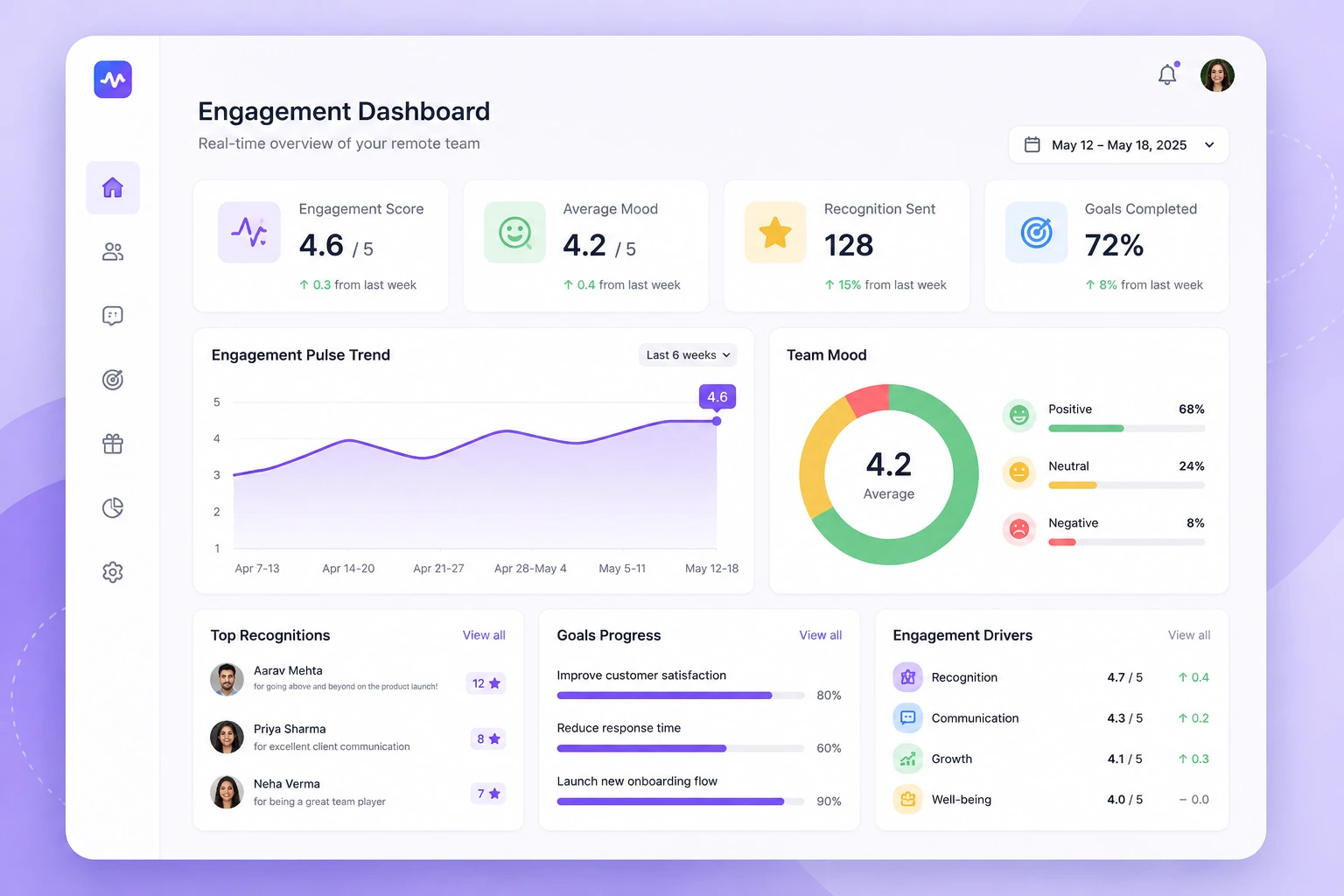
Measure remote engagement with a mix of signals rather than one number. The trend line matters more than any single score, because a sudden drop is your earliest warning.
| Metric | What it tells you | Cadence |
|---|---|---|
| Pulse survey score (ESS) | Structured engagement level you can slice by team and period | Every 1 to 2 weeks |
| Daily mood trend | Momentum between survey waves, and early dips | Daily, opt-in |
| Participation rate | Whether people still feel it is worth responding | Every wave |
| Recognition frequency | Whether good work stays visible across distance | Weekly |
| eNPS | Willingness to recommend the company as a place to work | Quarterly |
| Goal progress | Whether daily work still connects to purpose | Weekly |
Read these together. Healthy scores with flat goals may signal boredom. Falling participation with quieter recognition often signals people checking out. The point is to act on the pattern, then close the loop by sharing what you heard and what you will change.
Mistakes that quietly kill remote engagement
Most remote engagement problems trace back to a handful of avoidable habits.
-
Relying on one annual survey, so you learn about problems a quarter too late.
-
Treating perks as engagement. Swag and happy hours do not fix a connection gap.
-
Vague or absent recognition, which leaves remote contributors feeling invisible.
-
Surveillance-style monitoring, which erodes trust and drives your best people out.
-
Ignoring managers, the exact group with the most influence over team engagement.
The bottom line
Remote employee engagement does not come from a better perk. It comes from designing the connection that distance removes.
Pick two steps from this guide and start this week. Measure continuously and recognize often, then layer in prepared 1:1s and early warning signals as the habit sticks. The teams that treat engagement as a rhythm, not an event, are the ones people stay with.
Give your distributed team one place to listen, recognize, and grow Pulsewise is free forever for the first 100 teams, with up to 100 users, no credit card, and no feature limits. Claim your free spot, or schedule a quick demo
FAQs
What is remote employee engagement?
Remote employee engagement is the emotional commitment distributed workers feel toward their team, their work, and their employer. It reflects whether people who work outside a shared office stay motivated, connected, and invested in results. Unlike satisfaction, it predicts effort and retention, and it is best tracked through continuous signals rather than a single annual survey.
How do you keep remote employees engaged?
Keep remote employees engaged by designing connection instead of leaving it to chance. Measure sentiment continuously, recognize good work often and specifically, run prepared 1:1s, and tie daily tasks to visible goals. Equip managers to lead at a distance, since they drive most of the variance in team engagement. Small, consistent rhythms beat occasional events.
Why is employee engagement harder for remote teams?
Engagement is harder remotely because the informal signals that sustain connection in an office do not happen on their own. A manager cannot notice someone going quiet across a video call the way they would in a hallway. Isolation also runs higher for remote workers. The fix is intentional design, not a return-to-office mandate.
How do you measure remote employee engagement?
Measure remote engagement with a mix of signals rather than one number. Track short pulse surveys every week or two, a daily mood trend, participation rates, recognition frequency, and goal progress, plus quarterly eNPS. Watch the trend line, not just the score. Sudden drops in participation or mood often flag disengagement before it shows up in results.
How often should you survey remote employees?
Survey remote employees on two rhythms. Run a short pulse of three to five questions every one to two weeks to catch shifts in morale early. Pair it with one deeper engagement survey each quarter or half-year for a fuller picture. Frequency matters less than follow-through: share what you heard and what you will change.
What are the best remote employee engagement ideas?
The best remote engagement ideas focus on daily rhythms, not one-off events. Try wins-and-blockers standups, recognition moments at the start of meetings, asynchronous updates that respect time zones, and structured cross-team pairing. Rotate who leads rituals so they do not depend on one person. For a fuller list, see our remote and hybrid engagement ideas.