TL;DR
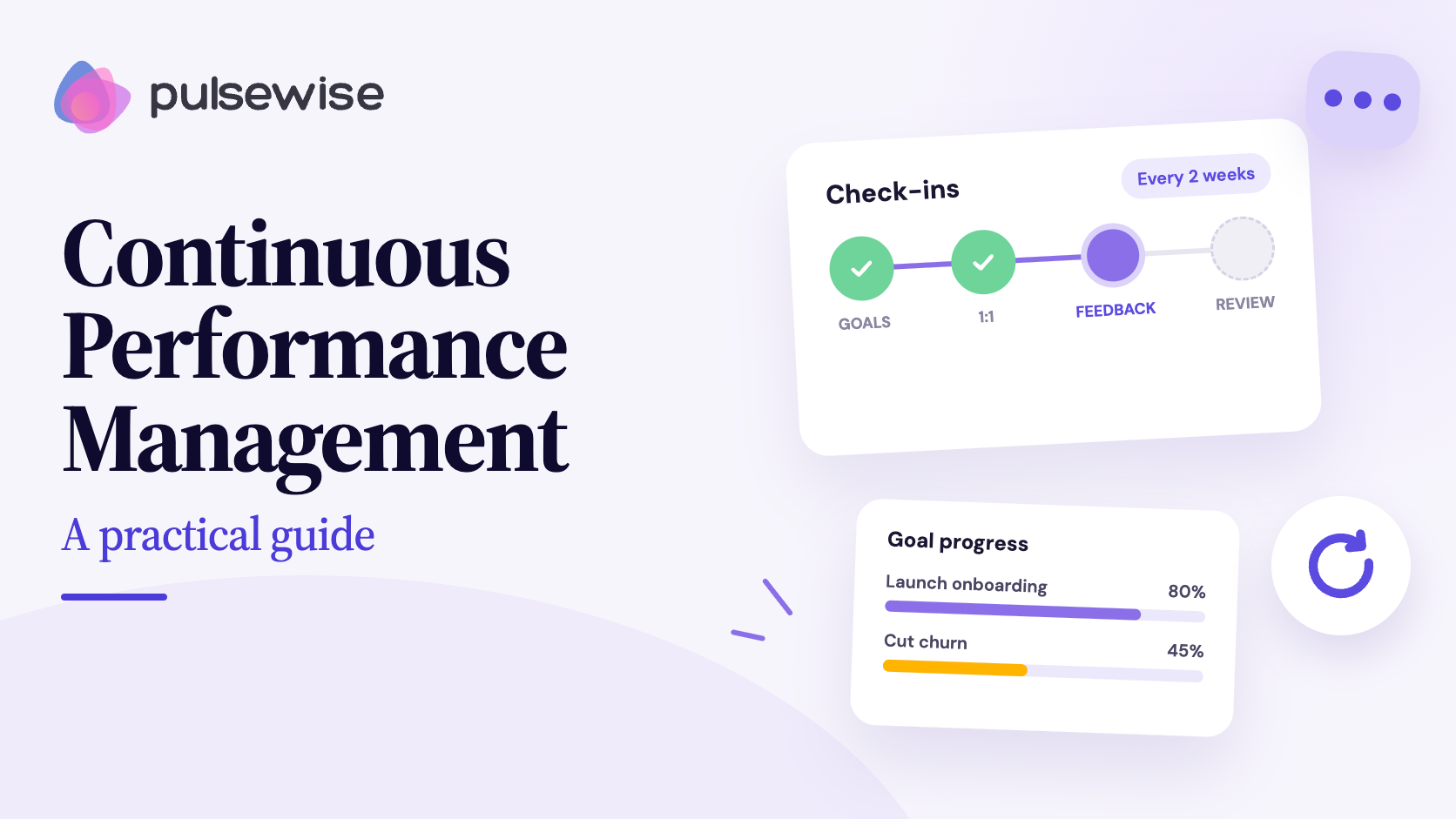
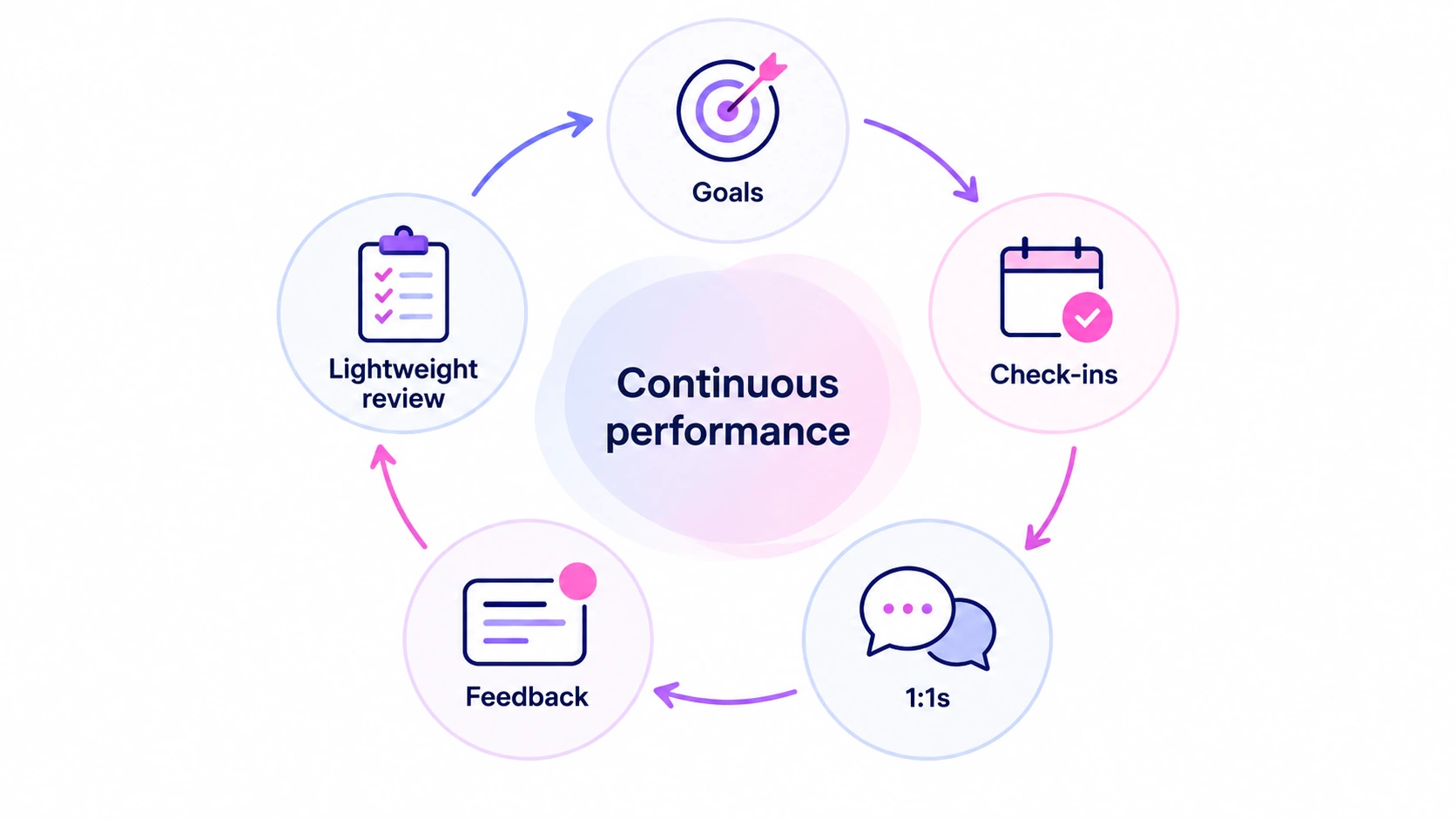
Continuous performance management is an operating rhythm of goals, check-ins, 1:1s and feedback through the year, with lighter formal reviews that summarise what the team already knows. It does not abolish reviews. It changes their job from discovery to confirmation. The five components are goals people revisit, short check-ins, coaching 1:1s, continuous feedback and lightweight reviews. For 100 to 300 person hybrid teams, the hard part is not process design. It is keeping the evidence in one place so managers stop rebuilding a year from memory. Copy the six templates below and use the 90-day rollout plan to start with one team.
What is continuous performance management?
Continuous performance management is an approach to managing performance through regular goal check-ins, 1:1 conversations and real-time feedback throughout the year, with lighter formal reviews that summarise evidence the team has already gathered. The word continuous describes the cadence of conversation, not the frequency of ratings.
A continuous performance management system is the set of habits, owners and tools that makes that cadence stick. Software helps, but the system itself is the rhythm: who meets, how often, what they discuss and where it gets written down.
What continuous performance management is not
-
Not the end of reviews. Most teams still run one or two formal cycles a year for promotion and pay decisions.
-
Not constant rating. Ongoing performance reviews means ongoing conversation, not a score every week.
-
Not surveillance. The aim is coaching context for managers, not activity tracking.
-
Not a tool you switch on. Without manager habits, any platform just stores empty check-ins.
Why annual reviews alone stop working
Annual reviews ask a manager to remember twelve months of work in one sitting. Memory favours the last few weeks, the loudest moments and the people the manager sees most often. In a hybrid team, that last bias quietly penalises the people who work remotely.
The research on traditional reviews is unkind. Gallup reports that only 14% of employees strongly agree their reviews inspire them to improve. It also finds that traditional feedback approaches make performance worse about a third of the time.
Cost is the other problem. When Deloitte counted the time spent on forms, meetings and ratings, it found close to 2 million hours a year, as Marcus Buckingham and Ashley Goodall described in Harvard Business Review. In the same piece, 58% of executives Deloitte surveyed said their approach drove neither engagement nor high performance.
None of this makes reviews useless. It means a single review cannot do the work of twelve months of conversation, and that gap is exactly what continuous performance management fills.
Continuous performance management vs annual reviews
The clearest way to see the difference is side by side. The table below compares the two models on the things a People team actually has to defend: timing, evidence, fairness and time cost.
| Dimension | Annual review model | Continuous performance management |
|---|---|---|
| Feedback timing | Saved up for the year-end form | Given within days of the moment |
| Goals | Set in January, revisited in December | Checked in on weekly or fortnightly, reset each quarter |
| Manager role | Judge at the end of the year | Coach throughout the year |
| Evidence behind ratings | Manager memory and last-minute peer requests | Check-ins, feedback notes and 1:1 records gathered all year |
| Surprises | Common, often at the worst moment | Rare, because issues surface early |
| Time cost | Packed into a stressful few weeks | Spread across 5 to 30 minute weekly habits |
| Hybrid fairness | Favours people the manager sees most | Written evidence levels the field for remote staff |
| Job of the formal review | Discover what happened | Confirm what everyone already knows, then decide on growth and pay |
Notice that the right-hand column keeps the formal review. It simply changes the review’s job from discovery to confirmation, which is the shift most People leaders are really after.
This comparison is about performance cadence, not listening. If you are weighing survey frequency instead, read our breakdown of pulse surveys vs annual surveys.
See the whole loop in one workspace. Pulsewise keeps goals, feedback, 1:1s and reviews together in Perform & Grow, so the evidence is already waiting when the review cycle opens. See how Pulsewise works
The five components of a continuous performance management system
Every working system uses the same five building blocks. The cadence changes from team to team, but skipping any one of them breaks the chain between everyday work and the formal review.
1. Goals people actually revisit
Goals give every later conversation something concrete to anchor to. Keep three to five per person per quarter, link each one to a team goal, and write the outcome rather than the activity.
Most goal programmes fail on the revisit, not the setting. A good goal check-in takes two minutes: the progress number, what changed, what is in the way and what would help.
TEMPLATE: Quarterly goal with a weekly check-in Goal: Cut new-customer onboarding time from 21 days to 14 days by 31 December. Linked team goal: Improve first-90-day retention for Q4 customers. Owner: Priya Nair, Customer Success Lead Key results: (1) Median onboarding time at or below 14 days for the November and December cohorts. (2) Handover checklist used on 100% of new accounts. (3) Onboarding CSAT at or above 4.5. Check-in, week of 3 November. Progress: 45%. What changed: welcome guide published and October median down to 18 days. What is in the way: sales handover notes still arrive late on enterprise deals. What would help: 15 minutes with the sales lead to agree a handover deadline. Swap in your own goal, numbers and owner, and keep the four check-in prompts.
If you want this in software, Pulsewise Goals & todos pairs each goal with check-ins and linked todos, so progress and the story behind it stay together. For company-wide roll-ups, see how goal alignment works across teams.
2. Short, regular check-ins
Check-ins are the heartbeat of the system. A written check-in once a week takes about five minutes and gives the manager a signal before small problems become big ones.
Keep check-ins separate from 1:1s. The check-in is the signal, and the 1:1 is the conversation about it. For remote and hybrid teams, asynchronous written check-ins also create a record that does not depend on who was in the office that day.
TEMPLATE: Weekly async check-in Name: Tomás Ferreira, Product Designer | Week ending: Friday 7 November 1. Wins this week: Shipped the new onboarding checklist screens. In a usability test, four of five customers finished without help. 2. Priorities next week: Final copy review with Priya, then start the empty-state designs for reports. 3. Blockers: Waiting on an engineering estimate for the progress bar animation. 4. Energy this week (1 to 5): 4 5. One thing my manager could do: Nudge engineering for the estimate before Wednesday. Swap in prompt wording that matches your team’s language, and keep it to five questions or fewer.
3. 1:1 conversations that coach rather than report
The 1:1 is where check-in signals turn into coaching. A 30-minute conversation every week or fortnight works for most teams, and the employee should own most of the agenda.
If your 1:1s drift into status updates, our guide on how to run a 1:1 meeting covers structure and questions in depth. For senior leaders, skip-level meeting questions add a second layer of context.
TEMPLATE: 30-minute fortnightly 1:1 agenda 0 to 5 min, how they are doing: “What is taking more energy than it should right now?” 5 to 15 min, their topics: Tomás wants to lead the next customer walkthrough. 15 to 22 min, goals and blockers: Onboarding goal at 45%, engineering estimate still open. 22 to 27 min, feedback both ways: “Your test summary made the decision easy. Next time, put the one-line recommendation at the top.” 27 to 30 min, actions with owners and dates: Manager emails the engineering lead by Tuesday. Tomás drafts the walkthrough plan by 14 November. Swap in your report’s real topics, and keep the last three minutes for actions every time.
4. Continuous feedback that names the moment
Continuous feedback means specific notes given close to the moment, by managers and peers, in both directions. A useful rule of thumb is to share it within 48 hours, while both people still remember the details.
Good feedback names a real moment, the behaviour, its impact and a next step. The same structure works for praise and for constructive notes.
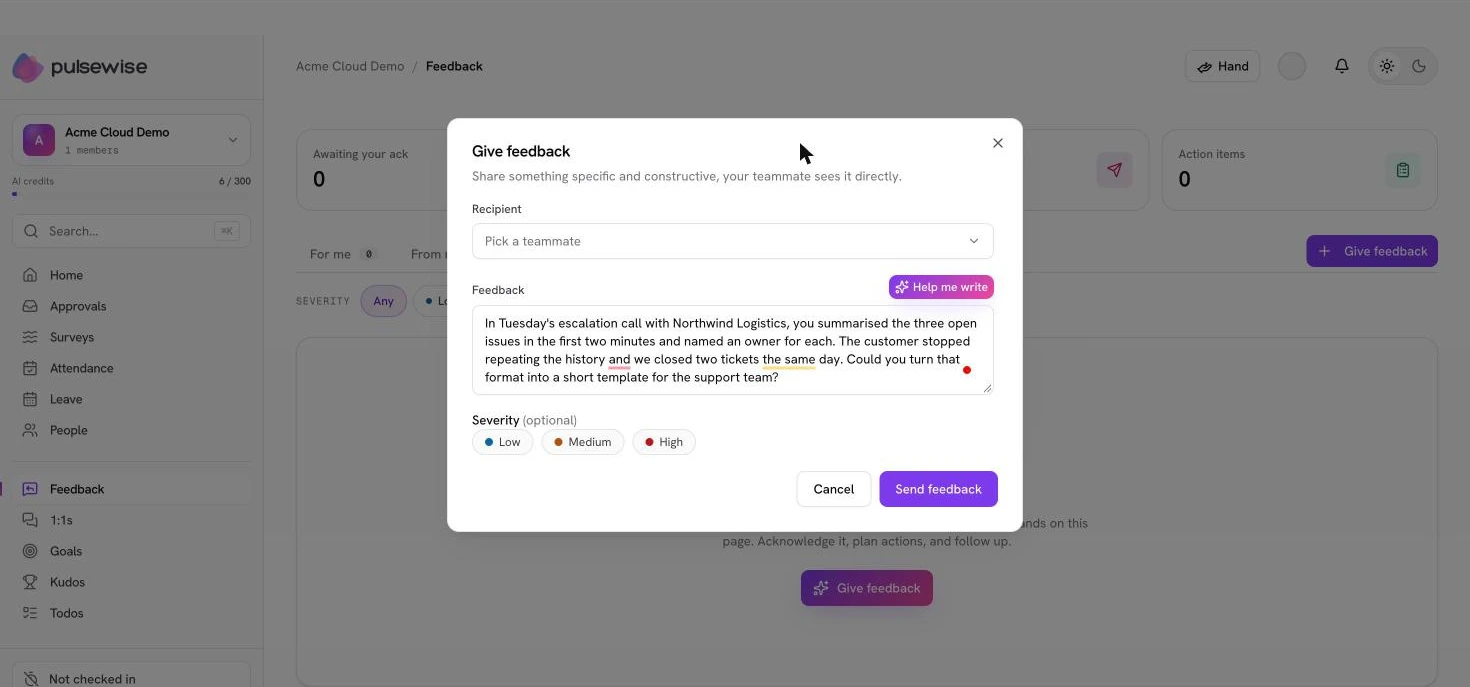
TEMPLATE: Feedback note: moment, behaviour, impact, next step To: Aisha Khan, Account Manager | From: Daniel Okafor, Support Lead | Date: 12 November Moment: Tuesday’s escalation call with Northwind Logistics. Behaviour: You summarised the three open issues in the first two minutes and named an owner for each. Impact: The customer stopped repeating the history, and we closed two of the three tickets the same day. Next step: Could you turn that summary format into a short template for the support team? Constructive version: “In Tuesday’s call, the pricing question went unanswered for ten minutes, and the customer asked twice. Next time, could you flag it to me in chat so I can jump in?” Swap in a real moment from this week. If you cannot name the moment, the note is not ready yet.
Recognition belongs here too. Public appreciation through kudos and recognition adds positive evidence that a review would otherwise miss.
5. Lightweight reviews that confirm, not discover
The formal review still matters for calibration, promotion and pay. In a continuous model it gets shorter, because the evidence already exists, and many teams add a one-page quarterly snapshot between full cycles.
TEMPLATE: One-page quarterly lightweight review Employee: Priya Nair | Quarter: Q4 2026 | Reviewer: Marcus Lindqvist, Head of Customer 1. Goal outcomes (from check-ins): Onboarding time cut to 15 days against a 14-day target. Checklist adoption at 100%. Onboarding CSAT at 4.6. 2. Strongest contribution and why it mattered: Rebuilt the sales-to-customer-success handover, which removed the main cause of onboarding delays. 3. One area to grow next quarter: Delegate the weekly reporting so she has time for the enterprise cohort. 4. Evidence used: 11 goal check-ins, 6 feedback notes and 5 1:1 records. 5. Support needed: Budget for one onboarding specialist from February. 6. Overall rating: Strong (scale: Low, Inconsistent, Core, Strong, Outstanding). Swap in your own rating scale, and keep question 4 so every rating shows its evidence.
Pulsewise Performance reviews follow the same idea, with review templates, self, peer and manager input, and a clear path to sign-off.
What a continuous performance cadence looks like
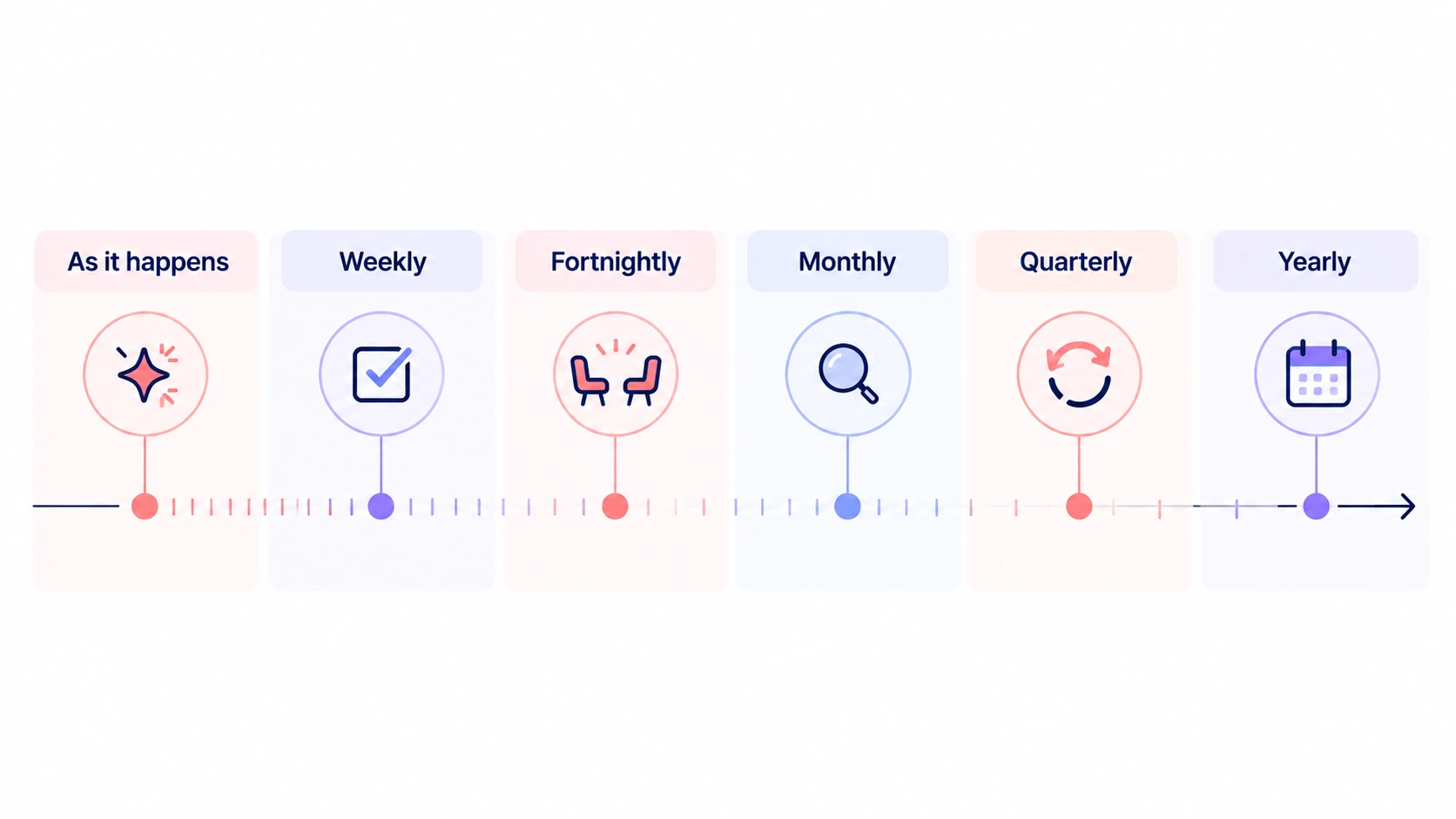
Cadence is where most rollouts succeed or fail. The table below is a sensible starting rhythm for a 100 to 300 person hybrid company, with realistic time costs.
| Rhythm | What happens | Owner | Time per person |
|---|---|---|---|
| As it happens | Feedback and kudos after notable moments | Anyone | 2 minutes |
| Weekly | Async check-in on goals, blockers and energy | Employee | 5 minutes |
| Fortnightly | 1:1 conversation | Employee leads, manager supports | 30 minutes |
| Monthly | Manager scans check-ins and feedback for patterns | Manager | 20 minutes per team |
| Quarterly | Goal reset and one-page review snapshot | Manager and employee | 45 minutes |
| Once or twice a year | Formal review with calibration and pay decisions | People team | 60 to 90 minutes |
The weekly layer matters more than it looks. Gallup found that 80% of employees who received meaningful feedback in the past week are fully engaged, regardless of how many days they spent in the office.
How to roll out continuous performance management in 90 days
Do not launch company-wide on day one. Start with one willing team, prove the rhythm works, then expand with templates you have already fixed.
| Phase | Weeks | What to do | Done when |
|---|---|---|---|
| Design | 1 to 2 | Pick a pilot team of 8 to 15 people with a willing manager. Agree the cadence, templates and where evidence lives. Write a one-page note on who sees what. | The pilot team has seen the cadence, templates and privacy note |
| Pilot | 3 to 8 | Run weekly check-ins and fortnightly 1:1s. Set quarterly goals. Encourage one feedback note per person each fortnight. | 80% of check-ins arrive on time for four weeks in a row |
| Review | 9 to 10 | Run a lightweight review using only pilot evidence. Ask the team what felt useful and what felt like admin. | Each review takes under 45 minutes per person |
| Expand | 11 to 13 | Fix what the pilot exposed, train the next three managers and set a date for the first company-wide cycle. | The next wave starts with adjusted templates |
Swap in your own pilot size and thresholds. The 80% and 45-minute targets are starting points, not benchmarks.
Manager capability decides whether the pilot sticks. Our guide to manager enablement covers the training most first-time coaches need.
CTA Plan your first continuous 1:1 tonight. Turn a few topics into an editable agenda with the free Pulsewise 1:1 agenda builder.
Five mistakes that quietly kill continuous performance management
1. Adding meetings without removing paperwork
If the old annual form stays the same length, managers feel double the work. Shorten the formal review the moment check-ins start producing evidence.
2. Letting check-ins become status reports
A check-in that only lists tasks gives the manager nothing to coach on. Keep at least one prompt about blockers and one about support.
3. Rating people every week
Frequent conversation is the goal, not frequent scoring. Weekly ratings make people defensive and turn coaching back into judgement.
4. Leaving evidence across four tools
When goals, surveys, recognition and reviews live in separate apps, nobody can see the full picture before a 1:1. Managers end up rebuilding the year by hand, which is the exact problem the system was meant to solve.
5. Skipping manager training
Gallup notes that organisations replacing annual reviews without enough training quickly find their managers do not know how to talk to employees. Budget time for coaching practice before you scale.
How to tell whether it is working
Track a small set of leading and lagging signals each quarter. You need both, because engagement and retention move slowly while habit metrics move within weeks.
| Signal | What to measure | Healthy starting target |
|---|---|---|
| 1:1 completion | Share of scheduled 1:1s that actually happen | 80% or higher |
| Check-in freshness | Share of active goals updated in the last 14 days | 75% or higher |
| Feedback flow | Feedback notes per person per month, and the peer-to-peer share | At least 2 per person, a third from peers |
| Review effort | Hours per person in the formal cycle | Falling cycle on cycle |
| Surprise rate | Share of people who say their rating was a surprise | Under 10% |
| Regretted attrition | High performers leaving over 12 months | Falling year on year |
Swap in targets from your own baseline after the pilot. These numbers are illustrative starting points, not industry benchmarks.
For the engagement side of the dashboard, see our list of employee engagement metrics. If attrition is the headline concern, start with how to reduce employee turnover.
What to look for in continuous performance management software
A spreadsheet can run a pilot, but it cannot run 200 people for a year. When you evaluate software, focus on how well the parts connect rather than how many features appear on the pricing page.
-
One home for the evidence. Goals, check-ins, feedback, 1:1s and reviews should sit together, so the review draws on real records.
-
AI that assists, not decides. Drafting, summarising and spotting themes save time, but people should confirm every rating.
-
Clear privacy rules. Know what is anonymous, what is attributed and who can read 1:1 notes before rollout.
-
Async by default. Hybrid and remote teams need written check-ins and agendas that work across time zones.
-
Pricing that fits 100 to 300 people. Per-module pricing adds up fast when you need performance and engagement together.
Lattice and 15Five publish heavily on this topic and are worth a look. If you are comparing, see Pulsewise vs Lattice, Pulsewise vs 15Five and our roundup of Lattice alternatives.
How Pulsewise supports continuous performance management
Pulsewise is an AI-first platform that brings people intelligence and HRMS together. Its Perform & Grow area covers the core of continuous performance management in one workspace: Goals & todos, Feedback, 1:1 conversations and Performance reviews.
Because those modules share one workspace, the same evidence follows a person from a Tuesday check-in to the year-end review. Pulsewise is a newer platform, so it has fewer public reviews than older tools, but the connected design is the point.
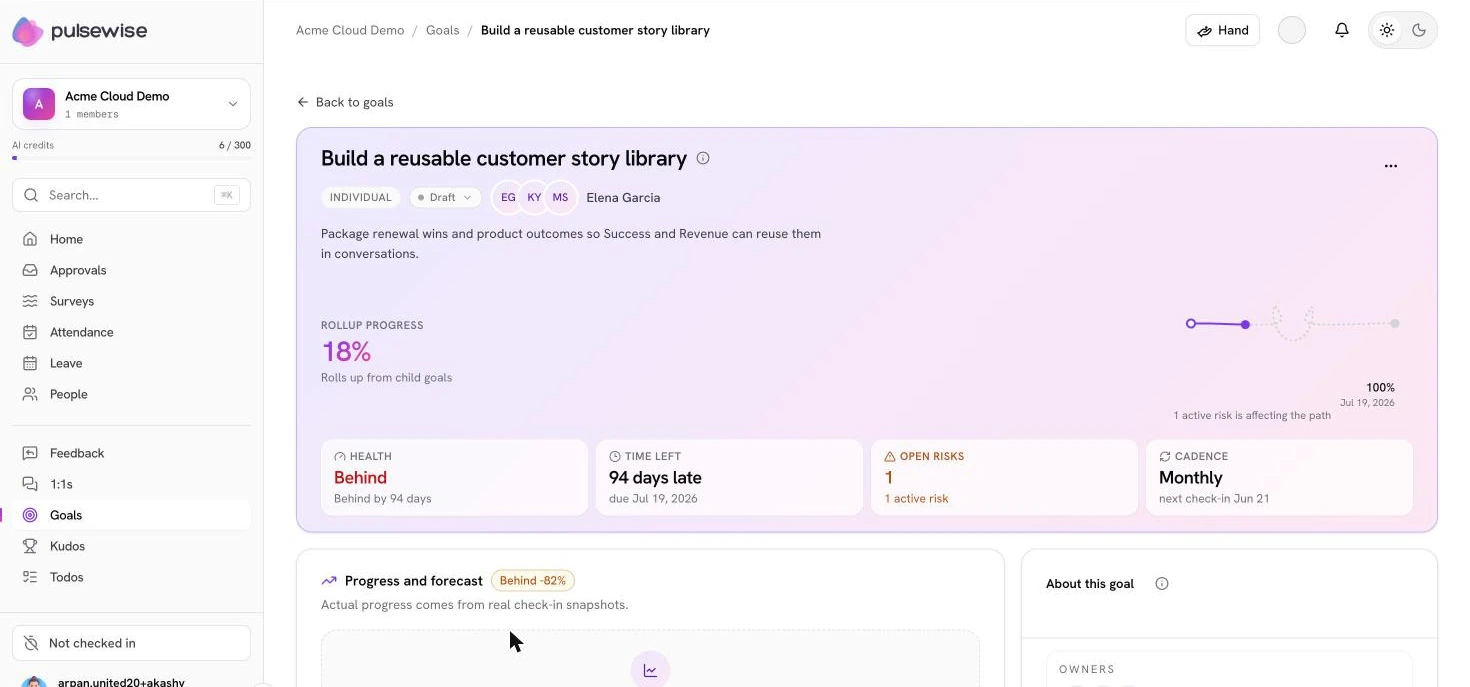
Goals & todos
Goals & todos connect individual goals to team goals and keep a history of check-ins, including what changed and what support is needed. Linked todos give each next step an owner and due date, and where enabled, AI insights and risk analysis flag concerns for discussion.
Feedback
Everyday Feedback names its sender and recipient, so both people can add context and ask questions. A note can turn into a follow-up task, and AI identifies themes such as collaboration and communication as evidence for a manager to discuss rather than a verdict.
1:1 conversations
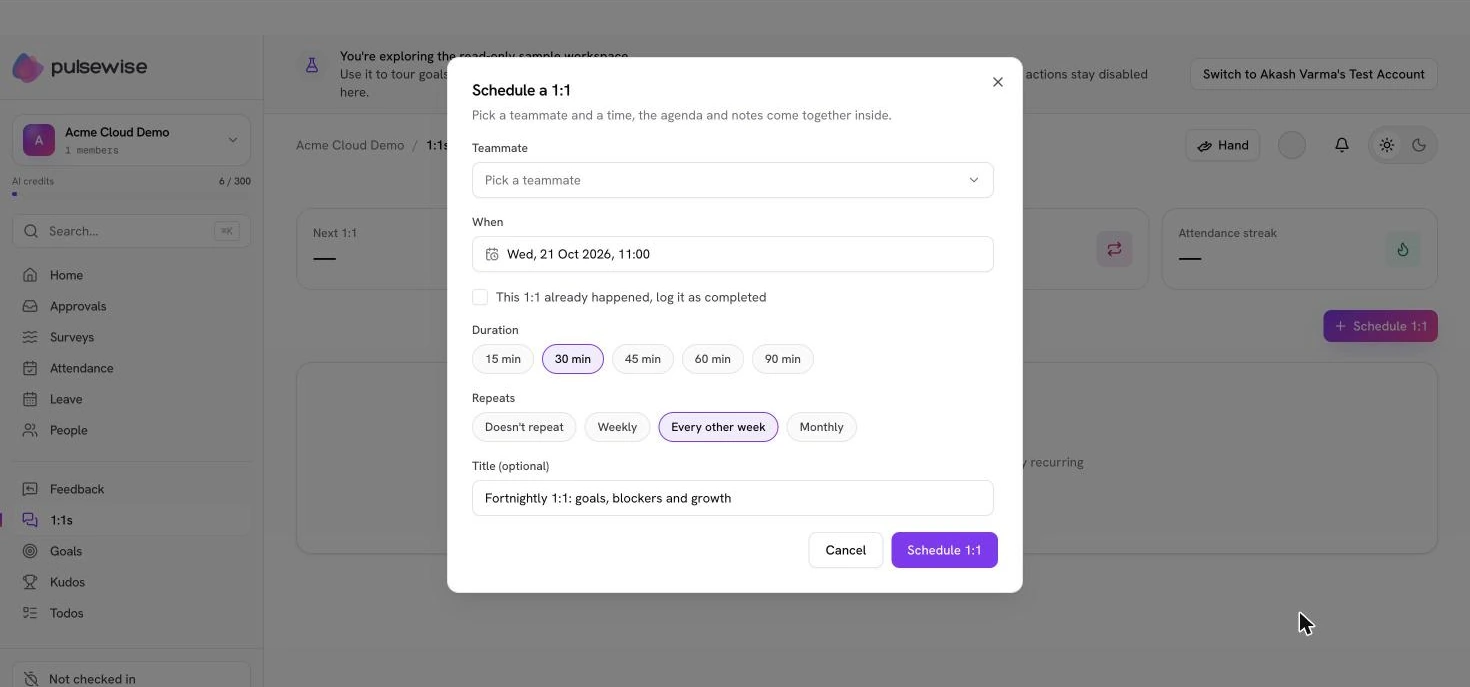
1:1 conversations bring shared agendas, goal and feedback context and meeting follow-through into one place. Agreements become trackable action items, and private meeting notes are not analysed for individual Reputation.
Performance reviews
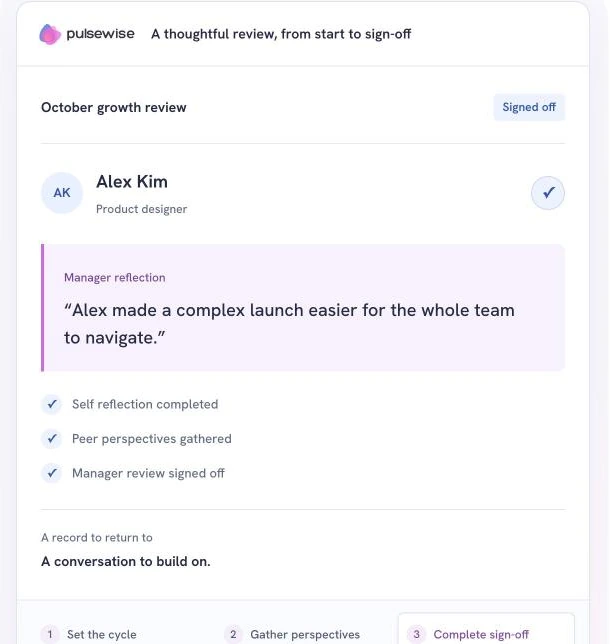
Performance reviews use reusable templates and gather self, peer and manager input in one cycle. HR can track outstanding work, AI helps draft responses that each reviewer checks and submits, and the cycle closes with approval and sign-off.
Reputation and recognition
Kudos, feedback, goal activity and completed 1:1s contribute to an individual Reputation score across 12 dimensions, which gives growth conversations real evidence. Anonymous pulse responses stay separate and never feed a named score, as the how it works page explains.
Compensation planning, which would connect review outcomes to pay decisions, is in development and not yet available. Teams that use AI assistants can also connect them through Pulsewise MCP to prepare for a 1:1 or update a goal.
On pricing, the launch offer gives the first 100 eligible teams one workspace free forever for up to 100 users, with no credit card required and subject to availability. Pulsewise confirms the included modules before activation, and performance reviews sit on eligible plans.
Bring goals, feedback, 1:1s and reviews into one workspace. The first 100 eligible teams get one Pulsewise workspace free forever for up to 100 users. Check the launch offer or book a demo
Final thoughts
Continuous performance management is less about new software and more about a steadier rhythm. Goals get revisited, feedback arrives while it still matters, and the formal review confirms what everyone already knows.
Start with one team, use the templates above and measure the habits before the outcomes. Once the evidence lives in one place, managers stop flying blind between reviews and the annual cycle stops being a surprise. For the wider engagement picture, our employee engagement master guide is a good next read.
FAQs
What is continuous performance management in simple terms?
Continuous performance management means talking about performance all year instead of once. Managers and employees set goals, share short check-ins, hold regular 1:1s and exchange feedback close to the moment. A lighter formal review then summarises that evidence, so ratings and pay decisions rest on twelve months of notes rather than memory.
What are the main components of continuous performance management?
Most systems use five components: goals people revisit, short weekly or fortnightly check-ins, 1:1 conversations focused on coaching, continuous feedback from managers and peers, and lightweight reviews that confirm what the evidence already shows. Recognition often sits alongside them. Skipping any one component usually breaks the chain between everyday work and the formal review.
Does continuous performance management replace annual reviews?
Usually not. Most companies keep one or two formal review cycles a year for promotion, calibration and pay decisions. What changes is the job of that review. Instead of discovering what happened, it confirms what goals, check-ins, feedback and 1:1 records already show, which makes the cycle shorter and far less surprising for everyone.
How often should managers hold check-ins?
A practical starting cadence is a five-minute written check-in every week and a 30-minute 1:1 every two weeks. Goals get reset each quarter, and the formal review runs once or twice a year. Hybrid and remote teams benefit from written, asynchronous check-ins because they create a record that does not depend on office visibility.
What is the difference between continuous feedback and continuous performance management?
Continuous feedback is one ingredient: specific, timely notes about real moments of work, from managers or peers. Continuous performance management is the whole operating rhythm that feedback sits inside, including goals, check-ins, 1:1 conversations and lighter reviews. Feedback without goals and follow-through tends to fade, which is why teams need the full system.
What are the disadvantages of continuous performance management?
The main risks are meeting overload, check-ins that turn into status reports and managers who lack coaching skills. Scattered tools also create extra admin, because evidence lives in four places. Teams avoid these problems by removing old paperwork as they add new habits, training managers early and keeping goals, feedback, 1:1s and reviews in one place.