A senior engineer resigns on a Tuesday. Nobody saw it coming. You pull up the engagement survey from four months ago and find she rated her manager relationship a 4 out of 5.
The survey was not wrong. It was late.
That gap between what your data says and what your people are actually doing is the central argument behind the debate over pulse surveys versus annual surveys. Most content on this topic ends with a tidy “use both.” That answer is fine if you have a people analytics team. If you are a People Ops lead supporting 180 employees, “use both” is not a strategy; it is a wish.
So here is the harder question, and the one this post answers: which listening model actually fits the way your company makes decisions?
TL;DR
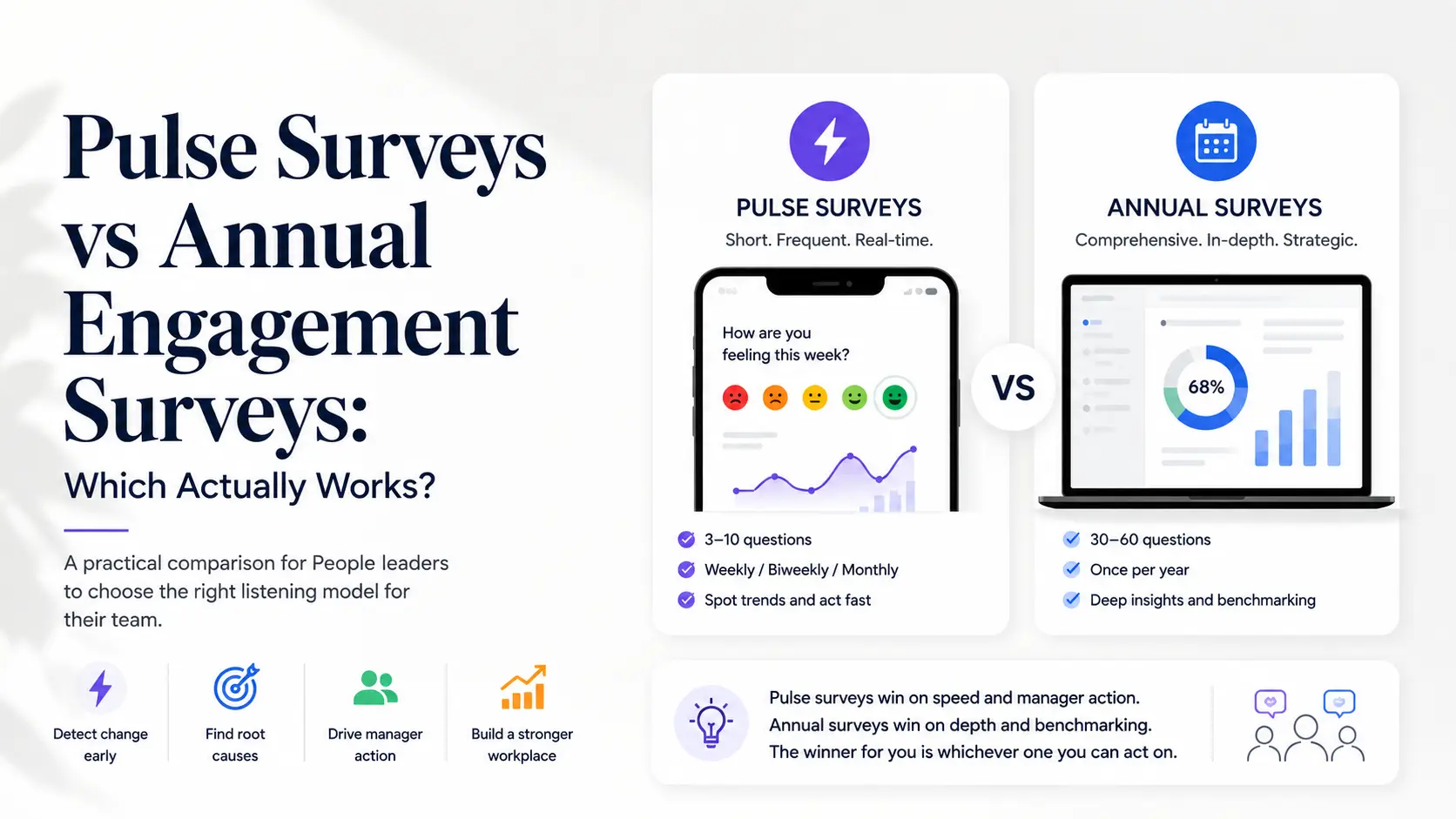
A pulse survey is a short, recurring employee survey of roughly 3 to 10 questions, run weekly, biweekly, or monthly, designed to detect change early. An annual engagement survey is a comprehensive once-a-year census of roughly 30 to 60 questions, designed to diagnose root causes and benchmark against external norms. Neither one fails because of its length. Both fail for the same reason: nobody acts on the results. In one UK study, only 19 percent of employees believed their feedback was acted on. The right cadence is not a matter of calendar questions. Gallup’s own guidance is that survey cadence should match your managers’ capacity to review and act on results. Under 150 employees, run pulse-first and skip the annual census. Between 150 and 500, run a pulse-first program with one lightweight annual deep dive. Above 500, you need both to be properly resourced. The one-line answer: pulse surveys win on speed and manager action, annual surveys win on depth and benchmarking, and the winner for you is whichever one you can actually close the loop on.
What is a pulse survey?
A pulse survey is a short, recurring employee survey, typically 3 to 10 questions, sent on a weekly, biweekly, or monthly cadence to track sentiment in near real time.
Its job is detection, not diagnosis. A pulse survey tells you that something moved, which team it moved in, and roughly when. It rarely tells you why on its own.
Most pulse surveys take under three minutes to complete. The best programs use two or three fixed anchor questions for trend tracking, then rotate the remaining questions across themes like workload, psychological safety, recognition, and manager support.
If you are building your question bank, our guide to the employee engagement questions worth asking breaks down which questions belong in a short pulse and which need the room of a longer survey.
What is an annual engagement survey?
An annual engagement survey is a comprehensive, organization-wide census run once a year, typically with 30 to 60 questions, measuring multiple dimensions of the employee experience against a consistent baseline.
Its job is diagnosis and comparison. It covers engagement, manager effectiveness, career growth, culture, wellbeing, inclusion, and strategic alignment. It produces statistically robust data that you can cut by department, tenure, and location.
It also produces the artifact that most people forget matters: an external benchmark. When your CEO asks whether a score of 68 is good, the annual survey is what lets you answer.
Pulse survey vs annual survey: side-by-side comparison
Here is how the two models compare on the dimensions that actually change your decision.
| Dimension | Pulse survey | Annual engagement survey |
|---|---|---|
| Length | 3 to 10 questions | 30 to 60 questions |
| Time to complete | 1 to 3 minutes | 15 to 25 minutes |
| Cadence | Weekly, biweekly, or monthly | Once per year |
| Primary job | Detection: Catch the change early | Diagnosis: find root causes |
| Time to insight | Days | Six to twelve weeks |
| Statistical depth | Light, trend-based | Robust, multi-dimensional |
| External benchmarking | Weak or unavailable | Strong |
| Who acts on it | Managers, weekly | HR and leadership, annually |
| Typical response rate | 60% and above is strong | 70% and above is strong |
| Main failure mode | Asking without acting | Acting far too late |
| Best for | Real-time alerts and manager coaching | Strategic planning and board reporting |
Read that table quickly, and the answer looks obvious. Pulse wins on everything that sounds modern. That is exactly the trap.
The real question nobody asks: Does your listening cadence match your decision cadence?
Almost every article on this topic frames the choice as a survey design problem. It is not. It is an operating rhythm problem.
Ask yourself a different question. How often does your company actually make people decisions? Not plan them. Make them.
For most companies in the 100 to 300 employee range, the honest answer is monthly or quarterly. Headcount moves quarterly. Manager changes happen when they happen. Compensation cycles run once or twice a year. Team restructures land with about three weeks of notice.
Now match those two clocks. If your listening cadence is annual and your decision cadence is quarterly, you are making three out of every four people’s decisions with no current data at all. You are not data-driven. You are data-adjacent.
This is not a fringe view. It is buried in Gallup’s own survey best practices, which state plainly that survey cadence should match your managers’ capacity to review and act on results.
That single sentence reframes the entire debate. The question was never “which survey is better.” The question is “how fast can we act, and are we measuring at that speed or slower?”
The lag math: how an annual survey makes you eight months late
Put real dates on a standard annual cycle, and the problem stops being abstract.
| When | What happens | Data age |
|---|---|---|
| June | A team lead quietly checks out. Workload creeps up. | Invisible |
| October | Annual survey runs. Scores dip in that department. | 0 weeks |
| December | Results analyzed and packaged for leadership. | 8 weeks |
| February | Action plan approved. Managers briefed. | 16 weeks |
| March | Two people from that team have already resigned. | 20 weeks |
The problem started in June. You acted in February. That is an eight-month detection-to-action gap on an issue that was visible in the team’s Slack channel within weeks.
A monthly pulse compresses that same loop to roughly three to five weeks. That is the entire value proposition, and it is worth being precise about it: pulse surveys do not give you better data than an annual survey. They give you the same data sooner, which is a different and often more valuable thing.
Our analysis of what the 2026 disengagement data actually shows goes deeper into how quickly a team can drift from green to red, and why the annual cycle structurally cannot catch it.
Curious what a monthly signal would surface in your team? Pulsewise runs lightweight scheduled pulses with department-level roll-ups, so you see the mood shift in the week it starts. Explore pulse surveys.
What annual surveys genuinely do better
Pulse survey vendors love to strawman the annual survey. That is a mistake, and it costs credibility with anyone who has actually run one.
Here is the honest case for the annual census.
1: It diagnoses causes, not just symptoms
A three-question pulse can tell you that morale dropped in the sales team. It cannot tell you whether the cause is compensation, a new manager, unclear targets, or a burned-out top performer dragging the room down. Some dimensions, like belonging, purpose, and leadership trust, simply do not compress into two questions.
2: It gives you a defensible external benchmark
Pulse data is internally relative. If your engagement score drops four points, you know it dropped, but you cannot tell if you are still ahead of your industry. The moment leadership pushes back on an investment, that benchmark is your entire argument.
3: It creates a two-way conversation, not a one-way readout
This is the point most pulse advocates skip. A well-run annual survey ends in a structured team debrief where managers and employees build an action plan together. A pulse that fires into a dashboard and stops there is measurement, not listening.
4: It surfaces the slow-moving problems
Career stagnation, quiet inequity, and eroding trust in leadership do not spike week to week. They drift over quarters. A short survey optimized for detecting change is structurally blind to problems that never change fast enough to trigger it.
What pulse surveys genuinely do better
The case for pulse surveys is not that they are shorter. It is that they change who owns the data.
-
They make the manager the actor, not HR. Annual survey results land with HR, get packaged, and trickle down. Pulse results land with the manager while the context is still fresh.
-
They shorten the trust loop. Employees judge a listening program by how fast they see something change. A monthly cycle lets you close the loop twelve times a year instead of once.
-
They measure whether your fixes worked. Run an action plan, then pulse the same team six weeks later. Annual surveys cannot do this, because the next measurement is a year away.
-
They catch attrition risk while it is still reversible. Sentiment declines usually precede resignations by weeks or months. That is a window an annual survey never sees.
-
They hold up under high response rates. A one-minute survey gets finished. A 45-question survey gets abandoned, and abandonment skews your sample toward the very engaged and the very angry.
That last point matters more than it looks. If your annual survey is answered mostly by your happiest and your most frustrated people, your “company average” describes a population that does not exist.
Our leader’s guide to people analytics covers how that sampling skew quietly corrupts decision-making.
Where pulse surveys fail (and why it is not survey fatigue)
Survey fatigue is the most misdiagnosed problem in people ops.
Employees do not get tired of being asked. They get tired of being asked and seeing nothing happen. Frequency is not the disease; silence is.
That distinction matters because it changes the fix. If you believe frequency is the problem, you survey less often, and the program dies slowly. If you believe silence is the problem, you fix the follow-through, and frequency stops mattering.
Pulse programs fail in four specific ways, and none of them is about length.
-
You ask faster than you can act. A weekly pulse with a quarterly action cycle trains employees that feedback disappears. This is the single most common failure.
-
You have no baseline to interpret against. A three-point drop means nothing without a reference. Is this seasonal? Is this a reorg effect? Is this normal variance? Without a baseline, you are reading tea leaves.
-
You rotate questions so aggressively that nothing trends. If the question set changes every cycle, you have twelve unrelated snapshots, not a trend line.
-
You treat it as a poll. Pulse surveys are for an engagement signal. The moment you use them to pick the office snack, employees stop reading them as serious.
The rule that prevents all four: do not ask another question until you can answer what you will do differently if the score drops. If you cannot commit to acting monthly, do not run a monthly pulse.
Which should you run? A decision framework by headcount
This is the section every other article skips. “Use both” is a real answer only if you have the headcount and budget to run both well. Most companies do not.
Here is the honest recommendation by company size.
1: Under 50 employees
Run pulse-only. Skip the annual census entirely.
At this size, an annual survey is theatre. Your leadership team can already see most of what it would tell you, and your sample sizes are too small to produce meaningful department cuts without breaking anonymity.
Run a monthly five-question pulse. Pair it with real one-on-ones. That is a complete listening program at this stage.
2: 50 to 150 employees
Run pulse-first. Add a single annual deep dive only if you need an external benchmark.
This is the range where the informal signal breaks. The CEO can no longer feel the mood of the room, because there is no longer one room. But you almost certainly do not have a dedicated people analytics function.
Run a biweekly or monthly pulse as your operating instrument. If your board or investors want a benchmarked number once a year, add one 25-question annual survey. Do not build the whole program around it.
3: 150 to 500 employees
Run a pulse-first program with one lightweight annual deep dive. This is the genuine hybrid zone.
Here, you need both, but not equally. The pulse is your operating cycle, the thing managers actually use every month. The annual survey is your diagnostic and benchmarking instrument, run once, kept short, and explicitly designed to answer the questions the pulse cannot.
The critical discipline is non-overlap. If your annual survey asks the same questions as your pulse, you have doubled the employee burden and learned nothing new. Design them as two instruments with two distinct jobs.
This is also the size band where manager enablement becomes the bottleneck rather than data collection. Getting results to the managers who can actually act on them matters more than the survey design itself.
4: 500 or more employees
Run both, properly resourced, as one coordinated program.
At this scale, the annual census earns its keep. You have the sample sizes for meaningful segmentation, the board reporting requirements, and usually the headcount to run action planning at the department level.
The failure mode at this size is not choosing wrong. It is running the two programs through separate teams with separate vendors and separate question sets, which produces redundant survey burden and unclear ownership of action.
| Headcount | Recommended model | Annual census? |
|---|---|---|
| Under 50 | Monthly pulse plus real 1:1s | No |
| 50 to 150 | Pulse-first operating cycle | Only if benchmarking is required |
| 150 to 500 | Pulse-first plus one short annual deep dive | Yes, kept lightweight |
| 500 plus | Fully resourced dual program | Yes, fully resourced |
Start listening at the speed you actually make decisions Pulsewise is free forever for the first 100 teams, with up to 100 users and every module included. Pulse surveys, recognition, goals, feedback, and AI analytics in one platform. No credit card, no trial clock. Claim your free spot or see how it works.
How to move from annual to pulse-first in 90 days
If you decide to shift, do not simply cancel the annual survey and announce a new one. That reads to employees as an HR churning process, and your response rates will show it.
Run this sequence instead.
Days 1 to 14: keep your baseline
Pull your last annual survey results and select the three to five drivers that scored lowest or matter most to the business. These become your pulse anchor questions. You are not discarding the annual survey, you are converting it into a starting point.
Days 15 to 30: build the action loop before the survey
Decide who reviews results, on what day, and what they are required to do. Name the person. Put the review on a recurring calendar invite. If you cannot fill in this step, stop here, because the survey will fail regardless of design.
Days 31 to 45: launch a five-question monthly pulse
Three anchor questions that never change, plus two rotating questions on a theme. Keep it under two minutes. Tell employees exactly what will happen with the results and when they will hear back.
Days 46 to 60: close the loop loudly
Within two weeks of the first pulse closing, publish what you heard, what you are changing, and what you cannot change right now and why. That third element is the one most teams skip, and it is the one that builds the most trust.
Days 61 to 90: prove the loop works
Run pulse two and pulse three. Show the team the trend line alongside the action you took. Once employees see a score move because of something they said, participation stops being a compliance problem forever.
For the manager-level habits that make this stick, our 15 strategies for improving employee engagement cover the weekly rhythms that turn survey data into behaviour change. Distributed teams should also read our guide to engagement in remote and hybrid teams, where the listening gap is widest.
The mistake that kills both models
You can run a perfect pulse program and a perfect annual census and still fail.
In one UK study, only 19 percent of employees said they believed their feedback was acted on. That number is the whole story. Four out of five people are answering your survey while assuming it goes nowhere.
Nothing about survey length fixes that. Nothing about frequency fixes it either.
What fixes it is a visible, repeatable loop: you asked, here is what we heard, here is what we changed, here is what we could not change and why. Run that loop consistently and employees will fill in almost any survey you send. Skip it, and your response rate will decay no matter how elegant your instrument is.
The practical implication for tooling is that the survey is the easy part. What matters is whether the signal reaches the manager, whether the manager knows what to do with it, and whether the action shows up in the next one-on-one conversation. That connection is the thing most survey tools leave to you.
How Pulsewise approaches this
Pulsewise was built around the loop rather than the survey. Pulse responses, recognition, goal momentum, and feedback all feed one intelligence layer, so a mood dip in a department shows up next to the goals that stalled and the recognition that stopped.
That means a manager does not receive a score. They receive a signal with context and a suggested next step, surfaced in their weekly coaching view. The culture analytics dashboard rolls the same signals up for leadership, engagement and retention flags attrition risk before a resignation letter arrives.
We are an emerging platform, not a decade-old incumbent, and we are honest about that. What we can say is that the model is built for the company that has to pick one listening system and make it count.
The bottom line
The pulse survey vs annual survey debate is really a debate about honesty.
An annual survey lets you say you listened. A pulse survey forces you to prove it, twelve times a year, in front of people who will notice if nothing changes. That is uncomfortable, and it is exactly why it works.
So do not start by picking a survey. Start by writing down how fast your company can actually act on what it hears. Then choose the cadence that matches, and be ruthless about not exceeding it.
If the answer is monthly, run a monthly pulse and close the loop every single time. Your engineer who resigned on a Tuesday would have shown up in the data in September, not in an exit interview in March.
See what a continuous signal looks like in your own data Walk through your current listening setup with our team, and we will show you what a pulse-first cycle would surface in your organisation. Schedule a demo
FAQs
Can pulse surveys replace annual engagement surveys?
For companies under about 150 employees, yes. A monthly pulse plus strong one-on-ones is a complete listening program at that scale. Above 150, pulse surveys cannot fully replace the annual census, because they cannot deliver external benchmarking or the multi-dimensional depth that diagnoses root causes.
What is the difference between a pulse survey and an engagement survey?
A pulse survey is short and frequent, usually 3 to 10 questions run monthly, and it exists to detect change early. An engagement survey is long and infrequent, usually 30 to 60 questions run annually, and it exists to diagnose causes and benchmark performance. One measures speed, the other measures depth.
How often should you run pulse surveys?
Monthly suits most companies. It gives you enough time to analyse results and act before the next cycle opens. Run biweekly only if you have a dedicated action process, and weekly only if managers genuinely review results every week. Never survey faster than you can respond.
What is a good pulse survey response rate?
Above 60 percent is strong for a pulse survey, and above 70 percent is strong for an annual engagement survey. Below 50 percent usually signals that employees do not believe feedback leads to change. Response rate is less a participation metric than a trust metric.
How many questions should a pulse survey have?
Three to ten, completable in under three minutes. Use two or three fixed anchor questions so you can track a trend line, then rotate the remaining questions across themes like workload, recognition, and manager support. Completion rates drop sharply once a pulse passes about 90 seconds.
Do pulse surveys cause survey fatigue?
Not on their own. Fatigue comes from being asked and seeing nothing change, not from being asked often. Pulse programs with visible follow-through sustain high participation for years. Programs that collect responses and go quiet lose participation within two or three cycles, regardless of frequency.