50 Employee Engagement Survey Questions (With Examples)

TL;DR
- 50 employee engagement survey questions organized across eight categories that map to Gallup’s engagement hierarchy: basic needs, role clarity, recognition, growth, manager effectiveness, culture, wellbeing, and AI readiness.
- Each question includes why it matters and what example responses reveal, so your team can interpret results without a consultant.
- Global engagement dropped to 20% in 2025 (Gallup, 2026 report). Manager engagement fell five points in a single year, from 27% to 22%.
- The best survey strategy pairs a comprehensive annual survey of 25 to 35 questions with short pulse surveys of 3 to 5 questions every one to two weeks.
- Asking questions without acting on responses does more harm than not asking at all. Assign owners, set timelines, and close the loop publicly.
Most employee engagement surveys fail before anyone clicks submit. The problem is not response rates or timing. It is the questions themselves.
A 60-question survey that asks “Are you satisfied?” ten different ways produces mountains of data and zero useful direction. Meanwhile, the questions that actually predict whether someone stays or leaves never get asked.
Gallup’s 2026 State of the Global Workplace report found that global employee engagement fell to 20% in 2025, costing the world economy an estimated $10 trillion in lost productivity. That is not a data point to glance at and move on from. Each percentage point of engagement represents roughly 21 million workers who have checked out.
The right questions, asked at the right cadence, surface friction before it turns into turnover. This guide gives you 50 proven employee engagement survey questions organized by category, with example response insights and scoring interpretation so you know exactly what each answer tells you.
What are employee engagement survey questions?
Employee engagement survey questions are structured prompts designed to measure how committed, motivated, and connected employees feel toward their roles, teams, and organization. Unlike satisfaction surveys that ask whether someone is content, engagement surveys dig into the drivers of discretionary effort, the reasons people stay, and the friction points that push them toward the door.
The distinction matters. A satisfied employee might show up, do the minimum, and collect a paycheque. An engaged employee feels connected to the mission, takes initiative without being asked, and actively contributes to the team’s success.
The best engagement surveys combine scaled questions (strongly agree to strongly disagree) with open-ended questions. Scaled questions give you trends and benchmarks over time. Open-ended responses surface the specific stories behind the numbers.
Want to run engagement surveys on a steady rhythm without survey fatigue? Explore how Pulsewise pulse surveys work.
Why your survey questions matter more in 2026
The workplace has shifted faster in the past three years than in the previous decade. AI is changing workflows and roles. Hybrid work has made culture harder to observe. Managers are carrying more emotional and operational load than ever before.
Gallup’s 2026 report confirms the impact. Global employee engagement fell to 20% in 2025, the lowest level since 2020. Manager engagement dropped from 27% to 22% in a single year, the steepest decline Gallup has ever recorded. That matters because managers account for approximately 70% of the variance in team engagement.
Generic surveys built five years ago miss these shifts entirely. They do not ask about AI confidence, remote-work isolation, or whether managers have the support they need to coach effectively. A survey that does not reflect how work actually feels in 2026 will collect polite answers and miss the real signals.
How to choose the right response scale
Consistency in your response scale matters more than the specific format you choose. A five-point Likert scale (strongly disagree, disagree, neutral, agree, strongly agree) is the most widely used because it is simple, familiar, and easy to benchmark over time.
Some organizations prefer a six-point scale that removes the neutral option, forcing respondents to lean one direction or the other. This reduces fence-sitting but can frustrate employees who genuinely feel neutral on a topic.
For eNPS-style questions (“how likely are you to recommend this company?”), a 0 to 10 scale is standard. Promoters score 9 to 10, passives 7 to 8, and detractors 0 to 6. Pair scaled questions with at least two or three open-ended questions per survey to capture the reasoning behind the numbers.
50 employee engagement survey questions with examples
These 50 questions are organized across eight categories. Each category maps to a proven engagement driver, from foundational needs like role clarity up to forward-looking themes like AI readiness.
For every question, you will find a short explanation of why it matters and an example of what a strong or weak response pattern tells you.
A: Role clarity and expectations
Clarity is the foundation of engagement. When employees do not understand what success looks like in their role, everything downstream suffers. Gallup’s Q12 framework places role clarity at the base of the engagement hierarchy for exactly this reason.
1. “I know what is expected of me at work.”
Why it matters: Role ambiguity is one of the fastest paths to disengagement. When expectations are unclear, employees either freeze or guess, and both waste energy.
Example insight: If more than 25% of a team disagrees, the issue is likely a manager communication gap, not an employee performance problem.
2. “I understand how my work contributes to the company’s goals.”
Why it matters: Purpose drives discretionary effort. Employees who see the connection between their tasks and the bigger picture are more likely to push through challenging periods.
Example insight: Low scores here often correlate with high scores on “I feel like my work does not matter,” creating a compounding disengagement risk.
3. “My role makes good use of my skills and abilities.”
Why it matters: When people spend most of their time on tasks that do not match their strengths, frustration builds quietly. This question surfaces misalignment before it turns into a resignation.
Example insight: A team where 80% agree is well-matched. Below 60%, consider role audits or internal mobility conversations.
4. “I have the tools and resources I need to do my job well.”
Why it matters: Missing tools create daily friction that compounds over weeks. This could be software, hardware, access to information, or adequate staffing.
Example insight: Consistently low scores in a specific department often point to a budget allocation problem, not an individual complaint.
5. “My job responsibilities are clearly defined.”
Why it matters: Overlapping or undefined responsibilities create conflict between teammates and slow decision-making across the organization.
Example insight: If this score drops after a reorganization, it signals the transition communication was insufficient.
6. “I receive clear priorities when multiple tasks compete for my time.”
Why it matters: Prioritization clarity reduces stress and improves output quality. Without it, employees default to whoever asks loudest rather than what matters most.
Example insight: Teams that score below 50% on this question typically also report higher stress and longer working hours.
B: Recognition and appreciation
Recognition is one of the strongest predictors of retention. Employees who feel valued for specific contributions are significantly less likely to search for new roles. The key word is specific. Generic praise (“good job”) registers far less than targeted acknowledgment tied to a behaviour or outcome.
7. “In the past seven days, I have received recognition or praise for good work.”
Why it matters: Gallup’s research shows weekly recognition is the minimum cadence for maintaining engagement. Monthly or quarterly recognition is too infrequent to sustain momentum.
Example insight: A score below 40% suggests recognition is event-driven (annual awards) rather than embedded in daily work. That is fixable without budget.
8. “Recognition at this company is fair and based on merit.”
Why it matters: Perceived favouritism destroys trust faster than a lack of recognition altogether. This question surfaces whether the system feels equitable.
Example insight: If certain teams score high while others score low, investigate whether some managers are naturally better at recognition or whether structural bias exists.
9. “I feel valued for the work I contribute to my team.”
Why it matters: Feeling valued goes beyond formal recognition programs. It includes being listened to, being included in decisions, and having contributions acknowledged in meetings.
Example insight: Low scores here combined with high scores on “I am recognized” may indicate surface-level praise without genuine respect for the person’s expertise.
10. “My manager acknowledges effort, not just results.”
Why it matters: Effort-based recognition encourages risk-taking and innovation. Outcome-only recognition trains people to play it safe and avoid challenging projects.
Example insight: Teams that score above 70% on this question tend to have higher rates of internal innovation and idea-sharing.
11. “I know exactly what behaviours or outcomes earn recognition here.”
Why it matters: Ambiguity about what is valued creates anxiety. When employees do not know what earns praise, they default to visible busyness rather than meaningful work.
Example insight: If this score is low company-wide, the recognition criteria need to be documented and communicated, not just assumed.
12. “My peers appreciate my contributions to our shared work.”
Why it matters: Peer recognition matters as much as manager recognition. Employees who feel appreciated by teammates report stronger belonging and are more willing to help others.
Example insight: High peer-recognition scores with low manager-recognition scores suggest the team culture is healthy but the management layer needs coaching.
Building a recognition rhythm does not require a big budget. See how Pulsewise kudos and recognition works to make peer acknowledgment visible and trackable.
C: Manager effectiveness
Gallup’s data is unambiguous: managers account for about 70% of the variance in team engagement. In 2025, manager engagement itself fell to 22%, the lowest level on record. When managers disengage, their teams follow. These questions diagnose whether your managers are connecting, coaching, or just supervising.
13. “My manager cares about me as a person, not just an employee.”
Why it matters: This is one of Gallup’s original Q12 items. When employees believe their manager sees them as a whole person, they are more willing to share concerns early rather than letting problems fester.
Example insight: Low scores here are a leading indicator of turnover. People leave managers, not companies. If a specific manager’s team scores below 40%, prioritize a coaching conversation.
14. “My manager gives me regular, useful feedback on my performance.”
Why it matters: Feedback frequency matters more than formality. A five-minute weekly comment beats a 60-minute annual review for keeping people on track and feeling supported.
Example insight: If feedback scores are low but 1:1 meeting frequency is high, the meetings may be status updates rather than developmental conversations.
15. “I feel comfortable raising concerns with my direct manager.”
Why it matters: Psychological safety at the manager level is the gateway to honest feedback, early problem reporting, and team innovation. Without it, surveys themselves become unreliable.
Example insight: Compare this score to the overall engagement score. A large gap suggests employees feel safe answering surveys anonymously but not speaking up in person.
16. “My manager helps me develop my strengths, not just fix my weaknesses.”
Why it matters: Strengths-based development produces better performance outcomes than deficit-focused coaching. Employees who use their strengths daily are six times more likely to be engaged.
Example insight: Teams where managers focus on strengths show higher innovation scores and lower burnout rates.
17. “My manager sets clear expectations and follows through on commitments.”
Why it matters: Inconsistency from managers creates learned helplessness. When promises are broken repeatedly, employees stop investing effort in goals they suspect will be changed or forgotten.
Example insight: Track this score across survey cycles. A declining trend signals growing distrust that will eventually surface as attrition.
18. “My manager supports my work-life balance in practice, not just in words.”
Why it matters: Policy-level flexibility means nothing if a manager emails at midnight and expects immediate responses. This question tests whether stated values match daily behaviour.
Example insight: High scores here correlate strongly with lower burnout and higher intent-to-stay.
19. “My manager advocates for our team’s needs with senior leadership.”
Why it matters: Employees need to know their manager fights for resources, headcount, and priorities on their behalf. Without advocacy, teams feel forgotten by the broader organization.
Example insight: Low scores may indicate the manager feels disempowered themselves. Address the manager’s relationship with their own leadership first.
Managers who want better 1:1 conversations can use AI-prepared talking points from Pulsewise to turn every meeting into a coaching opportunity.
D: Growth and development
Growth is the number one reason employees stay, and the number one reason they leave when it is absent. These questions measure whether people see a future with your organization or are quietly building one elsewhere.
20. “I see clear opportunities for career growth at this company.”
Why it matters: Visibility of career paths matters as much as the paths themselves. Employees who cannot see their next step assume there is not one.
Example insight: If scores are high for senior employees but low for mid-level staff, the growth bottleneck is likely at the promotion layer.
21. “I have had a meaningful conversation about my career development in the past six months.”
Why it matters: Career conversations signal investment. When six months pass without one, employees interpret the silence as indifference.
Example insight: Below 50% on this question is an urgent signal. It takes minimal effort to fix because it requires conversations, not budget.
22. “I have access to the learning and training I need to grow in my role.”
Why it matters: Growth does not always mean promotion. Skill development, stretch assignments, and lateral moves all count. This question surfaces whether those options are visible and accessible.
Example insight: Low scores in specific teams may indicate the training budget is being allocated unevenly across departments.
23. “This company encourages me to try new approaches, even if they might fail.”
Why it matters: Innovation requires psychological safety around failure. Employees who fear punishment for experimentation default to safe, incremental work.
Example insight: High scores on this question typically correlate with higher product innovation and better customer satisfaction.
24. “I am learning something new at work at least once a month.”
Why it matters: Stagnation is engagement poison. People who feel they have stopped learning start looking for environments where they can.
Example insight: Track this score by tenure. A drop after the two-year mark suggests the learning curve has flattened and new challenges are needed.
25. “My skills are being developed in ways that prepare me for future roles, not just my current one.”
Why it matters: Forward-looking development signals long-term commitment from the organization. It tells employees that the company sees them as part of its future.
Example insight: Scores below 40% combined with rising attrition in the 2-to-4-year tenure band confirm a development gap is driving exits.
26. “I believe promotions and advancement here are based on merit and performance.”
Why it matters: Perceived fairness in advancement decisions affects the entire team, not just the individuals being promoted or passed over.
Example insight: Low scores often correlate with low trust in leadership. If both are weak, the perception of advancement unfairness may be systemic.
Tie growth conversations to visible goals. See how Pulsewise goal tracking connects individual milestones to company-level OKRs.
Running engagement surveys across multiple teams? Pulsewise connects surveys, goals, and performance reviews in one platform so you act on results instead of filing them. See how it works.
E: Culture and belonging
Culture is what employees experience when leadership is not in the room. These questions measure whether your stated values match the lived reality, and whether people feel they belong.
27. “I feel like I belong at this company.”
Why it matters: Belonging is the emotional glue of engagement. Without it, employees perform their tasks but never fully invest in the team or mission.
Example insight: Disaggregate this score by demographic and tenure. Uneven belonging scores across groups signal inclusion gaps that require targeted action.
28. “I am proud to tell others where I work.”
Why it matters: External pride correlates strongly with internal engagement. When employees feel embarrassed or indifferent about their employer, it reflects in their daily effort.
Example insight: An eNPS below 10 combined with low pride scores suggests a reputation problem that is visible both inside and outside the organization.
29. “The company’s values are reflected in how decisions are made here.”
Why it matters: Values on a wall mean nothing if they are contradicted by daily decisions. This question tests whether the stated culture matches the operational culture.
Example insight: A gap between leadership scores and individual contributor scores on this question reveals a perception disconnect worth investigating.
30. “I feel safe being my authentic self at work.”
Why it matters: Psychological safety enables vulnerability, honesty, and collaboration. Google’s Project Aristotle identified it as the single strongest predictor of high-performing teams.
Example insight: If this score is high overall but low in specific teams, the issue is localized and likely manager-driven.
31. “People on my team trust each other.”
Why it matters: Team-level trust is the foundation for collaboration, knowledge sharing, and mutual support during high-pressure periods.
Example insight: Low trust scores in recently reorganized teams are expected. If they persist beyond three months, the integration process needs attention.
32. “This company treats all employees fairly, regardless of their background or identity.”
Why it matters: Perceived fairness affects every other engagement dimension. Unfairness in one area (pay, promotion, recognition) contaminates trust across the board.
Example insight: Compare scores across demographic groups. A 15-point gap or larger between any two groups warrants an equity audit.
33. “I have at least one close colleague at work I can rely on.”
Why it matters: Gallup’s research consistently shows that having a best friend at work is one of the 12 core elements of engagement. Social connection reduces isolation and increases resilience during difficult periods.
Example insight: Remote employees typically score lower here. If the gap exceeds 20 points between remote and on-site workers, invest in connection-building rituals.
Culture is hard to measure without a unified view. Pulsewise culture analytics brings survey, feedback, and recognition data into a single dashboard.
F: Communication and leadership trust
Trust in leadership is one of the strongest predictors of both engagement and retention. Employees who trust their leaders are significantly more likely to share ideas, stay during uncertainty, and advocate for the organization externally.
34. “I trust the senior leadership team to make decisions that are good for the company and its people.”
Why it matters: Leadership trust is fragile and slow to rebuild once damaged. This question provides an early warning when organizational decisions are eroding confidence.
Example insight: A sharp decline after a layoff, restructure, or policy change is expected. If the score does not recover within two survey cycles, communication strategy needs a reset.
35. “Leadership communicates openly about the company’s direction and challenges.”
Why it matters: Transparency reduces the rumour mill. When employees hear bad news from leadership directly, trust increases. When they hear it from Slack gossip first, trust craters.
Example insight: Organizations that share financial performance data quarterly with all employees consistently score 15 to 20 points higher on this question.
36. “I understand how decisions that affect my team are made.”
Why it matters: Decision-making transparency is different from outcome transparency. Employees want to know the process, not just the result.
Example insight: Low scores on this question often pair with high scores on “I feel left out of important decisions,” indicating a participation gap.
37. “Communication between departments at this company works well.”
Why it matters: Cross-functional communication breakdowns create silos, duplicate effort, and internal friction. This question surfaces structural coordination problems.
Example insight: If three or more departments score below 40% on this question, the issue is organizational rather than team-specific.
38. “When senior leaders say they will do something, they follow through.”
Why it matters: Follow-through is the behavioural test of trust. Commitments made during town halls, all-hands meetings, or survey debriefs must be visibly kept or explicitly acknowledged when plans change.
Example insight: Track this score against the specific promises made after the previous survey. A declining trend means the action loop is broken.
39. “My opinions and suggestions are genuinely considered, even if they are not always adopted.”
Why it matters: Being heard is more important than being obeyed. Employees can accept a “no” if they understand it was thoughtfully considered, not dismissed.
Example insight: This question often reveals the gap between managers who listen actively and those who treat feedback sessions as a formality.
G: Wellbeing and work-life balance
Gallup’s 2026 report found that 40% of employees globally experience daily stress. Wellbeing questions surface burnout risk before it manifests as sick leave or resignation. These are not soft questions. They predict hard business outcomes.
40. “I can maintain a healthy balance between my work and personal life.”
Why it matters: Work-life balance is consistently one of the top three reasons employees stay or leave. When this score drops, attrition typically follows within three to six months.
Example insight: Remote and hybrid employees may score higher on flexibility but lower on boundary-setting. Disaggregate by work mode for accurate insights.
41. “My workload is manageable on most days.”
Why it matters: Sustained overwork degrades performance, increases errors, and eventually leads to burnout. This question catches workload problems before they become health problems.
Example insight: A single team scoring below 40% while others score above 70% indicates a staffing or prioritization imbalance, not a company-wide issue.
42. “This company genuinely supports employee wellbeing, not just through policies but through daily practices.”
Why it matters: Policies on paper (flexible hours, mental health days) matter only if managers and culture actually permit their use. This question tests the gap between policy and practice.
Example insight: Organizations that score above 70% on this question typically have managers who model the behaviours themselves, like actually taking their own leave.
43. “I rarely feel burned out by my work.”
Why it matters: Burnout is not just about hours. It is about sustained demand without adequate recovery, autonomy, or recognition. This question provides a direct signal.
Example insight: Reverse-scored questions (“I often feel burned out”) sometimes produce more honest responses. Test both versions and compare completion rates.
44. “I feel comfortable taking time off when I need it without worrying about being judged.”
Why it matters: Leave anxiety is a hidden engagement killer. When employees feel guilty for using their allocated time off, the benefit exists on paper but not in practice.
Example insight: If this score is low but your leave policy is generous, the issue is cultural, not structural. Manager behaviour is usually the bottleneck.
45. “I am able to disconnect from work outside of business hours.”
Why it matters: Digital overload is accelerating. The Microsoft Work Trend Index found that meetings after 8pm increased by 16% year over year. This question tests whether your culture respects boundaries.
Example insight: Compare by role level. If individual contributors can disconnect but managers cannot, the management load is unsustainable.
H: AI readiness and hybrid work
These questions are new to most survey programmes in 2026. AI is reshaping roles, workflows, and employee anxiety levels in ways that traditional engagement surveys do not capture. Hybrid work creates distinct connection challenges that generic questions miss. Ignoring these themes means missing the fastest-changing drivers of engagement.
46. “I feel confident about my role given the changes happening with AI and automation.”
Why it matters: AI-related job anxiety is real and broadly underreported in traditional surveys. Getting ahead of this concern builds trust and reduces the rumour-driven anxiety that erodes focus.
Example insight: If more than 30% of employees disagree, leadership needs to communicate a clear narrative about how AI will affect roles, including which roles are safe and which will evolve.
47. “The tools and technology available to me help me do better work, not just more work.”
Why it matters: Technology investments can create productivity pressure without improving quality of experience. This question surfaces whether new tools are genuinely helpful or just adding to the pile.
Example insight: Low scores often indicate that tool rollouts lacked adequate training or that the tool was chosen without input from the people who use it daily.
48. “This company is transparent about how AI is being used in ways that affect my work.”
Why it matters: Employees want to know when and how AI is being deployed in their workflow, especially when it touches hiring, performance evaluation, or workload distribution.
Example insight: Transparency scores on AI closely track overall leadership trust. If leadership trust is low, AI-related concerns will amplify faster.
49. “I feel connected to my team despite working remotely or in a hybrid arrangement.”
Why it matters: Isolation is a leading engagement risk for remote workers. Gallup found that remote employees who do not feel connected to their team are three times more likely to be actively disengaged.
Example insight: Compare this score across fully remote, hybrid, and on-site employees. A 20-point gap or larger requires targeted connection interventions for the lowest-scoring group.
50. “I have the equipment and environment I need to work effectively from wherever I work.”
Why it matters: Poor home office setups create daily friction and quietly signal that remote employees are an afterthought. This is a basic-needs question for the hybrid era.
Example insight: If on-site employees score high but remote employees score low, consider a home-office stipend or equipment programme.
How to build your survey: a question selection guide
Not every survey needs all 50 questions. The right selection depends on what you are trying to learn. Here is a quick guide to help you choose.
| Your goal | Recommended questions | Why |
|---|---|---|
| Baseline engagement benchmark | 1, 7, 13, 20, 27, 34, 40 | One question per category gives a balanced snapshot without survey fatigue. |
| Diagnose turnover risk | 2, 9, 15, 21, 28, 38, 40 | These questions target the strongest predictors of intent to stay or leave. |
| Evaluate manager effectiveness | 13 through 19 | Run this set quarterly as a pulse. Pair with 1:1 coaching for managers who score below the team average. |
| Assess culture after a reorg | 27 through 33, plus 36 | Culture and belonging questions surface integration issues before they calcify. |
| Measure AI readiness | 46 through 50 | New for 2026. Run as a standalone pulse before and after an AI tool rollout. |
| Full annual survey | Select 25 to 35 from all categories | Covers every engagement dimension. Keep it under 15 minutes to maintain completion rates. |
Annual vs pulse: choosing the right cadence
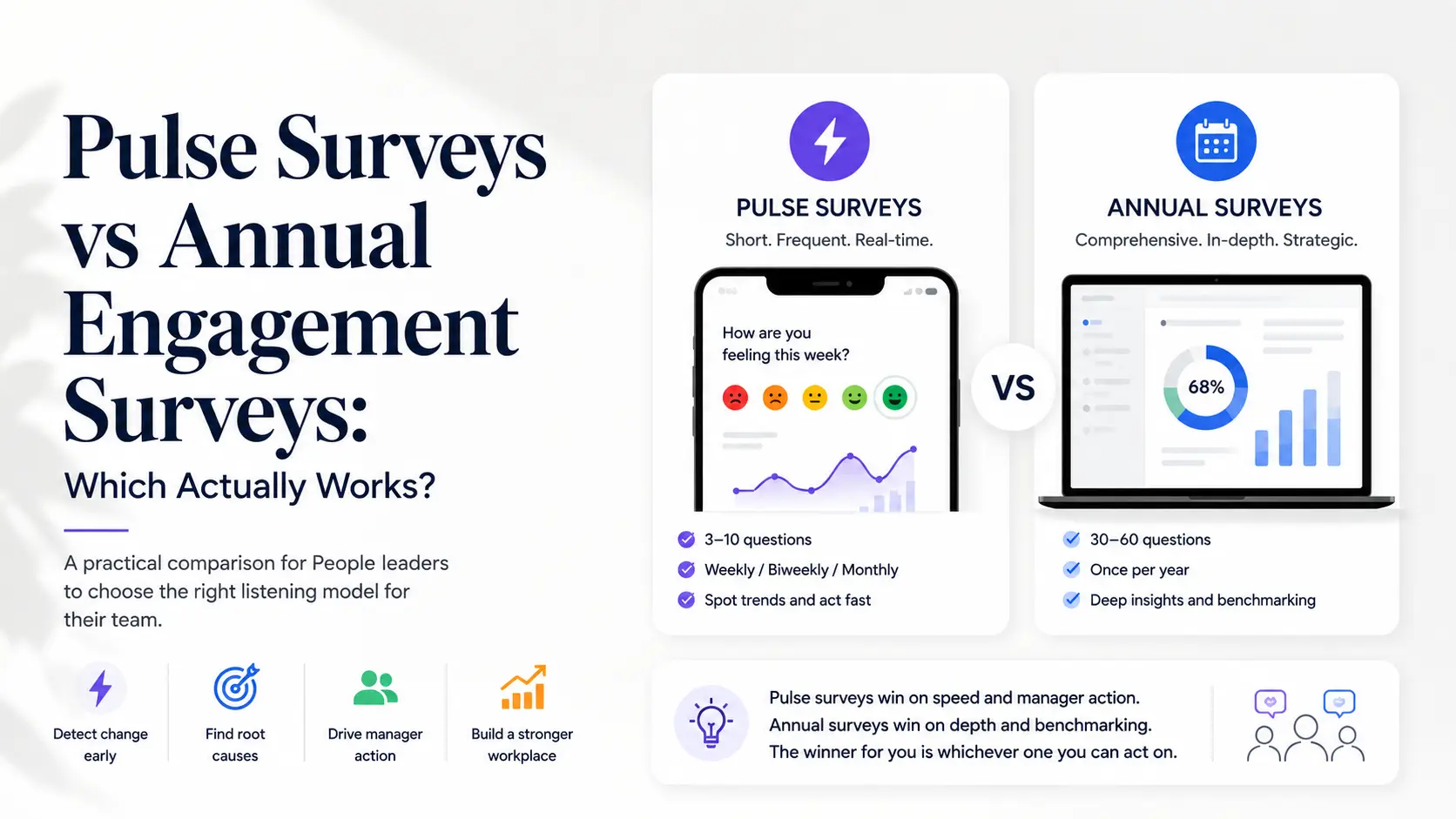
The most effective survey strategy is not annual or pulse. It is both.
A comprehensive annual survey of 25 to 35 questions captures a full-spectrum view of engagement across every dimension. It sets your baseline, tracks year-over-year trends, and identifies systemic issues that require structural changes.
Pulse surveys of 3 to 5 questions every one to two weeks capture shifts in real time. They catch sudden dips in morale, workload spikes, and team-specific issues while memories are fresh and action is still possible. Keep pulse surveys under 90 seconds. Completion rates drop sharply beyond that.
Rotate pulse topics across the eight categories above. One week, ask about the manager’s effectiveness. Next, ask about well-being. Over a quarter, you build a complete picture without ever overwhelming employees with a long form.
Pulsewise pulse surveys are built for exactly this rhythm. Set up short, anonymous surveys that rotate topics automatically and feed results into a single intelligence layer.
What to do after the survey closes
Asking questions and doing nothing with the answers is worse than not asking at all. Gallup’s research shows that teams whose managers share results and discuss them with their people see significantly higher engagement in the next survey cycle. Teams where results disappear into leadership-only decks see the opposite.
Here is a five-step action loop that turns survey data into measurable improvement.
- Share results transparently. Publish high-level findings company-wide within two weeks of the survey closing. Specifics go to the relevant team.
- Identify two to three focus areas. Do not try to fix everything at once. Pick the areas with the largest gaps between where you are and where you want to be.
- Assign owners and deadlines. Every insight needs a named owner, a specific action, and a timeline. Without these, insights become nice-to-know data points.
- Communicate progress visibly. Update employees monthly on what has changed because of their feedback. Close the loop publicly so people see their voice mattered.
- Re-measure. Run a targeted pulse survey 60 to 90 days after your action plan launches to check whether the needle moved.
The organizations that get engagement right are not the ones with the biggest survey budgets. They are the ones who treat every survey as a promise to act.
Want to see how other teams close the loop between surveys and outcomes? Read Pulsewise case studies.
The bottom line
Employee engagement survey questions are only as valuable as the action they generate. The 50 questions in this guide are organized to help you diagnose engagement across every dimension that matters in 2026, from foundational clarity and recognition through to AI anxiety and hybrid-work isolation.
Start by picking the questions that match your most pressing goal. Run them consistently. Share results openly. Act on what you hear. That loop, not the survey itself, is what separates organizations where people thrive from those where they quietly disengage.
Pulsewise is free for the first 100 teams, up to 100 users, no credit card required. Replace your disconnected survey tools with one platform that connects pulse surveys, feedback, recognition, goals, and performance reviews. Claim your free spot.
FAQs
What are the best employee engagement survey questions to ask?
The best questions cover the core engagement drivers: role clarity, recognition, manager effectiveness, growth opportunities, belonging, leadership trust, and wellbeing. Gallup’s Q12 framework is a validated starting point, but effective 2026 surveys also include questions about AI readiness and hybrid-work connection. Choose 25 to 35 questions for an annual survey or 3 to 5 for a pulse.
How many questions should an employee engagement survey have?
A comprehensive annual survey works best with 25 to 35 questions, which takes employees about 10 to 15 minutes. Pulse surveys should include 3 to 5 questions and take under 90 seconds. Research from Qualtrics shows that completion rates drop sharply past 15 minutes, so length directly affects data quality.
How often should you run employee engagement surveys?
The strongest approach combines a full annual survey with short pulse surveys every one to two weeks. Annual surveys establish baselines and track systemic trends. Pulse surveys catch real-time shifts in morale, workload, or team dynamics while there is still time to act.
What is the Gallup Q12 employee engagement survey?
The Gallup Q12 is a scientifically validated survey of 12 questions developed by Gallup based on decades of workplace research. It measures core engagement elements like role clarity, recognition, development, and belonging. The Q12 is proprietary to Gallup, but its themes can inform your own survey design.
Should employee engagement surveys be anonymous?
Yes. Anonymous surveys produce more honest responses, especially on sensitive topics like manager effectiveness and leadership trust. Make anonymity clear in your survey introduction, and explain that individual responses will never be shared. Ensure group-level results are only reported when the group has enough respondents to protect individual identities.
What should you do with employee engagement survey results?
Share high-level results within two weeks. Identify two to three focus areas, assign owners and deadlines, and communicate progress monthly. Run a follow-up pulse survey 60 to 90 days later to check whether actions are working. The biggest mistake is collecting feedback and doing nothing with it.