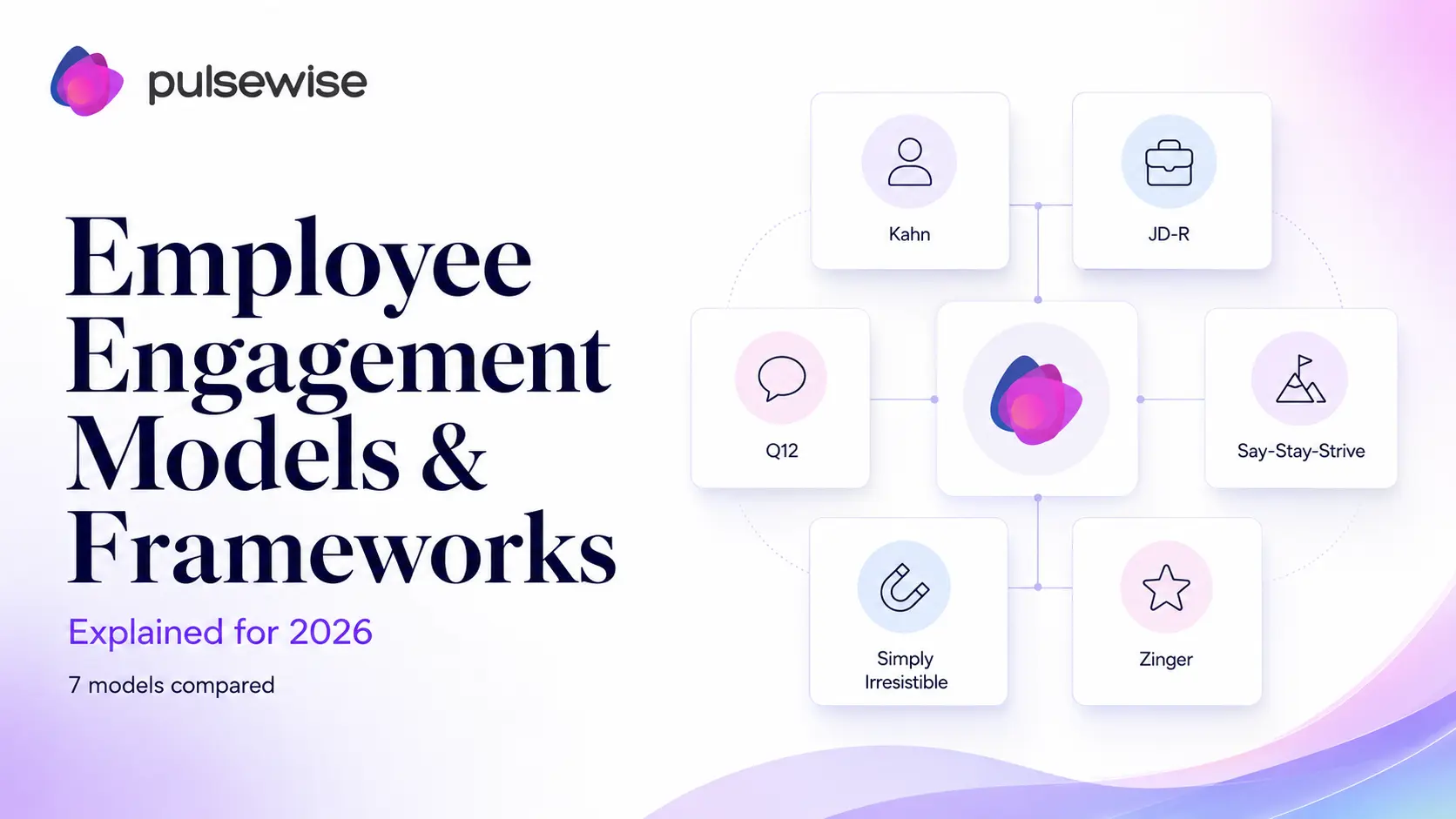
Somebody sends you a slide with six employee engagement models on it and asks which one your organisation uses. You recognise the names. You are much less sure which of them are actually research and which are a consultancy’s branded diagram.
That distinction matters more than the choice itself. Some employee engagement models come from peer-reviewed organisational psychology with decades of replication behind them. Others are commercial frameworks built to sell a survey product, which does not make them useless, but does change how much weight they should carry.
This guide covers seven models, states plainly where each one came from, and grades the evidence behind it. Then it maps the frameworks onto drivers you can actually measure, because a model you cannot instrument is a poster.
TL;DR
- An employee engagement model is a structured explanation of the conditions that produce engagement and the outcomes engagement produces.
- Three models are research-grade: Kahn’s psychological conditions (1990), the Job Demands-Resources model (2001), and Gallup’s Q12, which carries the largest validation dataset in the field.
- Say-Stay-Strive is still widely called the Aon Hewitt model, but Aon sold that business to Spencer Stuart in July 2019. It now sits with Kincentric.
- Deloitte’s Simply Irresistible, the Zinger CARE model, and Maslow-derived hierarchies are useful communication tools rather than validated measurement instruments.
- Pick by problem, not by popularity. Burnout and workload point to JD-R. Manager capability points to Q12. Culture and meaning point to Kahn.
What is an employee engagement model?
An employee engagement model is a structured explanation of the conditions that produce engagement at work and the outcomes engagement produces in return. It converts a vague ambition into named components you can measure and act on.
A good model does three things. It defines engagement precisely, it identifies the drivers that move it, and it links those drivers to outcomes the business already tracks.
A model is not the same as an initiative. A recognition programme, a wellbeing budget, and a quarterly pulse survey are all initiatives. The model is the logic that tells you why those initiatives should work and which one to fund first.
Frameworks only pay off when you can see them in your own data. Pulsewise tracks 12 organisational dimensions daily, including psychological safety, morale, teamwork, recognition, and growth. See how Culture Analytics works.
The provenance test: research or marketing?
Before comparing models, sort them by where they came from. This single question saves People teams from defending a framework in a board meeting that turns out to have no published validation behind it.
Three categories cover the field.
-
Academic models come from peer-reviewed journals, carry published effect sizes, and have been replicated by researchers with no commercial stake. Kahn and JD-R sit here.
-
Commercial models with published validation are owned by a vendor but supported by disclosed methodology and large datasets. Gallup’s Q12 and Say-Stay-Strive sit here.
-
Commercial frameworks without published validation are useful for communication and structuring a conversation, but should not be presented as evidence. Simply Irresistible, Zinger, and most acronym models sit here.
None of these categories is disqualifying. The third group contains genuinely good communication tools, and a framework people remember often beats a rigorous one they ignore.
The mistake is presenting a category-three framework as though it carries category-one evidence. That is how engagement programmes lose credibility with finance teams.
Kahn’s three psychological conditions
Kahn’s model holds that people bring their full selves to work only when three psychological conditions are met: meaningfulness, safety, and availability. It is the origin point for the entire field.
William Kahn published it in the Academy of Management Journal in 1990, drawing on two qualitative studies of summer camp counsellors and an architecture firm. Almost every model that followed borrows from it, usually without attribution.
The three conditions
-
Meaningfulness: Does this work feel worthwhile, and does the person get a return on investing themselves in it?
-
Safety: can they show up as themselves without fear of damage to their image, status, or career?
-
Availability: Do they have the physical, emotional, and cognitive resources to engage right now?
Availability is the condition most organisations skip. A person can find their work meaningful and feel entirely safe, and still be too depleted to engage.
Kahn’s safety condition is also the direct ancestor of psychological safety as a workplace measure. Best for: culture diagnosis, leadership development, and understanding why an engagement score refuses to move despite good management.
The Job Demands-Resources (JD-R) model
The JD-R model holds that every job splits into demands, which cost energy, and resources, which restore it and enable performance. Engagement rises when resources outweigh demands, and burnout rises when they do not.
Demerouti, Bakker, Nachreiner and Schaufeli published it in the Journal of Applied Psychology in 2001. Bakker and Demerouti extended it in 2007, and it now has one of the largest replication bases in occupational health psychology.
The two processes
JD-R describes two parallel paths, which is what makes it more useful than most models.
-
The health impairment path: sustained demands such as workload, role ambiguity, and emotional labour drain energy and lead to exhaustion.
-
The motivational path: resources such as autonomy, feedback, social support, and development opportunity drive engagement and performance.
Resources also buffer demands. A heavy workload damages people far less when autonomy and support are high, which explains why two teams with identical workloads report very different engagement.
Best for: burnout risk, workload disputes, and any situation where engagement is falling while headcount is flat.
The Gallup Q12 model
The Q12 model measures engagement through twelve statements covering the workplace conditions Gallup found most predictive of team performance. It is the most widely administered engagement instrument in the world.
The twelve items cover clarity of expectations, materials and equipment, doing what you do best, recognition in the last seven days, someone caring about you as a person, encouragement of development, opinions counting, mission connection, colleagues committed to quality, a best friend at work, progress conversations, and opportunities to learn and grow.
Why the evidence base matters
Gallup’s Q12 meta-analysis reached its 11th edition in 2024, covering 183,806 business units across 53 industries and 90 countries. No other engagement instrument publishes validation at that scale.
Comparing top-quartile with bottom-quartile teams, Gallup reports 23 percent higher profitability, 18 percent higher productivity measured by sales, 78 percent lower absenteeism, and 63 percent fewer safety incidents.
The practical strength of the Q12 is that most items describe manager behaviour. That makes results directly actionable rather than abstract.
Best for: building a business case, benchmarking, and diagnosing manager capability across teams.
Note on use: Q12 is a registered trademark of Gallup, and the item wording is licensed. Organisations frequently write “Q12-style” items themselves, which is legitimate as an internal instrument but means Gallup benchmarks no longer apply to your scores.
Say-Stay-Strive, formerly the Aon Hewitt model
The Say-Stay-Strive model defines engagement through three observable behaviours: whether people speak positively about the organisation, intend to remain, and exert discretionary effort. It is explicitly outcome-oriented rather than condition-oriented.
An ownership correction most articles miss
Nearly every current article still calls this the Aon Hewitt model. Aon sold its Culture and Engagement business to Spencer Stuart in a transaction that closed on 1 July 2019, and it now operates as Kincentric.
If you are citing the model in a board paper, attribute it to Kincentric or describe it as originating with Aon Hewitt. Presenting Aon as the current owner is a small error that an informed reader will catch.
How the model works
Six driver categories feed the three behaviours: the work itself, people, opportunities, total rewards, company practices, and quality of life.
Aon’s own research reported that companies in the top quartile of engagement, at 72 percent or above, delivered 50 percent higher total shareholder return than the average company. That analysis drew on a database of more than eight million employees.
Best for: linking engagement to financial outcomes, and for executive audiences who respond better to behaviours than to psychological constructs.
Put a number on your current position first
Before adopting any framework, quantify what disengagement already costs you. The Pulsewise Wellbeing Calculator estimates the cost of turnover, sick leave, and low engagement for your team size and salary band in about 60 seconds. No signup required.
Deloitte’s Simply Irresistible Organization
Deloitte’s model argues that engagement follows from making the organisation genuinely worth joining, and groups the work into five elements: meaningful work, hands-on management, a positive work environment, growth opportunity, and trust in leadership.
Each element carries specific practices underneath it, such as autonomy and small empowered teams under meaningful work, or clear goals and coaching under hands-on management.
Its strength is breadth and communicability. Executives grasp it quickly, and it covers ground that narrower models leave out, particularly leadership trust.
Its limitation is that it functions as a consulting framework rather than a validated measurement instrument. There is no published item set or effect-size table you can point to.
Best for: structuring a people strategy or an executive conversation, not for measurement.
The Zinger model
David Zinger’s model treats engagement as a set of interlocking actions rather than a state to be measured, often summarised through the CARE acronym covering connect, authenticity, recognition, and engagement.
The fuller version is a pyramid of building blocks moving from achieving results at the top through enhancing wellbeing, leveraging strengths, and connecting people at the base.
Practitioners like it because it is behavioural and prescriptive. It tells managers what to do rather than what to measure.
Treat it as a manager coaching aid rather than an evidence-based. It has no published validation study, and it was designed as practitioner guidance rather than research.
Best for: manager enablement and team-level habits.
Maslow-derived engagement hierarchies and acronym frameworks
Several popular models adapt Maslow’s hierarchy of needs to the workplace, arguing that people cannot engage with purpose and growth until pay, safety, and belonging are handled first.
The sequencing insight is sound and matches what most People teams observe. Recognition programmes fail predictably in organisations where pay is below market or job security feels shaky.
The caution is that Maslow’s strict hierarchy has not held up well under empirical testing. Use it as an ordering heuristic, not as a law.
Acronym frameworks
Short mnemonic frameworks such as the 5 C’s, covering clarity, communication, collaboration, commitment, and competence, work well as diagnostic prompts in workshops. Treat each C as a conversation starter and write your own survey items underneath it.
These frameworks earn their place through memorability. Nobody should present them as research.
Employee engagement models compared
One table, six columns, seven models. This is the section worth bookmarking.
| Model | Origin | Evidence grade | Core components | Best for | Main limitation |
|---|---|---|---|---|---|
| Kahn | Academic, 1990, Academy of Management Journal | Peer-reviewed, foundational | Meaningfulness, safety, availability | Culture diagnosis and leadership development | No ready-made measurement instrument |
| JD-R | Academic, 2001, Journal of Applied Psychology | Peer-reviewed, heavily replicated | Job demands, job resources, health impairment and motivational paths | Burnout, workload, and well-being risk | Says little about recognition or meaning |
| Gallup Q12 | Commercial, Gallup, 1990s onward | Published meta-analysis, 11th edition | 12 workplace condition items, mostly manager-controlled | Business case, benchmarking, manager capability | Licensed wording, benchmarks need a Gallup engagement |
| Say-Stay-Strive | Commercial, Aon Hewitt, now Kincentric since 2019 | Vendor research, large dataset | Three behaviours plus six driver categories | Executive and financial framing | Measures outcomes more than causes |
| Simply Irresistible | Commercial, Deloitte | Consulting framework, no published items | Meaningful work, hands-on management, environment, growth, trust | Strategy structuring and exec communication | Not a measurement instrument |
| Zinger | Practitioner, David Zinger | No published validation | Connect, authenticity, recognition, engagement, plus a results pyramid | Manager enablement and team habits | Prescriptive rather than diagnostic |
| Maslow-derived | Adapted from the 1943 motivation theory | The original hierarchy is poorly supported empirically | Tiered needs from pay and safety up to purpose | Sequencing and prioritisation arguments | Strict hierarchy does not hold in testing |
Which model should you choose?
Choose by the problem in front of you, not by which name carries the most authority. Most organisations end up combining two: one to diagnose and one to communicate.
| If your problem is | Start with | Because |
|---|---|---|
| Burnout, attrition among high performers, and workload complaints | JD-R | It separates the energy drain from the motivation problem, which no other model does cleanly |
| Wide variation in engagement between teams with similar work | Gallup Q12 | Most items describe manager behaviour, so the results point to a specific person and habit |
| Scores look fine but people leave anyway | Kahn | Meaning and psychological safety are usually the missing variables, and standard surveys measure them badly |
| Leadership does not believe engagement affects results | Say-Stay-Strive or Q12 | Both publish outcome linkages that you can put in front of a CFO |
| No people strategy exists yet, and you need a structure | Simply Irresistible | Broad enough to organise a first-year plan without over-claiming precision |
| Managers know the theory but do not change their behaviour | Zinger | It is prescriptive at the level of weekly habits rather than annual strategy |
From framework to measurable drivers
A model earns its keep only when each component maps to something you can observe on a regular cadence. This is where most adoptions fail, because the framework lives in a strategy deck and the data lives somewhere else.
The mapping below translates framework components into signals a modern engagement platform already collects.
| Framework component | Appears in | Measurable signal |
|---|---|---|
| Psychological safety | Kahn, Q12 (opinions count) | Feedback dimension scoring, open-text sentiment, dissent volume in surveys |
| Recognition | Q12, Zinger, Say-Stay-Strive | Kudos volume, recipient spread, and whether appreciation tracks contribution |
| Clarity of expectations | Q12, Simply Irresistible | Goal coverage per person, nested goal alignment, stalled milestone rate |
| Job resources and support | JD-R | 1:1 frequency and quality, manager response time, autonomy items in pulses |
| Job demands and depletion | JD-R, Kahn (availability) | Daily mood trend slope, workload pulse items, absence and leave patterns |
| Growth and development | All seven models | Internal mobility rate, development conversation coverage, growth dimension scores |
| Intent to stay | Say-Stay-Strive | Regretted attrition by team, retention risk flags, and exit theme analysis |
The hard part is not collecting these signals. It is holding them in one place long enough to see a pattern. When surveys sit in one tool, recognition in another, and goals in a third, no framework survives contact with the reporting cycle.
Pulsewise consolidates those signals into a single intelligence layer, with real-time team pulse monitoring feeding department comparisons and trend alerts.
Three mistakes when adopting a model
Adopting a model you cannot measure
Simply Irresistible and Zinger are strong communication tools with no accompanying instrument. If you adopt one, pair it with a measurement model rather than pretending the framework itself produces data.
Switching models between cycles
Changing frameworks resets your trend line. Two years of imperfect but consistent measurement beats a perfect instrument with no history behind it.
If you must switch, run both for one cycle so you can bridge the two datasets.
Treating the model as the programme
A framework tells you what to look at. It does not do the looking, and it certainly does not hold the conversation with the manager whose team is struggling.
Whichever model you choose, the delivery mechanism is the same: manager cadence. Our guide to 15 strategies for improving employee engagement covers the tactical layer, and the employee engagement master guide sets out the fundamentals.
The bottom line
The model matters less than the honesty about what it is. A framework with published effect sizes and one drawn on a consultant’s whiteboard are both useful, but only one of them belongs in a board paper as evidence.
Pick the model that fits your actual problem, check that every component maps to a signal you already collect, and then leave it alone long enough to build a trend line.
Most engagement programmes fail on the last point rather than the first.
Instrument your framework, whichever one you pick
Pulsewise brings pulse surveys, feedback, recognition, goals, and performance into one intelligence layer, so the components of your chosen model map to signals you can actually watch move. Pulsewise is free forever for the first 100 teams, with up to 100 users, no feature limits, and no credit card required. Claim your free spot | Schedule a demo
FAQs
What is an employee engagement model?
An employee engagement model is a structured framework that explains which workplace conditions produce engagement and which outcomes engagement produces. It defines engagement precisely, names the drivers that move it, and links those drivers to business results. Models differ in whether they focus on psychological conditions, job characteristics, or observable behaviours.
What are the most widely used employee engagement models?
The most cited are Kahn’s three psychological conditions, the Job Demands-Resources model, Gallup’s Q12, Say-Stay-Strive from Aon Hewitt and now Kincentric, Deloitte’s Simply Irresistible Organization, the Zinger model, and Maslow-derived hierarchies. The first three carry the strongest published evidence.
What is the Gallup Q12 model?
The Q12 is Gallup’s twelve-item instrument measuring the workplace conditions most predictive of team performance, covering clarity, resources, recognition, development, and belonging. Its 11th-edition meta-analysis spans 183,806 business units across 90 countries and links top-quartile engagement to 23 percent higher profitability.
What is the JD-R model of employee engagement?
The Job Demands-Resources model splits every job into demands that cost energy and resources that restore it. Demands drive exhaustion through a health impairment path, while resources drive engagement through a motivational path. Resources also buffer demands, which is why identical workloads produce very different engagement across teams.
Is the Aon Hewitt engagement model still called that?
Not accurately. Aon sold its Culture and Engagement business to Spencer Stuart in a deal that closed on 1 July 2019, and it now operates as Kincentric. The Say-Stay-Strive framework itself is unchanged, but current attribution should reference Kincentric rather than Aon.
Which employee engagement model is best?
There is no single best model. Choose by problem: JD-R for burnout and workload, Gallup Q12 for manager capability and benchmarking, Kahn for meaning and psychological safety, and Say-Stay-Strive for executive financial framing. Most organisations pair one measurement model with one communication framework.