40 Stay Interview Questions Managers Should Ask Before It's Too Late
A stay interview is a one-on-one conversation where a manager asks a current employee what keeps them at the company and what might make them leave. The questions you ask decide whether you get real answers or polite ones.
That second sentence is the whole problem, really.
Most managers who try a stay interview ask something like “So, are you happy here?” And the employee says, “Yeah, it’s good.” Then both of them move on, relieved.
Nothing was learned. Nothing changes. Six months later, that same employee hands in their notice, and the manager says the thing managers always say.
“I had no idea.”
Well, better ques fix that, i mean just better ones and not more ones.
Below are 40 stay interview questions, grouped by what you’re actually trying to find out. Each one comes with a note on why it works, or what to listen for.
You won’t use all 40 in one conversation (please don’t). Pick the ones that fit the person in front of you.
There’s also a free template at the end, and a section on what to do once you have the answers. That part matters more than the questions.
TL;DR
- A stay interview asks current employees what keeps them and what could pull them away, while you can still act on it.
- Don’t ask all 40 questions. Pick five to eight, keep a core set the same for everyone, and spend most of the time listening.
- The questions are grouped into five themes: motivation, growth, manager support, workload, and flight risk, plus a few warm-up and closing questions.
- Avoid yes/no questions, leading questions, and broad pay questions. They get scripted answers.
- Every stay interview should end in a short stay plan and a follow-up within two weeks.
- Stay interviews only reach one person at a time. Running a handful of the same questions as an anonymous pulse survey shows you which teams need the conversation first.
What is a stay interview?
A stay interview is a planned, one-on-one conversation between a manager and an employee they want to keep. It covers what the employee values, what frustrates them, and what might tempt them to leave. The goal is to act on those answers early.
It’s not a performance review. Nobody is being rated.
It’s also not a regular 1:1. A 1:1 meeting is usually about this week’s work. A stay interview steps back and asks about the job itself.
For the full process (who runs it, how often, and how to prepare), see our guide to stay interviews.
Stay interview vs exit interview
The questions look similar. The timing changes everything.
| Stay interview | Exit interview | |
|---|---|---|
| When | While the employee still plans to stay | After they’ve resigned |
| Who asks | Their direct manager | Usually HR |
| Honesty | Depends on trust with the manager | Often guarded; they want a good reference |
| What you can do with it | Fix things for this person | Spot patterns for the next person |
An exit interview tells you why someone left. A stay interview tells you why the next person is about to.
Here’s why the timing matters so much. Gallup studied people who voluntarily left a job and found that 45% said no manager or leader had discussed their satisfaction, performance, or future with them in their final three months.
Not a bad conversation. No conversation.
How to use this list (read this first)
Forty questions is a menu. It’s not a script.
If you walk into a stay interview with a printout of all 40, it stops being a conversation. It turns into a survey read out loud, and your employee will answer like it’s one.
So a few ground rules before the list.
Pick five to eight questions. That’s plenty for 30 minutes. HR consultant Richard Finnegan, who is closely associated with the stay interview method, argues that five well-chosen questions are enough when you probe properly.
Keep a core set the same for everyone. Choose three or four questions you ask every person on your team, then add a couple that fit the individual. Consistency is how you spot patterns later.
Listen for about 80% of the time. This is Finnegan’s guidance too. Ask, then stop talking, and let the silence do some work.
Follow up on everything. The first answer is usually the safe answer, and the second or third is the real one. Keep these follow-ups in your pocket:
- “Can you give me an example?”
- “Tell me more about that.”
- “How long has that been true?”
- “Is that the main thing, or is there something else?”
Write down the words they use. Their words, not your summary. “I’m a bit bored” and “I feel stuck” point to very different problems.
Okay. On to the questions.
Warm-up questions (1 to 3)
Don’t open with “Have you thought about leaving?” Nobody answers that honestly in the first minute.
Start somewhere easy. These questions get people talking about their job in their own words, which gives you something real to probe later.
1. What does a really good week at work look like for you? This shows you what energizes them. Compare it to what their weeks actually look like right now.
2. What’s something you’ve worked on recently that you’re proud of? An easy win to start with. It also tells you what kind of work they value, which isn’t always what you’d guess.
3. If you were describing this job to a friend, what would you say? People describe jobs to friends more honestly than they describe them to managers. Listen for the first adjective they reach for.
Motivation: what keeps them here (4 to 11)
This theme answers the question most managers never ask directly. Why does this person stay?
It matters because the reasons people stay are often invisible to leadership. A great teammate, a flexible Friday, a project they care about.
Those are easy to break by accident during a reorg, if nobody knows they exist.
4. What do you look forward to most when you start work each day? This is one of Finnegan’s original five, lightly adapted for hybrid teams. If they struggle to answer, that pause tells you something too.
5. Why do you stay here? Blunt, and it works. Follow it with “If you had to narrow it down to one reason, what would it be?” That single reason is what you protect.
6. What would you miss most if you left tomorrow? Sometimes easier to answer than “why do you stay.” It surfaces the people, rituals, and perks that matter most.
7. Which parts of your job give you the most energy? Pair it with question 8. The ratio between the two answers is often more telling than either answer alone.
8. Which parts of your job drain you? Don’t defend the draining parts. Just note them. You’re mapping the job as they experience it.
9. When did you last feel really motivated at work? What was happening? A specific memory beats a general opinion. If the answer is “honestly, a while ago,” that’s your cue to gently ask what changed.
10. What keeps you here even on the hard days? Useful for people in demanding roles. The answer is usually about people, purpose, or pride in the work.
11. How connected do you feel to what the company is trying to do? Some people stay for the mission. Others couldn’t care less, and that’s fine. You just need to know which one you’re talking to.
Growth and career (12 to 19)
Career development has been the number one reason employees quit, for more than ten consecutive years, according to Work Institute’s exit interview research.
So this theme deserves real time.
The trick is to ask about growth without making promises you can’t keep. You’re finding out what they want. Not agreeing to give it to them in the room.
12. What are you learning here right now? Another Finnegan question. If they say “not much,” follow with “What would you like to be learning?”
13. What skill would you most like to build in the next year? Specific and forward-looking. It gives you something concrete to support, like a project, a course, or a mentor.
14. Where do you see yourself in two years? Does that path exist here? The second half is the important part. If the honest answer is no, you’d rather know now than at their exit interview.
15. Is there a role here, besides your own, that looks interesting to you? Internal moves keep people who would otherwise leave to grow. Many managers never ask because they don’t want to lose a good team member. That’s exactly how they lose them to another company instead.
16. Do you feel your career is moving at the pace you want? Listen for words like “stuck,” “plateau,” or “same thing every day.” Those tend to show up well before a resignation.
17. What’s one thing we could do to help you grow faster? It invites a practical answer. Often it’s small, like being included in a meeting or owning a piece of work end to end.
18. Do you understand what it takes to get promoted here? If they don’t, that’s a clarity problem, not a talent problem. It’s one of the cheapest things to fix on this whole list.
19. Are you using your strengths in your current role? People who feel underused get bored, and bored people browse job boards. Ask them to name a strength they rarely get to use.
Manager support and recognition (20 to 27)
This is the uncomfortable section. It’s also the one that matters most.
When Gallup asked leavers what could have kept them, 21% said more positive interactions with their manager. Another 8% said fewer negative ones, like rudeness or micromanaging.
That’s nearly three in ten of the fixes leavers named. And you control all of it.
A quick warning before you ask these. If you get defensive, even once, the rest of the interview is over. Your only job here is to say “thank you, that’s useful” and write it down.
20. What can I do to make your job better for you? Finnegan’s fifth question, and maybe the most important one on this list. Follow up with “What’s one thing I should start doing?”
21. What’s one thing I should stop doing? Harder to ask, and harder to answer. That’s exactly why it’s valuable, so give them time.
22. How do you prefer to receive feedback from me? Some people want it in the moment, some want it written down, and some want it privately. Most managers never ask.
23. Do you feel recognized for the work you do? Then ask “When did you last feel really appreciated here?” If they can’t remember, you have your answer.
24. How would you like to be recognized when you do great work? Public praise delights some people and mortifies others. Asking takes ten seconds and saves you from getting it wrong for years.
25. Do you get enough time with me? Too much? Some people feel ignored. Others feel micromanaged. Both lead to the same resignation letter.
26. Do you feel comfortable raising problems with me? If the answer is hesitant, don’t argue. Ask “What would make it easier?”
27. Do you have what you need from me to do your best work? Covers clarity, tools, decisions, and unblocking. Listen for anything they’re waiting on you for.
Workload, balance, and friction (28 to 34)
When Gallup asked leavers what could have kept them, 13% pointed to organizational issues, and another 9% to staffing, workload, or scheduling. Together, that’s more than one in five.
These questions find the friction. The broken process, the meeting nobody needs.
The workload that crept up quietly after someone left and was never backfilled.
28. How manageable does your workload feel right now, honestly? The word “honestly” matters. It signals you want the real answer, not the brave one.
29. What’s taking up time that you think it shouldn’t? People know exactly which meetings, reports, and approvals are waste. They’re rarely asked.
30. What’s one process here you’d fix if you could? Friction compounds. One broken process, tolerated for a year, becomes “nothing ever gets fixed around here.”
31. Is there anything getting in the way of doing your job well? Broad on purpose. Tools, people, decisions, access. Let them pick.
32. How well are you able to switch off after work? A gentle way into burnout without using the word. If they laugh before answering, pay attention.
33. Does your current setup (remote, hybrid, or office) work for you? Especially important for distributed teams. Our guide to remote employee engagement goes deeper on this.
34. If you could change one thing about how our team works together, what would it be? Shifts the focus from them to the team. People often raise sensitive issues more easily when they’re framed as “we” problems
Flight risk: the direct questions (35 to 38)
Now for the questions that feel scary to ask. Ask them anyway.
You’ve built some trust over the last 20 minutes. This is where you use it.
Remember, 36% of voluntary leavers told no one before deciding to resign. These questions are how you become the person they tell first.
35. When was the last time you thought about leaving? What prompted it? Finnegan’s fourth question, and the most valuable one here. Notice it assumes they have thought about it. That makes it easier to say yes.
36. If a recruiter called you tomorrow, what would make you take the call? Less confronting than “would you leave?” It invites them to describe what’s missing, without admitting to anything.
37. What would another company have to offer to tempt you away? Listen for whether the answer is about money or about something else entirely. Often it’s growth, flexibility, or a better manager, all of which you can influence.
38. On a scale of 1 to 10, how likely are you to be here in a year? What would make it a 10? The number matters less than the second half of the question. That’s your stay plan, written by the employee.
If someone tells you they’ve been looking, don’t panic and don’t pitch. Say thank you, then ask what would need to change. They’ve just given you a chance most managers never get.
Closing questions (39 to 40)
End well. How the conversation closes shapes whether they believe anything will happen next.
39. Is there anything I haven’t asked that I should have? Some of the most useful answers come here, once the pressure is off. Leave a real pause after asking it.
40. What’s the one thing you’d most like to see change after today? This gives you the priority for the stay plan. It also sets an expectation that something will change, which means you need to follow through.
If you only have 30 minutes: the starter five
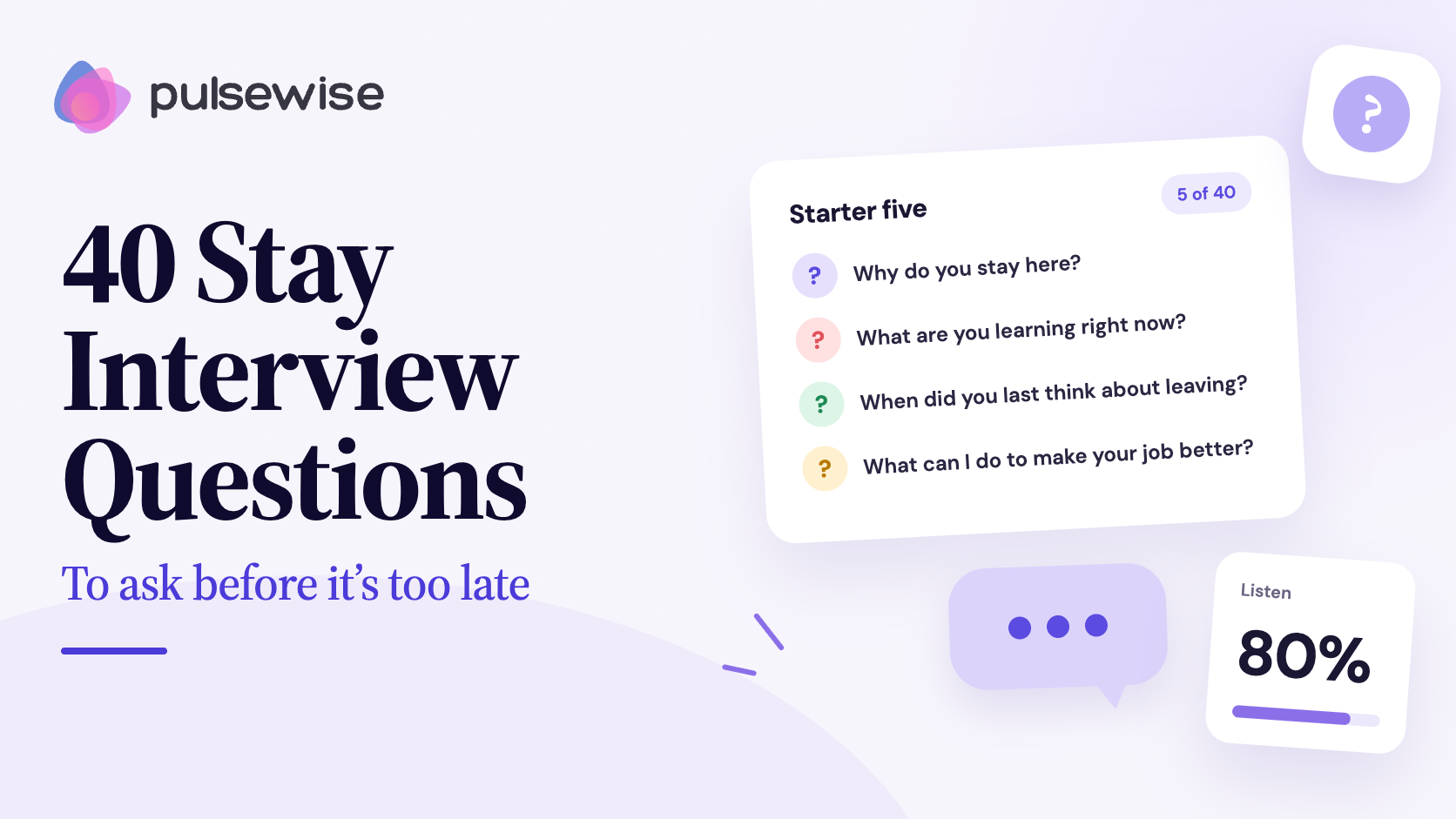
Forty is a lot. If you’re running your first stay interviews, start with these five. They cover every theme, and they work for almost anyone.
| # | Question | Theme |
|---|---|---|
| 4 | What do you look forward to most when you start work each day? | Motivation |
| 12 | What are you learning here right now? | Growth |
| 5 | Why do you stay here? | Motivation |
| 35 | When was the last time you thought about leaving? What prompted it? | Flight risk |
| 20 | What can I do to make your job better for you? | Manager support |
These closely follow Finnegan’s original five, which he developed and refined through years of practice. Ask them to everyone, in the same order, every time. Then add one or two from the full list based on the person.
Questions to avoid, and what to ask instead
Some questions look reasonable and quietly kill the conversation. Here are the usual suspects.
| Avoid | Why it fails | Ask instead |
|---|---|---|
| ”Are you happy here?” | Yes/no. You’ll get “yeah, it’s fine." | "What does a really good week look like for you?" |
| "You’re not thinking of leaving, are you?” | Leading. It tells them the right answer. | ”When did you last think about leaving?" |
| "Do you think you’re paid enough?” | Almost everyone says no, and you likely can’t fix it in the room. | ”Do you understand how pay and promotions work here?" |
| "Why didn’t you tell me sooner?” | Blames them for your blind spot. | ”What would make it easier to raise things with me?" |
| "What do you think of [colleague]?” | Puts them in an awkward spot, and it’ll get around. | ”How well is the team working together right now?" |
| "Is there anything else?” (while standing up) | Signals you’re done listening. | Question 39, asked sitting down, with a real pause. |
A note on pay, because it always comes up.
SHRM’s guidance points out that broad pay questions tend to produce scripted answers, from both sides. So don’t open that door yourself.
If the employee raises pay, though, never dodge it. Explain how pay decisions are made, when the next review is, and what you’ll personally do. Then do it.
Which questions to use for which employee
Different people need different conversations. Here’s a quick guide to picking from the list.
| Employee | Why they’re different | Good picks |
|---|---|---|
| New hire (first 90 days) | Early doubts are common and easy to fix | 1, 3, 9, 18, 27, 39 |
| Top performer | Most likely to be recruited away | 5, 14, 15, 19, 36, 38 |
| Long tenure (3+ years) | Risk of feeling stuck or taken for granted | 6, 12, 16, 23, 30, 37 |
| Remote or hybrid | Harder to spot drift from a distance | 25, 26, 32, 33, 34 |
| Recently passed over for promotion | Disappointment can quietly harden | 14, 17, 18, 35, 40 |
| After a reorg or manager change | Old reasons for staying may have disappeared | 5, 6, 21, 27, 35 |
Keep your three or four core questions in every conversation. Use the table to pick the rest.
Free stay interview template
We’ve turned everything above into a two-page template you can use in the room. It’s a Word document, so you can edit it for your team.
It includes:
- A short script to open the conversation, so the employee knows it isn’t a performance review
- The starter five, with follow-up probes for each
- Space for two extra questions you choose from the list
- A notes column for the employee’s own words
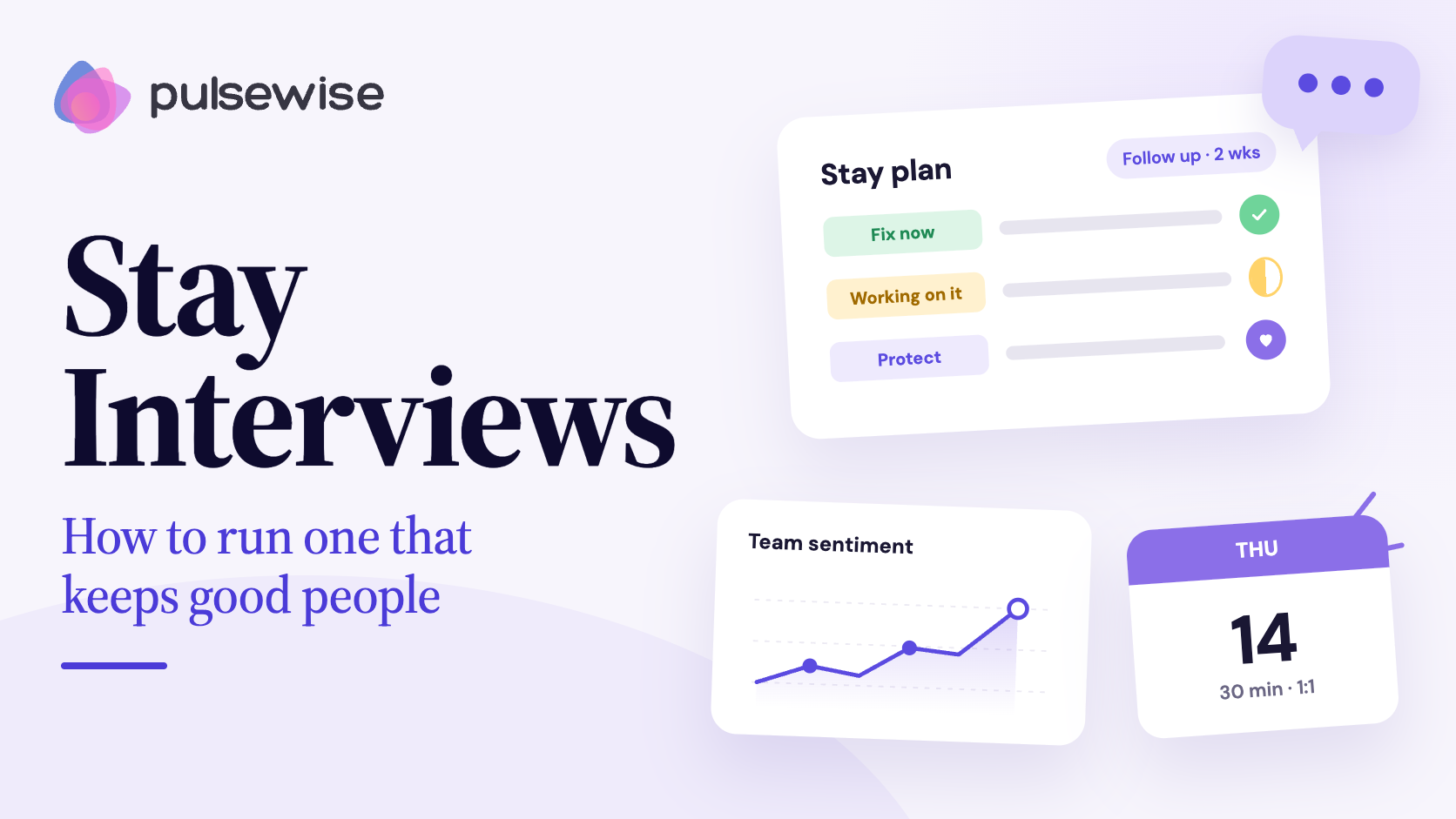
- A stay plan table with four buckets: fix now, working on it, can’t change, and protect
- An after-the-conversation checklist with a follow-up date, because this is the step everyone forgets
Download the free stay interview template. Two pages, fully editable, ready for your next conversation. Get the template
Preview: the stay plan section
This is the part of the template that turns a nice chat into something useful.
| What they said | Bucket | What I’ll do | By when |
|---|---|---|---|
| Fix now | |||
| Working on it | |||
| Can’t change (and why) | |||
| Protect (keep doing) | |||
| Follow-up meeting booked for: |
What to do with the answers
Here’s the part most guides skip.
Asking good questions is maybe 30% of the job. The other 70% is what you do in the two weeks after. A stay interview with no visible follow-up is worse than no stay interview at all.
Why? Because now you’ve taught the employee that being honest with you leads nowhere.
1. Sort what you heard into three buckets
Before the conversation ends, go through the main points together:
- Fix now. Things you control and can change within a month.
- Working on it. Things that need someone else. Give a date for an update.
- Can’t change. Say so kindly, and explain why. People handle “no” much better than silence.
- Protect. The things they love about the job. Easy to break by accident, so write them down too.
Pick one to three actions. Not ten, because ten actions means none of them happen.
2. Send it in writing the same day
A short message. What you heard, what you’ll do, and when you’ll check back.
It takes five minutes. And it tells the employee you were actually listening.
3. Follow up within two weeks
Even if the only update is “I raised it with HR, here’s what they said.” Progress matters less than proof you didn’t forget.
4. Match the answer to the right response
Some answers come up again and again. Here’s a starting point for each.
| If you hear… | It often means… | A good first move |
|---|---|---|
| ”I’m not really learning anything new” | Growth has stalled | Agree one stretch project or skill goal this quarter |
| ”I don’t really know how promotions work” | A clarity problem | Walk through the criteria together, in writing |
| ”I’m fine, just busy” (said flatly) | Workload or burnout | Ask what could come off their plate this month |
| ”Nobody really notices what I do” | Recognition gap | Recognize specific work, publicly or privately as they prefer |
| ”I get a lot of recruiter messages lately” | Active flight risk | Bring their growth and pay conversation forward |
| ”The team’s great, it’s the process” | Organizational friction | Fix one process and tell them you did |
| ”I’m not sure where I fit anymore” | Role or mission drift | Talk about where they want to go, and whether that path exists here |
If you’re seeing several of these at once, our guide to the signs of a disengaged employee will help you work out what’s going on.
5. Roll up the themes across the team
One person saying “priorities keep changing” is a conversation. Five people saying it is a management problem.
Once a quarter, HR or People Ops should look across all stay interview notes for repeating themes. That’s how individual conversations turn into company-level fixes. For a structured way to do that, see our employee engagement action plan.
Run the same questions as an anonymous pulse survey
There’s a catch with stay interviews.
They’re personal, so people are only as honest as their trust in you allows. And they only happen once or twice a year, so a lot can shift in between.
Gallup found 77% of voluntary leavers either left within three months of starting a job search, or never actively searched at all. Three months is shorter than the gap between most stay interviews.
So here’s a simple idea. Take a handful of your stay interview questions, turn them into short survey statements, and run them as an anonymous pulse across the whole team.
The stay interview tells you why one person feels the way they do. The pulse tells you where to look first.
How the questions translate
Open questions work in a conversation. In a survey, short statements on a scale work better. Here’s how some of the questions above convert.
| Stay interview question | Pulse survey version |
|---|---|
| 5. Why do you stay here? | ”I can see myself working here a year from now.” |
| 12. What are you learning here right now? | ”I’m learning and growing in my role.” |
| 18. Do you understand what it takes to get promoted? | ”I know what I need to do to progress here.” |
| 23. Do you feel recognized for your work? | ”I’ve been recognized for good work in the last month.” |
| 26. Do you feel comfortable raising problems? | ”I feel comfortable raising concerns with my manager.” |
| 28. How manageable is your workload? | ”My workload is manageable most weeks.” |
| 36. What would make you take a recruiter’s call? | Open text: “What’s one thing that would make this a better place to work?” |
Keep it to three to five statements at a time. Rotate them. Nobody wants a 20-question survey every week.
How Pulsewise fits in
This is exactly what Pulsewise pulse surveys are built for. You pick your questions, set a weekly or custom schedule, and each question is scored on a simple scale. Results roll up automatically by department, so you can see which teams are trending up or down.
Responses are aggregated at department level, so managers never see who said what. That’s what makes people answer honestly.
For the open-ended question, Pulsewise Feedback reads free-text comments and maps them across 12+ areas like workload, career growth, and leadership trust. So you see themes forming before the scores move.
And when a team’s sentiment starts to slide, the engagement and retention view flags it. That’s your signal to bring that team’s stay interviews forward.
See which team needs a stay interview first. Turn your stay interview questions into a weekly anonymous pulse, delivered in Slack or Teams, and spot drift before it becomes a resignation. See how Pulsewise pulse surveys work
Closing Note
Here’s the truth about stay interview questions.
The perfect question doesn’t exist. What exists is a manager who asks a decent question, stops talking, and waits.
So don’t overthink the list. Pick five questions, and book the conversation with the person you’d least want to lose.
Listen far more than you speak. Then do the one thing most managers never do.
Follow up.
If you want to know which team to start with, that’s where Pulsewise helps. It brings pulse surveys, feedback, recognition, goals, and 1:1s into one platform. It’s free forever for the first 100 teams, up to 100 users, with no credit card required.
Start listening before people start leaving. Claim your free Pulsewise spot, or book a 20-minute demo to see it with your own team in mind.
FAQs
What are the best stay interview questions?
The best stay interview questions are open, specific, and about the future. Strong examples include “Why do you stay here?”, “What are you learning, and what do you want to learn?”, “When did you last think about leaving?”, and “What can I do to make your job better?” Follow each one up by asking for an example.
How many questions should a stay interview have?
Five to eight questions is enough for a 30-minute stay interview. Fewer questions leave more time to listen and ask follow-ups, which is where the useful answers come from. Keep three or four core questions the same for everyone, so you can compare answers across your team.
What is a stay interview template?
A stay interview template is a short guide a manager uses during the conversation. It usually includes an opening script, a short set of core questions with follow-up probes, space for notes, and a stay plan section. The stay plan records what will change, who owns it, and when you will follow up.
What should you not ask in a stay interview?
Avoid yes/no questions like “Are you happy here?”, leading questions like “You’re not thinking of leaving, are you?”, and questions about specific colleagues. Avoid opening broad pay questions yourself too. If the employee raises pay, answer honestly, explain how pay decisions work, and follow up.
Should stay interviews be anonymous?
No. A stay interview is a named, one-on-one conversation, because the point is to act on what that person needs, while for honest team-wide signals, run a few of the same questions as an anonymous pulse survey. The survey shows where problems are forming, and the stay interview explains why.
How do you start a stay interview?
Start by explaining what the meeting is and what it isn’t, for example: “This isn’t a performance review, I just want to understand what’s working for you and what isn’t.” Then open with an easy question, such as what a good week looks like for them, before moving to harder topics.