You did not start searching for Lattice alternatives because Lattice is a bad product. You started because the renewal quote landed, you added up the modules your team actually uses, and the math stopped making sense. That story repeats across almost every People team we talk to.
Lattice is genuinely strong at structured performance reviews and OKRs. The friction shows up somewhere else. Modular pricing climbs as you bolt on engagement and growth, a $4,000 annual minimum sets a hard floor, and there is no self-serve trial to test fit.
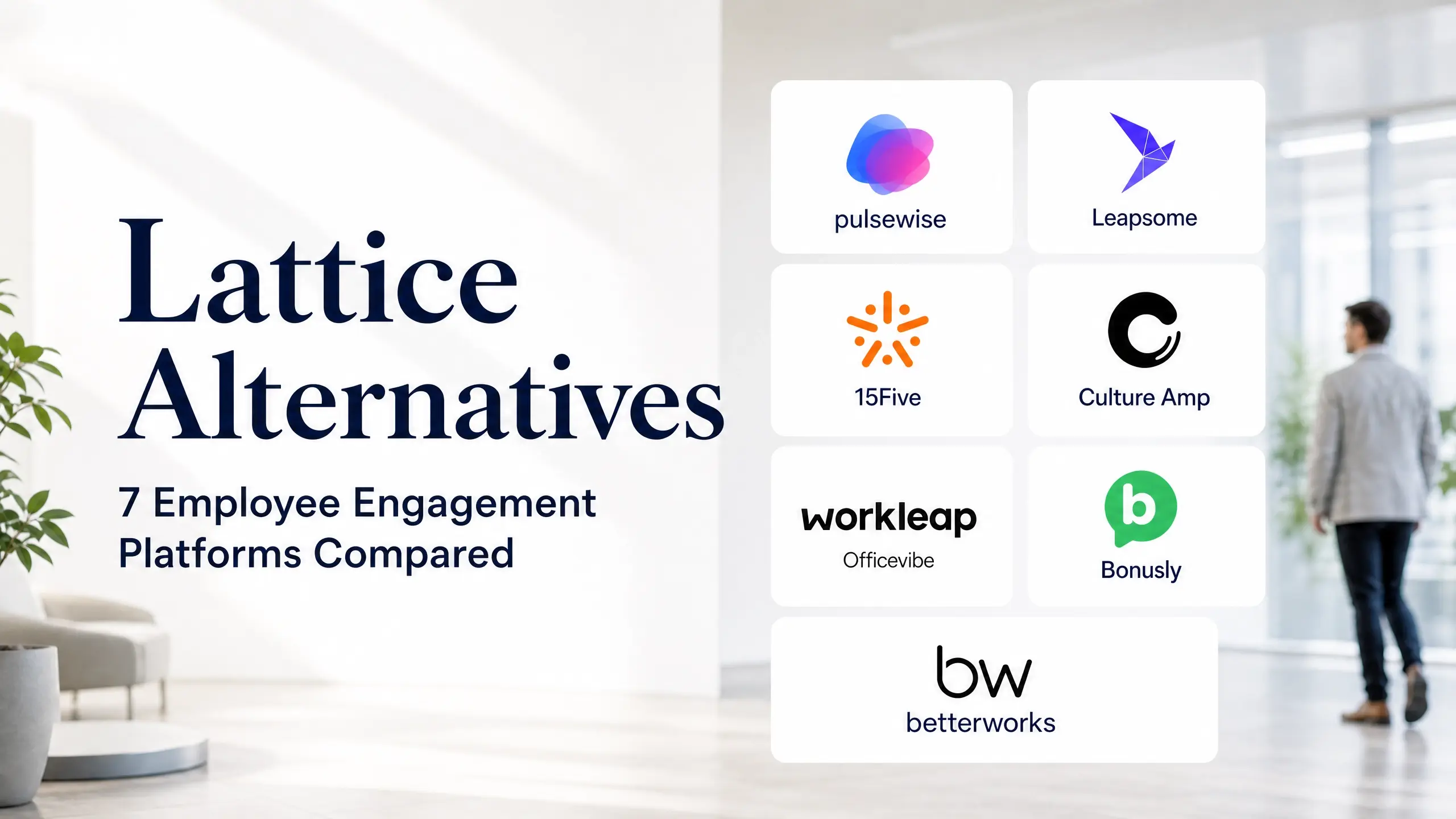
This guide compares seven employee engagement platforms that solve the same problem Lattice does, without the same tradeoffs. Each entry gives you real pricing, honest pros and cons, current G2 ratings, and the one scenario where it wins. We start with the pick built for exactly this buyer, then walk through six more.
TL;DR
-
Lattice starts at $10 per user per month for performance, with engagement, growth, and compensation billed as separate modules, plus a $4,000 annual minimum and no free plan.
-
The best Lattice alternative depends on your primary job to be done: all-in-one experience, deep survey analytics, manager coaching, or pure recognition.
-
Pulsewise is the strongest all-in-one pick for growing teams. It bundles surveys, recognition, goals, feedback, and reviews on a free-forever plan for the first 100 teams, up to 100 users.
-
Culture Amp leads on survey science and benchmarking, 15Five leads on manager effectiveness, and Bonusly leads on peer recognition.
-
Officevibe is the simplest low-cost engagement tool, Leapsome adds learning paths, and Betterworks fits enterprise OKR alignment.
Why teams look for Lattice alternatives
Most teams leave Lattice for one of three reasons: cost that compounds with headcount, rigid workflows that resist customization, or an engagement layer that feels bolted onto a review tool.
Start with the pricing math, since that is what usually triggers the search. Per G2 pricing data, the Performance and OKRs bundle runs $10 per user per month. Engagement and Grow each add $4, and Compensation adds $6, so a full stack quickly reaches five or six figures a year.
Then come the contract terms. Lattice enforces a $4,000 annual minimum regardless of seat count, sells almost entirely on annual contracts, and does not offer a self-serve free trial. A 10-person team still pays the $4,000 floor, well above what per-seat math suggests.
Setup adds more. Teams with 50 or more employees commonly report 4 to 8 weeks of implementation and $2,000 to $8,000 in services to get review templates and org data right.
There is also a product-shape issue. Lattice built its reputation on reviews, and engagement arrived later as a follow-on module, so continuous listening can feel like an add-on rather than the foundation. Lattice is also sunsetting its HRIS module in July 2026, which narrows its all-in-one story.
On G2, reviewers praise Lattice for ease of use, 1:1 management, goal setting, and support. The recurring complaints are a cluttered interface, a learning curve, limited customization, and a cost that creeps up as you add modules.
None of this makes Lattice a poor choice for a well-resourced HR team running structured cycles. It just means the fit breaks down for leaner, engagement-first teams paying enterprise prices for features they rarely open.
Curious what the all-in-one version looks like? Pulsewise is free forever for the first 100 teams, with no credit card and no feature limits. See what is included.
The 7 best Lattice alternatives to try in 2026
Here is the fast version. The table below sizes up all seven alternatives against Lattice on price, free access, and the one thing to watch. Detailed breakdowns follow underneath.
| Platform | Best for | Starting price | Free plan | Main watch-out |
|---|---|---|---|---|
| Pulsewise | All-in-one engagement for growing teams | Free forever (first 100 teams, up to 100 users) | Yes | Newer platform; some AI modules still rolling out |
| Leapsome | Performance plus built-in learning and L&D | From about $8 per user per month (modular) | No (free trial) | Cost climbs as you add modules; setup effort |
| 15Five | Manager effectiveness and weekly check-ins | From $4 per user per month; $16 full platform | No (free trial) | Survey customization limited; annual billing only |
| Culture Amp | Deep survey science and benchmarking | Custom; about $4,500 per year minimum | No | Expensive and opaque; overkill under 200 people |
| Workleap Officevibe | Simple, low-cost pulse surveys | $5 per user per month (10-user minimum) | Yes (starter) | No performance module; analytics are basic |
| Bonusly | Peer recognition and rewards | Free; Team plan $3 per seat per month | Yes | Narrow scope; rewards budget costs extra |
| Betterworks | Enterprise OKR alignment at scale | Custom; about $7 per user per month (est.) | No | Over-engineered under 1,000; long rollout |
| Lattice (baseline) | Structured performance reviews and OKRs | From $11 per user per month plus modules | No | Module cost creep; $4,000 minimum; annual lock-in |
The 7 Lattice alternatives compared in depth
I have explored the seven best alternatives to Lattice and have shared my experience below. Let us start with the current trending #1 in employee engagement software, Pulsewise.
1. Pulsewise, the best all-in-one engagement platform for growing teams
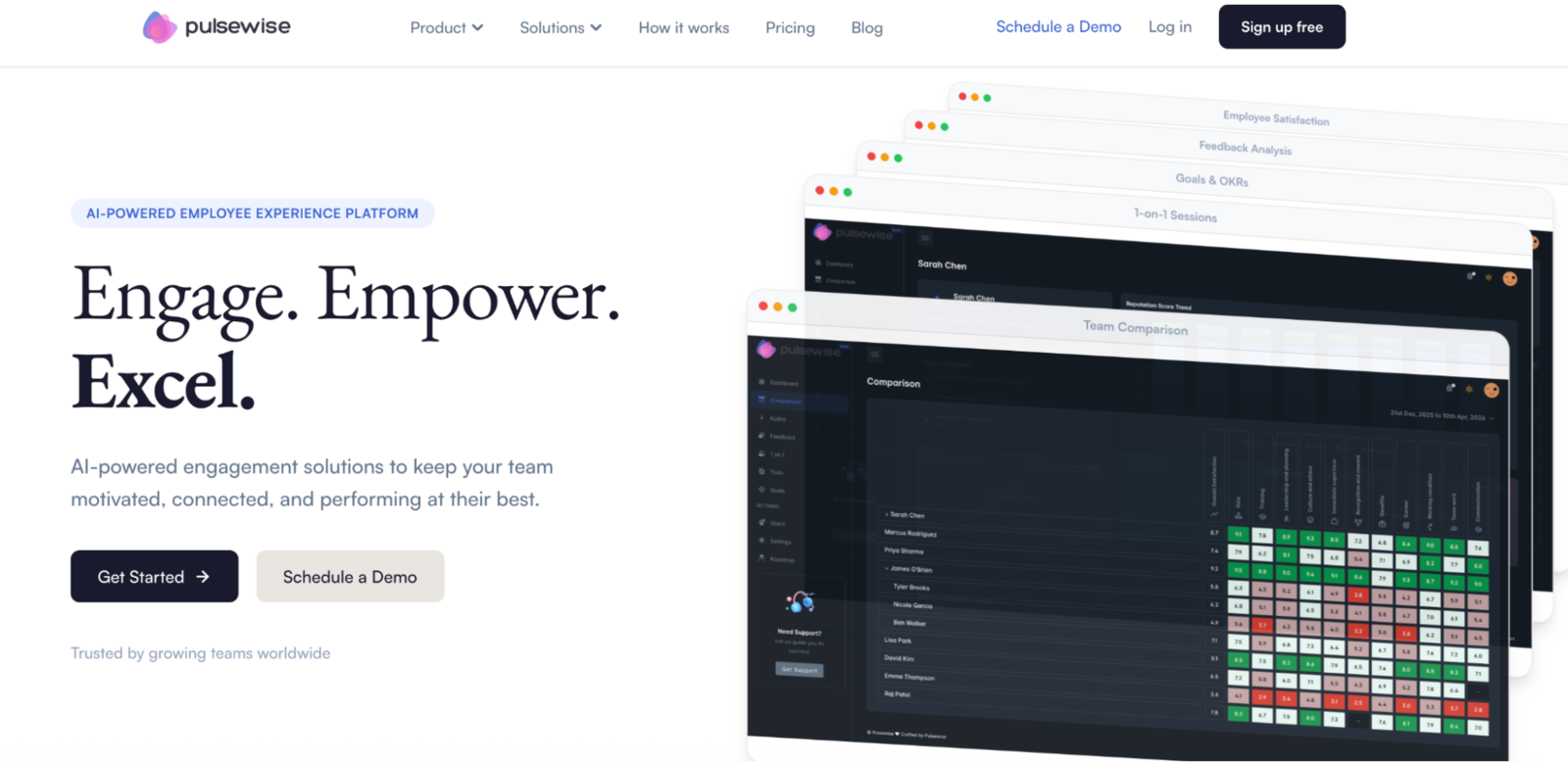
Pulsewise is an AI-first employee experience platform that replaces five disconnected HR tools with one connected system. It is built for the exact buyer looking at Lattice alternatives: People teams at hybrid or remote-first companies with 50 to 300 employees.
The platform covers real-time pulse surveys, feedback, recognition and kudos, goals and OKRs, 1:1s, and AI-assisted performance reviews, all feeding a single intelligence layer. Everything a Lattice buyer assembles from four modules lives in one place here.
That is the core reason it works as a Lattice alternative. Engagement is the foundation, not a bolt-on, so pulse data flows into recognition, goals, and reviews instead of sitting in a separate silo. The engagement and retention view turns that signal into early attrition warnings.
Pricing (verified live). Free forever for the first 100 teams, up to 100 users, with no credit card and no feature limits. Paid per-seat tiers are on the roadmap and will apply only to accounts created after the launch window closes.
Pros
-
Truly all-in-one, so there is no per-module stacking or surprise add-on math.
-
Free for up to 100 users, which undercuts every paid alternative for growing teams.
-
AI-first analysis, review drafting, and coaching nudges built in, not sold separately.
-
Fast self-serve setup with all integrations included, including Slack and Teams.
Cons
-
Newer than Lattice and Culture Amp, so it carries a smaller public review footprint.
-
Some advanced modules, such as AI performance reviews and AI compensation planning, are still rolling out to early adopters.
-
The free plan caps at 100 users, so larger orgs join a waitlist for paid tiers.
Reviews. As an emerging platform, Pulsewise does not yet carry the G2 review volume of incumbents, so weigh it on a hands-on trial rather than star counts. Early adopters report replacing three HR tools with one and cutting software spend meaningfully. You can see how it maps against a survey-led incumbent on our Pulsewise vs Culture Amp page.
Best for. Growing People teams of 50 to 300 that want the full engagement, recognition, goals, and review stack in one platform, without per-module pricing or an annual minimum.
Ready to try it? Claim one of the first 100 free-forever spots and set up your first pulse survey in minutes. Start free with Pulsewise.
2. Leapsome, best for performance plus built-in learning
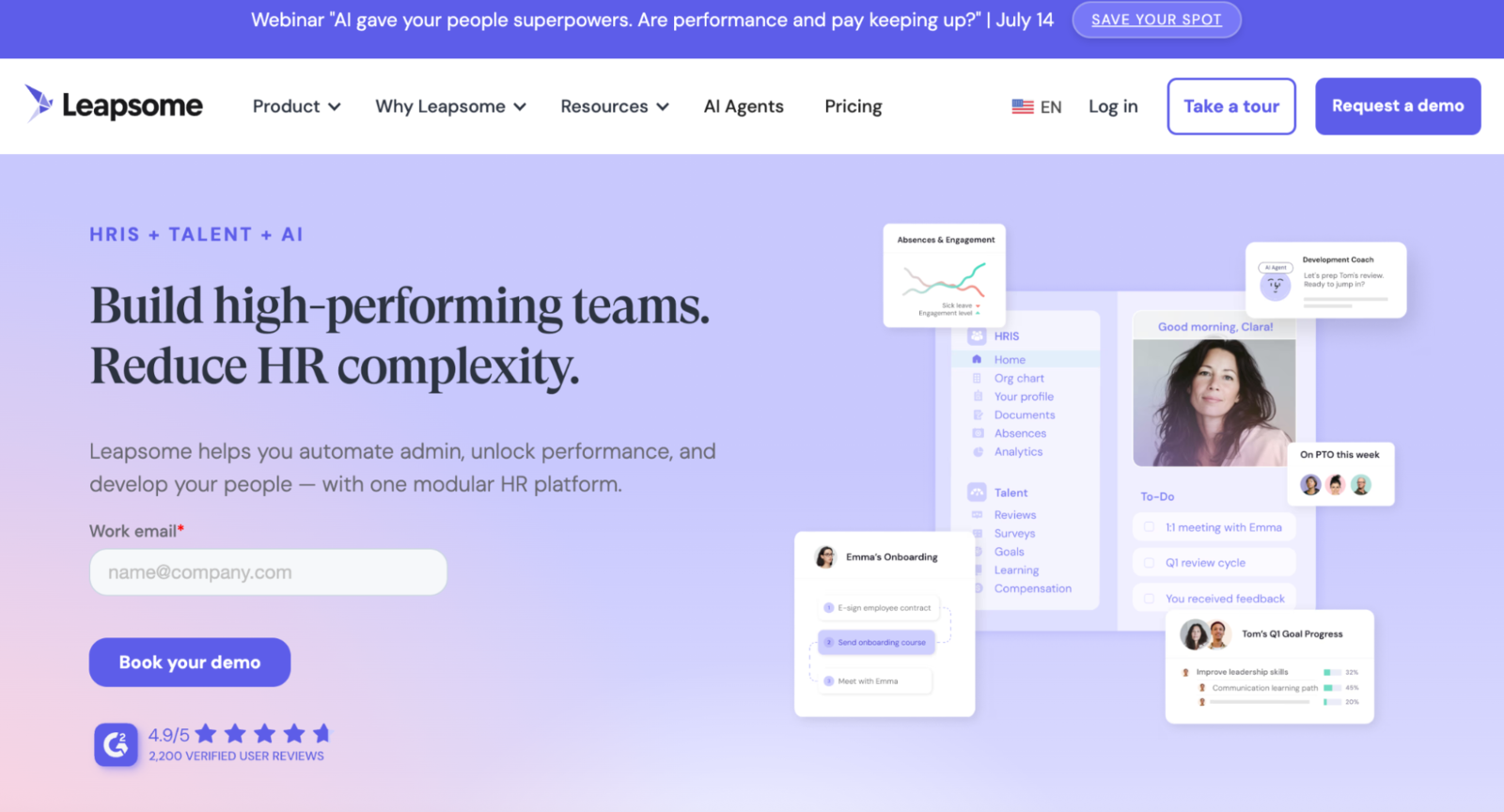
Leapsome is a Berlin-based people enablement platform that combines performance reviews, goals, engagement surveys, and learning in one system. It is well reviewed on G2, where teams consistently praise its breadth and clean interface.
It earns its place as a Lattice alternative by matching Lattice on performance and adding native learning paths that Lattice lacks. For teams that want development sitting next to reviews, that consolidation is real. Its EU-built, GDPR-first design also suits EMEA buyers, with multilingual support across dozens of languages.
Pricing. Modular, starting around $8 per user per month, with a custom quote for the full stack. A free trial is available, but there is no permanent free plan.
Pros
-
All-in-one breadth that includes learning paths alongside reviews, goals, and surveys.
-
Clean, well-designed UX that both admins and managers adopt easily.
-
Strong onboarding and support with dedicated customer success managers.
-
EU-built and GDPR-compliant, with a useful AI feedback-writing assistant.
Cons
-
Module-based pricing scales poorly for growing midsize teams, a common reason for churn.
-
Review setup and version management can feel unnecessarily complex.
-
Goal management often needs manual updates, and the learning module trails the others.
-
You usually need a sales call to pin down true total cost.
Best for. EU and GDPR-conscious teams that want L&D tightly linked to performance and engagement in a single, polished platform.
3. 15Five, best for manager effectiveness and check-ins
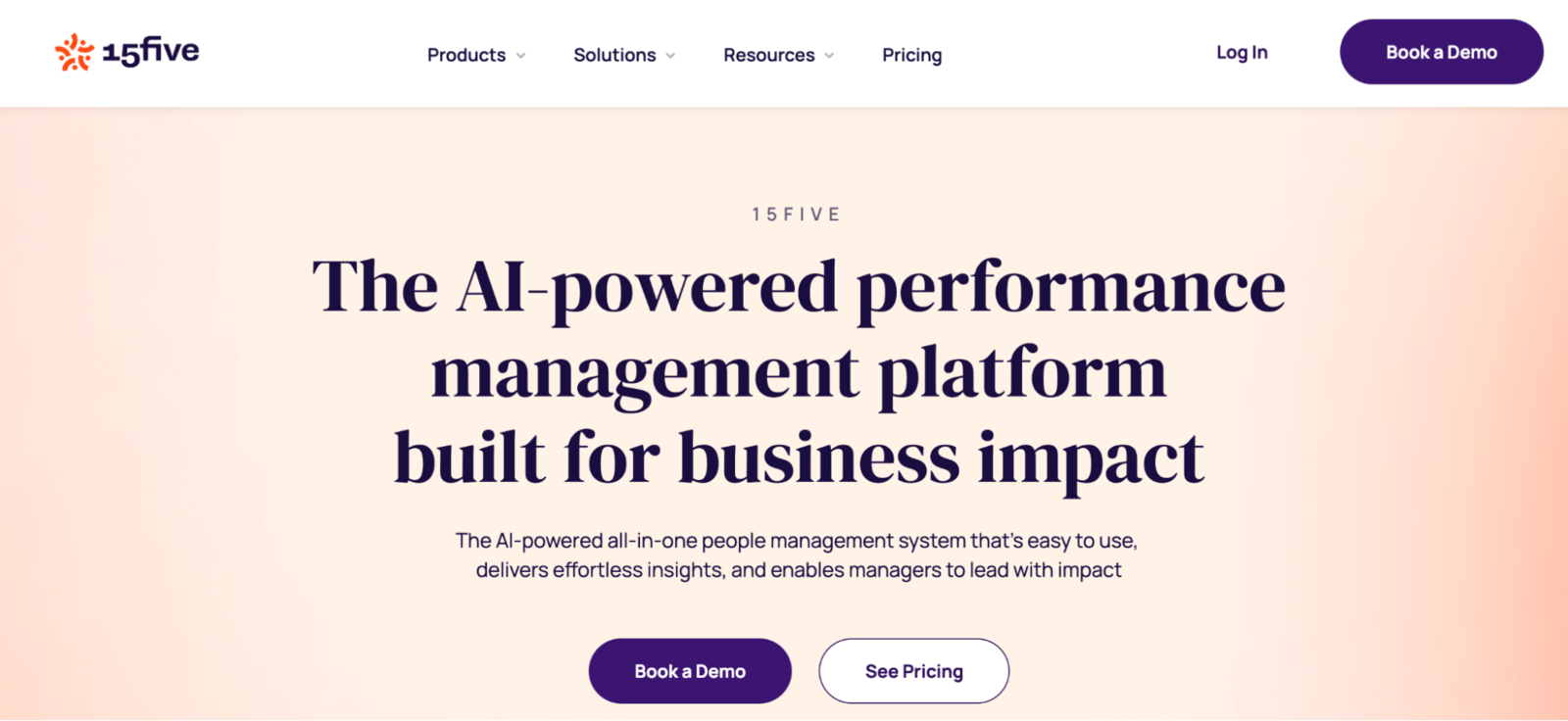
15Five is a performance and engagement platform built around weekly check-ins and manager coaching. It holds a 4.6 out of 5 rating on G2 and 4.7 on Capterra.
It works as a Lattice alternative by trading breadth for cadence. Weekly check-ins, 1:1s, and the Best-Self Management framework give managers a rhythm that annual review tools miss. Published per-seat pricing also lets you budget without a sales call, and its manager-effectiveness scores lead the category.
Pricing. Engage starts at $4 per user per month, Perform runs about $11, and Total Platform is $16. Billing is annual, a free trial is available, and coaching and compensation add-ons are priced separately.
Pros
-
Strongest framework in the category for structured manager-employee conversations.
-
Continuous check-ins, OKRs, engagement dashboards, and High Fives recognition in one flow.
-
Transparent, published pricing you can budget against without a demo.
-
Easy to roll out, with responsive support and quick manager adoption.
Cons
-
Pricing feels high for small teams, and some reviewers report steep renewal increases.
-
Survey customization is limited, and advanced reporting sits behind higher tiers.
-
Compensation planning is not part of the base platform.
-
Billing is annual only, with no month-to-month option.
Best for. Teams whose central problem is inconsistent manager-employee conversations and who want a coaching-first rhythm.
4. Culture Amp, best for survey science and benchmarking
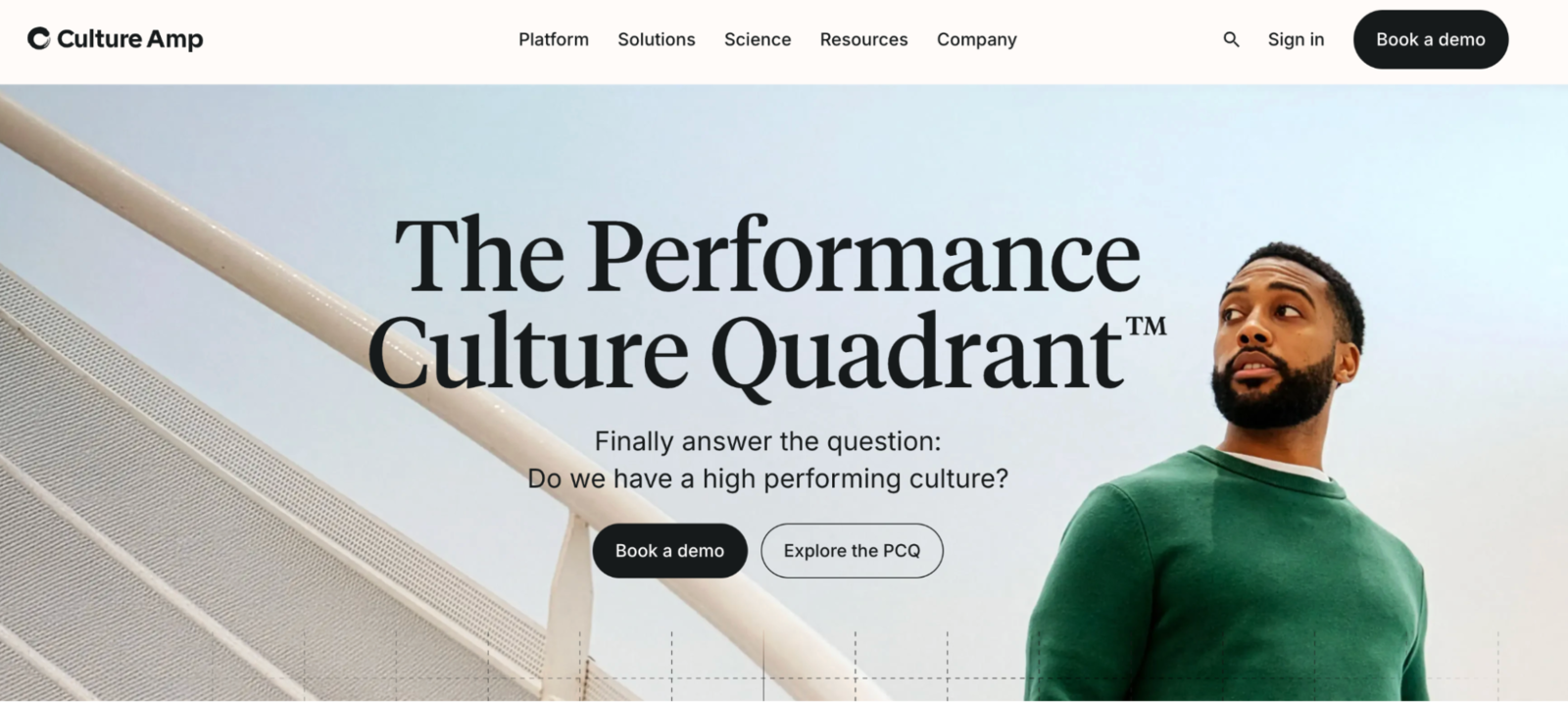
Culture Amp is the category’s most established employee experience platform, used by roughly 6,500 companies. Its G2 reviews point to deep analytics and mature survey science as the standout strengths.
It beats Lattice as an alternative when engagement measurement is the priority. Culture Amp goes far deeper on survey science and industry benchmarking than Lattice’s follow-on engagement module, backed by one of the largest employee datasets in the market. Multilingual support across 25-plus languages also suits distributed, EMEA-friendly teams.
Pricing. Not published publicly and quoted per company. Industry and procurement data put the minimum around $4,500 per year, with the engagement module roughly $5 to $9 per employee per month, and enterprise deals running $36,000 or more. There is no free plan.
Pros
-
Best-in-class benchmarking and people analytics backed by a huge dataset.
-
Mature, science-backed survey design with AI feedback summaries.
-
Multilingual and globally proven, with responsive support.
-
Strong fit for building a confident, data-driven People strategy.
Cons
-
Expensive, with opaque pricing that requires a sales cycle to get a number.
-
Weeks of onboarding and a real learning curve before value shows up.
-
Rigid workflows and limited customization; the 360 review setup is clunky.
-
Reviewers report scaling friction as teams grow, and it is overkill under 200 people.
Best for. Data-driven People teams with over 200 employees, where engagement analytics and benchmarking are the main event.
5. Workleap Officevibe, the best simple, low-cost engagement tool
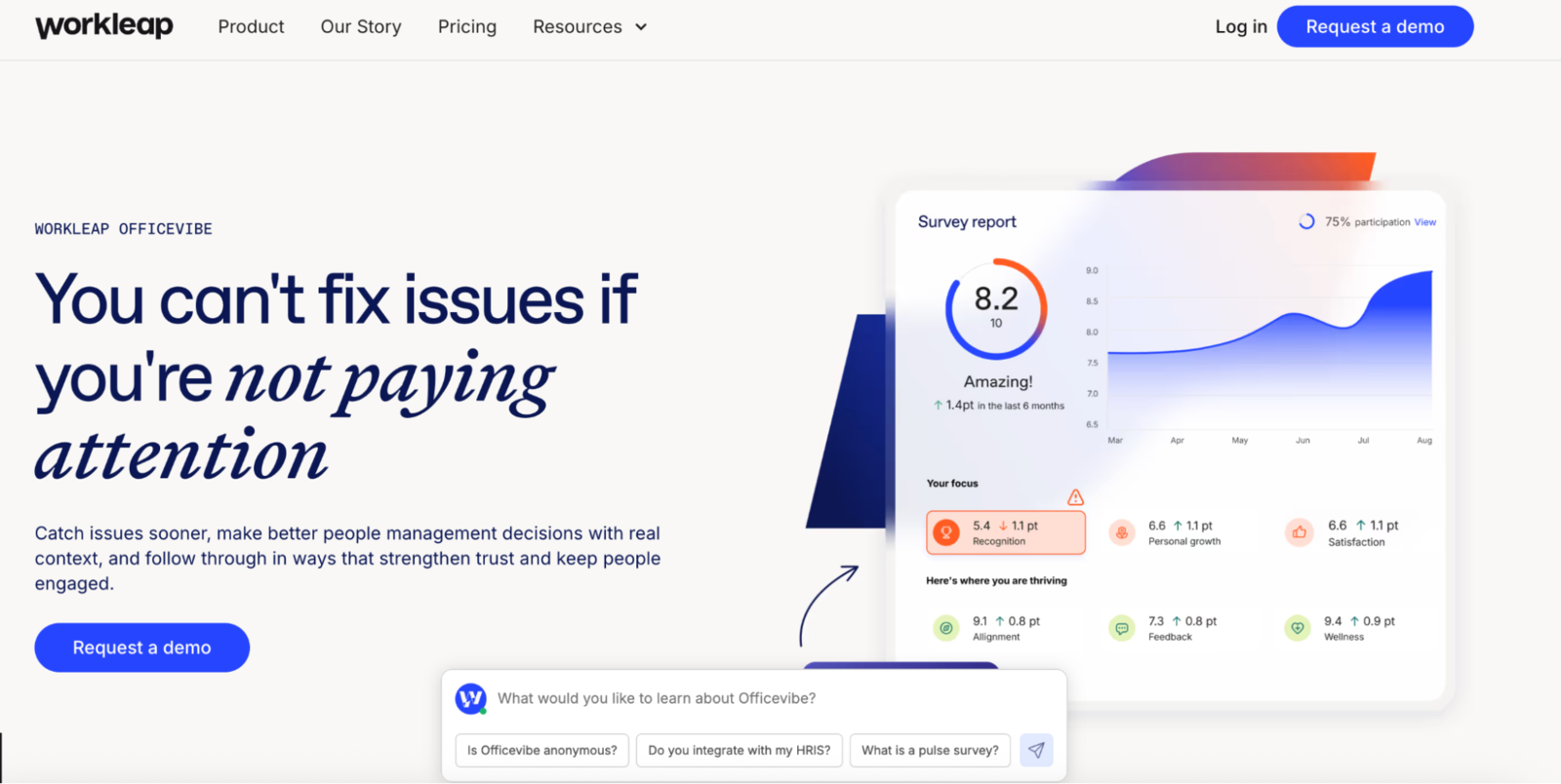
Workleap Officevibe is an always-on engagement and feedback tool built for HR and managers. It holds a 4.3 out of 5 rating on G2 and 4.6 on Capterra.
It stands out as a Lattice alternative in terms of simplicity and price. Automated weekly pulse surveys, an anonymous feedback channel, and Good Vibes recognition deliver continuous measurement at roughly half the cost of Culture Amp or Lattice for engagement. The manager dashboards are simple enough that busy managers actually check them.
Pricing. $5 per user per month billed annually, or $6.25 monthly, with a 10-user minimum. A free starter tier is available for one team.
Pros
-
Simplest pricing in the category, with all engagement features in one plan.
-
Automated pulse surveys drive high response rates across 10 engagement metrics.
-
The anonymous feedback channel is well-designed and genuinely gets used.
-
Clean manager dashboards plus a free starter tier to test before committing.
Cons
-
Analytics and benchmarking are basic, next to Culture Amp.
-
No performance module in Officevibe; reviews and OKRs sit in a separate Workleap product.
-
Integration options are limited, and SSO sits on the higher tier.
-
The 10-user minimum sets a $50 per month floor for micro-teams.
Best for. Small to midsize teams that want continuous engagement measurement, fast, without enterprise complexity or cost.
6. Bonusly, best for peer recognition and rewards
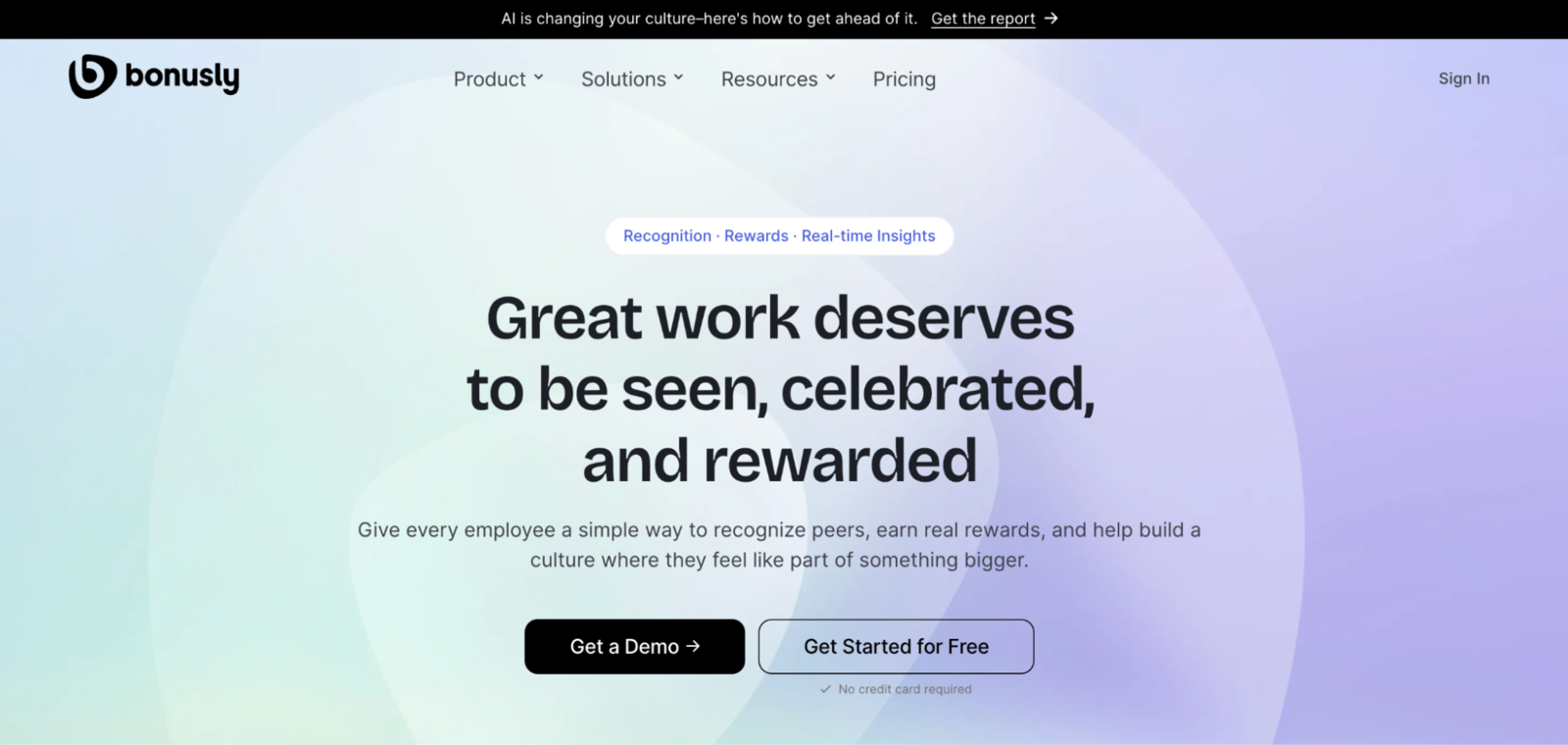
Bonusly is a recognition-first platform that makes peer appreciation a daily habit. It is highly rated for recognition on G2, with more than 3,400 organizations using it, including DoorDash and Toast.
It fills the exact gap Lattice barely touches. Recognition drives everyday culture rather than a once-a-cycle event, with peer points, a global rewards catalogue, and native Slack and Teams integration. If your core need is appreciation, pair the thinking here with our employee recognition ideas.
Pricing. A free-forever tier covers small teams with core recognition and 1:1s. The Team plan is $3 per seat per month, or $30 per seat per year, and Organization pricing is custom. Reward funds are budgeted separately on top of the subscription.
Pros
-
Effortless peer recognition that lifts morale and shows up in retention.
-
Strong native Slack and Teams integration, so recognition happens in the flow of work.
-
Engaging a global rewards catalogue, plus a free tier to start.
-
Very easy to adopt with minimal admin overhead.
Cons
-
Narrow scope; it is not a full engagement or performance suite.
-
Reward funds are an added cost on top of per-seat pricing.
-
The rewards catalog is thinner outside the US, and points expire monthly.
-
Reporting and analytics are light for larger organizations.
Best for. Teams whose main gap is recognition and everyday culture, rather than surveys, goals, or reviews.
7. Betterworks, best for enterprise OKR alignment
Betterworks is an enterprise performance platform built around cascading OKRs and calibration. It holds about a 4.3 out of 5 rating on G2 and 4.2 on Capterra.
It works as a Lattice alternative for large organizations that take goals seriously. Betterworks goes deeper than Lattice on OKR cascading and calibration at scale, with strong integrations into Slack, Teams, Jira, and Salesforce, plus AI talent intelligence layered on top.
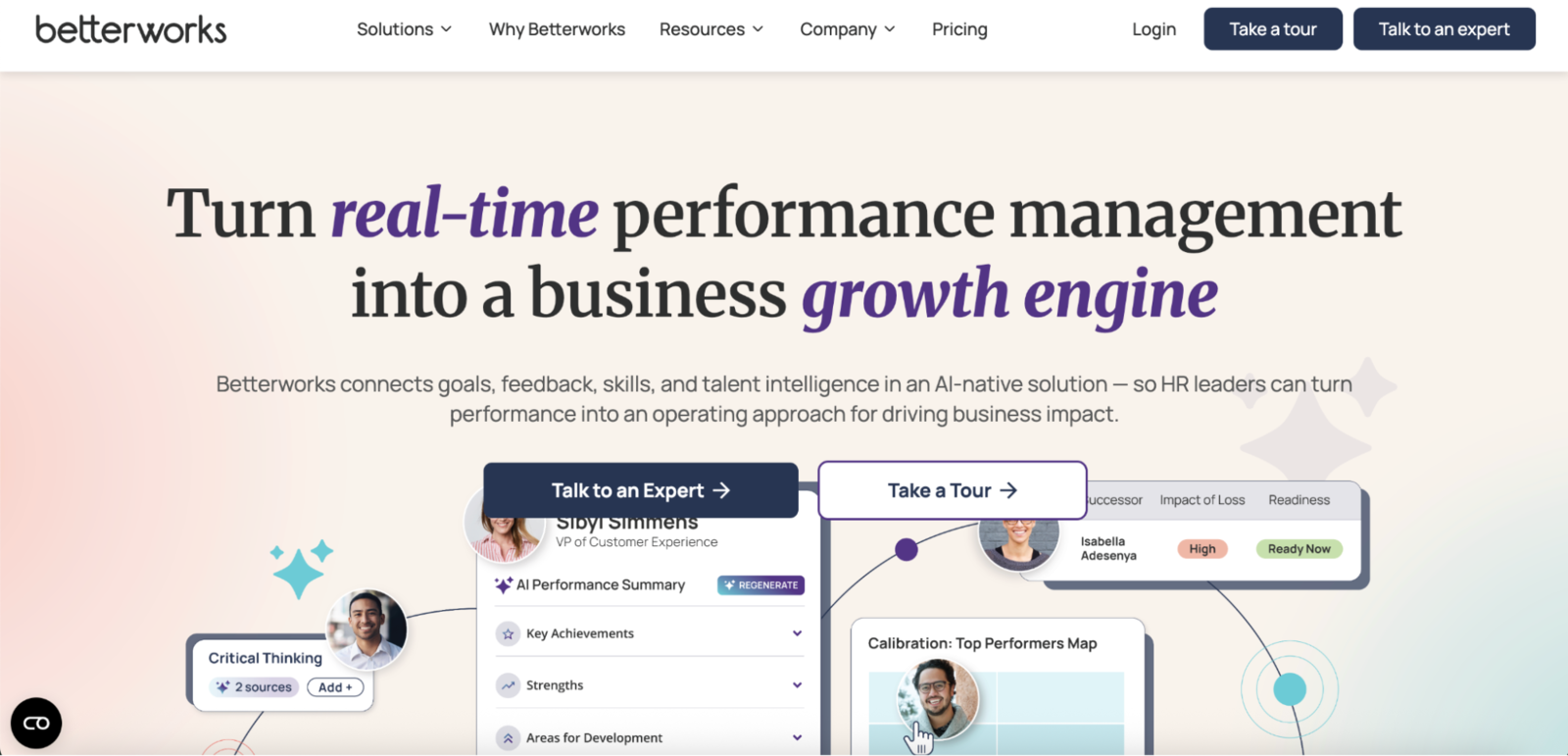
Pricing. Not published publicly, with public estimates around $7 per user per month. A Team edition targets smaller teams, and an Enterprise edition targets 250-plus employees. You contact sales for a quote.
Pros
-
Best-in-class OKR cascading and alignment across large, distributed workforces.
-
Standout calibration module that reduces manager bias in ratings.
-
Deep integrations into everyday work tools, with useful AI insights.
-
Talent intelligence that connects performance, skills, and readiness data.
Cons
-
The engagement module is newer and less mature than Culture Amp’s.
-
Implementation commonly takes 2 to 4 months with real change management.
-
Over-engineered for teams under about 1,000 employees.
-
Custom reporting and data exports are limited, and the mobile app is basic.
Best for. Large enterprises are standardising OKRs and calibration across many locations, departments, and levels.
How to choose the right Lattice alternative
The right Lattice alternative comes down to your primary job to be done and your headcount, not the longest feature list. Match the tool to where your team is today.
-
Want one platform for surveys, recognition, goals, and reviews without per-module pricing: Pulsewise.
-
Need learning and development sitting next to performance: Leapsome.
-
Your core problem is weak manager-employee conversations: 15Five.
-
Deep survey benchmarking drives your strategy, and you are over 200 people: Culture Amp.
-
You want simple, affordable pulse surveys fast: Workleap Officevibe.
-
Your only real gap is recognition and everyday culture: Bonusly.
-
You are aligning OKRs and calibration across a large, distributed org: Betterworks.
One caution from the field. Over-engineering your performance process is the fastest way to lose manager buy-in. A tool built for a 5,000-person enterprise usually creates friction for a team of 150, so weight simplicity and adoption heavily. For the broader landscape, our employee engagement master guide covers the fundamentals behind the tooling.
The bottom line
Lattice earned its reputation for a reason, and for a well-staffed HR team running structured cycles, it still delivers. The real question is not whether Lattice works. It is whether you are paying enterprise prices for a review tool when your actual goal is an engaged, connected team.
If engagement is the job and one connected platform is the goal, Pulsewise gives growing teams the full stack of surveys, recognition, goals, feedback, and reviews. No modules to stack, no annual minimum, and no sales call just to see a price.
Whichever way you lean, run a real trial before you sign. The best signal is not a feature list, it is whether your managers actually open the tool the week after rollout.
Start free with Pulsewise and give your team surveys, recognition, goals, and reviews in one platform. Claim your free-forever spot, or schedule a quick demo to see it on your own data.
FAQs
Why do companies switch from Lattice?
Most teams leave Lattice for three reasons: cost that compounds as headcount grows, rigid workflows that resist customization, and an engagement layer that feels bolted onto a review tool. Mid-market teams paying enterprise prices for modules they barely use tend to feel the friction first.
Is there a free alternative to Lattice?
Yes. Lattice has no free plan, but several alternatives do. Pulsewise is free forever for the first 100 teams with every feature unlocked. Bonusly offers a free recognition tier, and Workleap Officevibe includes a free starter tier for one team.
How much does Lattice cost?
Lattice uses modular pricing. The Performance and OKRs bundle starts at about $11 per user per month, with Engagement, Grow, and Compensation billed separately. Lattice also enforces a $4,000 annual minimum and sells on annual contracts, so real costs climb quickly as you add modules.
What is the best Lattice alternative for small and mid-size teams?
For teams of 50 to 300 that want engagement, recognition, goals, and reviews in one place, Pulsewise is the strongest fit because it bundles the full stack on a free plan. 15Five suits manager coaching, and Officevibe suits simple, low-cost pulse surveys.
What is the difference between Lattice and Culture Amp?
Culture Amp leads in survey science, benchmarking, and analytics, making it stronger for pure engagement measurement. Lattice ties tightly to performance reviews, goals, and 1:1s. Culture Amp fits data-driven teams of over 200 people, while Lattice fits teams wanting reviews and engagement together.
Does Lattice offer a free trial?
Lattice does not offer a self-serve free trial or a permanent free plan. You typically request a demo and go through a sales process before accessing the platform, which makes it harder to evaluate fit before committing to an annual contract.