The Best Employee Engagement Software in 2026 (Compared)
TL;DR
- Pulsewise combines surveys, feedback, recognition, goals, performance reviews, and compensation planning in one AI-first platform, and it is free forever for the first 100 teams with up to 100 users and no credit card required.
- Lattice is the strongest option for structured performance management with compensation integration, but modular pricing can reach $15 to $25 per user per month and the $4,000 annual minimum locks out smaller teams.
- Culture Amp leads in engagement survey science and benchmarking, but opaque pricing (starting at ~$4,500/year), weeks of onboarding, and weaker performance review tools make it a harder fit for growing teams.
- 15Five excels at weekly check-ins and manager coaching at an affordable entry point ($4/user/month), but it is not a full HR suite and its pulse survey questions become repetitive after several months.
- Leapsome offers the broadest all-in-one scope with reviews, goals, surveys, learning, and HRIS in one EU-built platform, but per-module pricing stacks up quickly for midsize teams.
- Bonusly is the best pure recognition platform with 3,700+ G2 reviews, but it covers only peer-to-peer kudos and rewards. No surveys, no reviews, no goals, no compensation.
You are probably reading this because your current HR setup looks something like this: one tool for surveys, another for recognition, a spreadsheet for goals, and a performance review process held together by calendar reminders and good intentions.
You are not alone. According to Gallup, only 20% of employees worldwide are engaged at work, and a major contributor is the fragmented tooling that keeps People teams reactive instead of proactive.
The employee engagement software market in 2026 is crowded. Over 100 platforms are claiming to solve engagement, and most comparison articles list 15 to 20 of them without telling you anything useful.
This guide is different. We compared five of the most established platforms head-to-head, with real pricing, verified G2 scores, honest pros and cons, and what actual practitioners say on Reddit.
Whether you are a Head of People evaluating your first platform or replacing a tool that is not delivering, this comparison gives you everything you need to make a confident decision.
Quick comparison table
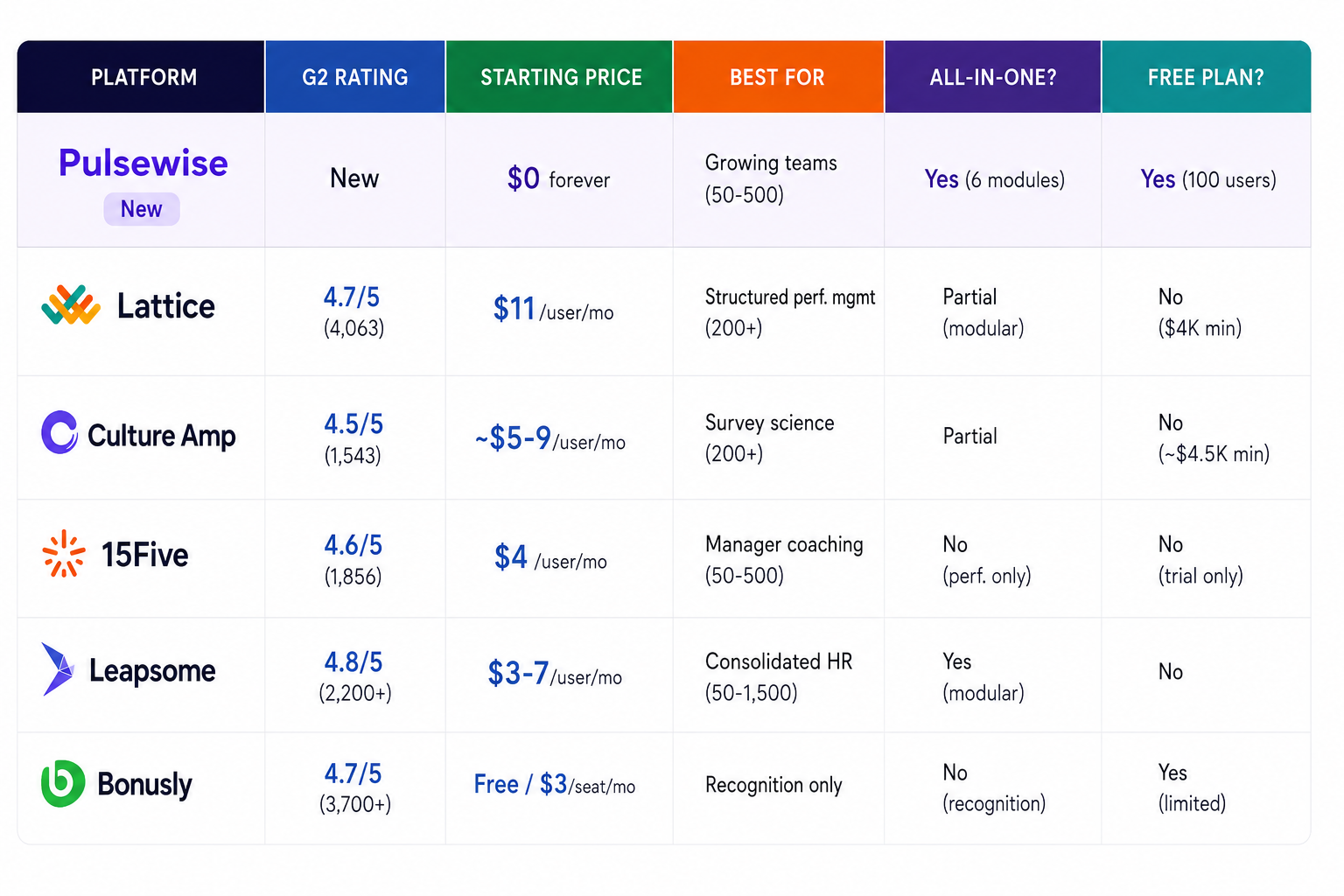
Before diving into each platform, here is a side-by-side snapshot of how they compare on the factors that matter most to People teams at companies with 50 to 500 employees.
Want to see how Pulsewise replaces your entire HR stack? See how it works.
1. Pulsewise: the AI-first, all-in-one employee engagement platform
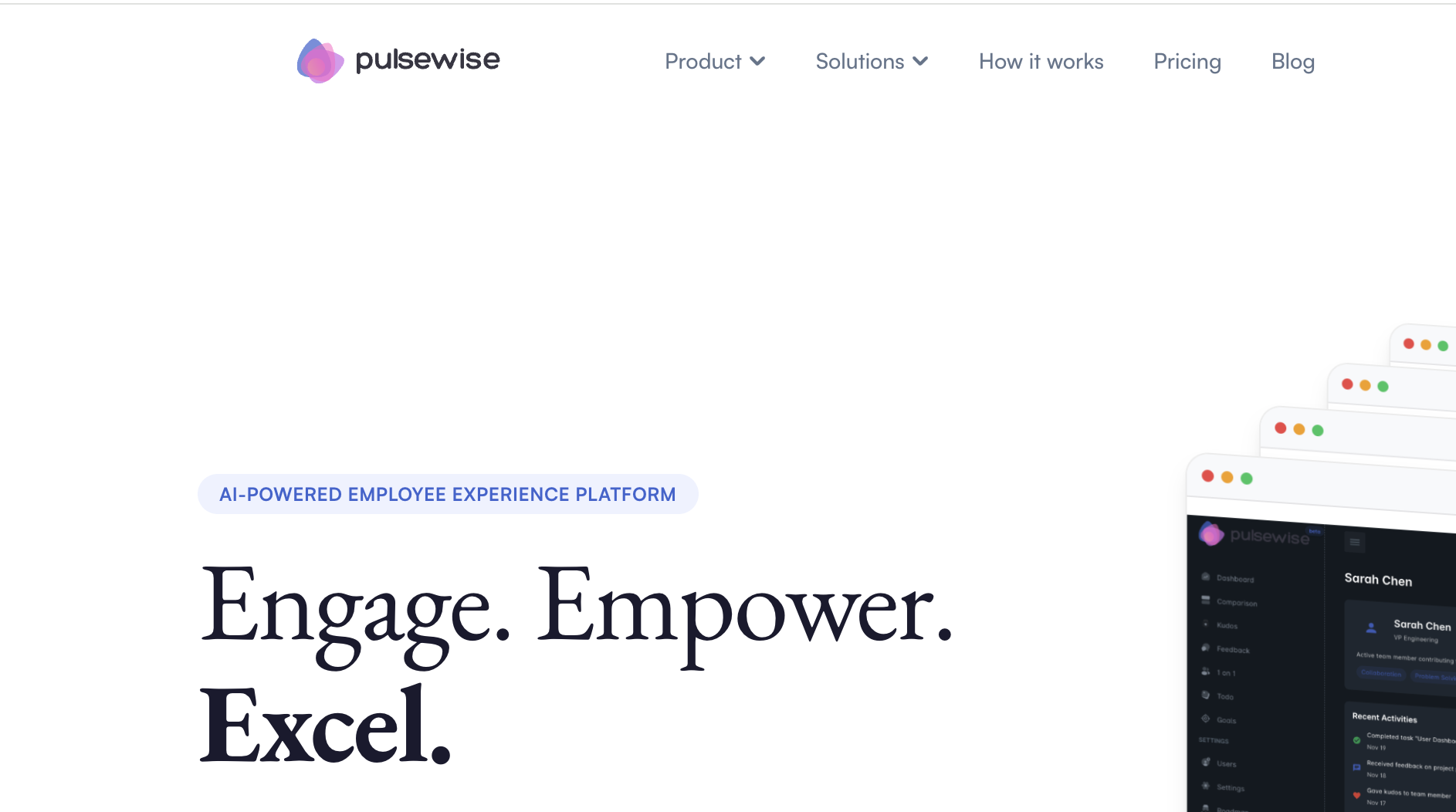
Pulsewise is an AI-first employee experience platform built for growing teams. It replaces five disconnected HR tools with one connected system that covers pulse surveys, structured feedback, kudos and recognition, goals and OKRs, performance reviews, and compensation planning.
Everything feeds into a single intelligence layer. Managers get AI-prepared talking points for every 1:1. Feedback is automatically mapped to dimensions like morale, teamwork, and psychological safety. Goals cascade with automatic roll-up progress from individual to organization level.
Key features
- Real-time pulse surveys with daily mood tracking and custom templates
- AI-powered feedback analysis mapped to engagement dimensions
- Peer-to-peer recognition with AI-crafted kudos that tie to company values
- Nested goal trees with automatic roll-up progress tracking
- AI-assisted performance reviews with built-in fairness guardrails
- Compensation intelligence with budget simulation and rating-driven calculations
- Integrations with Slack, Microsoft Teams, and other workplace tools
Pros
- Genuinely all-in-one: six modules where most competitors offer two or three
- AI-first across every module, not just AI-assisted in one feature
- Free forever for the first 100 teams (up to 100 users, no credit card, no feature limits)
- Built for the 50 to 500 employee sweet spot, not retrofitted down from enterprise
- No minimum contract, no sales call required to get started
Cons
- Newer platform, so fewer G2 reviews compared to established competitors
- Per-seat paid tiers are still on the roadmap (the free offer is the current live pricing)
- Advanced features like AI performance reviews and compensation planning are shipping soon
Pricing
Free forever for the first 100 teams. Up to 100 users. No credit card required. All features included: pulse surveys, recognition, goals, feedback, AI-powered analytics, all integrations, and priority support. Growth plans with per-seat pricing are on the roadmap.
G2 rating
New to G2. Early reviews highlight the all-in-one scope and zero-cost entry.
Best for
Hybrid or remote-first companies with 50 to 500 employees that want to replace their disconnected HR stack with one platform. Particularly strong for teams that do not have the budget for Lattice or Culture Amp but need more than Bonusly’s recognition-only approach.
Pulsewise is free for teams of up to 100. Claim your free spot.
2. Lattice: best for structured performance management
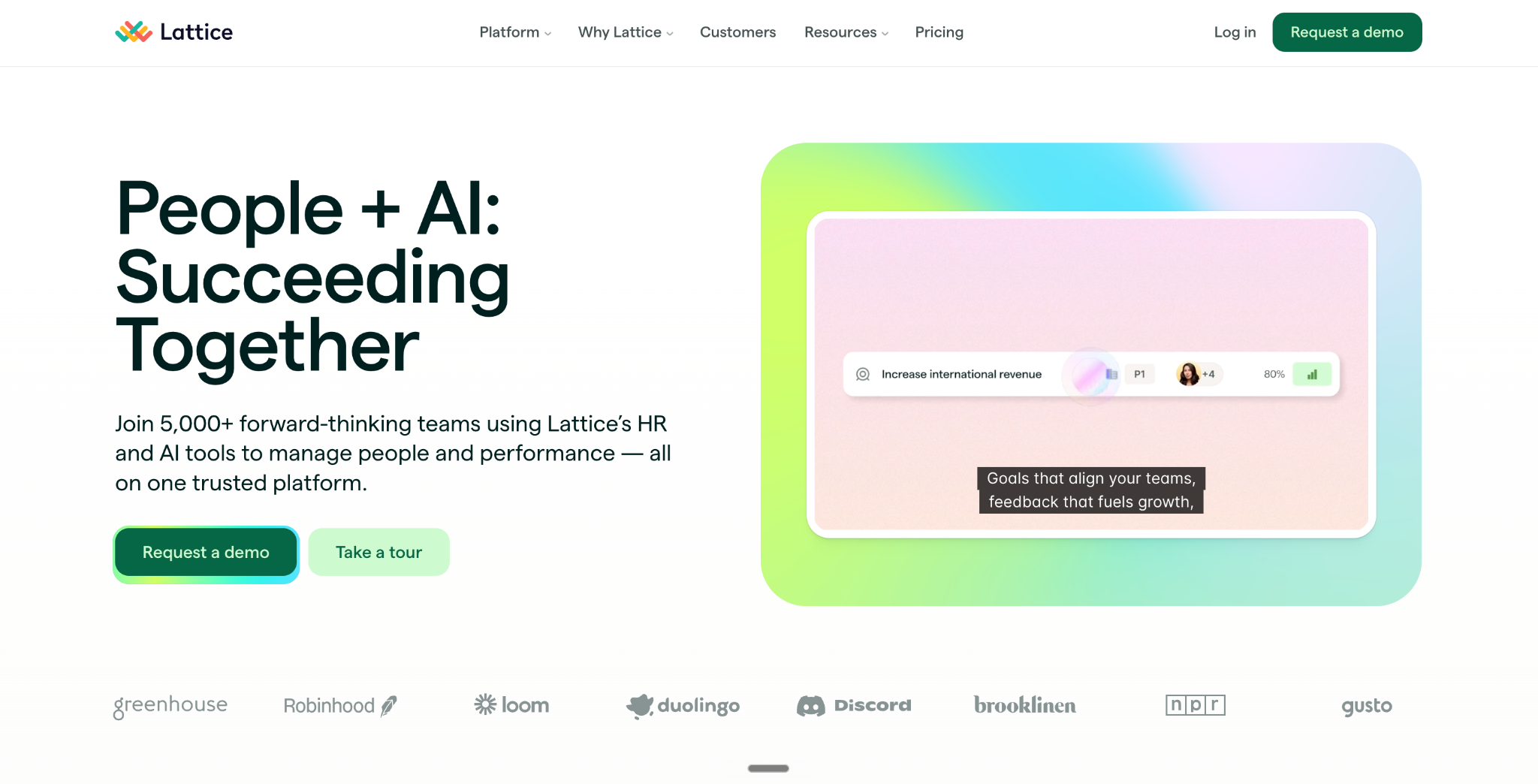
Lattice has become the default choice for growth-stage companies that take performance management seriously. The platform connects goals, reviews, feedback, compensation, and engagement surveys into a unified experience. It is trusted by 4,500+ organizations worldwide and was recognized on G2’s 2026 Best Software Awards for top HR products.
Lattice was built around structured performance cycles. If your organization runs on OKRs, conducts regular review cycles, and wants performance data to inform compensation decisions, Lattice delivers a polished, well-integrated system. The recently launched AI Agent acts as an always-on teammate that answers employee questions and coaches managers in the flow of work.
Key features
- 360-degree and project-based performance reviews with customizable templates
- OKR and goal tracking with company-wide alignment
- Engagement surveys, pulse checks, and eNPS with updated 2025 benchmarks
- Compensation management is tied directly to performance data
- AI Agent for self-service employee support
- 50+ native integrations, including Slack, Teams, Jira, and major HRIS systems
Pros
- Most comprehensive structured performance management in this comparison
- Compensation integration is directly tied to review cycles
- Strong customer support with dedicated success teams and Lattice University
- Modular design lets you start small and expand
- Recognized G2 leader with 4,063 verified reviews
Cons
- Pricing escalates fast as you add modules ($11 base + $4 engagement + $4 grow + $6 compensation = up to $25/user/month)
- $4,000 annual minimum contract locks out teams under ~30 employees
- Interface can feel cluttered, especially for first-time users
- Setup takes 4 to 8 weeks with significant HR team investment
- Announced sunsetting of HRIS and payroll modules by July 2026, narrowing back to reviews and OKRs
Pricing
Talent Management: $11/user/month. Add-ons: Engagement $4/user/month, Grow $4/user/month, Compensation $6/user/month. HRIS plan: $10/user/month. All billed annually. Minimum annual agreement: $4,000. No free plan. Free trial available on request.
G2 rating
4.7 out of 5 based on 4,063 reviews. Users praise ease of use, goal tracking, and customer support. Common complaints: pricing too high for smaller teams, cluttered navigation, and limited customization.
Best for
Mid-market to enterprise companies (200 to 2,000+ employees) with dedicated HR teams that need structured performance cycles integrated with compensation planning.
3. Culture Amp: best for engagement survey science
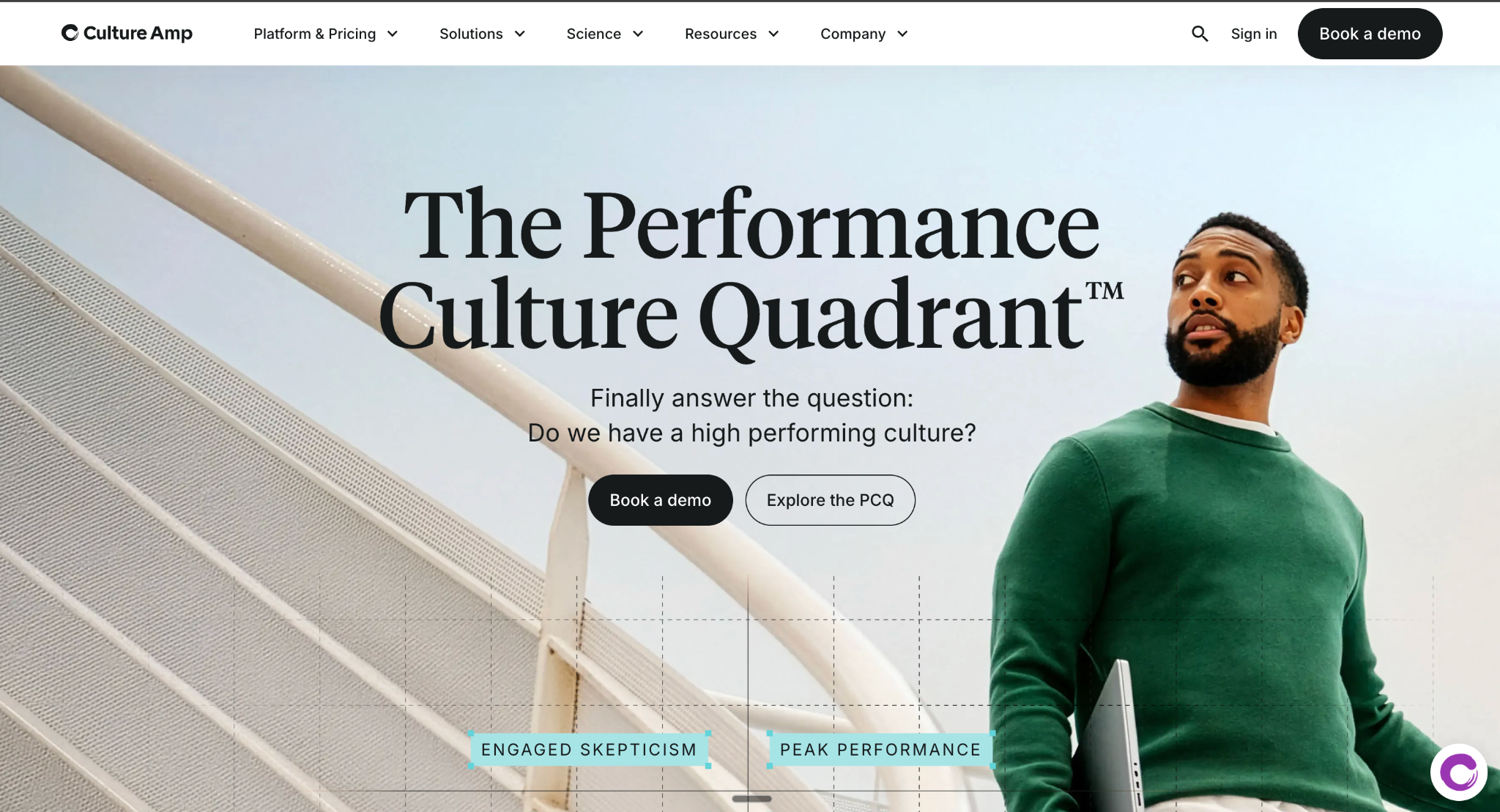
Culture Amp came to market as the leader in engagement surveys and people analytics, and that remains its core strength. Founded by organizational psychologists, the platform offers science-backed survey instruments, industry benchmarking against 6,500+ companies, and AI-powered attrition prediction. Over 25 million employees across 6,500 organizations use it.
The platform has expanded into performance management and career development, but its DNA remains research-driven. If your primary goal is deep engagement measurement with statistically valid benchmarks, Culture Amp is the gold standard.
Key features
- Science-backed engagement and pulse surveys designed by organizational psychologists
- Industry benchmarking against a 6,500+ company dataset
- AI-powered attrition prediction and driver analysis
- DEI analytics and inclusion measurement
- Performance reviews, 1:1s, and goal tracking (newer additions)
- Shoutouts: real-time recognition integrated with Slack
Pros
- Best engagement survey science in the market, period
- Strongest benchmarking dataset for comparing scores against industry peers
- Strong DEI and inclusion measurement tools
- Supports 30+ languages
- Good for organizations with an I/O psychology orientation toward people data
Cons
- Pricing is opaque: no public pricing page, sales call required, minimum ~$4,500/year
- Performance management and review features are weaker than Lattice or Leapsome
- Setup and onboarding can take weeks
- Multiple Capterra reviewers report scaling challenges beyond 100 employees
- Navigation can feel disjointed, with one reviewer noting it feels harder than Google Docs
Pricing
Not publicly listed. Based on procurement analysis and user reports, approximately $5 to $9 per employee per month for the base engagement plan. Minimum ~$4,500/year. Enterprise contracts range from $10,000 to $45,000+ annually, depending on modules and headcount. Implementation and training costs are additional.
G2 rating
4.5 out of 5 based on 1,543 reviews. Users praise survey quality and analytics depth.
Common complaints: opaque pricing, rigid workflows, performance module not as robust as competitors.
Best for
Data-driven HR teams at companies with 200+ employees that prioritize engagement measurement and benchmarking over performance management workflows.
Want engagement surveys, performance reviews, and recognition in one platform without the enterprise price tag? Try Pulsewise’s wellbeing calculator to see what disengagement is costing your team.
4. 15Five: best for weekly check-ins and manager coaching
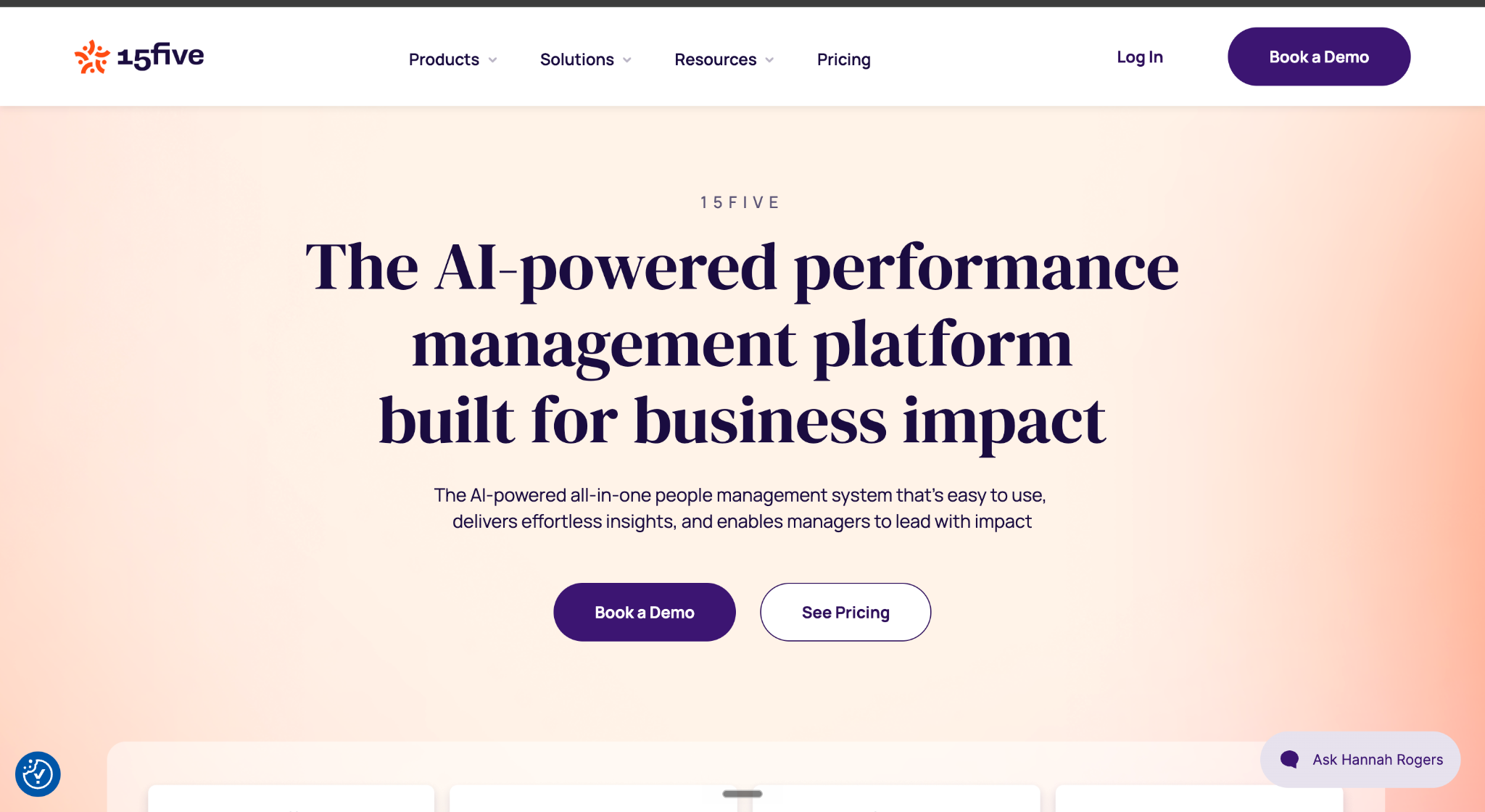
15Five takes a fundamentally different approach from the other platforms in this comparison. Instead of starting with structured review cycles or survey science, 15Five builds everything around the manager-employee relationship. Its signature feature is the weekly check-in: employees spend 15 minutes writing a structured update, managers spend five minutes reading and responding, and over time this lightweight rhythm replaces the anxiety of annual reviews with consistent, real-time dialogue.
The platform also offers engagement surveys (Engage tier), OKR tracking, High Fives peer recognition, and a unique Transform module that provides structured coaching programs for managers. If you believe great managers are the key to great engagement, 15Five is purpose-built for that philosophy.
Key features
- Weekly check-ins with structured questions and pulse ratings
- Performance reviews with 360-degree feedback and calibration
- OKR and goal tracking embedded in the weekly rhythm
- Engagement surveys with industry benchmarking (Engage tier)
- High Fives: peer-to-peer recognition integrated with Slack
- Transform: structured manager coaching and training programs
- HR Outcomes Dashboard connecting engagement, performance, and retention data (Total Platform tier)
Pros
- Coaching-first philosophy that measurably improves manager effectiveness
- Most transparent and affordable pricing in this comparison ($4/user/month entry)
- Fast setup: most teams are live within days, not weeks
- Weekly check-ins create a genuine feedback culture that reduces review-time surprises
- Strong ROI for reducing regrettable turnover through early signal detection
Cons
- Not a full HR suite: no HRIS, no compensation planning, no payroll
- Pulse survey questions become repetitive after 7 to 8 months, causing engagement drops
- Weekly check-ins can feel like homework if not positioned correctly with employees
- Fewer integrations than Lattice
- Engagement surveys are still maturing compared to Culture Amp’s depth
Pricing
Engage: $4/user/month (surveys, analytics, benchmarking). Perform: $10 to $11/user/month (reviews, 360 feedback, OKRs, check-ins, 1:1s). Total Platform: $14 to $16/user/month (everything plus HR Outcomes Dashboard, Manager Effectiveness Indicator, Transform coaching). All billed annually. Free trial available.
G2 rating
4.6 out of 5 based on 1,856 reviews. Capterra: 4.7/5. Users praise ease of use, weekly check-in model, and customer support.
Common complaints: limited customization, cost adds up at scale, repetitive survey questions over time.
Best for
Growing companies with 50 to 500 employees that believe great managers drive great performance and want a lightweight, coaching-oriented system rather than heavy enterprise tooling.
5. Leapsome: best for consolidated European-friendly HR
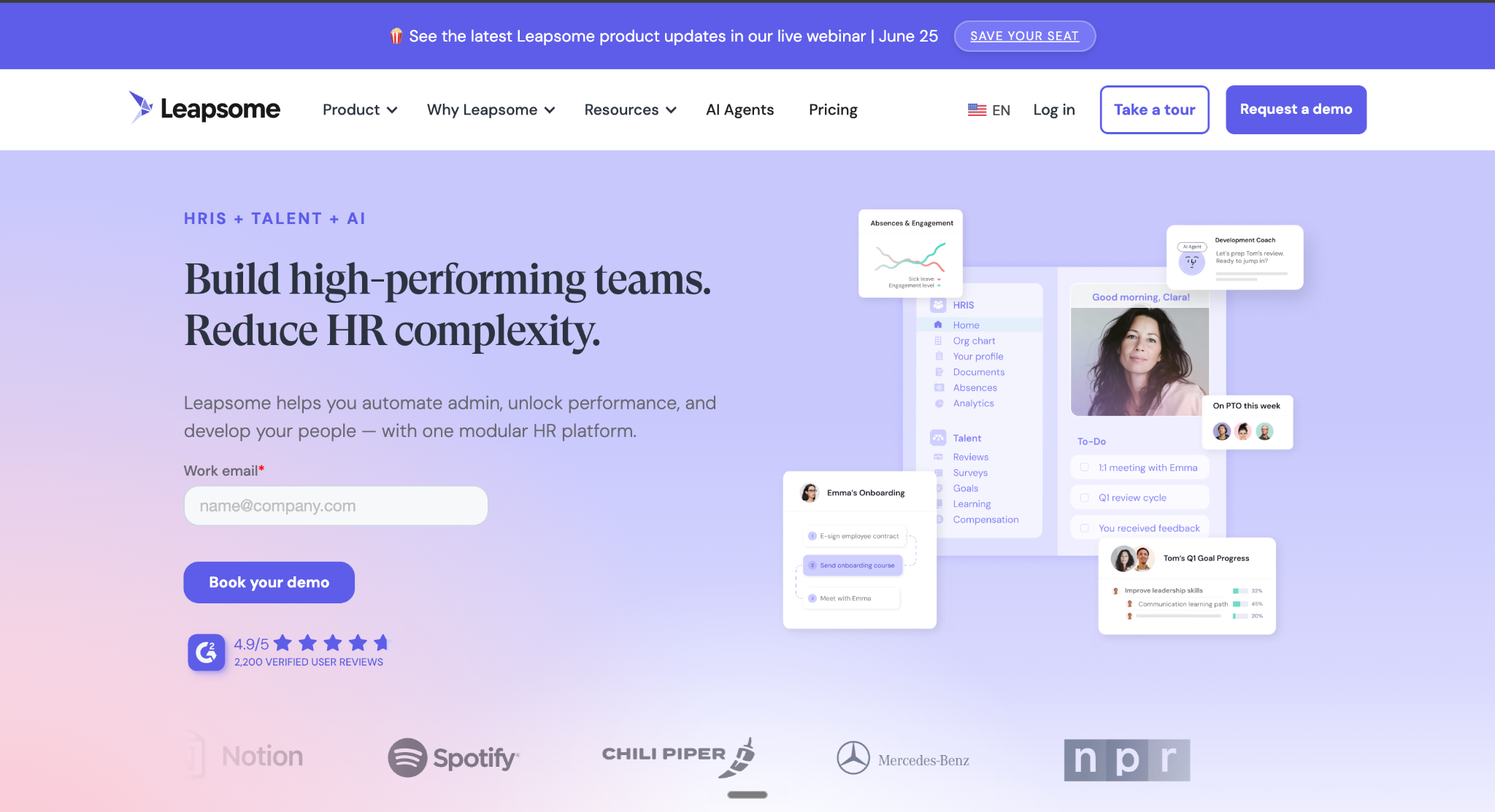
Leapsome is the platform that comes closest to Pulsewise in scope. Built in Berlin, it offers performance reviews, OKRs, engagement surveys, continuous feedback, learning paths, and an HRIS module in one system. It supports 38+ languages and is GDPR-compliant by default, which makes it a natural fit for EMEA-focused organizations.
The platform is used by over 1,500 organizations including Monday.com, Bumble, and Sony. Its AI writing assistant helps managers draft fair, detailed reviews using past data, and the feedback tools are consistently praised by reviewers for reducing the admin burden of running review cycles.
Key features
- 360-degree performance reviews with calibration and AI writing assistant
- OKRs and goal alignment with company-wide cascading
- Engagement and pulse surveys with eNPS tracking
- Continuous feedback with peer-to-peer recognition
- Learning paths and skill tracking
- HRIS module with employee records, org charts, and onboarding
- 38+ languages, ISO 27001 certified, GDPR-compliant
Pros
- Broadest all-in-one scope among established competitors (reviews, goals, surveys, learning, HRIS)
- EU-built with GDPR compliance baked in from the start
- AI included at no extra cost across all plans
- Clean, modern UI that reviewers consistently praise for usability
- Strong customer success support with dedicated teams
Cons
- Per-module pricing gets expensive at 40+ employees, and requires a sales call
- Goal management requires manual updates rather than automatic tracking
- Meeting notes feature has been flagged for bugs in recent reviews
- No native payroll (integrates with third-party payroll providers)
- Broader implementation scope means more setup and configuration than lighter tools
Pricing
$3 to $7 per employee per month per module. Not fully transparent; requires a sales conversation. AI is included in all plans at no extra cost. Free switchover program available until December 2026 if you are stuck in a contract with another provider. No free plan. Discounts available for bundling modules or larger headcounts.
G2 rating
4.8 out of 5 based on 2,200+ reviews (highest G2 score in this comparison). Capterra: 4.6/5. Users praise the all-in-one scope, clean UI, and standardized processes.
Common complaints: per-module pricing adds up, complex setup, navigation friction, and finding specific data.
Best for
European or GDPR-sensitive companies with 50 to 1,500 employees that want to consolidate multiple disconnected HR tools into one platform and need multi-language support.
6. Bonusly: best for peer-to-peer recognition
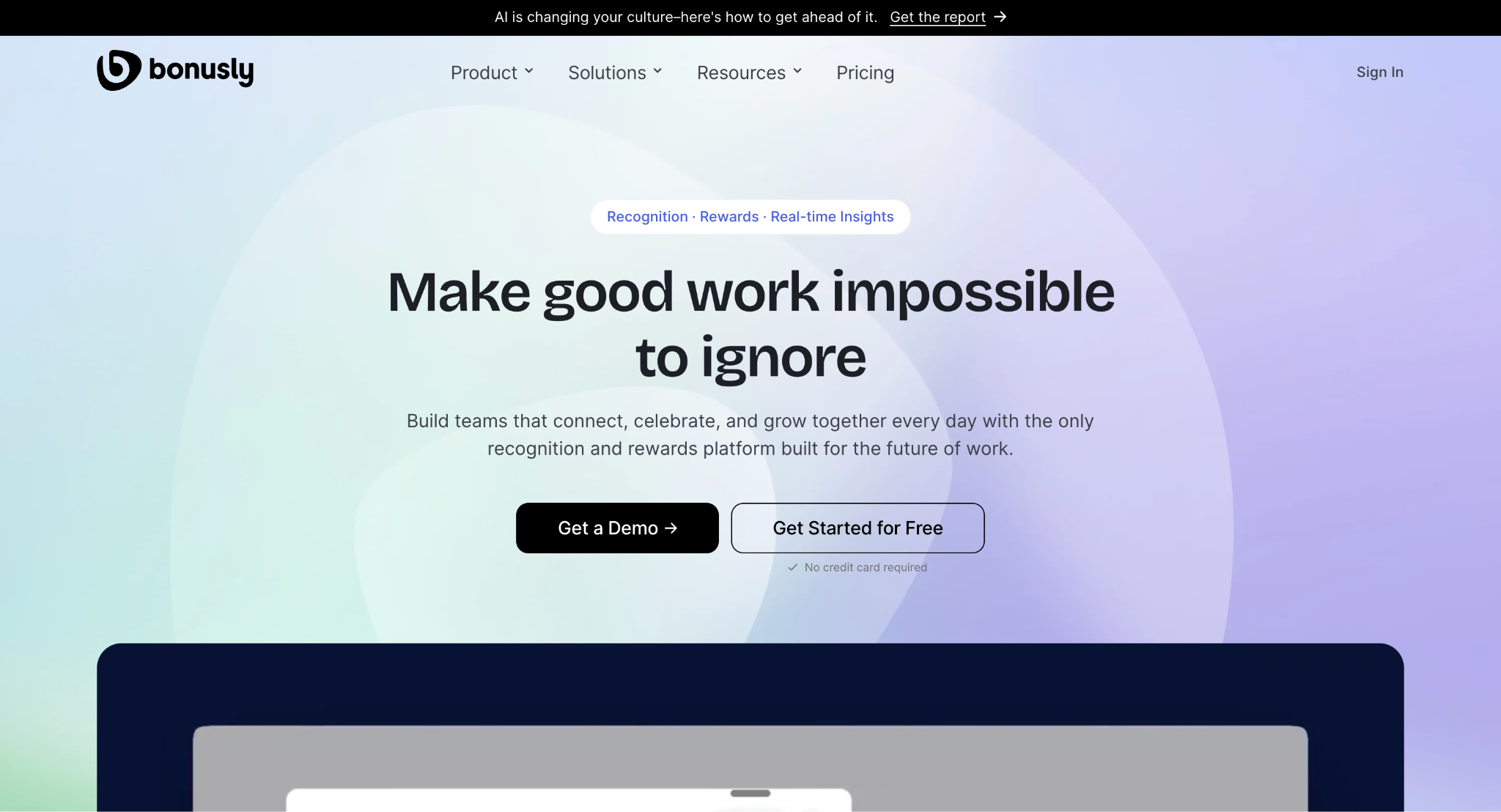
Bonusly is not trying to be a full employee engagement platform, and that is exactly why it is good at what it does. It is a dedicated recognition and rewards tool that makes peer-to-peer appreciation effortless. Employees give each other micro-bonuses tied to company values, and those points can be redeemed for gift cards, charitable donations, or custom company rewards.
The platform integrates deeply with Slack and Microsoft Teams, so recognition happens in the flow of work rather than in a separate HR tool. More than 3,400 organizations use it, including DoorDash, Toast, and SeatGeek. With 3,700+ G2 reviews, it is by far the most-reviewed recognition tool in the market.
Key features
- Peer-to-peer micro-bonus recognition tied to company values
- Global rewards catalog (gift cards, donations, custom company rewards)
- Public recognition feed with social media-like engagement
- Automated milestone celebrations (birthdays, work anniversaries)
- Lightweight check-ins and 1:1 tools (newer additions)
- Deep Slack and Microsoft Teams integration
- Analytics on recognition trends and participation rates
Pros
- Highest adoption rates in the recognition category thanks to a fun, intuitive interface
- Seamless Slack and Teams integration makes recognition part of daily workflow
- Free tier available for small teams getting started
- Social feed creates visibility and reinforces positive behaviors
- Very fast setup with minimal HR admin required
Cons
- Recognition only: no performance reviews, no engagement surveys, no goal tracking, no compensation planning
- Monthly points expire, creating pressure rather than organic appreciation for some users
- Reward catalog is limited outside the United States (especially Canada)
- Peer-to-peer model can reflect office popularity and social proximity rather than actual performance
- Analytics are basic compared to full engagement platforms
Pricing
Free tier: core recognition and structured 1:1s (limited features). Team: $3/seat/month (or $30/seat/year with annual billing). Organization: custom pricing on request. Note: the cost of actual rewards (gift card redemptions) is additional.
G2 rating
4.7 out of 5 based on 3,700+ reviews. Users overwhelmingly praise the ease of use, fun interface, and impact on morale.
Common complaints: limited monthly points, restricted reward options outside the US, analytics not deep enough for data-driven HR teams.
Best for
Teams of any size that want to build a strong peer recognition culture and are willing to use a separate tool for performance management, surveys, and goal tracking. Works well as an add-on to an HRIS that lacks native recognition.
How to choose the right employee engagement software
There is no single best platform for every team. The right choice depends on your headcount, your budget, your HR maturity, and which problems you are trying to solve first.
Here is a decision framework based on what we see working for companies with 50 to 500 employees.
Start with the problem, not the feature list
If your biggest gap is listening and measurement: Culture Amp’s survey science is the deepest in the market, but only if you have the budget ($4,500+/year minimum) and the team size (200+) to justify it.
If your biggest gap is manager effectiveness: 15Five’s weekly check-in model and coaching tools are specifically designed to make managers better at their jobs, starting at just $4/user/month.
If your biggest gap is structured reviews and compensation: Lattice connects performance data to pay decisions better than anyone else, though you will pay $15 to $25/user/month for the full suite.
If your biggest gap is tool consolidation: Leapsome and Pulsewise both offer genuine all-in-one platforms. Leapsome is more established but charges per module. Pulsewise is free for the first 100 teams and covers surveys, feedback, recognition, goals, reviews, and compensation in one system.
If your biggest gap is recognition culture: Bonusly is the best standalone recognition tool, but you will need a separate platform for everything else.
Watch for hidden costs
The sticker price on most engagement platforms does not tell the full story. Ask about minimum annual contracts (Lattice requires $4,000), implementation fees (often $2,000 to $8,000 for mid-size teams), per-module add-on costs, and reward redemption fees (Bonusly charges on top of per-seat pricing). Platforms with opaque pricing that require a sales call tend to cost more than you expect.
Prioritize adoption over features
The most feature-rich platform in the world is worthless if your team does not use it. The highest-rated platforms in G2 reviews (Leapsome at 4.8, Lattice at 4.7, Bonusly at 4.7) all get praised for usability. When evaluating, test the actual employee experience, not just the admin dashboard. Pulsewise’s engagement and retention tools are designed for daily use, not quarterly check-ins.
Concluding Here
Employee engagement software is only useful if it changes how your team actually works. A platform that collects data but does not drive action is just an expensive survey tool.
The five competitors in this comparison each do something well. Lattice is the best at structured performance management. Culture Amp has the deepest survey science. 15Five builds the strongest manager coaching habits. Leapsome consolidates the most HR functions. Bonusly makes recognition effortless.
But none of them gives a growing team the full picture without stacking modules, negotiating enterprise contracts, or stitching together two or three tools. That is the gap Pulsewise was built to close: one AI-first platform that covers surveys, feedback, recognition, goals, reviews, and compensation, free for the first 100 teams.
Stop paying for five tools that do not talk to each other. Start free with Pulsewise and replace your entire HR stack with one platform.
FAQs
What is employee engagement software?
Employee engagement software is a category of HR technology that helps organizations measure, track, and improve how connected and motivated their workforce is. Most platforms include surveys, feedback tools, recognition features, and analytics dashboards. The best ones connect engagement data to performance reviews, goals, and compensation so People teams can act on insights rather than just collect them.
How much does employee engagement software cost?
Prices range widely. Entry-level tools like 15Five start at $4/user/month, while comprehensive platforms like Lattice can reach $15 to $25/user/month with all modules. Culture Amp and Leapsome require sales calls for custom pricing. Pulsewise is currently free forever for the first 100 teams (up to 100 users), making it the lowest-cost option for growing companies that want a full-featured platform.
What is the best employee engagement software for small companies?
For companies with 50 to 200 employees, the best fit depends on priorities. 15Five is strong for building a coaching culture at an affordable price. Pulsewise offers the broadest feature set at zero cost (surveys, feedback, recognition, goals, reviews, and compensation). Bonusly works well if recognition is your only immediate need. Culture Amp and Lattice are better suited for larger organizations with bigger budgets.
Can employee engagement software replace annual performance reviews?
Yes, and most modern platforms are designed to do exactly that. Instead of one high-stakes annual review, tools like 15Five use weekly check-ins, Lattice supports continuous feedback cycles, and Pulsewise combines real-time pulse data with AI-assisted reviews. The shift toward continuous performance management is one of the strongest trends in HR technology for 2026.
What features should I look for in employee engagement software?
Prioritize pulse surveys with anonymity controls, continuous feedback (not just annual), peer recognition, goal tracking with company-wide alignment, performance reviews with manager support, analytics that surface actionable insights, and integrations with tools your team already uses (Slack, Teams, your HRIS). Platforms that combine these into one system reduce admin overhead and give you a connected view of engagement health.
Is employee engagement software worth the investment?
The data says yes. Gallup research shows engaged teams are 23% more profitable and have 43% lower turnover. The average cost of replacing a single employee is 50% to 200% of their salary. Even a modest improvement in engagement can save a 200-person company six figures annually in reduced turnover alone. The key is choosing a platform your team will actually use, not the one with the longest feature list.