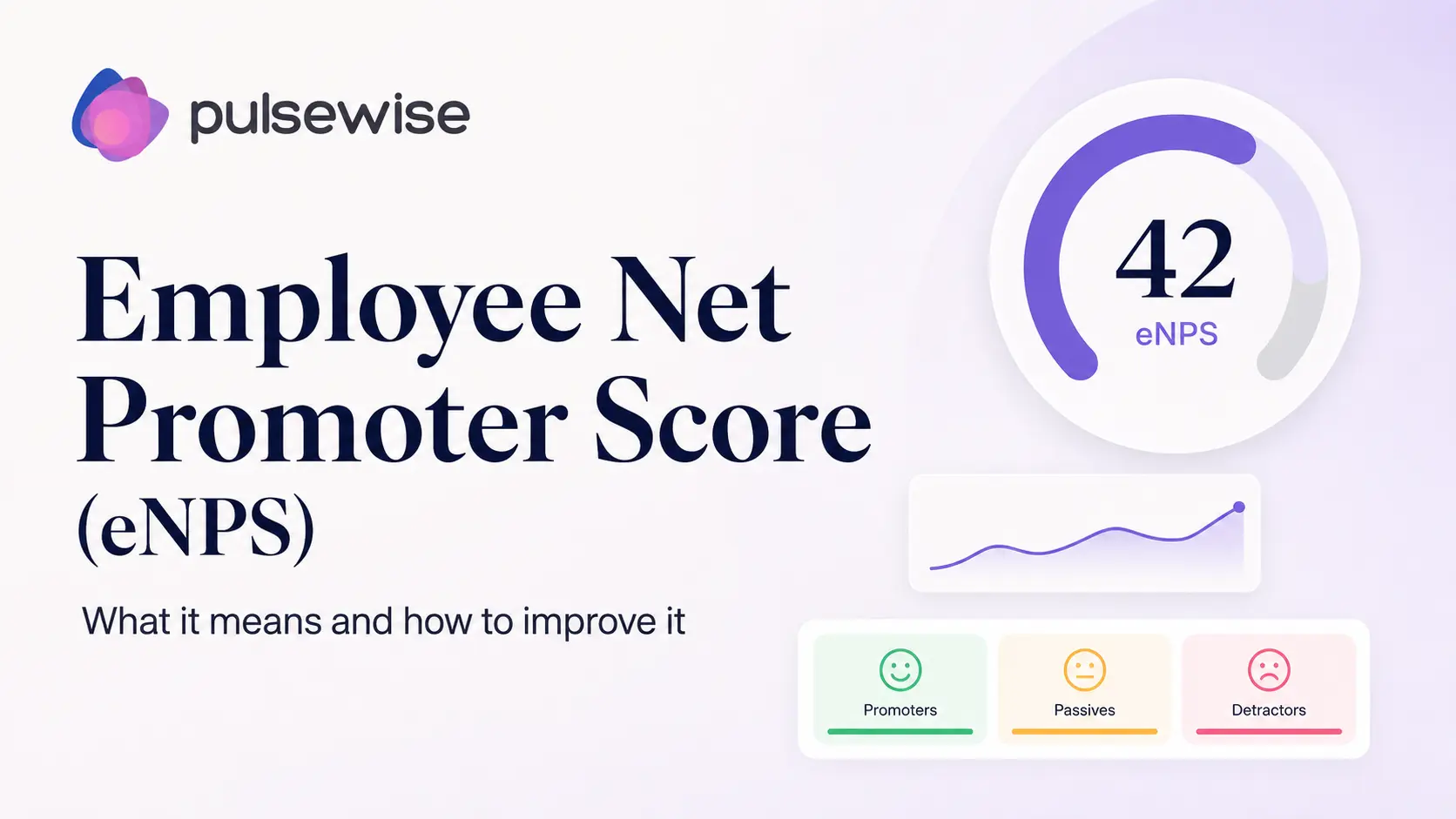
Employee Engagement Metrics: What to Track and Why
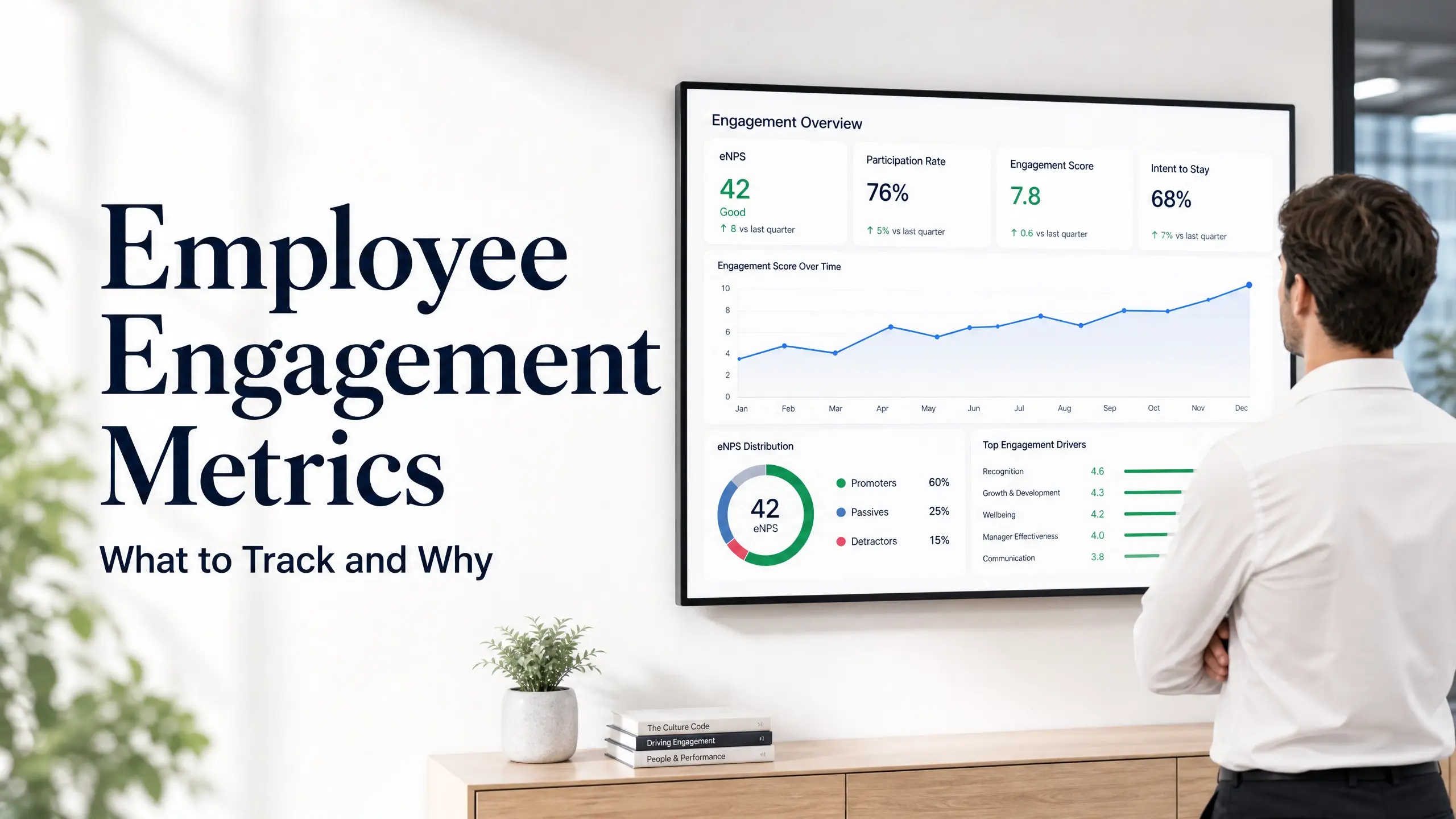
TL;DR
- Employee engagement metrics are measurable signals that tell you how connected, committed, and energized your workforce actually is, not just how satisfied they say they are.
- The five highest-impact metrics to start with are eNPS, voluntary turnover rate, survey participation rate, absenteeism rate, and recognition frequency.
- Match your tracking cadence to each metric: sentiment metrics monthly, behavioural metrics weekly, and outcome metrics quarterly.
- A metric without a target and an owner is just a number. Turn each metric into a KPI by assigning a goal, a review cadence, and a specific action triggered when the target is missed.
- Platforms like Pulsewise consolidate pulse surveys, recognition data, goal progress, and feedback into one dashboard so you are not stitching insights together from five different tools.
Most People teams track something about engagement. A survey goes out once a year, scores come back, a few charts land in a slide deck, and the conversation moves on. Six months later, two strong performers resign and nobody saw it coming.
The problem is rarely a lack of data. It is a lack of the right data, measured at the right frequency, with someone accountable for acting on it.
Gallup’s 2026 State of the Global Workplace report found that global employee engagement has dropped to 20%, its lowest point since 2020, costing the world economy an estimated $10 trillion in lost productivity.
This guide walks through the employee engagement metrics that actually predict retention, productivity, and culture health. For each metric, you will find a clear definition, the formula, a benchmark, a recommended tracking cadence, and the action to take when the number moves in the wrong direction.
What are employee engagement metrics?
Employee engagement metrics are quantifiable data points that measure how emotionally committed, psychologically invested, and behaviourally connected your people are to their work and your organization. They go well beyond satisfaction. A satisfied employee might be content enough to stay without ever contributing discretionary effort. An engaged employee actively cares about outcomes and looks for ways to improve them.
These metrics fall into three broad categories. Sentiment metrics capture how employees feel (eNPS, engagement survey scores). Behavioural metrics capture what employees do (recognition frequency, survey participation, feedback response rates). Outcome metrics capture the business results of engagement or the lack of it (voluntary turnover, absenteeism, productivity).
The strongest measurement systems draw from all three categories. Relying on sentiment alone tells you how people feel, but not whether that feeling is translating into action. Relying only on outcome metrics tells you what happened but not why, and usually too late to change it.
Want to see how these metrics look in a single dashboard? Explore Pulsewise pulse surveys to see real-time sentiment and engagement data for every team.
Why tracking engagement metrics matters in 2026
The business case for measuring engagement has never been stronger or more urgent. Gallup’s 2026 report found that only 20% of employees worldwide are engaged, down from a peak of 23% in 2022. That three-point drop represents roughly 63 million workers worldwide who have psychologically disconnected from their jobs.
The financial impact is staggering. Gallup estimates that low engagement costs the global economy approximately $10 trillion per year in lost productivity, a figure equal to nearly 9% of global GDP. At the individual company level, Gallup’s meta-analysis consistently shows that business units in the top quartile of engagement outperform those in the bottom quartile by 23% in profitability.
Manager engagement has declined even faster, dropping from 31% in 2022 to 22% in 2025. Since managers account for roughly 70% of the variance in team engagement, a disengaged management layer creates a ripple effect that drags the entire workforce down. Without engagement metrics that segment data by team and manager, this pattern stays invisible until the exit interviews pile up.
For People leaders at companies with 100 to 300 employees, these numbers carry a specific warning. You are large enough that engagement problems can hide inside individual teams, but small enough that a handful of preventable departures can cripple a department. Tracking the right metrics, at the right cadence, lets you see the cracks before they become collapses.
1: Sentiment metrics: how your employees feel
Sentiment metrics are your early warning system. They shift before anyone updates their LinkedIn headline, and they tell you where energy is rising or fading across the organization.
Employee net promoter score (eNPS)
eNPS measures how likely employees are to recommend your company as a place to work. It compresses broad sentiment into a single number that is easy to track and compare over time.
How to measure it: Ask one question: “On a scale of 0 to 10, how likely are you to recommend this company as a great place to work?” Employees who score 9 or 10 are Promoters. Those scoring 7 or 8 are Passives. Scores of 0 to 6 are Detractors.
Formula: eNPS = % Promoters minus % Detractors
Benchmark: The average eNPS across industries is roughly +14. A score above +30 is considered strong. A score above +50 is excellent. A negative score means detractors outnumber promoters and requires immediate attention.
Cadence: Monthly via pulse survey.
Action trigger: If eNPS drops more than 5 points in a single quarter, segment the data by department and manager to locate the source of the decline before drawing company-wide conclusions.
Employee satisfaction score (ESAT)
ESAT measures how content employees are with specific aspects of their work environment, such as management quality, workload, compensation, and growth opportunities. While engagement and satisfaction are not identical, sustained low satisfaction almost always erodes engagement over time.
How to measure it: Ask employees to rate statements like “I am satisfied with my role” or “I feel supported by my manager” on a scale of 1 to 5 or 1 to 10.
Formula: ESAT = (Total actual score / Maximum possible score) x 100
Benchmark: An ESAT above 75% typically indicates a healthy baseline. Scores below 60% signal systemic issues that need investigation.
Cadence: Quarterly, with annual deep-dive surveys for diagnostic context.
Engagement survey score
This is your composite engagement index, drawn from a multi-question survey that covers drivers like purpose, autonomy, growth, recognition, and manager quality. Unlike eNPS, which is a single question, the engagement survey score captures multiple dimensions at once.
How to measure it: Use a validated engagement survey (Gallup’s Q12 is the most widely cited) that maps to proven engagement drivers. Score responses on a 1 to 5 or 1 to 10 scale and calculate the overall average.
Benchmark: Gallup’s best-practice organizations achieve around 79% manager engagement and significantly higher overall scores. Aim to improve your own baseline by 3 to 5 points per year rather than chasing an abstract external number.
Cadence: Annual comprehensive survey, supplemented by monthly pulse checks on key drivers.
2: Behavioural metrics: what your employees do
Sentiment tells you how people feel. Behaviour tells you how they act on that feeling. These metrics reveal engagement patterns without requiring anyone to fill out a survey, and they often shift before sentiment scores do.
Survey participation rate
A low survey response rate is itself an engagement signal. When employees do not bother to share feedback, it usually means they do not trust the process, do not believe anything will change, or have mentally checked out.
Formula: Survey participation rate = (Number of completed responses / Total surveys sent) x 100
Benchmark: Gallup reports a median participation rate of 84% for census engagement surveys. For pulse surveys, 70% and above is strong. Below 50% suggests a trust or fatigue problem.
Cadence: Track with every survey wave.
Action trigger: If participation drops below 60%, investigate whether survey fatigue, manager credibility, or lack of visible follow-up is the cause before increasing survey frequency.
Recognition frequency
Recognition is a leading indicator of engagement, not a lagging one. Tracking how often recognition happens, who gives it, and who receives it reveals whether appreciation is flowing across the organization or trapped in pockets.
How to measure it: Count the number of recognition moments (peer kudos, manager shout-outs, values-based nominations) per employee per month.
Benchmark: Gallup’s research shows that employees who receive recognition at least once a week are significantly more engaged than those who receive it less often. A useful starting target is at least one recognition moment per employee per month.
Cadence: Weekly.
If recognition is buried in Slack channels or email threads, you are measuring nothing. Explore Pulsewise recognition and kudos to make every recognition moment visible, searchable, and tied to your engagement data.
Feedback loop closure rate
This metric tracks how often employee feedback leads to a visible response or action. Organizations that close the feedback loop consistently build the trust that sustains high survey participation rates over time.
How to measure it: Track the percentage of feedback items (survey comments, suggestion box entries, 1:1 action items) that receive a documented response or resolution within a defined timeframe.
Benchmark: No universal benchmark exists, but high-performing organizations aim to respond to at least 80% of feedback items within two weeks.
Cadence: Monthly review of feedback response pipeline.
Internal mobility rate
Internal mobility rate measures the percentage of open positions filled by existing employees. A healthy internal mobility rate signals that employees see a future inside the organization and that managers are developing, not hoarding, talent.
Formula: Internal mobility rate = (Internal hires / Total hires) x 100
Benchmark: LinkedIn’s Global Talent Trends data suggests that companies with strong internal mobility retain employees nearly twice as long. A rate above 20% is a positive indicator.
Cadence: Quarterly.
3: Outcome metrics: the business results of engagement
These metrics tell you what is already happening. They are the most visible to leadership and the easiest to tie to financial impact, but they also move the slowest. By the time voluntary turnover spikes, the engagement problem has been brewing for months. Pair these with sentiment and behavioural metrics to catch problems upstream.
Voluntary turnover rate
Voluntary turnover rate measures the percentage of employees who leave by choice within a given period. It is the most widely watched engagement outcome metric because the cost of replacing a departing employee is substantial, typically ranging from 50% to 200% of their annual salary depending on seniority.
Formula: Voluntary turnover rate = (Number of voluntary departures / Average headcount) x 100
Benchmark: Industry averages vary widely, but for knowledge workers in the 100 to 500 employee range, annual voluntary turnover above 15% is a warning sign.
Cadence: Quarterly, with monthly monitoring of early signals like exit interview themes.
Retention rate
Retention rate is the mirror image of turnover. It measures the percentage of employees who stay over a defined period, excluding new hires from both the numerator and denominator.
Formula: Retention rate = ((Employees at end of period minus new hires during period) / Employees at start of period) x 100
Benchmark: A retention rate above 90% on a 12-month rolling basis is healthy for most mid-market organizations.
Cadence: Quarterly.
Absenteeism rate
Absenteeism rate tracks the frequency of unplanned absences. Persistent high absenteeism often signals burnout, disengagement, or a workplace culture problem. It is also one of the clearest leading indicators that turnover is on its way.
Formula: Absenteeism rate = (Total unplanned absent days / Total available workdays) x 100
Benchmark: A rate around 1.5% is typical. Anything consistently above 3% for a team warrants investigation.
Cadence: Monthly, segmented by team.
4: Productivity metrics
Productivity metrics vary by role and industry, but the principle is consistent: engaged teams produce more and produce better. For knowledge workers, useful proxies include project completion rates, goal attainment percentages, and output per team member. For customer-facing roles, customer satisfaction scores and response times often correlate directly with engagement levels.
How to measure it: Define 2 to 3 role-relevant output metrics and track them at the team level. Avoid individual productivity surveillance, which damages trust and undermines the engagement you are trying to build.
Cadence: Quarterly, correlated against engagement survey scores from the prior period to validate the sentiment-to-output relationship in your organization.
How to choose the right metrics for your team
Tracking every metric in this guide would overwhelm your managers and drown your People team in dashboards. The goal is not to measure everything. It is to measure what matters most for your specific challenges right now.
Start by identifying your biggest people problem. If voluntary turnover is your primary pain, prioritize eNPS by department, retention rate, and exit interview analysis. If innovation is stalling, look at internal mobility, feedback loop closure rate, and recognition patterns across teams.
A strong starting set for most mid-market companies with 100 to 300 employees is five metrics: eNPS, voluntary turnover rate, survey participation rate, absenteeism rate, and recognition frequency. These five cover sentiment, behaviour, and outcomes, and they can all be tracked with a single employee engagement platform.
When evaluating which metrics to prioritize, apply five filters. The metric should be measurable with current systems. It should be actionable (a movement triggers a specific response). It should be representative of your full workforce, not just a vocal subset. It should be benchmarkable against industry standards or your own history. And it should be communicable (your leadership team can understand it without a statistics degree).
Turning metrics into KPIs: the accountability layer
A metric is a measurement. A KPI is a metric with a defined target, a review cadence, and a committed action when the target is missed. The difference is accountability, not data.
Voluntary turnover rate is a metric. “Below 15% annually, reviewed quarterly, with an exit analysis triggered on breach” is a KPI. eNPS is a metric. “Increase eNPS by 5 points per quarter, reviewed monthly by the HRBP, with a listening session triggered when the score drops below zero” is a KPI.
To convert your chosen metrics into KPIs, follow the SMART framework. Make each target Specific (“increase eNPS by 5 points,” not “improve engagement”). Make it Measurable with a precise formula and data source. Make it Achievable based on your current baseline. Make it Relevant to a business outcome that leadership cares about. And make it time-bound with a clear deadline.
Assign each KPI to an owner. For sentiment KPIs, the owner is typically the HR Business Partner or People Ops Lead. For outcome KPIs like turnover, it may be a shared ownership between HR and department heads. Without an owner, no one is accountable, and the metric reverts to being just a number on a dashboard.
The tracking cadence framework
Not every metric should be reviewed at the same frequency. Over-measuring creates noise, and under-measuring creates blind spots. A practical cadence framework matches review frequency to how quickly each metric type changes.
1: Sentiment metrics (eNPS, engagement score): Monthly. These shifts in response to management changes, organizational announcements, and workload pressures. Monthly pulse surveys give you enough frequency to catch trends without creating survey fatigue.
2: Behavioural metrics (recognition frequency, survey participation, feedback closure): Weekly. Behavioural patterns change faster than sentiment, and a weekly review lets managers intervene before a short-term dip becomes a structural problem.
3: Outcome metrics (turnover, retention, absenteeism): Quarterly. These move slowly and require enough data to be statistically meaningful. Monthly tracking of outcomes with small teams produces noisy data that leads to overreaction.
4: Annual deep-dive: Once a year, run a comprehensive engagement survey that covers all drivers in depth. This provides diagnostic context that short pulse questions cannot, and gives you a longitudinal benchmark. SHRM recommends this pulse-plus-annual model as the current best practice.
How Pulsewise helps you track engagement metrics
Most mid-market People teams run engagement surveys in one tool, recognition in another, goals in a third, and feedback in a fourth. The data stays siloed, the dashboards do not talk to each other, and no one has a single view of how engagement, recognition, and performance connect.
Pulsewise is an AI-first employee engagement platform that replaces those disconnected tools with one connected system. Pulse surveys, recognition and kudos, goals and OKRs, feedback, and performance reviews all feed a single intelligence layer.
For engagement metrics specifically, this means your eNPS scores, recognition patterns, goal progress, survey participation rates, and feedback data all live in one place. You can segment by team, manager, tenure, or location without exporting CSVs from five different platforms. AI-powered culture analytics surface trends and flag at-risk teams before the numbers hit your quarterly report.
Pulsewise is free forever for the first 100 teams (up to 100 users, no credit card required). If you are stitching engagement data together from multiple tools and want a single source of truth, it is worth seeing how it works.
Start tracking engagement metrics in one place. Sign up for free and replace your disconnected HR tools with a single platform that listens, recognizes, aligns, and grows your people.
Let Me Summarize!
Engagement is not a feeling you vibe-check once a year. It is a system you instrument, monitor, and improve continuously. The metrics in this guide give you the measurement layer. The cadence framework tells you when to look. The KPI model tells you who acts and when.
If your current setup involves exporting data from four platforms, pasting it into a spreadsheet, and hoping someone reads it before the next quarter, you already know the system is not working. Pick five metrics, assign owners, set targets, and track them in a platform that connects the dots for you.
The organizations that get engagement right are not the ones with the most data. They are the ones who act on the data they have.
FAQs
What are the most important employee engagement metrics?
The most impactful starting set includes eNPS, voluntary turnover rate, survey participation rate, absenteeism rate, and recognition frequency. Together, these cover sentiment, behaviour, and business outcomes, giving you a balanced view of engagement across the organization.
How do you measure employee engagement without surveys?
You can track behavioural signals like absenteeism patterns, internal mobility rates, recognition frequency, feedback loop closure, and participation in optional learning programmes. These metrics reveal engagement patterns through what people do rather than what they report in a survey.
What is a good eNPS score?
The average eNPS across organizations is around +14. Scores above +30 are considered strong, and scores above +50 are excellent. Any negative score means detractors outnumber promoters and should prompt immediate investigation by the department and the manager.
How often should you measure employee engagement?
Track sentiment metrics like eNPS monthly through pulse surveys. Review behavioural metrics like recognition frequency weekly. Measure outcome metrics like turnover and retention quarterly. Run a comprehensive engagement survey once a year for diagnostic depth.
What is the difference between an engagement metric and an engagement KPI?
A metric is a measurement. A KPI is a metric with a defined target, a review cadence, and a committed action when the target is missed. Turnover rate is a metric. “Below 15% annually, reviewed quarterly, with exit analysis triggered on breach” is a KPI. The difference is accountability.
How do engagement metrics connect to business results?
Gallup’s 2026 data shows that business units in the top quartile of engagement outperform those in the bottom quartile by 23% in profitability. Engaged teams also show lower absenteeism, lower turnover, and higher customer satisfaction. Tracking engagement metrics creates a direct line between people data and financial outcomes.