You promoted your best individual contributor last spring. Six months later, their team posts one of the lowest engagement scores in the company.
Nothing about the person changed. The job changed, and the support you wrapped around that job did not.
This is the manager enablement gap, and it quietly shapes engagement across your whole organization. Managers sit closest to the daily experience of work, yet most inherit a team with almost no system to lead it well.
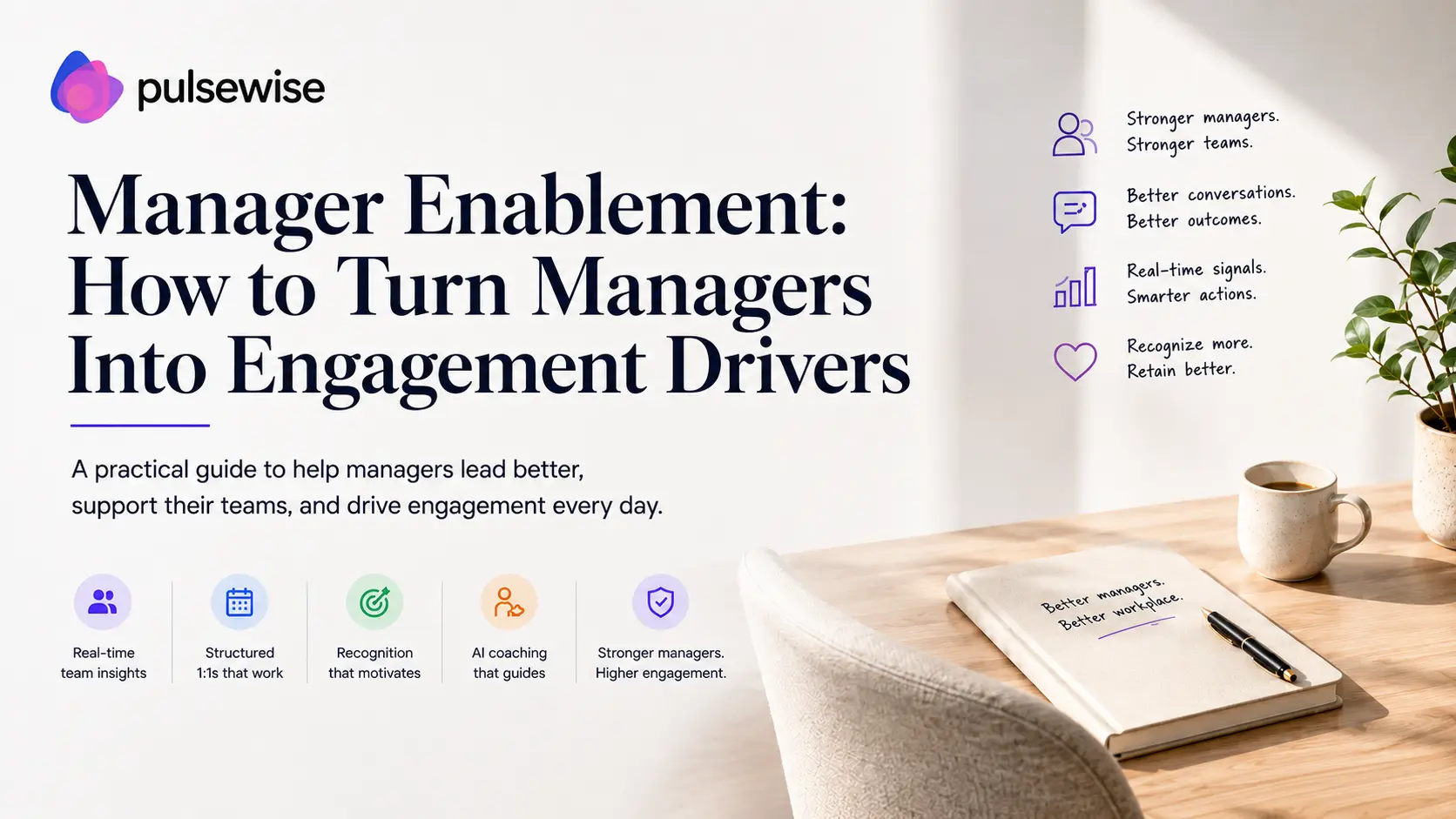
Manager enablement is how you close that gap on purpose. This guide covers why managers drive engagement, what real enablement looks like, and a practical checklist you can start this week.
TL;DR
-
Manager enablement is the ongoing system of data, structure, and coaching that helps managers lead engaged teams. It is not a one-time training course.
-
Gallup finds managers account for at least 70% of the variance in team engagement, which makes the manager the single biggest lever you can pull.
-
Training decays within weeks. Enablement works because it lives inside the weekly rhythm of pulse checks, one-on-ones, and recognition.
-
The fastest wins come from giving managers a real-time signal, so they stop leading blind between review cycles.
-
Measure manager effectiveness as an outcome, using team pulse trends, one-on-one consistency, recognition frequency, and regretted attrition.
What is manager enablement?
Manager enablement is the practice of equipping managers with the data, tools, structure, and coaching they need to lead engaged, high-performing teams. It treats good management as a system you build and maintain, not a personality trait or a skill people fully absorb in a single workshop.
Most companies stop at manager training. They run a workshop when someone gets promoted, hand over a slide deck, and move on.
Enablement is broader and continuous. It gives a manager five things on an ongoing basis: a real-time read on how their team feels, a repeatable meeting structure, timely recognition habits, in-the-moment coaching, and clear expectations about what good management looks like.
The distinction matters because the manager role has quietly become one of the hardest jobs in the modern org. Enablement is what makes that job doable, not just teachable.
Why managers are the number one lever in engagement
Managers are the single largest driver of team engagement, ahead of pay, perks, or company mission. If you can only improve one thing this year, improve the manager layer.
The clearest evidence comes from Gallup. Its State of the American Manager research, drawn from millions of employees across thousands of work units, found that managers account for at least 70% of the variance in team engagement scores.
That number is statistical, not motivational. It means that if you compare your most engaged team to your least engaged team inside the same company, the difference is explained mostly by who manages them, not by benefits or budget.
The downstream effects are just as concrete. Gallup reports that employees supervised by highly engaged managers are 59% more likely to be engaged themselves, and that one in two employees have left a job at some point to get away from a manager.
The 2026 twist: managers are stretched thin
Here is what most manager enablement advice misses. The people you are asking to drive engagement are often running on empty themselves.
Gallup found that manager engagement fell from 30% to 27% in 2024, with the sharpest declines among younger and female managers. Deloitte research has found that around half of middle managers feel frequently overwhelmed, a figure that has climbed since 2023.
Meanwhile, organizations keep flattening structures and widening spans of control. A McKinsey survey found that 44% of middle managers point to bureaucracy and administrative load as the biggest source of a negative experience in the role.
So, enablement in 2026 is not only about capability. It is about capacity. A manager buried in admin cannot coach anyone, no matter how good the training was.
Give your managers a system, not another to-do. Pulsewise supports managers with real-time pulse, AI coaching nudges, and structured recognition in one place: explore Pulsewise for Managers.
Manager enablement vs manager training: what is the difference?
Manager training is a one-time or occasional event that teaches skills. Manager enablement is the ongoing system that helps managers apply those skills in the flow of daily work. Training tells a manager what to do; enablement makes it easy to actually do it.
Both matter. The problem is that most companies invest heavily in the first and almost nothing in the second, then wonder why the workshop did not stick.
Here is how the two compare across the dimensions that decide whether they change behavior.
| Dimension | Manager training | Manager enablement |
|---|---|---|
| Timing | A one-time or annual event | Continuous, embedded in the weekly rhythm |
| Format | Workshops, courses, slide decks | Data, tools, nudges, and coaching in the flow of work |
| Retention | Decays within weeks without reinforcement | Reinforced every week by the system itself |
| Data | Generic, not tied to a manager’s real team | Real-time signal on the manager’s actual team |
| Ownership | Usually owned by L&D or HR | Shared, with managers acting on live insight |
| Outcome measured | Course completion and attendance | Team engagement, retention, and 1:1 consistency |
The takeaway is simple. Keep the training, but wrap it in a system, or the skills fade before the next review cycle.
The four pillars of a manager enablement system
A working enablement system rests on four pillars: signal, structure, support, and measurement. Miss any one, and the others weaken.
1. Signal: give managers a real-time read on their team
Most managers lead blindly between review cycles. They find out someone disengaged during an exit interview, which is far too late to act.
A lightweight real-time team pulse fixes this. Short, frequent check-ins surface mood shifts, recognition gaps, and stalling goals while a manager can still do something about them.
Signal is the fastest win in enablement. It costs a manager almost no time and immediately makes every other action better targeted.
2. Structure: build a repeatable rhythm of 1:1s and recognition
Engagement is built in weekly habits, not annual events. A quarterly offsite fades by Monday, while a consistent one-on-one compounds over months.
Give managers a standing rhythm: a weekly or fortnightly one-on-one, a regular recognition moment, and a simple goal check-in. Strong one-on-one meeting intelligence turns those meetings from status updates into growth conversations.
Recognition works best as a manager habit, not an HR program. Keep it specific and timely: name the behavior you saw and say it close to when it happened, rather than saving praise for a quarterly ceremony.
3. Support: replace one-off courses with in-the-flow coaching
Nobody learns to manage from a single workshop. Managers need coaching at the moment a situation arises, not six months earlier in a training room.
This is where continuous performance coaching earns its place. AI coaching nudges can prompt a manager before a one-on-one, for example: mood has dropped this week, consider opening with a wellbeing check.
That kind of prompt takes zero extra effort and changes the quality of the conversation. Over time, it shifts the whole team’s engagement curve.
4. Measurement: track manager effectiveness as an outcome
What gets measured gets managed. If you never measure manager effectiveness, enablement becomes a nice idea that quietly disappears.
Treat manager effectiveness as an outcome you can see in the data, not a vibe. The next sections show the checklist to run and the metrics to watch.
Want to size the stakes first? Run your numbers with the free Wellbeing Calculator to estimate what low engagement is costing your team in under 60 seconds. No signup required.
The manager enablement checklist you can start this week
You do not need a six-month transformation program. Start with one habit change per manager, then build. Use this checklist as a practical starting point.
Foundations (set up once)
-
Define what good management looks like at your company, in plain behaviors, not abstract values.
-
Give every manager a real-time view of their team’s mood and engagement trend.
-
Set a standing one-on-one cadence and protect it on the calendar.
-
Audit each manager’s span of control and admin load, then remove what you can.
Weekly rhythm (every manager)
-
Check the team pulse and note anyone whose mood has dropped.
-
Run one-on-ones with real preparation, not a status readout.
-
Give at least one specific, timely recognition to a team member.
Monthly and quarterly
-
Review recognition frequency and one-on-one consistency for each manager.
-
Share a summary with managers: here is what we heard, here is what we are doing.
-
Pair one enablement metric with each manager’s development conversation.
-
Refresh coaching support based on the patterns the data surfaces.
How to measure manager effectiveness
Manager effectiveness is best measured through team outcomes, not manager activity. Attendance at a course tells you little; a rising team pulse tells you plenty.
Track a small, balanced set of signals per manager rather than a sprawling scorecard.
-
Team pulse trend: the direction of mood and engagement over weeks, not a single snapshot.
-
Manager eNPS or a would-recommend score: how team members rate working for that manager.
-
One-on-one consistency: whether scheduled one-on-ones actually happen and hold.
-
Recognition frequency: how often, and how specifically, the manager recognizes good work.
-
Goal progress: whether the team’s goals move, stall, or drift.
-
Regretted attrition by team: the clearest lagging signal of a manager problem.
Common manager enablement mistakes to avoid
Even well-run programs stall for predictable reasons. Watch for these five.
-
Treating enablement as an event. A single workshop is not enablement. Behavior changes through weekly reinforcement, not a one-day session.
-
Building capability while ignoring capacity. Skills do not help a manager who has no time. Remove admin load before you add expectations.
-
Leaving managers to lead blindly. Without a real-time signal, managers only learn about disengagement after it costs them.
-
Measuring activity, not outcomes. Course completion is easy to count and easy to fake. Track team engagement and retention instead.
-
Letting HR own what managers should own. HR enables and equips. Managers execute recognition and coaching day to day.
For the wider strategy these habits plug into, see our guide on how to improve employee engagement.
How Pulsewise helps you enable managers
Manager enablement fails when the tools live in five different places. Pulsewise puts signal, structure, support, and measurement in one platform, enabling managers to stop being a project and become part of the weekly rhythm.
Here is how the four pillars map to what a manager actually gets.
| What managers need | How Pulsewise delivers it |
|---|---|
| Real-time signal | A daily team pulse in under two minutes, with response rates that typically run 75 to 90%. |
| Meeting structure | AI-prepared talking points and relationship context before every one-on-one. |
| In-the-flow coaching | AI nudges that flag who needs a check-in, what to raise, and when to recognize. |
| Recognition habit | Built-in kudos and recognition, so praise is timely and visible, not saved for reviews. |
| Measurement | Manager-level trends on mood, recognition, goals, and retention in one dashboard. |
| Setup and cost | Most teams are live within a day. Free forever for the first 100 teams, up to 100 users, no credit card required. |
The result is the difference described at the top of this guide. Instead of a newly promoted manager leading blind, they walk into every conversation with context, prompts, and a clear read on their team. See it in action on the Pulsewise for Managers page, or predict and prevent attrition with engagement and retention.
Start free with Pulsewise and turn your managers into your strongest engagement lever. Free forever for the first 100 teams, no credit card, no feature limits. Claim your free spot Schedule a demo
The bottom line
Go back to the manager you promoted last spring. Their team did not slip because they became a worse person overnight.
It slipped because you handed them the hardest job in the org and almost no system to do it. Manager enablement is about fixing that on purpose, not by hoping the next workshop lands better.
Start small. Give one manager a real-time signal, a protected one-on-one, and one recognition habit this week. Then measure what changes and build from there.
Your managers already carry 70% of the variance in engagement. The only question is whether you are equipping them to carry it well.
FAQs
What is manager enablement?
Manager enablement is the ongoing system of data, tools, structure, and coaching that helps managers lead engaged, high-performing teams. Unlike one-time training, it lives in the daily flow of work through pulse checks, one-on-ones, recognition, and coaching nudges, so good management becomes a repeatable habit rather than a personality trait.
Why are managers so important to employee engagement?
Managers are the biggest single driver of engagement. Gallup found that managers account for at least 70% of the variance in team engagement scores across business units. That means the gap between your best and worst teams is explained mostly by who manages them, not by pay, perks, or company mission.
What is the difference between manager enablement and manager training?
Manager training is a one-time event that teaches skills. Manager enablement is a continuous system that helps managers apply those skills in real work. Training tells managers what to do, while enablement gives them the data, structure, and coaching to actually do it, so skills do not fade after the workshop.
How do you support managers effectively?
Support managers by giving them real-time signals on their team, a protected one-on-one rhythm, timely recognition habits, and coaching in the moment rather than only at promotion. Just as important, protect their capacity by reducing admin load and unmanageable spans of control, since a buried manager cannot coach anyone.
What skills do managers need to drive engagement?
The highest-impact manager skills are running meaningful one-on-ones, giving specific and timely recognition, setting clear expectations, and coaching for growth. These matter more than technical expertise. The catch is that skills only stick when a system reinforces them weekly, which is why enablement beats training alone.
How do you measure manager effectiveness?
Measure manager effectiveness through team outcomes, not activity. Track the team pulse trend, a manager’s eNPS or would-recommend score, one-on-one consistency, recognition frequency, goal progress, and regretted attrition by team. Watching these together shows which managers lift engagement and which need more support, well before an exit interview does.