Exit Interview Questions: 40+ Questions to Uncover Why People Leave

TL;DR
- Most exit interviews fail because the questions are too polite, too late, or too generic. You get “great team, ready for a new challenge” and learn nothing useful.
- Good exit interview questions surface three things: the real trigger, the drift that preceded it, and the things the person wishes had been said sooner.
- Use the 40+ questions below across six categories: role and growth, manager, team, compensation, culture, and the decision itself.
- The strongest signal isn’t the exit interview. It’s the pattern across exits combined with what your current team is already telling you, if you’re listening weekly instead of annually.
If your exit interviews keep returning the same vague answers (“it was time”, “great experience”, “new opportunity”), the problem usually isn’t the employee. It’s the questions. Exit interview questions that are too broad, too HR-sounding, or too close to HR paperwork will get you polite nothing.
In this post, I’ll give you a full template of 40+ exit interview questions organized by category, a simple framework for structuring the conversation, and a short list of what to actually do with the answers so the signal doesn’t die in a spreadsheet.
What are exit interview questions?
Exit interview questions are structured prompts asked when an employee leaves an organization, designed to surface the real reasons behind their departure and the workplace patterns that shaped it. Good exit interview questions go beyond “why are you leaving?” and uncover the trigger event, the drift that preceded it, and the feedback the employee held back while they still worked there. The best questions are open-ended, timed carefully in the notice period, and asked by someone outside the direct reporting chain.
Why do most exit interviews produce useless data?
Here’s the pattern I’ve seen across dozens of People teams. The exit interview gets scheduled in the final week, often by someone the employee barely knows. They ask ten closed-ended questions, take notes, and file them. Six months later, a VP asks “why are people leaving?” and the answer is a vague theme summary with no teeth.
There are three reasons this happens.
First, the person leaving has nothing to gain from radical honesty and everything to lose. References, rehire eligibility, last-day awkwardness. They soften the truth. Research by Spain and Groysberg in Harvard Business Review found that employees share far more candid feedback when the interviewer is outside their direct reporting chain and when the conversation happens after the last day rather than during the final week (HBR).
Second, the questions are framed for HR, not the employee. “Rate your satisfaction with leadership development on a scale of 1-5” is a form. A real conversation sounds different.
Third, and this is the big one, exit interviews are trying to do a job they were never designed to do. By the time someone is leaving, the useful information is months old. Gallup’s attrition research has found that a large share of voluntary leavers say their manager or company could have done something to prevent their departure, but the signals were visible long before the resignation (Gallup).
The exit interview is a post-mortem. It’s still worth doing well. But it should be a sanity check on what you already knew, not the first time you’re hearing it.
How do you structure a good exit interview?
Before the questions, get the structure right. A few quick principles.
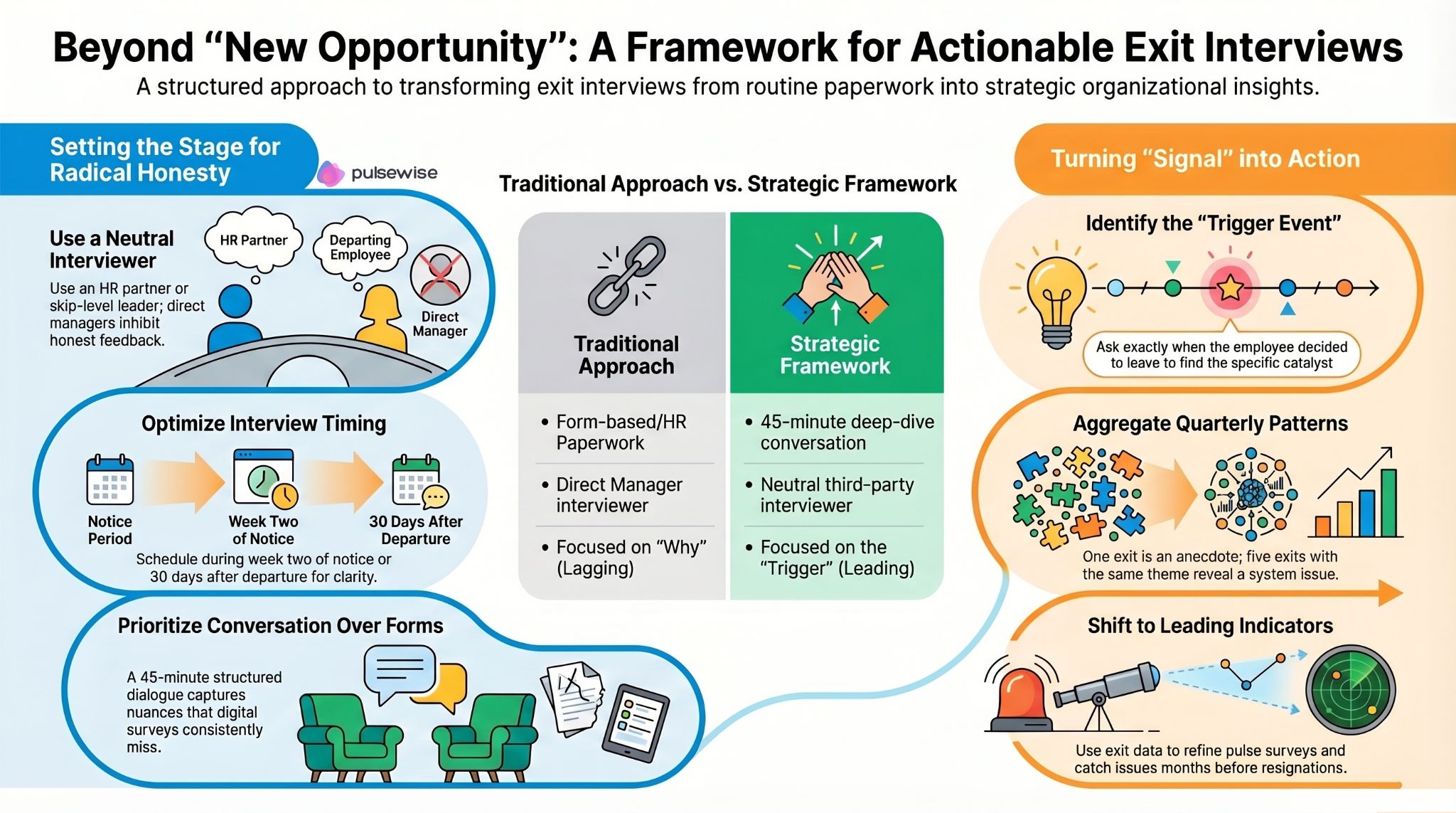
Timing. Schedule it in week two of the notice period, not the last day. Too early, and the employee is still in work mode. Too late, and they are mentally gone. Offer a second conversation 30 to 60 days after they leave, which is where the most honest insights tend to land.
Interviewer. Use someone outside the person’s management chain. An HR partner two levels removed, a People Ops lead, or a skip-level leader the employee trusts. Your direct manager is the worst possible interviewer.
Format. A 45-minute conversation beats any form. If you must use a form, use it to prep the conversation, not replace it.
Confidentiality. Tell them exactly how their answers will be used, who will see them, and what will be anonymized. Vague promises kill honesty.
The 40+ exit interview questions template
Use this as a menu, not a checklist. Pick 10 to 15 that fit the person and the role. Leave room to follow threads.
Category 1: The decision to leave (start here)
- Walk me through the moment you decided to start looking. What was happening that week?
- Was there a specific event, conversation, or realization that tipped it?
- If the offer you accepted didn’t exist, would you still be leaving? Why or why not?
- What were the top three things the new role offers that you couldn’t get here?
- Is there anything we could have done in the last 90 days that would have changed your decision?
- How long had you been thinking about leaving before you actually started applying?
These questions beat the generic “why are you leaving?” because they force a timeline. You learn the trigger, the drift, and the window you missed.
Category 2: Role and growth
- When did your role feel most meaningful? What was different about that time?
- When did it feel least meaningful, and what was happening then?
- Did you feel like you were growing in this role over the past 12 months? What evidence do you have either way?
- Were there skills or experiences you wanted to develop that this role didn’t offer?
- If you had to describe the gap between what this role was sold as and what it actually became, how would you describe it?
- Did you have a clear picture of what the next step in your career here would look like?
Category 3: Manager and management
- What’s one thing your manager did well that I should know about?
- What’s one thing that, if changed, would have meaningfully improved your experience?
- How often did you have real, substantive 1:1s? Not status check-ins, but actual conversations.
- Did you feel your manager understood your goals and what motivated you?
- When you raised concerns, did they get addressed, deflected, or forgotten?
- Was there feedback you wished your manager had given you earlier?
If you see themes across multiple exits pointing to a specific manager, that’s the signal. One person’s frustration is anecdote. Five people’s is a pattern.
Category 4: Team and collaboration
- How would you describe the team’s culture to someone considering joining?
- Did you feel psychologically safe to disagree, raise concerns, or admit mistakes?
- Were there conflicts or tensions that never got resolved? What were they about?
- Who on this team should we invest in, protect, or promote? And why?
- Is there a dynamic or behavior on the team that a new hire should be warned about?
Question 23 sounds aggressive. It isn’t. You’re asking the person with nothing to lose to tell you the truth about how the team actually operates.
Category 5: Compensation and recognition
- Was your compensation fair for the work you were doing? What informs your answer?
- Was your new offer significantly higher, similar, or lower than what you have here?
- Did you feel recognized for your contributions? When did recognition feel real, and when did it feel performative?
- Was there a specific piece of work you did that you felt went unnoticed?
Be careful with pay questions. Compensation is rarely the real reason someone leaves, but it’s often the one they’ll cite because it sounds rational. The deeper causes tend to be growth, manager, or meaning. Ask, but don’t over-index on the answer.
Category 6: Culture and environment
- What’s one thing people say this company values that doesn’t actually show up in how decisions get made?
- What’s something we do well that we should protect at all costs?
- How did the company’s values show up, or fail to show up, during tough moments like layoffs, reorgs, or conflict?
- Did you feel like you belonged here? Why or why not?
- Were there moments you felt your identity, background, or working style made things harder than they should have been?
- How would you describe the pace of change here? Too fast, too slow, or about right?
Category 7: Process, tools, and the day-to-day
- What part of your day felt like friction that shouldn’t exist?
- Were there tools or processes that made work harder instead of easier?
- Was there a meeting, ritual, or artifact that you think we should kill?
- What’s the first thing you’ll keep doing at your next job that you learned here?
Category 8: Forward-looking and candid
- If you were CEO for a week, what’s the first thing you’d change?
- Who should we talk to inside the company to understand what’s really going on?
- What would it take for you to consider coming back in 2 to 3 years?
- Is there something you’ve wanted to say in this conversation but haven’t? Now is the time.
That last question is often the most revealing of the whole interview. Don’t skip it, and don’t rush the silence after you ask it.
What to actually do with the answers
Exit data is only useful if it reaches the people who can act on it. A few principles.
Aggregate quarterly, not case by case. One exit is anecdote. Five exits with the same theme is a system issue. Build a simple quarterly exit themes report that surfaces the top three patterns, the affected teams, and the recommended action.
Share it with the managers it relates to, kindly. If a manager is showing up in multiple exit interviews, they need to know. Not as punishment. As development. Most managers have no idea what’s actually being said about their leadership. Pairing exit themes with continuous feedback analysis makes it easier to see whether those patterns are already showing up in day-to-day signals, not just in departure conversations.
Close the loop publicly when something changes because of an exit. “We heard in several exit interviews that our promotion criteria felt opaque. Here’s what we changed.” This single practice does more for trust than any engagement survey ever will.
Stop relying on exits as your primary signal. This is the hardest shift. Exit interviews tell you what already happened. The goal is to catch the signal six months earlier, while the person is still in the seat.
This is where continuous listening earns its keep. Tools like Pulsewise use Pulse Surveys and DailyMood tracking to give HR leaders a rolling view of how each team is feeling, week over week, instead of once a year. So instead of learning in an exit interview that a team has been quietly demoralized for four months, a People leader sees the dip in week two and has time to act. That shift, from post-mortem to early warning, is the whole point.
Common exit interview questions mistakes to avoid
I’ve watched good programs fall apart in predictable ways. Here are the patterns worth naming.
The form-only trap. If your exit “interview” is actually a 20-question form sent over email, you are collecting box-checking, not truth. Keep the form if you must, but pair it with a conversation.
The direct-manager interview. Asking someone’s manager to conduct their exit interview is like asking the defendant to run their own trial. Put a neutral party in the chair.
Not acting on patterns. Nothing kills internal trust faster than collecting feedback year after year and changing nothing. If you can’t commit to action, be honest and stop asking.
Treating exits as a feedback replacement. Exit data should be one input of many, not your primary source. If it is, your continuous listening is broken. This is where a lightweight pulse survey cadence changes the economics entirely. Short, scheduled pulses with department-level reporting mean you are not waiting until someone’s last day to find out what’s wrong.
Confidentiality theater. If you promise anonymity and then three people see the raw notes, you’ll never get honest answers again. Decide your data handling policy and stick to it.
A quick-win: try this next Monday
Pull your last 10 exit interview summaries. Lay them side by side on one page. Ignore the role and team columns. Just look at the reasons.
You will almost certainly see a pattern. Maybe it’s growth. Maybe it’s a specific manager. Maybe it’s the same phrase, “lack of clarity,” showing up six times in different words. That pattern has been sitting in your data the whole time. This one exercise, done once a quarter, is often more valuable than any new engagement initiative.
Then ask yourself the uncomfortable follow-up: what signals could have told us this three months ago, and why didn’t we see them?
Final thoughts
The best exit interview questions are honest, specific, and timed to give you the truth instead of the LinkedIn version of it. But the real goal isn’t to run better exit interviews. It’s to need fewer of them. Every good exit conversation should leave you with a slightly better map of what your organization is really like to work in, and a slightly tighter loop between hearing something and acting on it.
If you take one thing from this post: exits are lagging indicators. The leading indicators are already in your team. You just have to be listening for them.
FAQs
What are the most important exit interview questions to ask?
The three most important are: What was the specific moment you decided to start looking? Is there anything we could have done in the last 90 days to change your mind? And, is there something you’ve wanted to say but haven’t? These three surface the trigger, the window you missed, and the truth that formal questions don’t reach.
Who should conduct exit interviews?
Someone outside the employee’s direct management chain. Typically an HR business partner, a People Ops lead, or a skip-level leader. Never the direct manager. Employees rarely share candid feedback with the person they’re leaving.
When is the best time to do an exit interview?
Week two of the notice period is the sweet spot. The employee has mentally accepted leaving but is still engaged enough to reflect carefully. A second conversation 30 to 60 days after they leave often produces the most candid insights.
Should exit interviews be confidential?
Yes, and you should explain exactly what confidential means. Will the direct manager see it? Will quotes be anonymized? Will themes be shared but not verbatim answers? Vague promises of confidentiality produce vague answers.
Are exit interviews still worth doing if most people give polite answers?
Yes, but only if you pair them with continuous listening throughout the employee lifecycle. Exit interviews alone are a lagging indicator. Combined with regular pulse surveys and 1:1 signals, they become a useful sanity check on patterns you should already be seeing.