Psychological Safety at Work: Why It Matters More Than Perks

TL;DR
- Psychological safety at work is the shared belief that people can speak up, ask questions, and admit mistakes without fear of being shut down. It’s the single strongest predictor of high-performing teams.
- Free lunches and unlimited PTO won’t fix a culture where people stay quiet in meetings. Perks reward comfort. Safety addresses fear.
- The biggest sign of low safety isn’t conflict, it’s silence. If your best ideas only show up in private DMs, you have a problem.
- Building it takes consistent daily behavior from managers, not an annual workshop. Three things to try this week: ask better 1:1 questions, respond well to bad news, and admit one of your own mistakes out loud.
A few months ago an HR director at a 240-person SaaS company shared a story that stuck with me. Her team had just rolled out a glossy new wellness program. Subsidized therapy. Mental health days. A meditation room with weighted blankets. The whole package.
Three weeks later, a senior engineer quit. In her exit interview she said almost the same sentence four other people had said that quarter: “I didn’t feel like I could disagree with my manager.”
That gap, between what companies offer and what people actually need, is the whole point of psychological safety at work. It’s the most important condition for high-performing teams, and it has very little to do with the benefits page on your careers site.
This piece is for HR leaders who already sense the gap and want something practical to do about it. I’ll cover what psychological safety actually is, why it’s the lever you should be pulling on right now, and the small daily moves that build it (or quietly destroy it). No fluff. Just what works.
What Is Psychological Safety at Work?
Psychological safety at work is the shared belief that team members can speak up, ask questions, share ideas, and admit mistakes without fear of being punished or humiliated.
The term was popularized by Harvard Business School professor Amy Edmondson in the late 1990s and has since become one of the most studied ideas in organizational behavior.
Edmondson’s research, summarized in her book The Fearless Organization, found something counterintuitive. Teams with higher psychological safety reported more errors, not fewer. At first that sounds like a problem. It isn’t. They were catching and surfacing the errors. The unsafe teams were quietly hiding them.
Google reached a similar conclusion through its multi-year study of team performance, Project Aristotle. Of the five dynamics they identified, psychological safety came out on top.
So when an HR leader asks me, “What’s the one thing we should focus on to lift performance and retention?” the answer is almost always the same. It isn’t perks. It’s whether your people feel safe enough to speak.
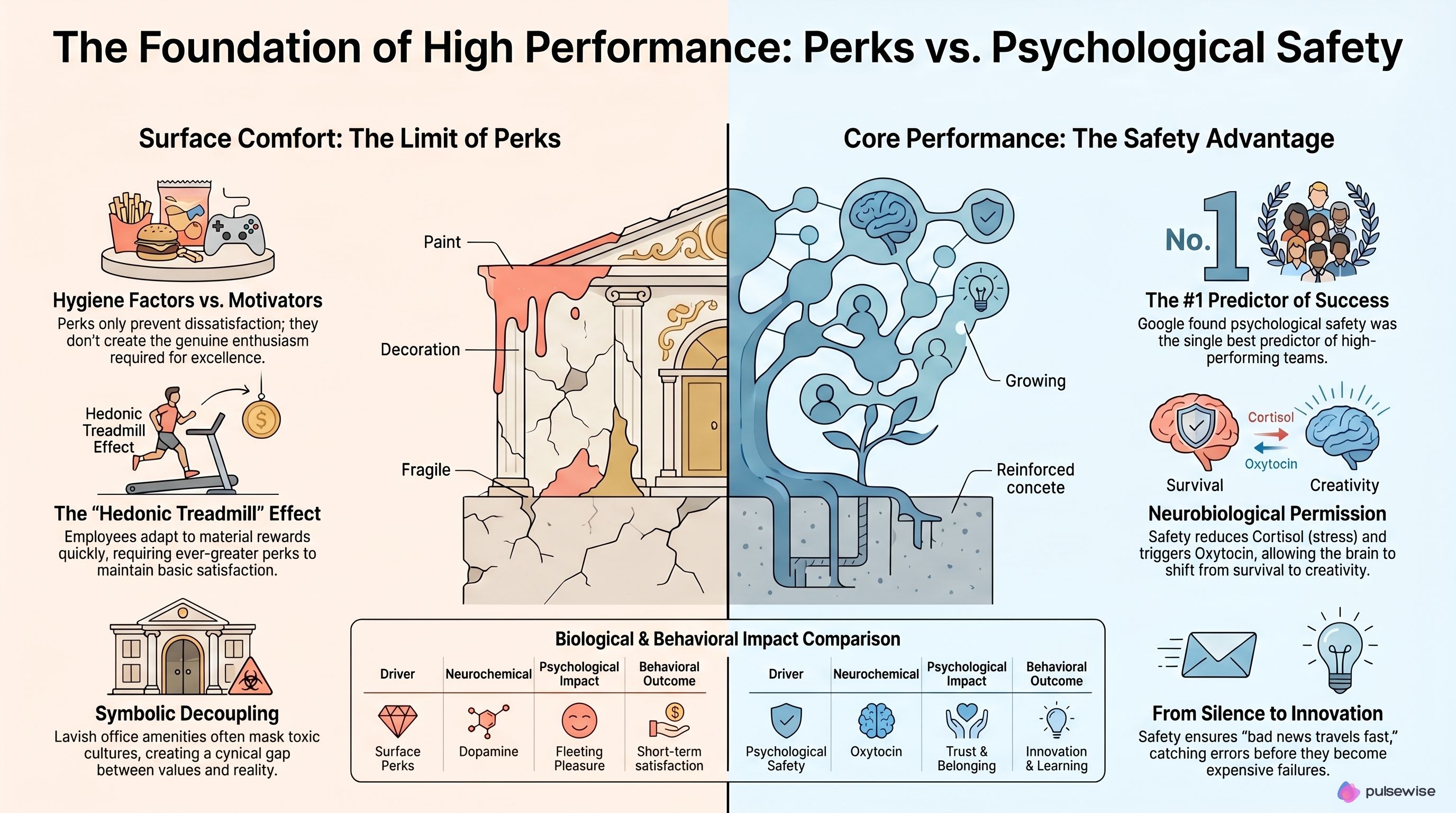
Why Don’t Perks Fix Psychological Safety?
Look at the standard playbook for HR leaders trying to lift engagement: free lunch, gym stipend, no-meeting Wednesdays, foosball table, unlimited PTO. Each one is fine on its own. But none of them solves the real problem, which is that smart people are afraid to be wrong out loud.
Here’s a quick mental test. Picture your most promising mid-level employee. They have an idea that contradicts their VP. Do they raise it in the next leadership meeting, or do they vent about it to a peer in Slack and never bring it up again?
If your honest answer is the second one, no amount of cold brew is going to fix that.
Gallup’s 2024 State of the Global Workplace report put global employee engagement at 23%, with 62% “not engaged” and 15% “actively disengaged.” More telling: Gallup has consistently shown that the manager relationship accounts for the lion’s share of variance in engagement, far more than company-wide perks. People don’t quit benefits packages. They quit feeling unheard.
Perks vs. Psychological Safety: What Each Actually Solves
Snacks, PTO, stipends
Comfort, convenience, and day-to-day friction.
Whether people speak honestly with their manager.
Recruiting and short-term satisfaction.
A daily speak-up culture
Willingness to flag risks, ideas, and mistakes early.
Doesn't replace fair pay or competitive benefits.
Retention, innovation, and team performance.
This is the gap Pulsewise was built to close. Their core belief is simple: people experience work daily, not annually. So measurement and support need to match that rhythm, not lag behind it by six months. An annual engagement survey tells you about a culture that no longer exists by the time you read the results.
What Are the Signs of a Low-Safety Culture?
Diagnosing psychological safety is tricky because the warning signs look like good behavior on the surface. Quiet meetings. Few objections. No one rocking the boat.
Here’s what to actually watch for:
- Decisions get re-litigated after the meeting. People nod in the room, then disagree on Slack the next morning.
- Bad news travels slowly. You learn about a delayed project, a churned customer, or a struggling teammate two weeks too late.
- Your high performers stop offering ideas. They’ve learned that suggestions either get ignored or quietly punished.
- One or two voices dominate every discussion, usually the most senior, often well-meaning, almost always closing off divergent thought without realizing it.
- People apologize a lot for asking questions. “Sorry if this is a dumb question, but…” is a phrase that should make you nervous.
When I work with HR teams I tell them to pay less attention to topline satisfaction scores and more attention to the shape of what employees say. A team that complains specifically and constructively is healthier than a team that gives every survey a 4 out of 5 and moves on.
How Do You Build Psychological Safety at Work?
Most companies try to fix psychological safety with a training. A two-hour session, some slides about vulnerability, maybe a guest speaker. The needle barely moves. Why? Because safety is a habit, not a concept.
Here are the moves that actually work, ranked by leverage.
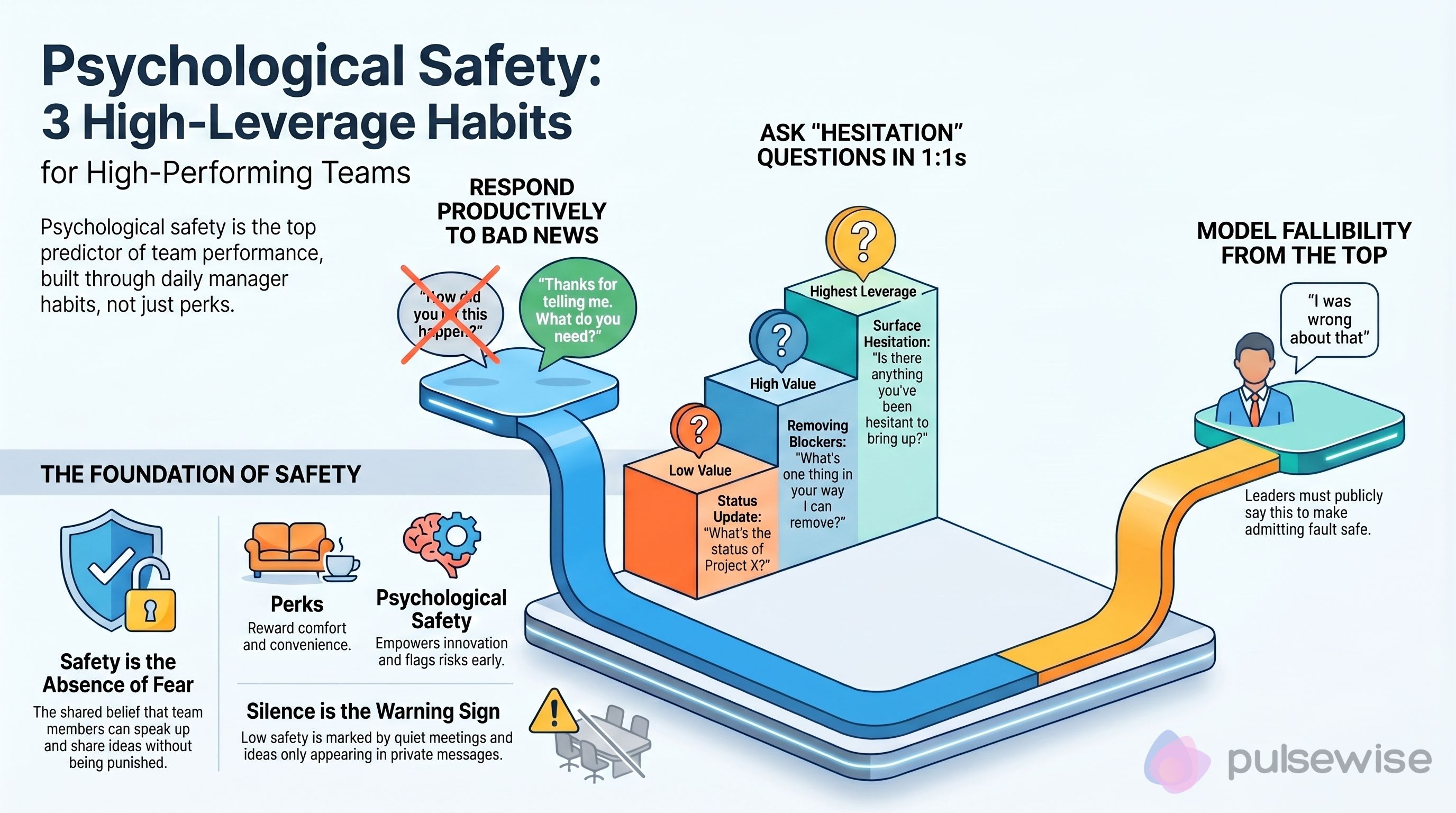
1. Train managers to respond well to bad news
This is the single highest-leverage action you can take. When a direct report tells a manager something difficult, a missed deadline, a customer complaint, a mistake, the manager’s first three sentences set the temperature for every conversation that follows.
Bad reactions (“How did you let this happen?”) teach the team to hide. Good reactions (“Thanks for telling me. What do you need?”) teach the team to surface things early. It’s a coachable skill, and most managers have never been coached on it.
2. Ask better questions in 1:1s
Most 1:1s default to status updates. Status updates are the lowest-value use of one-on-one time. Try replacing your opening question with one of these:
- What’s one thing getting in your way this week I could help remove?
- What’s a recent decision you would have made differently?
- Is there anything you’ve been hesitant to bring up?
The third question feels awkward to ask. That’s the point. Most managers never ask it, and that’s why most teams never answer it.
3. Make the daily signals visible
The biggest reason psychological safety quietly erodes is that nobody sees it happening. By the time someone resigns, the fix is too late.
This is where Pulsewise’s AI Daily Feedback is useful. It takes the messy, unstructured notes managers already write (things mentioned in 1:1s, comments left on goals, observations from project retros) and converts them into structured signals across dimensions like morale, teamwork, psychological safety, and learning. Instead of waiting six months for an engagement survey to tell you a team is struggling, you can spot the pattern this week.
The point isn’t surveillance. It’s catching the small drift before it becomes attrition.
4. Model fallibility from the top
If senior leaders never publicly say “I was wrong about that,” your culture will assume admitting fault is dangerous. The fastest way to shift that is to do it yourself, in writing, somewhere people can see. One sentence in a team standup. One line in a quarterly recap. That kind of small public acknowledgement does more than most leadership offsites.
What Stops HR Leaders From Making Progress?
Even when HR leaders know all of this, three things tend to stall progress.
The “we did a workshop” reflex. A one-time training does not change daily behavior. Treat psychological safety like fitness, not vaccination. It needs reps.
Manager overload. Most managers in mid-sized companies are running larger spans of control with less time and limited training. Telling them to “build a safer culture” without giving them tools or breathing room is unfair, and it doesn’t work.
Confusing safety with comfort. Psychological safety doesn’t mean nobody ever feels uncomfortable. It means people can engage in productive conflict without it becoming personal. A safe team disagrees more, not less. They just disagree better.
The aim is to make managers feel supported rather than judged, and to give them enough signal to lead with clarity instead of guesswork. That framing shift sounds small. It changes how the work lands.
A 15-Minute Experiment to Try This Week
If you want a low-cost way to test where your culture sits, try this.
Pick one team. Ask the manager to run a short “what could we have done better” segment at the end of their next team meeting. Keep it specific to a recent decision or project. The manager goes first with one of their own (yes, this is the awkward part): “Here’s what I think I got wrong.”
Then watch the room. If teammates contribute, your safety baseline is healthy. If it goes quiet, you’ve just learned something important and now you have somewhere concrete to start.
Pair that with a lightweight ongoing feedback loop, even a simple weekly mood check-in via pulse surveys, and you’ll start to see drift before it becomes damage.
Final Thoughts
The real reason psychological safety matters more than perks is straightforward. Perks reward people for showing up. Safety determines whether they bring their full self once they do. Companies don’t lose great people because the snacks ran out. They lose them through a thousand small moments where speaking up didn’t feel worth it.
Start small. Pay attention to what people aren’t saying. The strongest cultures aren’t the ones with the best benefits page, they’re the ones where the truth travels fast.
FAQs
What does psychological safety at work mean?
Psychological safety at work is the shared belief that team members can speak up, ask questions, share ideas, and admit mistakes without fear of being punished or humiliated. The concept was developed by Harvard professor Amy Edmondson and is widely considered the strongest predictor of high-performing teams.
Why is psychological safety more important than benefits and perks?
Perks like free meals, wellness stipends, and remote flexibility shape comfort and convenience. They don’t change whether a person feels safe to speak honestly. Research from Gallup, Google’s Project Aristotle, and Edmondson consistently shows that the quality of daily manager and team interactions has a much larger impact on retention, engagement, and innovation than benefits packages.
What are signs of low psychological safety on a team?
Common signs include silent meetings followed by Slack disagreement, bad news arriving late, high performers no longer offering ideas, one or two voices dominating discussions, and people apologizing before asking questions. The pattern is silence rather than open conflict.
What is an example of psychological safety at work?
A clear example is a manager who responds to a missed deadline by asking “What do you need from me?” rather than “How did you let this happen?” Another example is a team member admitting they don’t understand a technical decision in a meeting and the team treating that as useful rather than weak.
How do you measure psychological safety in a team?
The most reliable approach combines short pulse surveys with continuous behavioral signals. Specific items like “It is safe to take a risk on this team,” paired with weekly observations from managers aggregated into trends, give a clearer picture than annual engagement scores. AI tools that turn unstructured manager notes into structured signals make this practical without adding survey fatigue.
Who is responsible for psychological safety, HR or managers?
Both. HR sets the structures, language, and accountability. Managers create the day-to-day experience. Without HR, managers don’t get trained or supported. Without managers, HR’s frameworks stay theoretical. The strongest cultures treat psychological safety as a shared operating habit, not a single department’s deliverable.
Can psychological safety be built in remote or hybrid teams?
Yes, though it takes more deliberate work. Remote and hybrid teams lose the ambient signals (a quiet sigh, a side conversation) that office managers use to gauge mood. The fix is structure: regular 1:1s with non-status questions, lightweight check-ins, and continuous feedback systems that surface emotional and performance signals between formal meetings.