How to build an employee engagement program (step by step)
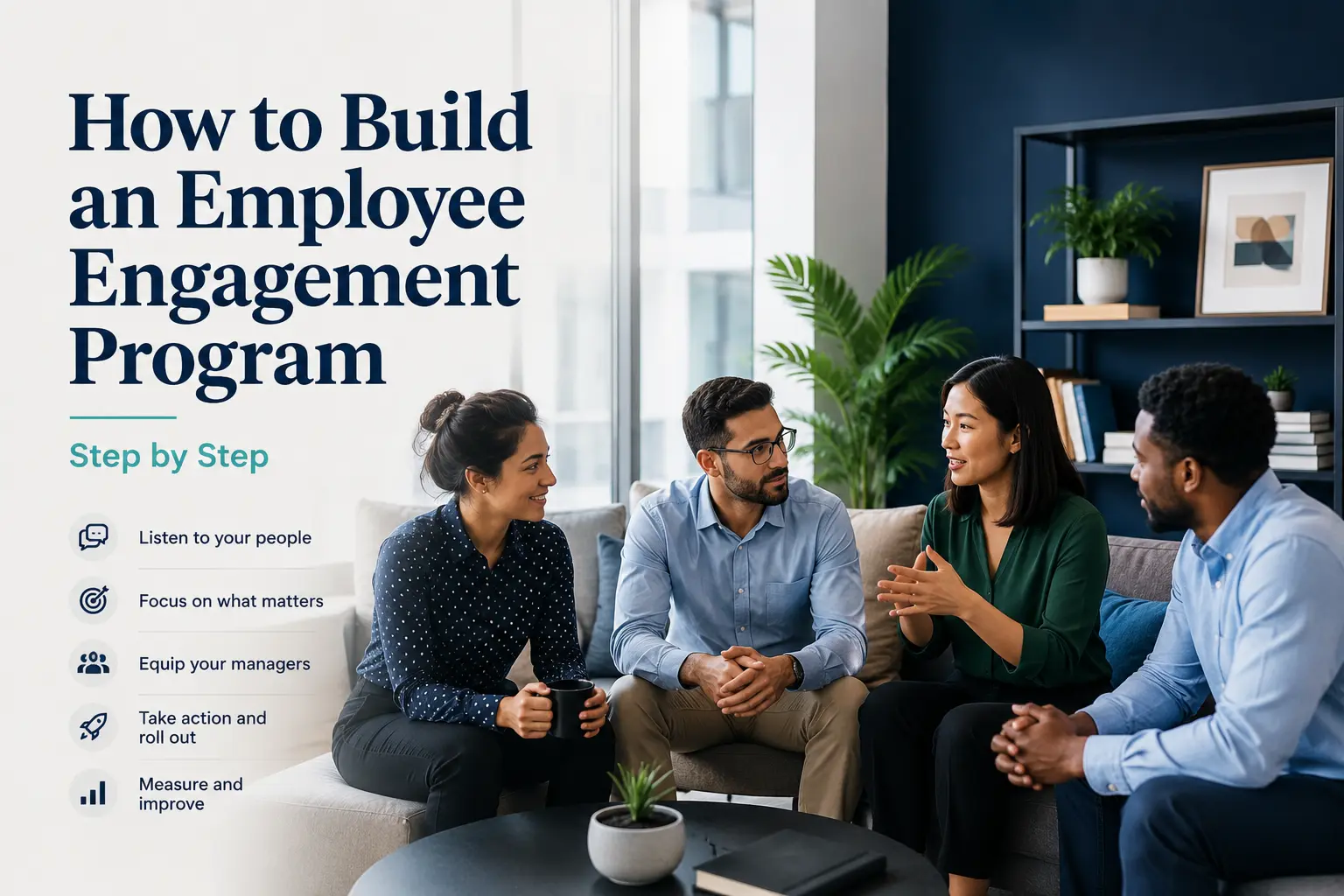
Most employee engagement programs do not fail because the ideas are bad. They fail because nobody builds them as a system. A pulse survey goes out, a few recognition shout-outs happen, and the effort quietly fades until the next annual review.
If you lead People at a growing company, you have felt this. You are running an annual review, the odd ad-hoc survey, and sporadic recognition across three or four disconnected tools. Your managers fly blind between cycles, and engagement stays exactly where it was.
This guide walks you through how to build an employee engagement program step by step, the way the strongest People teams do it in 2026. You will get an eight-step build sequence, the metrics that actually matter, and an honest look at where most programs break.
TL;DR
- An employee engagement program is an ongoing, owned system for listening to employees and acting on what you hear, not a one-off list of activities.
- Gallup reports that only 21% of employees worldwide are engaged, and nearly 80% are not engaged or are actively disengaged, despite years of rising effort.
- Most programs fail for four reasons: no executive ownership, over-complicated design, vanity metrics, and surveys that never lead to action.
- The build sequence that works: secure ownership, set a baseline, listen continuously, pick two or three focus areas, design the components, equip managers, roll out in phases, then measure and close the loop.
- Managers drive roughly 70% of the variance in team engagement, so any program that ignores manager habits is building on sand.
What is an employee engagement program?
An employee engagement program is an ongoing, owned system for understanding how your people feel and acting on it to improve their commitment, performance, and retention. It connects listening, recognition, growth, and feedback into one repeatable rhythm, rather than a scatter of standalone activities.
The distinction matters. An engagement initiative is a single thing you do, like a recognition wall or a wellbeing week. A program is the operating model that decides which initiatives you run, who owns them, how often you measure, and how you act on the results.
If you want a foundational primer on the concept itself, our employee engagement master guide covers the what and the why in depth. This article assumes you already know engagement matters and focuses on the how.
Why most employee engagement programs fail
Before you build, it pays to know exactly how these programs die. Gallup has studied this for decades, and the failure pattern is remarkably consistent. The headline number is sobering: nearly 80% of employees worldwide are still not engaged or are actively disengaged, despite increased effort from companies.
Four failure modes show up again and again.
It gets treated as “an HR thing.” When leadership does not model or prioritize engagement, the program has no air cover and no budget. Gallup is blunt that the single greatest cause of failure is the belief that engagement belongs to HR alone.
The design is too complicated. Teams chase predictors that managers cannot control and that have little to do with employees’ core needs. Complexity feels rigorous, but it buries the few things that actually move the needle.
The metrics mislead. Many programs lean on a “percent favorable” score that inflates results and hides real problems. You end up with a healthy-looking dashboard and a quietly disengaged team.
Surveys go out, action never comes. This is the most common one. Teams overuse pulse surveys to collect feedback, then rarely act on it, which trains employees to stop responding honestly. The cost of all this is not abstract. Gallup estimates that disengagement drains roughly 438 billion dollars a year from the global economy in lost productivity, and our own breakdown of the 2026 disengagement data shows how fast a team can slide when no one is watching.
The good news is that every one of these failures is avoidable. The eight steps below are built to counter each one directly.
See how continuous listening replaces the annual survey. If your current “program” is one survey a year and a results deck nobody acts on, that is the gap to close first. Explore real-time team pulse and see what the weekly signal looks like.
How to build an employee engagement program, step by step
Here is the build sequence. Work through it in order, because each step sets up the next. You do not need a big budget or a six-month transformation plan to start; you need a clear owner and a rhythm.
Step 1: Secure executive ownership and name an owner
Start at the top, not with activities. Before you design anything, get one executive sponsor who will communicate that engagement matters and model it themselves. Then name a single accountable owner for the program, usually you or a People Ops lead.
This step exists because the number one failure mode is leadership treating engagement as someone else’s job. Executives set the tone, managers make it real, and employees live it day to day. When leaders can see the same picture the People team sees, ownership becomes natural rather than forced.
Give leadership a shared, board-ready view so the conversation stays grounded in data. Pulsewise Org Health rolls people’s signals into one dashboard your leadership team can actually read, which makes the quarterly engagement conversation a five-minute look at trends instead of a debate about whether there is a problem.
Step 2: Set a baseline before you act
You cannot improve what you have not measured. Run a baseline pulse to capture where engagement sits today, then define two or three success metrics you will hold the program to. Good candidates include participation rate, eNPS, voluntary turnover, and a stable satisfaction score.
Avoid the “percent favorable” trap here. Pick metrics that tell you the truth even when the truth is uncomfortable, and write down your starting numbers so you can prove movement later. This baseline becomes your business case when you ask for budget or headcount.
Pulsewise pulse surveys give you a clean baseline in days rather than weeks, and the AI analytics surface the themes hiding inside open-text responses. That means your baseline is a starting line you can act on, not a spreadsheet that sits in a drawer.
Step 3: Build a continuous listening engine
This is the heart of a modern program, and it is where you break from the old annual-survey model for good. A team can drift from green to red in about six weeks, which means an annual survey leaves you six to ten months late to a problem that was obvious in the team’s Slack channel in near real time.
Replace the once-a-year snapshot with a steady, lightweight signal. Short weekly or bi-weekly pulses, plus a simple daily mood read, give you a trend line that matches how quickly team sentiment actually changes. The goal is early detection, not perfect measurement.
Pulsewise Team Pulse does exactly this, with real-time mood tracking and daily listening that flags a dip before it becomes a resignation. The shift from annual snapshot to continuous signal is the single biggest measurement change People teams are making right now, and it is the foundation everything else sits on.
Step 4: Choose two or three focus areas
Do not try to fix everything at once. Read your baseline and listening data, then pick the two or three needs with the highest impact and the most urgency. A focused program that moves one real problem beats a sprawling one that touches ten and shifts none.
Let the data choose for you. If attrition risk is climbing in a specific team, that is your focus. If recognition scores are low across the board, start there.
Pulsewise Engagement and Retention helps you predict and prevent attrition early by connecting sentiment trends to exit risk, so you can aim your program at the people most likely to walk before they do. That turns a guessing game into a targeting exercise.
Step 5: Design the program components
Now you build the actual components, mapped to what drives engagement rather than to what looks fun. Gallup’s research points to five durable drivers: purpose, development, caring managers, ongoing conversations, and a focus on people’s strengths. Strong components serve those drivers directly.
Here is how the common building blocks map, and where each one lives in practice.
| Driver | Program component | What it looks like |
|---|---|---|
| Recognition and belonging | Recognition and kudos | Peer-to-peer praise made visible and frequent |
| Development and purpose | Goals and growth plans | Clear goals, learning paths, visible progress |
| Ongoing conversations | Feedback loops | Continuous feedback, not a once-a-year event |
| Caring managers | Structured 1:1s | Regular, prepared check-ins with real follow-up |
| Wellbeing | Wellbeing and balance | Workload visibility, flexible rhythms, mental health support |
The advantage of building these in one place rather than four tools is that the signals connect. Recognition with Pulsewise Kudos feeds the same intelligence layer as your goals and OKRs, so a manager sees mood, recognition, and goal progress side by side instead of stitching three apps together. That connection is what lets a program feel coherent to employees rather than like a series of unrelated HR campaigns.
Run the whole program from one place. Tool sprawl is its own failure mode. Mid-market teams routinely spend 45,000 dollars or more a year on five separate HR tools that barely talk to each other. See how Pulsewise works as a single connected system for listening, recognition, goals, and reviews.
Step 6: Equip managers to own engagement daily
If you remember one statistic from this article, make it this: managers account for roughly 70% of the variance in team engagement. They control the day-to-day experience of work, so a program that does not change manager habits is decoration.
The problem is that most managers are not disengaged; they are unequipped. Disengagement rarely starts with a blow-up. It usually starts with a manager who has not run a proper 1:1 in three weeks and has missed a mood change in their best performer.
Give managers preparation, not more meetings. Pulsewise Performance Coaching sends weekly nudges and AI coaching insights, and the 1:1 intelligence board hands a manager a prompt before a check-in, for example, “mood trend has dropped this week, consider opening with a wellbeing check.” That nudge costs nothing to act on and changes the entire tone of the conversation. For more on supporting managers specifically, our guide for managers goes deeper.
Step 7: Roll out in phases with a 30-60-90 plan
Do not launch everything on day one. A phased rollout lets habits form and gives you quick wins to point to. Here is a simple 30-60-90 structure you can adapt.
- Days 1 to 30: Turn on continuous listening, announce the program from leadership, and capture your baseline.
- Days 31 to 60: Launch recognition, and coach managers on one new habit such as a prepared weekly 1:1.
- Days 61 to 90: Add goals and growth conversations, then run your first metrics review and share what changed.
Phasing also protects your budget and your credibility. Because Pulsewise is free forever for the first 100 teams, with no credit card and no trial clock, a People lead can stand up the listening layer and recognition without a procurement battle, then expand as the program proves itself.
Step 8: Measure the right metrics and close the loop
A program lives or dies on follow-through. Track the metrics you defined in Step 2, act on them visibly, and tell employees what changed because of their feedback. This last part is not optional.
Gallup found that engagement is almost three times higher when employees strongly agree that their organization acts on the results of surveys they complete. In other words, the act of closing the loop is itself one of your strongest engagement levers. Acting on feedback within days, not quarters, is what builds trust.
Use Pulsewise Culture Analytics to watch the trend lines and Review Cycles to tie engagement back to performance, so the loop you close is a real cycle of listen, act, and confirm. Then return to Step 4, pick your next focus area, and run it again.
Employee engagement program examples
Programs look different depending on the company’s stage. Here are three grounded examples you can borrow from, sized for the kind of growing teams Pulsewise is built for.
| Company stage | Focus | Example program shape |
|---|---|---|
| 50 to 100 employees | Build the rhythm | Weekly pulse, monthly recognition ritual, prepared 1:1s for every manager |
| 100 to 300 employees | Target attrition | Continuous listening, attrition-risk alerts, manager coaching nudges, quarterly metrics review |
| 300 to 500 employees | Connect to performance | All of the above, plus goal alignment and engagement-linked review cycles |
For a deeper menu of specific tactics to slot into these shapes, see our 15 strategies to improve employee engagement and our playbook of engagement ideas for remote and hybrid teams. This guide gives you the system, those give you the building blocks.
Tools to run your employee engagement program
You can run a basic program with a survey tool and a spreadsheet, but it falls apart at scale because the signals never connect. Point tools each solve one slice. Lattice and Culture Amp lean into analytics and performance, Bonusly focuses on peer recognition, and each one bills per employee per month, which adds up fast across a stack.
The alternative is one connected platform where listening, recognition, goals, and reviews share a single intelligence layer. That is the gap Pulsewise was built to close, replacing five HR tools with one and removing the integration tax that makes most programs feel fragmented.
For growing teams, the pricing also removes the usual barrier to starting. Pulsewise is free forever for the first 100 teams to claim a spot, with up to 100 users, all integrations, and AI analytics included, and no credit card required. That makes it realistic to launch a real program this quarter rather than waiting on a budget cycle.
The bottom line
The companies that get engagement right are not the ones with the biggest budgets or the slickest perks. They are the ones who treat it as a program with an owner, a steady listening rhythm, and managers who have better conversations more often.
You do not need to launch all eight steps tomorrow. Pick Step 1 and Step 3, name an owner and turn on continuous listening, and you will already be ahead of most teams still relying on an annual survey. Build the rest from there, one focus area at a time.
When you are ready to put a real listening engine behind your program, Pulsewise is free forever for the first 100 teams. Start for free in under a minute, no credit card required, or book a quick demo to see it running on your own team’s data.
FAQ
What is an employee engagement program?
An employee engagement program is an ongoing system for listening to employees and acting on what you learn to improve commitment, performance, and retention. It connects recognition, growth, feedback, and continuous listening into one owned rhythm, rather than running disconnected one-off activities that fade after a few weeks.
How do you create an employee engagement program?
Start by securing executive ownership and naming one accountable owner. Set a baseline, build continuous listening, pick two or three focus areas, design components around real engagement drivers, equip managers, roll out in phases, then measure and act on results. Work the steps in order for the best outcome.
What are some employee engagement program examples?
Common examples include recognition and kudos programs, structured 1:1 and feedback rhythms, goal and development plans, wellbeing initiatives, and manager coaching. The strongest programs combine a few of these around a continuous listening engine, so the activities respond to real data instead of running on a fixed calendar regardless of need.
Who is responsible for an employee engagement program?
Responsibility is shared. Executives set the tone and model engagement, a named People owner runs the program day to day, and managers make it real for their teams. Gallup finds managers drive roughly 70% of the variance in team engagement, so equipping managers is the highest-leverage part of any program.
How do you measure the success of an employee engagement program?
Define two or three metrics up front, such as participation, eNPS, voluntary turnover, and a stable satisfaction score. Capture a baseline, then track movement over time using continuous pulse data rather than a single annual survey. Avoid “percent favorable” scores, which inflate results and hide real problems on your team.
How much does an employee engagement program cost?
It can cost very little to start. Many high-impact components, like prepared 1:1s and weekly recognition, need better habits more than a budget. On the tooling side, Pulsewise is free forever for the first 100 teams, so a growing company can run a full program without the per-seat fees that point tools typically charge.