Employee Burnout: Early Warning Signs and How to Intervene

TL;DR
- Employee burnout is not a personal failing. The World Health Organization classifies it as an occupational phenomenon caused by chronic, unmanaged workplace stress.
- The earliest warning signs are behavioral, not verbal: a sudden drop in initiative, shorter messages, missed small commitments, and quieter 1:1s.
- The biggest predictor of burnout is not workload. McKinsey found toxic workplace behavior explains more than 60% of the global variance in burnout symptoms.
- Effective intervention starts with one specific 1:1 conversation, not a wellness webinar. A 15-minute “where are you on a scale of 1 to 10” check changes more than a survey ever will.
- You cannot fix burnout you cannot see. Daily signals beat annual surveys, every time.
A senior engineer on a team I worked with stopped saying “good morning” in Slack. That was it. No dramatic resignation post, no late-night email. Just a small social ritual that disappeared. Three weeks later she handed in her notice, and in the exit interview she described nine months of slow, invisible burnout that no one had named.
This is how employee burnout almost always shows up. Not as a crisis, but as a quiet flattening. In this guide, I will walk through the early warning signs of burnout that most managers miss, the difference between stress and burnout, and the specific things HR leaders, technical leaders, and people managers can do this week to intervene before someone disengages or leaves.
What is employee burnout (and what it isn’t)?
Burnout is not just “being tired.” The World Health Organization included burn-out in the ICD-11 in 2019, defining it as “a syndrome conceptualized as resulting from chronic workplace stress that has not been successfully managed.” Notice the precise wording: chronic, workplace, unmanaged. It is not a personality trait. It is a system signal. (WHO ICD-11 classification)
Researchers Christina Maslach and Susan Jackson, whose Maslach Burnout Inventory remains the most cited measure of burnout in academic literature, describe three dimensions:
- Exhaustion: Persistent, deep fatigue that does not resolve with a weekend off.
- Cynicism: A growing emotional distance from work, the team, or customers. Often shows up as eye-rolls, dark humor, or “whatever” responses.
- Reduced professional efficacy: The feeling that nothing you do matters, even when objectively you are still producing.
If you only remember one thing from this section, remember this: burnout is not stress. Stress is “I have too much to do.” Burnout is “I no longer believe what I do matters.” (Maslach Burnout Inventory overview)
That distinction is what makes early intervention possible. By the time someone hits efficacy collapse, you are usually too late.
How widespread is employee burnout right now?
Pretty widespread. And worsening, not improving.
SHRM’s 2024 Employee Mental Health Research Series found that 44% of U.S. employees feel burned out at work, 45% feel emotionally drained, and 51% feel “used up” at the end of the workday. Workers reporting burnout are nearly three times more likely to be actively job hunting, 45% versus 16% of employees who do not. (SHRM 2024 burnout research)
Gallup’s 2024 State of the Global Workplace report found 41% of employees worldwide feel “a lot of stress” each day, and only 33% report thriving on their life-evaluation metric. Manager wellbeing dropped harder than individual contributor wellbeing, especially for women managers. (Gallup State of the Global Workplace)
And Deloitte’s 2025 workforce research highlighted a quiet but important shift: mental fatigue, cognitive strain, and decision friction have overtaken raw workload volume as the leading indicators of burnout. People are not just doing too much. They are deciding too much, switching contexts too often, and feeling unsupported while doing it. (Deloitte Workplace Burnout Survey)
The financial cost is just as real. The World Health Organization and other research consortia estimate workplace stress and burnout cost the global economy hundreds of billions of dollars annually in lost productivity, absenteeism, and turnover. SHRM estimates replacing a single employee can cost between 50% and 200% of their annual salary, and significantly more for leadership roles.
You do not need a study to see this on your team. You need to know what to look for.
The early warning signs of employee burnout managers actually miss
Most burnout content focuses on the obvious late signs: angry resignation, visible breakdown, taking long medical leave. By then, the person has already left emotionally. The early signs are quieter, and they are almost always behavioral.
Here is the short version, formatted as a quick reference. These are the patterns people managers should treat as a soft alarm.
8 early warning signs of employee burnout:
- Withdrawal from informal channels. They stop posting in team chat, skip optional standups, and go quiet in retros.
- Shorter, flatter messages. Replies become “ok” or a thumbs-up emoji where previously you’d get a paragraph.
- A drop in initiative. They still do their work, but they stop suggesting things, raising risks, or volunteering for stretch projects.
- Quality erosion on details, not big things. Typos, missed PR comments, forgotten follow-ups in 1:1s. The big work still ships.
- Subtle cynicism. “Sure, like that’s going to change anything.” Watch for sarcasm aimed at leadership decisions, not at peers.
- Calendar avoidance. Cameras off in meetings they used to lead. Frequent rescheduling of 1:1s. Low energy on calls.
- Boundary collapse. Sending messages at 11 p.m. and 6 a.m., or working through illness “because no one else can do this.”
- Disrupted sleep or visible fatigue. Often mentioned in passing, almost as an aside. “Slept 4 hours, anyway, about the launch.”
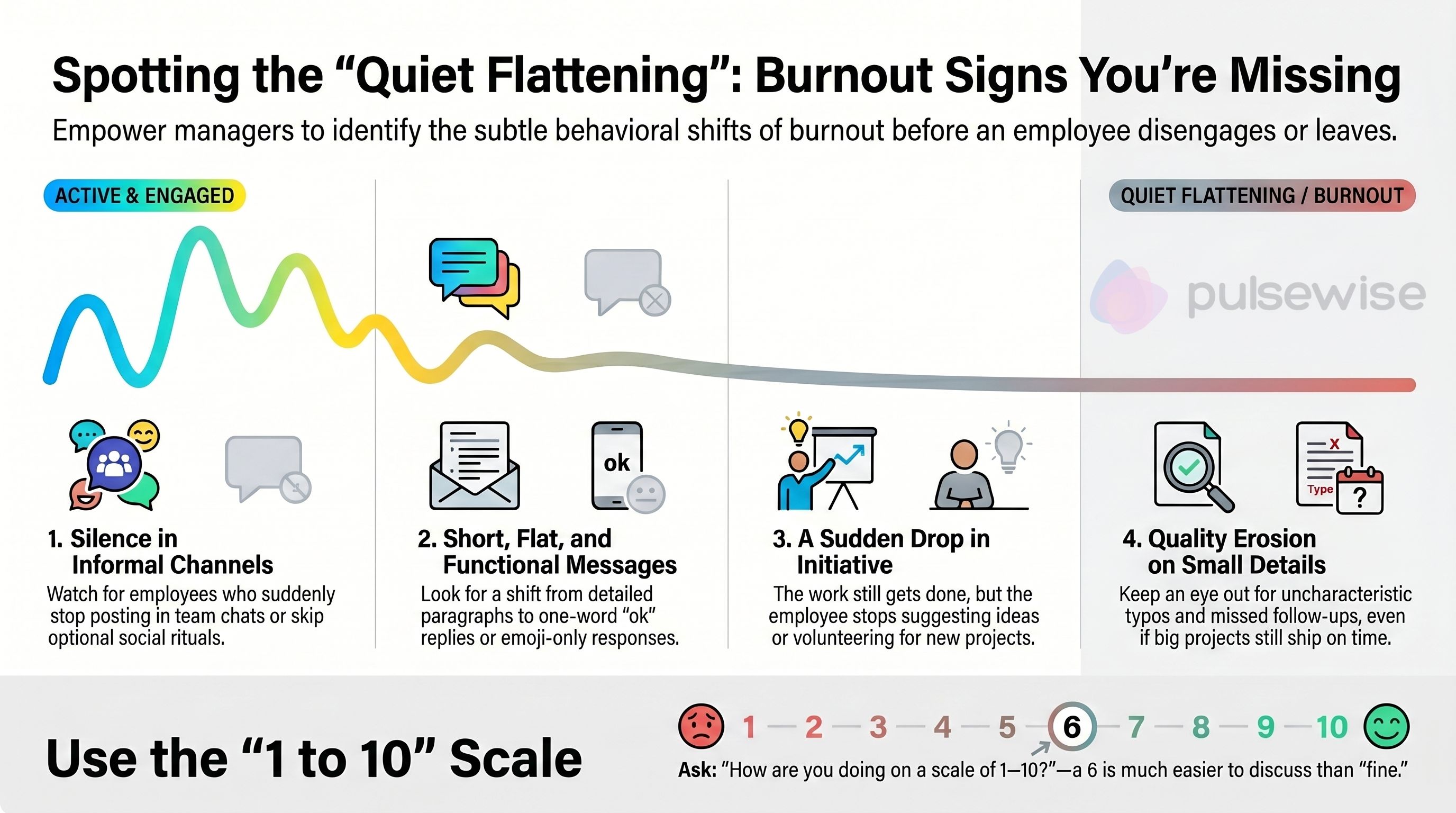
Notice how few of these are the things wellness surveys typically ask about. Annual engagement surveys catch dissatisfaction. They rarely catch the early stages of burnout, because by the time someone fills in a low score on a once-a-year form, the damage is well underway.
This is exactly the gap Pulsewise was built to close. Their core belief is simple: people don’t experience work annually, they experience it daily. So measurement and support need to match that rhythm. Pulsewise’s DailyMood feature lets employees log a quick daily check-in (it takes seconds), and pairs that with structured pulse surveys so you can see whether one person’s flat week is part of a broader pattern in their team. That kind of continuous signal is what turns a vague “something feels off” into a clear, kind conversation.
How to tell stress from burnout (a quick framework)
This is the single most useful distinction for new managers. Stress and burnout look similar from a distance, but they need very different responses.
"I have too much to do."
Spiky. High pressure, short recovery between peaks.
Still cares about outcomes and team success.
Short term and narrow, but still functional.
A weekend off or some PTO genuinely helps.
Reduce load, protect focus time, set clearer priorities.
"I don't think any of this matters."
Flat. Low energy even after a full weekend off.
Detached, cynical, going through the motions.
Foggy, slow, easily distracted by anything.
A weekend changes nothing. Monday feels the same.
Restore autonomy, recognition, and reconnection to purpose.
If a teammate is stressed, the right move is usually to reduce load and protect time. If a teammate is burning out, reducing load alone will not fix it. They also need autonomy, recognition, and reconnection to purpose. We will get to specific scripts in a moment.
What actually causes employee burnout?
If you only treat burnout as a workload problem, you will miss most of it.
McKinsey’s research on workplace mental health surveyed employees across 15 countries and found that toxic workplace behavior, defined as exclusionary, abusive, unethical, or non-inclusive conduct from supervisors or peers, was the single biggest predictor of burnout symptoms and intent to leave. It explained more than 60% of the total global variance. Workload mattered, but autonomy, fairness, and a respectful environment mattered more. (McKinsey on toxic behavior and burnout)
SHRM’s data points the same direction. Their work has consistently identified unfair treatment as the strongest predictor of burnout, ahead of unmanageable workload, unclear communication, and unreasonable time pressure.
In practical terms, the things most likely to burn out a high performer in your organization right now are probably one of these:
- A workload that has crept up by 30% over the past year with no acknowledgment.
- A direct manager who is themselves burned out and has stopped giving feedback.
- A goal or OKR they cannot influence, attached to a metric they cannot move.
- A recent reorg, layoff, or change in scope that left them carrying ambiguity.
- Repeated unrecognized effort, even good performance reviews, but no real “I see you” moments.
Workload reduction alone will not fix any of these. What helps is a small set of leadership behaviors, repeated over time.
How do you intervene in employee burnout early?
Here is what to actually do, in the order most likely to work, and roughly the timeline. Pick the level that matches your role: people manager, technical leader, or HR.
If you are a people manager
Within 48 hours of noticing a warning sign, have a private 1:1 conversation. Do not wait for the next scheduled one. Do not put it in a group chat. Do not bring data. Bring care.
Open with a specific observation, not a vague concern. Avoid “are you okay?” as an opener, because most people will reflexively answer “yeah, fine.”
Try one of these instead:
“I’ve noticed you’ve been quieter in standups this past week, which is not like you. I might be reading it wrong, but I wanted to check in. How are you actually doing right now, on a scale of 1 to 10?”
The 1 to 10 ask is small but powerful. It makes the answer specific. A “6” is much easier to follow up on than “fine.”
Then follow up with one of these, depending on the answer:
“What’s making it a 6 instead of an 8 right now?”
“What’s one thing pulling energy from you this week that I might be able to remove or shift?”
“If we could change one thing about how this project is set up, what would it be?”
Avoid jumping into solutions in this first conversation. Your job in the first ten minutes is to listen, reflect back what you are hearing, and confirm that you take it seriously. Then you can co-create a plan.
In the next 1 to 2 weeks, change something visible. Even a small change. Move a deadline. Cancel a recurring meeting. Reassign a task. Take a thing off their plate and put it on yours. The action is what tells them this conversation was different.
This is also where lightweight tooling earns its keep. Tools like Pulsewise’s AI Daily Feedback can flag, before your 1:1, that an employee’s mood trend has dropped over the last 10 days, and surface specific signals from their recent feedback patterns. So instead of going into a conversation hoping to “remember to ask how they’re doing,” a manager walks in with a concrete starting point. That nudge costs nothing to act on, but it changes the entire tone of the conversation.
If you are a technical leader or department head
You probably manage managers, not individual contributors. Your highest-leverage intervention is upstream.
- Audit manager span and load. Harvard Business Review’s reporting on manager burnout has consistently found that midlevel leaders are now the most burned-out group in many organizations, often carrying responsibility without authority. If your managers are at 12+ direct reports or are doing significant individual contributor work on top of management, that is an organizational design problem. (HBR on manager burnout)
- Make recognition structural, not occasional. Do not rely on managers remembering to say thank you. Build it into the cadence: weekly team kudos, public acknowledgment of behaviors not just outcomes, and an explicit hand-off ritual when projects ship.
- Protect deep-work time at the team level. Set a no-meeting window twice a week. Default Friday afternoons to async. Defend it yourself, otherwise nobody else will.
- Run quarterly listening, not annual surveys. Even one well-designed pulse survey per quarter will catch things 12-month engagement surveys miss. Look for trend changes more than absolute scores.
If you are in HR or People Operations
Your job is to make sure the rest of the organization can do the work above without it being heroic.
Three priorities, ordered roughly by impact:
- Build a continuous listening system, not a survey program. Annual engagement surveys are a snapshot. Daily and weekly signals are a movie. APA’s 2025 Work in America survey found that workers who feel their employer cares about their wellbeing report significantly lower job loss anxiety and higher engagement, but that “feeling” is built through small repeated signals, not big once-a-year campaigns. (APA 2025 Work in America Survey)
- Train managers in three behaviors, not twelve. Most “manager training” is too broad. Focus on three specific things: how to have a structured 1:1, how to give clear feedback, and how to spot burnout early. Practice them in role-play, not slide decks.
- Audit your worst processes, not your best people. If exit interviews keep mentioning the same review cycle, the same deadline pattern, or the same approval bottleneck, that is a system problem, not a people problem. Fix the system.
What are the most common mistakes when responding to burnout?
Even well-intentioned interventions go wrong in predictable ways. A few to watch for.
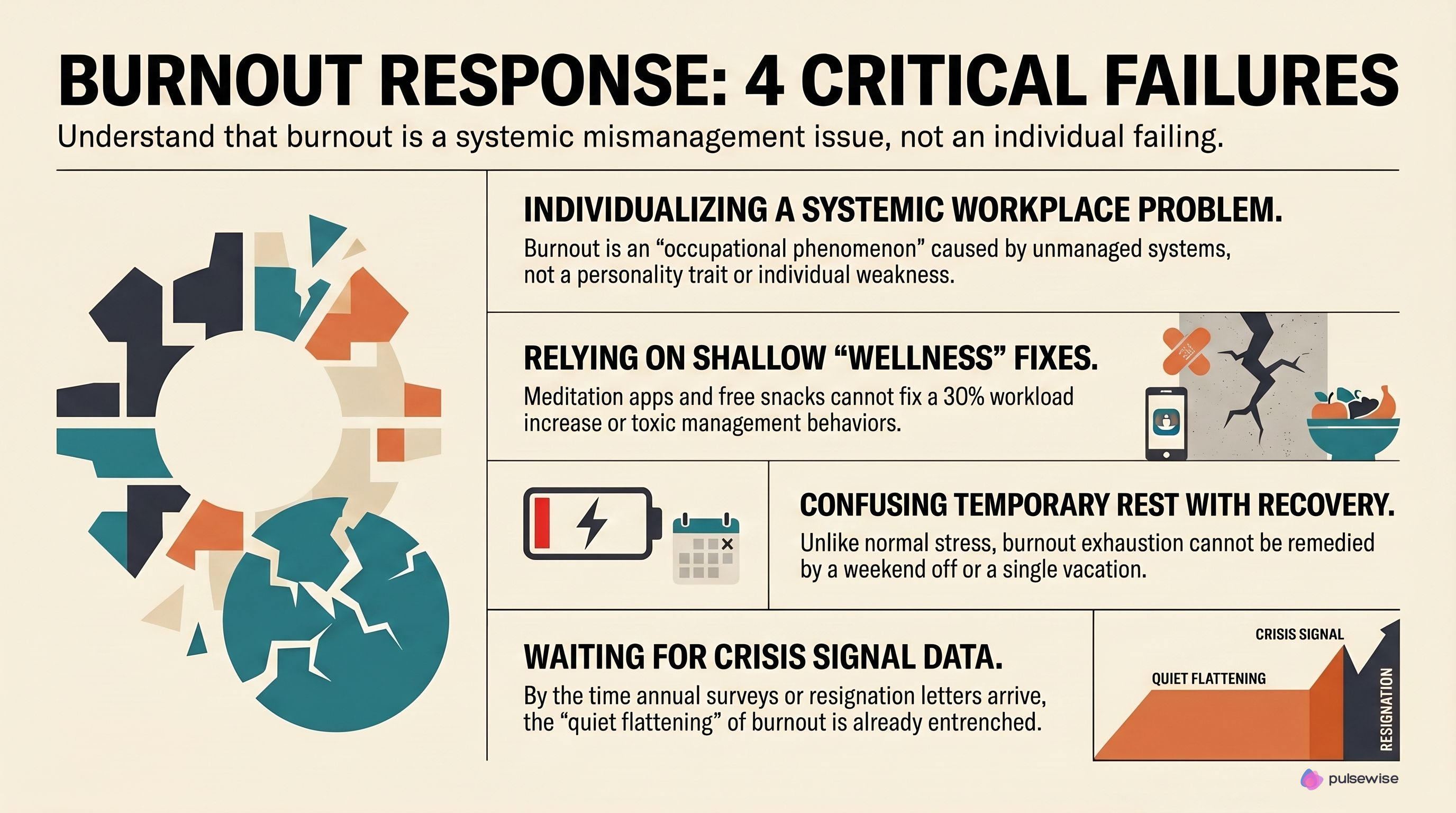
Treating it as an individual problem. Sending someone to a meditation app does not fix a workload that has crept up 30% in 12 months. Decades of organizational research, including the McKinsey work cited above, suggests that interventions targeting only individuals have far less sustainable impact than systemic changes.
Asking once and then dropping it. A single 1:1 where you ask “how are you?” and the person says “fine” is not a check-in. It is a permission slip for them to keep performing. You need a pattern of repeated, specific, low-stakes touchpoints over weeks.
Confusing wellness perks with wellbeing. Free snacks, gym discounts, and meditation subscriptions are nice. They do not address the work itself. Most employees will not trade autonomy and recognition for snacks.
Waiting for the survey results. If you sense something is off, do not wait for next quarter’s pulse to confirm it. Talk to the person now. The data should support your judgment, not replace it.
Skipping the manager. HR sometimes intervenes around a struggling employee without looping in the direct manager, which leaves the manager out of the loop and reduces the chance of sustainable change. Wherever possible, the manager should lead the conversation, with HR coaching from the side.
Case example: spotting it before it spirals
A 180-person SaaS company I worked with noticed in their pulse survey data that one product squad’s average mood score had dropped from a 7.4 to a 6.1 over six weeks. No single person had triggered an alarm. No one had quit. But the trend was directional and the team’s open-comment responses started to mention “always behind” and “no end in sight.”
The engineering manager, instead of running a survey debrief, did three things in the next 10 days. First, she had individual 1:1s with each person on the team using the “1 to 10” opener. Second, she found that two senior engineers were carrying invisible technical-debt work that was not on any roadmap. She got it added, and gave them explicit authorization to spend 20% of the next quarter on it. Third, she postponed a non-critical feature by a sprint, in writing, and told the team the reason.
Six weeks later, the team’s mood score was back at 7.6. No one had quit. One person told her in a 1:1, “I think you saved my job. I was three weeks from looking.” That outcome did not require a wellness program. It required a manager who could see the signal early and was willing to change something visible.
Final thoughts
Burnout almost never arrives as a thunderclap. It drifts in. The good news is that drift is detectable, if you set up your team to notice small signals and act on them quickly.
The single most important habit is this: stop asking “is this person okay?” once a year, and start asking “what’s the one thing pulling energy this week?” once a month, with everyone you manage. That alone will catch most burnout long before it becomes attrition.
If you take one action from this article, make it this. In your next 1:1, ask: “Where are you on a scale of 1 to 10 right now, and what would move it up by one?” Then actually do whatever moves it.
FAQs
What are the first signs of employee burnout?
The earliest signs of employee burnout are usually behavioral, not verbal. Watch for withdrawal from informal channels like team chat, shorter and flatter messages, a drop in initiative, calendar avoidance, and subtle cynicism toward leadership decisions. These show up weeks or months before someone hits visible exhaustion or quits.
How is burnout different from stress?
Stress is feeling overwhelmed by what you have to do. Burnout is no longer believing that what you do matters. Stress usually responds to rest and load reduction. Burnout adds emotional exhaustion, cynicism, and a sense of reduced professional efficacy, and it does not resolve with a weekend off. The Maslach Burnout Inventory frames burnout along these three dimensions.
Can a manager actually prevent burnout?
A single manager cannot solve systemic problems alone, but they have outsized influence on the conditions that drive burnout. Research from McKinsey and Gallup shows that direct manager behaviors, especially around fairness, recognition, autonomy, and feedback, are among the strongest predictors of whether someone burns out. The most effective managers run regular structured 1:1s, change something visible after concerns are raised, and protect deep-work time on behalf of their team.
How often should we measure employee wellbeing?
Once a year is not enough. Most leading research, including Deloitte’s recent workforce reports, supports a continuous-listening model: short, frequent pulses (weekly or monthly), combined with deeper quarterly check-ins. The point is to detect trend changes before they become exits, not to file a single annual report.
What should HR do when a manager reports a burned-out employee?
Coach the manager to lead, instead of taking over. Help them prepare for a private, specific 1:1 conversation, support them in changing something visible within two weeks (workload, scope, deadline, or recognition), and check back at the 30-day mark. HR’s role is to remove obstacles for the manager, not to replace them in the conversation.
Does remote or hybrid work cause more burnout?
The mode of work matters less than the design of work. Remote employees can burn out from isolation, ambient pressure to be “always on,” and missing recognition. In-office employees burn out from commute fatigue, meeting load, and visible understaffing. The fix in both cases is the same: clear expectations, real recovery time, structured recognition, and managers trained to notice early signals.