Employee Onboarding Checklist: First 90 Days Done Right

TL;DR
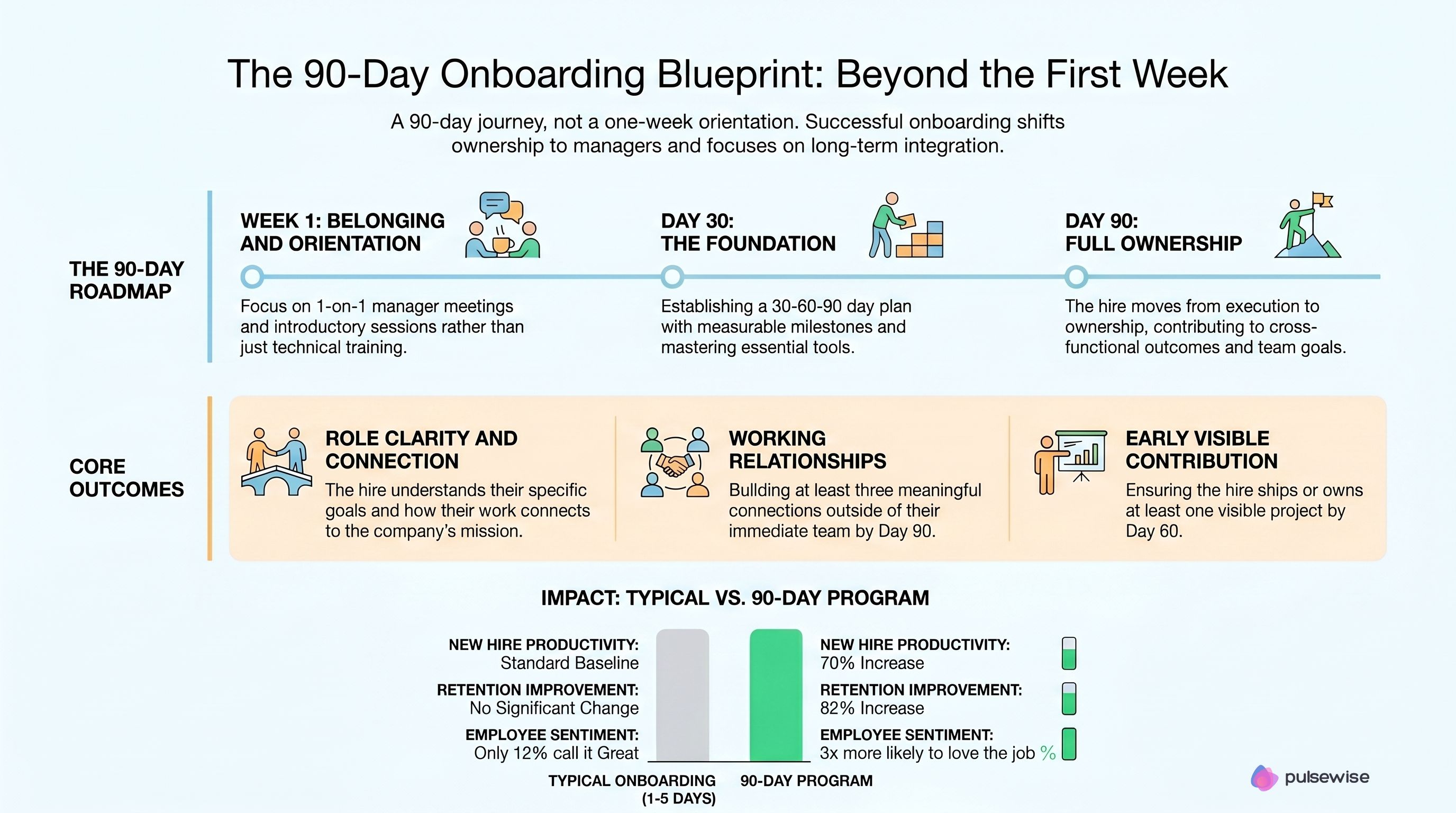
- Most onboarding fails because it ends on Day 7. Strong programs run a full 90 days, broken into preboarding, week one, days 8 to 30, days 31 to 60, and days 61 to 90.
- Use this employee onboarding checklist as a template you can lift straight into your HRIS, Notion, or 1:1 docs. Each phase has clear owners, a “done” definition, and a check-in rhythm.
- The number one predictor of a successful new hire isn’t the welcome kit. It’s whether the manager runs a real 60-minute 1:1 in Week 1 and gives the hire a 30-60-90 plan with measurable outcomes.
- Track three signals weekly: mood, role clarity, and early contribution. If any slip, intervene before Day 30, not after.
What is an employee onboarding checklist?
An employee onboarding checklist is a structured plan of tasks, conversations, and outcomes that guides a new hire through their first 30, 60, and 90 days on the job. It defines what HR, the hiring manager, and the new hire each own at every stage, so the experience is consistent across hires and the new employee reaches productivity faster.
The first 90 days decide whether a new hire becomes a top performer or starts updating their LinkedIn before their first quarter ends. Despite this, most companies still treat onboarding as a paperwork sprint that ends when the laptop is set up. Gallup’s research shows just 12% of employees strongly agree their organization does a great job of onboarding new hires. That gap between intent and execution is one of the most expensive problems in HR, and most of it comes down to not having a real employee onboarding checklist that runs past Week 1.
This article gives you that checklist. Not a vague list of “set up your email and meet the team” tasks, but a structured 90-day plan with owners, outcomes, and the signals that tell you whether it’s working. It is written for HR leaders who want a template they can adapt this week, not next quarter.
Why most onboarding programs quietly fail
Walk into almost any company and ask “how is your onboarding?” The answer is usually “we have a process.” Then ask the new hires from the last six months and the story shifts. The most common complaint isn’t about the welcome kit or the swag. It’s about feeling lost after Week 1, having no clear goals, and not really knowing whether the manager has time for them.
Brandon Hall Group’s research on the strategic value of onboarding found that organizations with a strong onboarding process improve new hire retention by 82% and productivity by over 70%. That’s a serious lift. In real money, it’s the difference between a hire who pays for themselves in three months and one who quietly costs you their salary plus replacement costs (which SHRM estimates at 50-200% of annual salary depending on role).
The failure pattern is almost always the same. The HR side of the process is well documented: forms, accounts, benefits, the policy walkthrough. The manager side, which is where the actual experience lives, is usually improvised. So the new hire ends Week 1 fully provisioned and completely unsure what success looks like.
Here’s a more useful way to think about it. Onboarding isn’t really a checklist of things you give to a new hire. It’s a 90-day window during which the new hire is quietly deciding whether they want to stay. That reframe changes what you build for.
Old onboarding vs a 90-day program (how to tell the difference)
"Get them set up by Friday."
1 to 5 days, then "you're on your own."
HR runs the process end to end.
Paperwork, policies, and account setup.
Vague or absent. "Figure it out as you go."
Annual performance review, months later.
Onboarding tasks completed.
A welcome lunch on Day 1, then silence.
"Set them up to stay and ship."
90 days, with weekly touchpoints throughout.
Manager owns the experience, HR supports.
Role conversation, team context, and a real 1:1.
A written 30-60-90 plan with measurable milestones.
Weekly 1:1s plus 30, 60, and 90 day check-ins.
Mood trend, role clarity, and early contribution.
Specific public recognition for the first owned project.
What a 90-day onboarding plan should actually deliver
Before getting to the checklist itself, set the bar. A complete employee onboarding program in the first 90 days should produce four outcomes:
- Role clarity. The new hire can explain their role, their team’s goals, and how their work connects to the company in their own words.
- Working relationships. They’ve built at least three meaningful working relationships outside their direct manager.
- Early contribution. They’ve shipped or owned at least one visible piece of work by Day 60.
- Belonging signal. They feel safe enough to ask questions, push back, and admit confusion without it feeling risky.
If your current onboarding doesn’t produce all four by Day 90, the checklist below will close the gaps. (One quick gut check before you read on: ask the last three people you onboarded which of those four they actually got. The answer is usually one or two.)
The 90-day employee onboarding checklist
This is structured into five phases. Each phase lists what to do, who owns it, and how you know it is done. Copy this directly into your onboarding doc.
Phase 1: Preboarding (Offer accepted to Day 0)
The goal of preboarding is simple: reduce Day 1 anxiety and prove the company is organized. Most attrition during the offer period happens because the candidate goes silent for two weeks and starts second guessing.
HR / People Ops owns:
- Send a personal welcome note from the hiring manager within 48 hours of offer acceptance.
- Ship laptop and equipment to arrive at least 3 days before start date.
- Provision all accounts (email, Slack, HRIS, core tools) before Day 1, not on Day 1.
- Send a “what to expect in your first week” doc with the agenda for Day 1, dress code, parking or remote login, and lunch plans.
- Confirm benefits enrollment paperwork is queued, not blocking.
Hiring manager owns:
- Send one short personal message before start date. Not a template. Something like: “Looking forward to Monday. Lunch is on me. Anything you want me to set aside time for in your first week?”
- Block calendar time for a 60-minute Day 1 conversation.
- Identify and brief an onboarding buddy from the team.
You’ll know preboarding worked when: the new hire shows up on Day 1 knowing what time to arrive, where to go (or how to log in), who they’re meeting, and what the first week looks like. No surprises.
Phase 2: Days 1 to 7 (The first week)
The first week is about belonging and orientation, not output. The mistake most managers make is loading week one with technical training. Ironically, that is exactly when the new hire is least able to absorb it.
Day 1:
- Welcome from the hiring manager in the first hour.
- Workspace tour (physical or virtual): tools, channels, where things live.
- Lunch with the team or buddy.
- 60-minute manager 1:1: review the role, the team, what the manager cares about most, and how they like to work. Not a tactical meeting.
- HR orientation: benefits, policies, security, payroll. Keep it under 90 minutes.
Days 2 to 5:
- Schedule 5 to 7 introductory meetings with cross-functional partners. Not just “meet and greets.” Each meeting has a purpose: “Learn how Marketing measures success” or “Understand how Engineering ships.”
- Buddy meets the new hire daily for 15 minutes. Their job is to be the dumb-question safety net.
- Manager has a 30-minute end-of-week check-in. Two questions matter: “What was confusing this week?” and “What surprised you, good or bad?”
- Read-only access to recent team docs, decisions, and OKRs. Let them lurk before they contribute.
Day 7 deliverable from the new hire:
- A short written reflection: top 3 things they learned, top 3 things still unclear, and one observation they want to share. This becomes the input for Week 2.
Week 1 is on track when: the new hire can name 8 to 10 colleagues, knows what their team is working on this quarter, and has had at least one conversation with their manager that wasn’t purely transactional.
This is also where lightweight pulse signals start to matter. A simple Day 7 mood check, captured through something like Pulsewise’s pulse surveys and DailyMood tracking, gives HR an early read on whether the experience is matching the promise. You don’t need a 40-question survey. You need one number and one open text field, weekly. The earlier you catch a mismatch, the cheaper it is to fix.
Phase 3: Days 8 to 30 (Foundation)
Now the work begins. This phase is about building the foundation: tools mastery, process understanding, and the first scoped contribution.
Manager owns:
- A real 30-60-90 day plan written and shared with the new hire. Not a Word doc that lives in a folder. A living document with measurable milestones.
- Weekly 1:1s, 30 minutes minimum. Use the same agenda each time: wins, blockers, what you need from me, what I need from you.
- Identify one project or workstream the new hire can own by Day 30. It does not need to be big. It needs to be visible.
New hire owns:
- Complete role-specific training (whatever that looks like in your org).
- Shadow at least 3 customer-facing or cross-functional sessions to understand context.
- Begin to contribute in their channel. Ask questions in public. Comment on docs.
HR owns:
- 30-day check-in conversation, separate from the manager 1:1. Three questions: “What’s working? What’s not? What would you change?” This is your early-warning system.
- Validate that the manager is actually meeting weekly. The number of new hires who report “my manager keeps canceling our 1:1s” is higher than most HR leaders realize.
By Day 30, you should see: the new hire owning a defined piece of work, working from a 30-60-90 plan they helped shape, and pushing back on something at least once. (Yes, pushback is a positive signal. It means they feel safe.)
Phase 4: Days 31 to 60 (Contribution)
Days 31 to 60 are when momentum either builds or stalls. The new hire should be moving from “learning the team” to “shipping with the team.”
Manager owns:
- Continue weekly 1:1s with the same structure.
- Provide one piece of substantive feedback per week. Not “great job.” Specific, behavior-anchored, forward-looking. If you don’t have feedback, you’re not paying attention.
- Begin connecting their work to broader team goals visibly. Share their contributions in team updates.
New hire owns:
- Ship the first owned project or milestone by Day 45.
- Begin building relationships with the second ring of stakeholders (people they’ll work with monthly, not weekly).
- Start asking “why” more than “what.” This is the sign they are moving from execution to ownership.
HR / People Ops owns:
- Light-touch 60-day pulse: short survey or async note. The signal you are watching for is engagement direction, not absolute score. A 7 trending down is worse than a 5 trending up.
A 60-day check-in is also where structured recognition starts to matter. New hires who get specific, public recognition for their first contribution are significantly more likely to stay through the first year. Tools like Pulsewise’s Kudos and Recognition system make this easier by giving managers AI-assisted prompts for what to recognize and why, so it doesn’t feel performative or generic. That nudge to recognize a specific behavior, not just say “thanks for the help,” changes how the new hire interprets their early wins.
By Day 60, you should see: the new hire has shipped real work, received specific feedback they can act on, and started showing up in cross-team conversations without being prompted.
Phase 5: Days 61 to 90 (Ownership)
The last 30 days are about consolidating ownership and setting up for the post-onboarding stretch. This is also when many companies “declare onboarding complete” and stop tracking. That is a mistake. Days 61 to 90 are where habits form.
Manager owns:
- 90-day review conversation. Not a performance review. A “how is this going for both of us” conversation. What is working, what needs to shift, what does the next 90 days look like.
- Confirm the new hire has clear goals for the next quarter that connect to team OKRs.
- Adjust the working rhythm based on what you’ve learned about how this person works best.
New hire owns:
- Own at least one cross-functional outcome by Day 90.
- Have a clear point of view on at least one part of the role or team they think could be better. (And feel safe to share it.)
- Be able to onboard the next person at least informally. Teaching is the proof of learning.
HR owns:
- Run a structured 90-day review with the new hire and the manager separately, then together. Use a consistent template across all hires so you can spot patterns.
- Pull the data. Across all hires onboarded in the last quarter, what are the common pain points? Don’t just collect feedback. Aggregate it.
By Day 90, you should see: the new hire has goals for the next quarter, owns visible work, has a real working relationship with their manager, and would recommend the company to a friend without hesitation.
How do you actually know if your onboarding is working?
Most onboarding programs are evaluated by completion: “Did the new hire finish all 27 onboarding tasks?” That is the wrong metric. Completion measures activity. It does not measure whether the new hire is going to stay or contribute.
The three signals that actually predict success:
- Mood and energy trend. Not the absolute number, the direction. A new hire whose weekly mood drops three weeks in a row is in trouble, regardless of how high they started.
- Role clarity score. “On a scale of 1 to 5, how clear are you on what success looks like in your role?” Ask this at Day 7, 30, 60, and 90. It should go up. If it stays flat or drops, the manager isn’t communicating expectations.
- Manager 1:1 consistency. Are 1:1s actually happening weekly? This is the single most reliable predictor of new hire retention in the first year. Track it.
If you can track those three signals reliably, you don’t need much else. This is where the operating layer matters more than the checklist itself. Pulsewise was built around the belief that people experience work daily, not annually, so measurement and support need to match that rhythm. For onboarding, that means lightweight signals captured weekly through Pulse surveys and AI Daily Feedback feed directly into the manager’s One on One Board, where AI-suggested next actions show up like: “Mood trend dropped this week. Suggest opening with a wellbeing check.” That’s the kind of nudge that turns a generic 1:1 into a useful one, especially for a manager onboarding their fifth direct report this year.
Common mistakes that break onboarding
A few patterns show up over and over, even in companies with otherwise strong People functions.
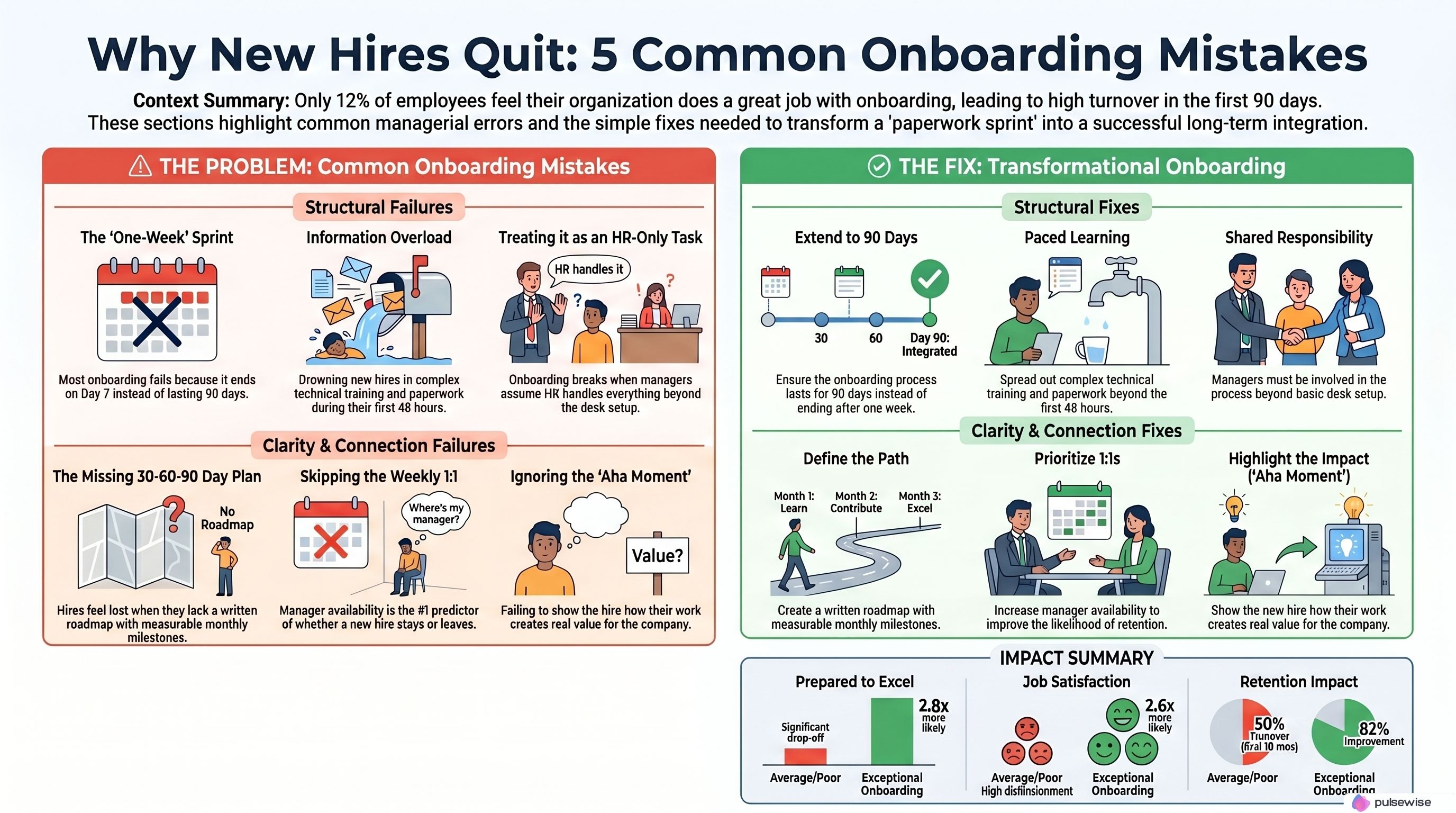
Treating onboarding as an HR program. It isn’t. It’s a manager program with HR support. One People Ops lead I spoke to recently described it as “we kept polishing the welcome doc while the actual managers kept skipping their first 1:1s.” That’s the trap. If managers don’t own it, no template will save you.
Front-loading everything into Week 1. Information overload in week one is the fastest way to make a new hire feel incompetent. Spread it out.
No 30-60-90 plan, or a plan that lives in a doc no one opens. A 30-60-90 plan that isn’t reviewed weekly is a wishlist, not a plan.
Confusing “we set up their accounts” with onboarding. Provisioning is the floor, not the ceiling.
Not running a structured 30-day check-in. This is when most resignations are quietly decided, even if they’re announced months later. By Day 30, the new hire has already formed a strong opinion about whether this was the right move. You have a narrow window to influence that opinion.
Stopping at Day 30 or Day 60. Days 60 to 90 are when habits and identity solidify. Letting onboarding fade out at Day 30 is one of the most common (and most fixable) mistakes.
Quick wins you can ship this week
If reading this checklist made you realize your current onboarding is shorter than it should be, here are three things you can ship in the next seven days without rebuilding the whole program:
- Add a Day 7 written reflection. A simple template: top 3 learnings, top 3 unclear things, one observation. It costs nothing and changes the second week entirely.
- Mandate a real 60-minute Day 1 manager 1:1. Not orientation. Not benefits. A real conversation about role, team, and how to work together. Block it on every new hire’s calendar before they accept the offer.
- Run a 30-day check-in conducted by HR, not the manager. Three questions, 20 minutes. The data you’ll get from your next five hires will reshape your program more than any consultant ever could.
Final thoughts
A great employee onboarding checklist isn’t really a checklist at all. It’s a 90-day operating rhythm built around four things: clarity, relationships, contribution, and signal. The companies that get this right don’t have fancier tools or longer programs. They just don’t drop the ball after Week 1.
Start with the structure above. Adapt it to your team’s reality. And then watch the signals, not the checkboxes.
FAQs
How long should employee onboarding actually last?
A complete onboarding program lasts 90 days at minimum, with structured touchpoints continuing through the first year. The first week is orientation. Days 8 to 30 build foundation. Days 31 to 90 build ownership. Treating onboarding as a one-week event is the most common reason new hires leave in the first six months.
What should be included in a 30-60-90 day plan?
A strong 30-60-90 plan has three things for each phase: clear learning goals, scoped deliverables, and relationships to build. By Day 30, the new hire understands the role and team. By Day 60, they own a specific project. By Day 90, they have shipped visible work and have goals tied to team OKRs.
Who owns employee onboarding: HR or the manager?
The manager owns the new hire’s experience. HR owns the structure, the templates, and the safety net. The most common failure mode is HR running onboarding as a process and managers treating it as someone else’s job. Successful programs make the manager accountable for outcomes, with HR providing the rhythm and the data.
What are the most important onboarding metrics to track?
Three metrics matter most: weekly mood trend (direction, not absolute), role clarity score at Day 7, 30, 60, and 90, and 1:1 consistency between manager and new hire. Completion rates of onboarding tasks tell you about activity. These three tell you about outcomes.
How do I know if our onboarding is broken?
Three quick signals: new hires who can’t clearly explain their role at Day 30, first-year attrition above 20%, and exit interview feedback that mentions “lack of clarity” or “no real onboarding.” If any of those show up, your checklist isn’t the problem. The structure of your 90-day plan is.